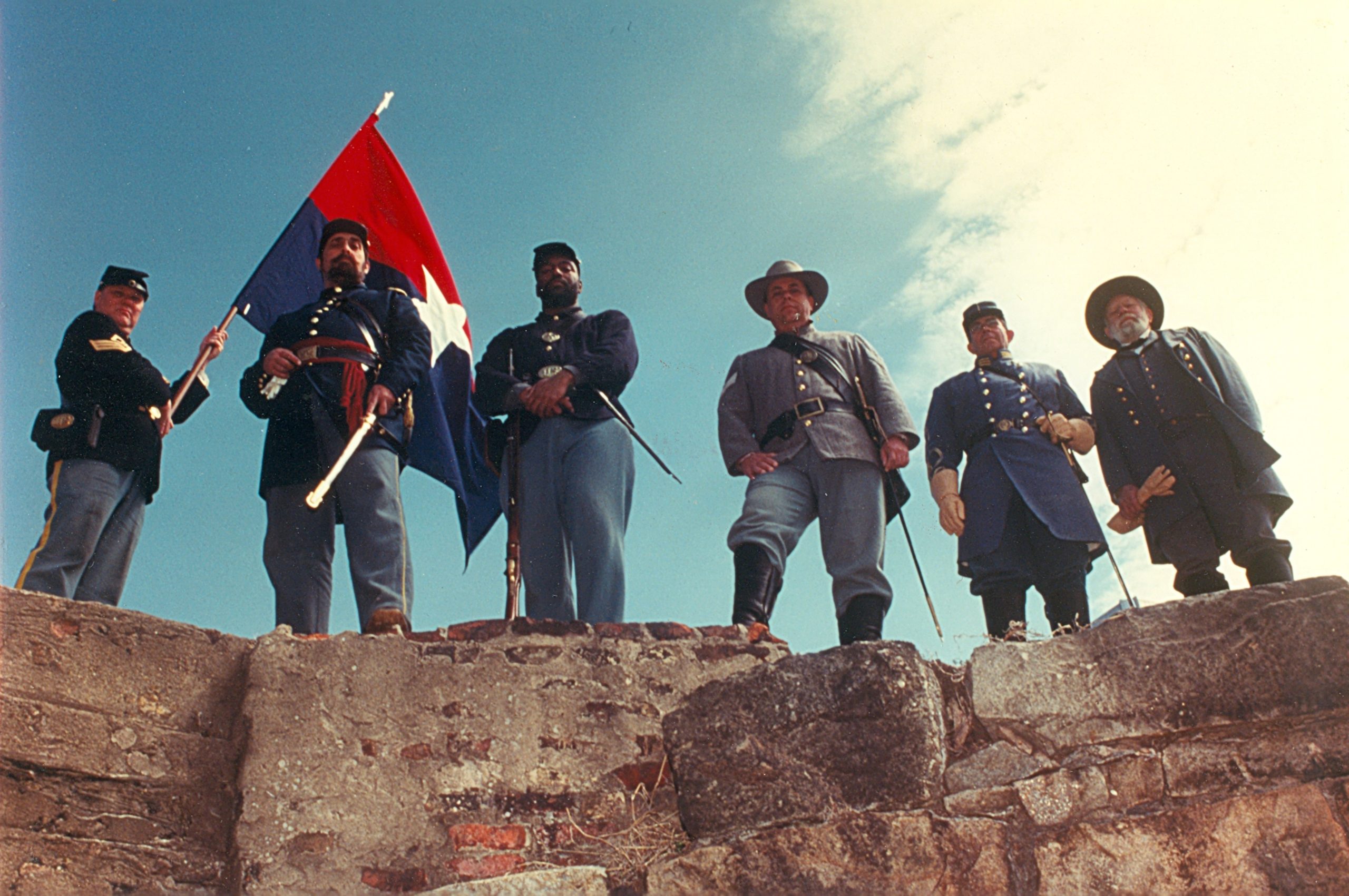
On April 2, 1995. A battalion of African-American living historians, belonging to the 54th Massachusetts Volunteer Infantry commemorative unit, portrayed United States Colored Troops of the XXV Army Corps under General Godfrey Weitzel, who was portrayed by his great-grand-nephew. The event had been planned and coordinated by the National Park Service, the City of Richmond, Virginia and the Museum of the Confederacy. Serving on the planning committee were Howard Bartholf and myself, representing the First New York Volunteer Engineer Regiment Association, a living history organization interpreting the role of federal engineers soldiers as volunteers for the National Park Service. Bartholf is a descendant of a member of the regiment and a member of the Sons of the American Revolution. At the time, I was Visiting Artist at East Carolina University, conducting research and interpreting battlefield landscapes through my drawings and paintings, which had been exhibited at Saint Joseph’s University and F.A.N Gallery in Philadelphia, Peninsula Fine Arts Center in Newport News, Virginia, Danville (VA) Museum of Art, Second Street Gallery in Charlottesville, Virginia, Waterworks Art Center in Salisbury, North Carolina, and Greenville Art Museum in North Carolina.
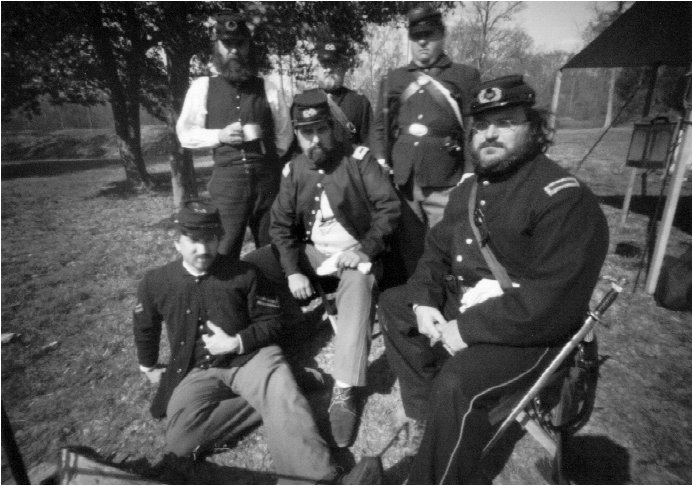
Left: Men of Company K, 1st New York Engineer Regiment. Lensless photograph by Willie Anne Wright. 1995
Encampments had been held on Saturday at Dorey Park in Henrico County, which had been designated as the gathering-place for most participants. The 54th Massachusetts, First New York Engineers and 33rd Wisconsin Volunteer Infantry camped overnight at Fort Harrison-Burnham, also in Henrico County. A dawn we arose to make our preparations. Following breakfast we formed a column, with the 33rd Wisconsin out front as pioneers and skirmishers. Proceeding along Osborne Turnpike, motorists honked at us. A driver n a pickup truck slowed to a crawl. Poking his head out of the cab he asked, “Who y’all supposed to be?”
“Army of the James” I replied, pointing to our large blue-and-red banner with a single white star.
“Well ALRIGHT!” He shouted, let go a rebel-yell and sped away. I guess he didn’t notice our blue uniforms.
Perhaps he didn’t realize that we were Yankees.
We took a break at the turnpike converged with New Market Road, near the very place where on April 2, 1865 Richmond mayor Joseph Carrington Mayo had ridden out to surrender the city to the federal commander. Mayo explained to Godfrey Weitzel that a monumental conflagration was then underway, the city under mob rule. Weitzel agreed to send troops to fight the fire, restore order and protect private property.
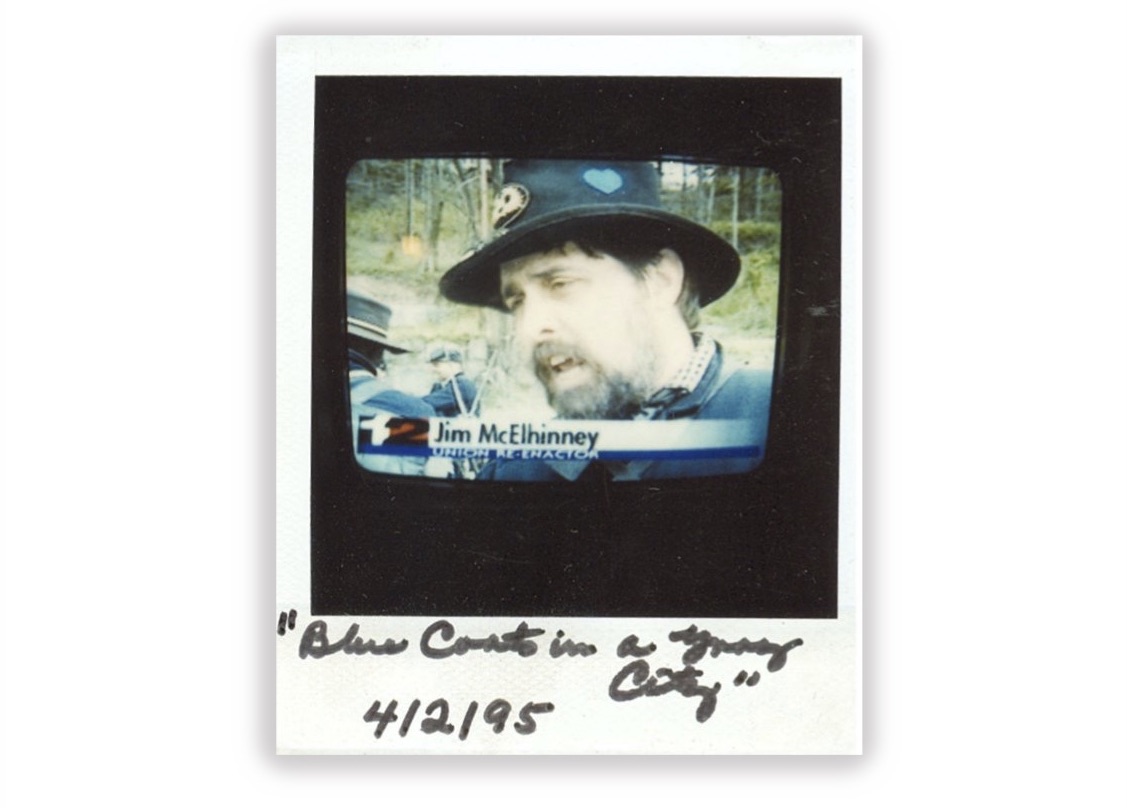
James McElhinney by Willie Anne Wright, 1995.
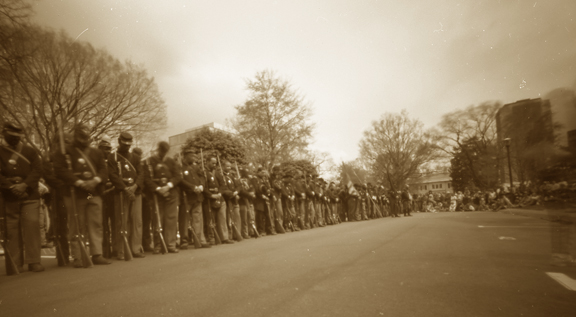
The full distance from Fort Harrison to Rockett’s Landing is about eight miles. Around two hundred reenactors were waiting when we arrive at mid-morning. The next task was to form a large column, for the final march to the Virginia Capitol. African-American troops were given the honor of leading the column into the city, with a regimental marching-band from Maine. The Downeasters had been cautioned by the city police, the National Park Service and Virginia Capitol security that under no circumstances were they to play the tune “Dixie”, despite the fact that the record showed that was the first air the federals played, as they arrived in 1865.
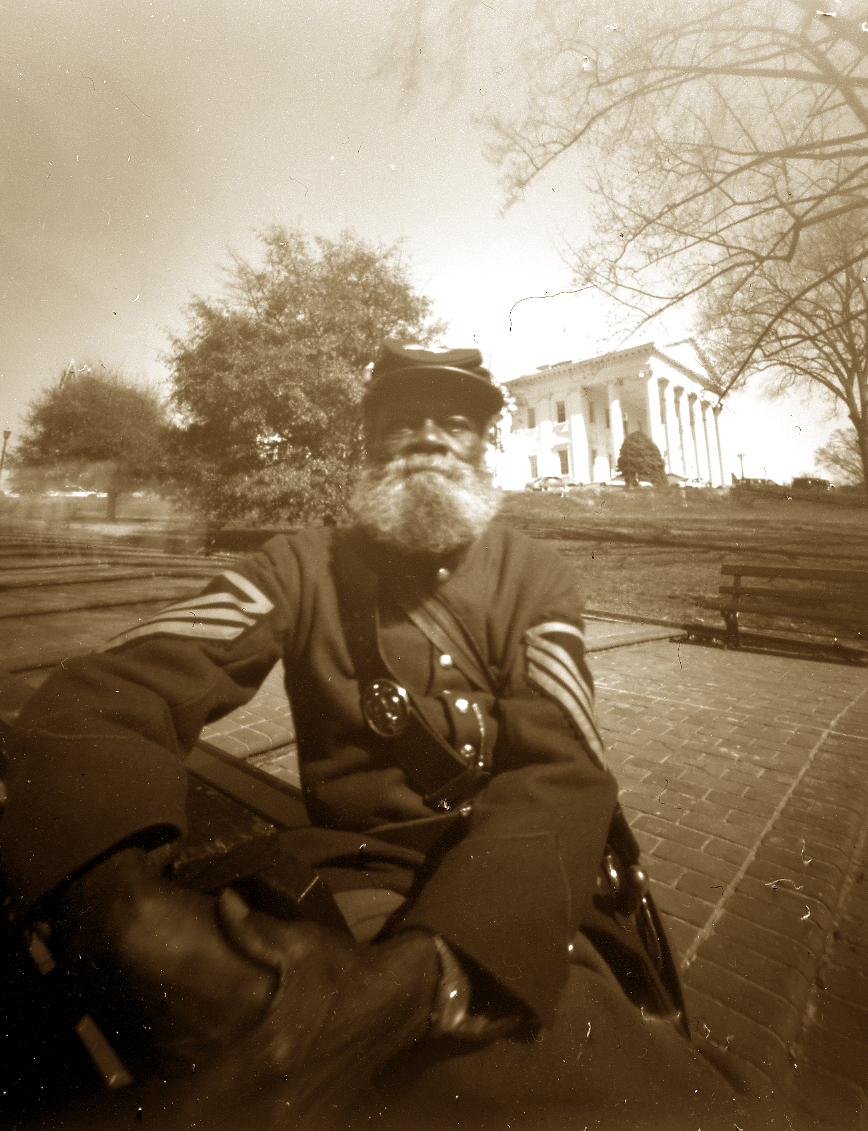
Richmond is a city of hills. Spirits were high, but as we turned to the right up Ninth Street, it was as if we had hit a wall. The climb was very steep. Everyone had to push themselves and mind their step. The 54th’s elderly sergeant Baptiste stumbled. One of the men grabbed his elbow, to help him on his way. I was back with the colors, behind the 54th. I saw the Mainers turn right, marching into Capitol Square. As they did a turn around the equestrian monument to Washington, we heard a flourish of fifes and drumbeats, and then, the familiar opening notes of “Dixie”. The 54th burst into a jubilant cheer. Huzzahs ran the full length of our indigo inchworm, bristling with sharp steel, as a thousand brogans beat a brisk cadence. Suddenly we all were light as air. Marching to the assembly-point along the northern wall of the Capitol Building, we passed a cluster of officials. I caught a disapproving look from one of the green-and-grey Park-Service historians. His frown slowly twist into a smile. Then he just shook his head, beaming from ear to ear.
Link: Sons of Union Veterans