All posts by James L. Mcelhinney

MONOTHON ROAD TRIP: Santa Fe and The Southern Rockies. March 28-April 12, 2023

On March 28, 2023 I will be heading to Santa Fe, New Mexico—to participate in the 2023 MONOTHON—a printmaking marathon happening  from April 1—8, 2023).  Thanks to my loyal patrons who generously underwrote the print sessions!

BE PART OF THE ADVENTURE

During my travels, friends will be able to follow me through daily updates and regular live ZOOM meetings from on the road, in the field, and at work in the studio.

SUBSCRIBE. Collectors an opportunity to acquire new monoprints at a significant discount before they enter the retail market.

DONATE via GoFundMe.

WATCH this six-minute video of master printer Michael Costello, owner of  Hand Graphics in Santa Fe since. 1987.


DONATE:

COLLECTORS’ EXCLUSIVE: 


James Lancel McElhinney is represented by Gerald Peters Gallery in Santa Fe. For information contact Maria Hajic at

mh****@gp*******.com


Disclaimer: The GoFundMe campaign is a separate fundraising effort—apart from the collectors’ subscription offer described above. Funds raised by the GoFundMe campaign cannot be applied toward subscribers’ purchase of monoprints, or any other material incentive.

BACK TO HOME PAGE

SANTA FE “MONOTHON” ROAD TRIP: Be Part of The Adventure.

Note: March 3, 2023. I am heading to Santa Fe, to participate in the 2023 MONOTHON—a printmaking marathon taking place from April 1—8, 2023).  Follow me with daily updates and regular live ZOOM meetings from on the road, in the field, and at work in the studio. Here are ways to get involved:

SUBSCRIBE. Pre-production offer. Subscribers acquire new monoprints at  significant discounts, before they enter the retail market.

DONATE via GoFundMe.

WATCH watch this six-minute video for more about the monoprinting process.


DONATE: Click the Logo


COLLECTORS’ EXCLUSIVE:

Disclaimer: The GoFundMe campaign is a separate fundraising effort—apart from the collectors’ subscription offer described above. Funds raised by the GoFundMe campaign cannot be applied toward subscribers’ purchase of monoprints, or any other material incentives.

BACK TO HOME PAGE

New Video: MONOPRINTING @ HAND GRAPHICS SANTA FE

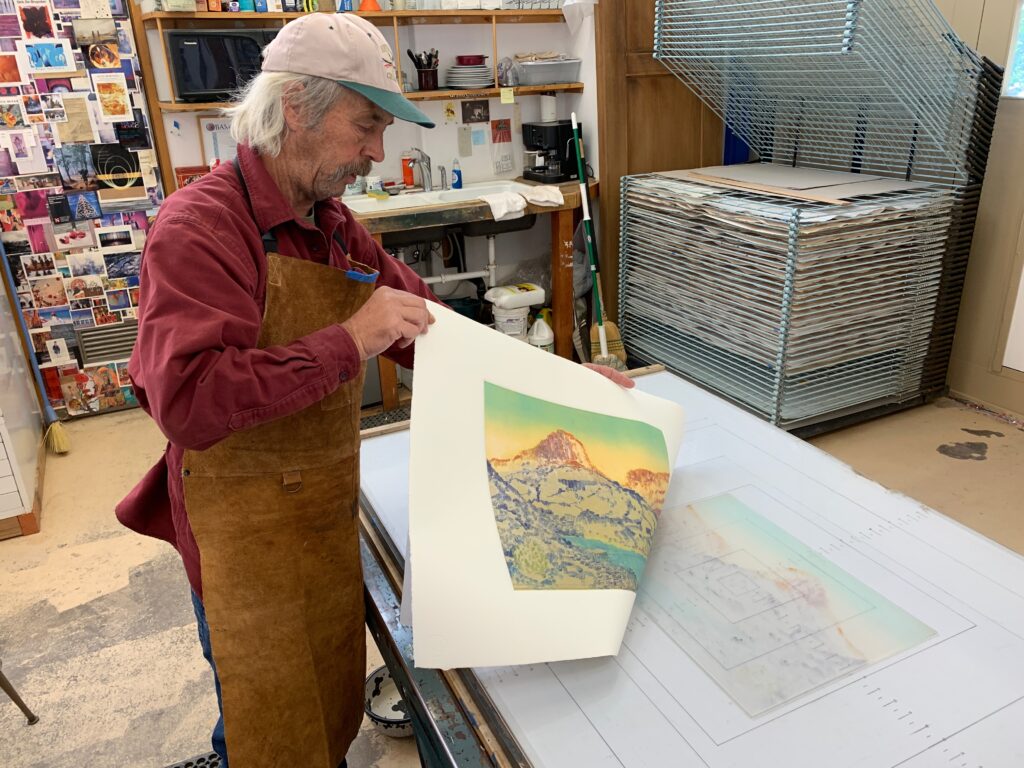
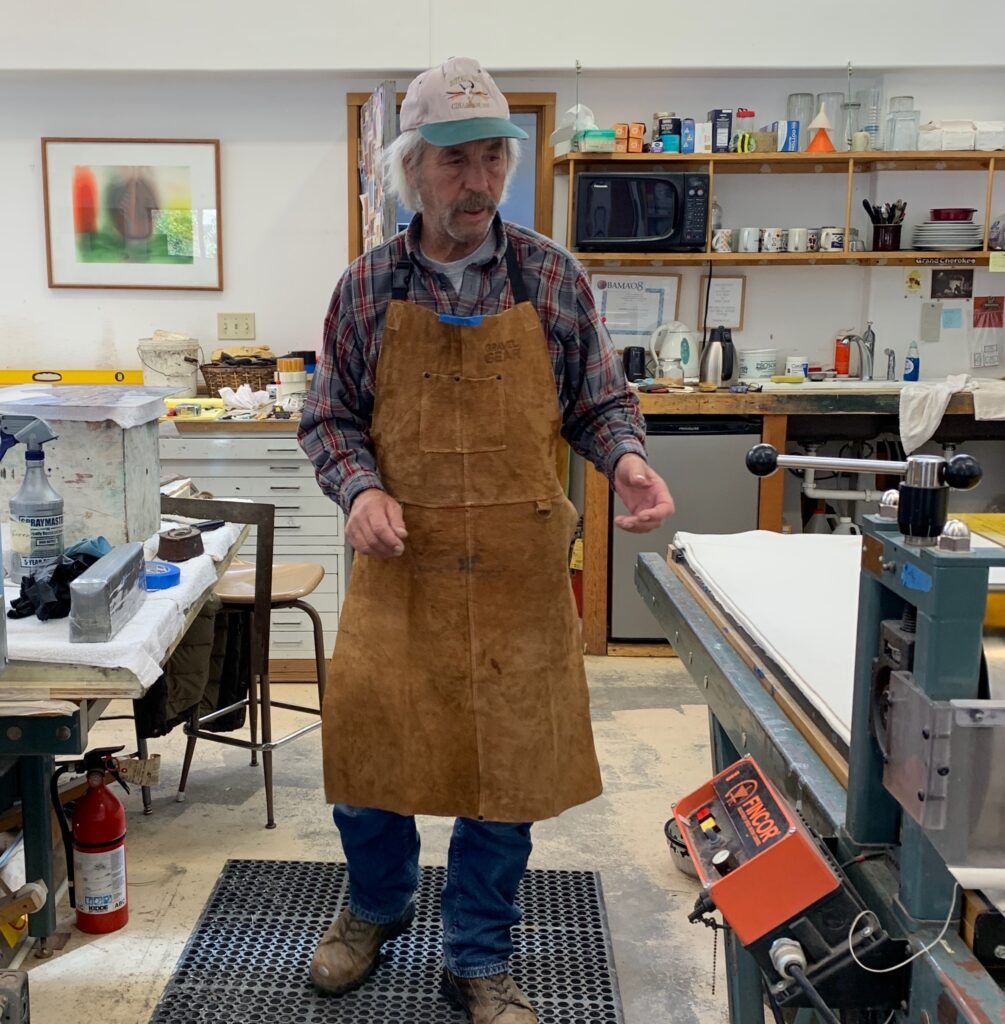
In 2019, my travels took me to the upper reaches of the Rio Grande. Over the course of three western sojourns that year, I followed the river from southern Colorado down into New Mexico. Through a mutual friend I met master printer Michael Costello, who since 1987 has owned and operated Hand Graphics; a fine art print studio in Santa Fe.

Over the years Michael has worked with artists such as Carol Anthony, John T. Biggers, Robert Colescott, Luis Jimenez, Forrest Moses, Nathan Olivera, and Emmi Whitehorse. Upon seeing my field-books, Michael suggested that we try a couple of sessions to explore transforming some of the images into monoprints.
What’s a monoprint? Instead of working on canvas or panel, one paints a reversed image onto a plate, then runs it through an etching-press. The result is a painting on paper. Michael and I booked four days in May, and three days in October. Many of our prints used a technique known as Chine-collé—literally “China paste.”
A thin piece of Japanese washi (rice paper) is sandwiched between the plate and the paper with a dusting of powdered adhesive, such as wheat starch. When the print is pulled, the ink sits on this barrier-material, which also contrasts with the whiteness of the sheet. To explore added tension between line and color, I produced several drawings in orange ink, which were scanned and printed onto the Kitakata paper we used in the Chine-collé process. This six-minute video offers a look into our process.

Michael Costello and I will be working together again in April, as part of the MONOTHON SANTA FE 2023; a week-long monoprint marathon, which benefits local print shops, galleries, and youth arts programs.

Monoprints and other works of art are available in Santa Fe at Gerald Peters Gallery, 1005 Paseo de Peralta. Santa Fe, New Mexico 87501. Contact Maria Hajic at

mh****@gp*******.com


, or call +1 (505) 954-5769

Santa Fe Monothon or Bust! Be Part of The Adventure


One of my winter projects is the development of a series of nocturnes—a subject with deep poetic resonance that expands the direct-painting practice of on-the-spot fieldwork. Night scenes invite us to imagine the world in a state of suspension. Just as winter represents the passage from the dying of autumn of the rebirth of spring, the dark hours between twilight and dawn welcome sleep, summon dreams and stir the imagination.
Apart from a few youthful experiments with the subject, I had not produced night-scapes for many years prior to working with Michael Costello at Hand Graphics in Santa Fe in May & October of 2019. Those sessions produced a number of monoprints, including several nocturnes. These struck me in such a way that I feel compelled to revisit this subject, when I participate in the 2023 Print Santa Fe Monoprint Monothon during the first week of April. Watch a short (6-minute) video about the monoprint process.:

While I have found sponsors for my Monothon printing sessions, I seek backers for my travel expenses to and from Santa Fe from the Champlain Valley.  The trip will involve a flight from Montreal to Denver, then overland travel through the southern Rockies to the San Luis Valley, Taos, the Rio Grande Gorge, and on to Santa Fe.  I will keep a written and visual  journal of my travels, and welcome supporters to join me for regular ZOOM meetings to get receive updates. CLICk the GoFundMe logo below to donate.  Thanks for your support!

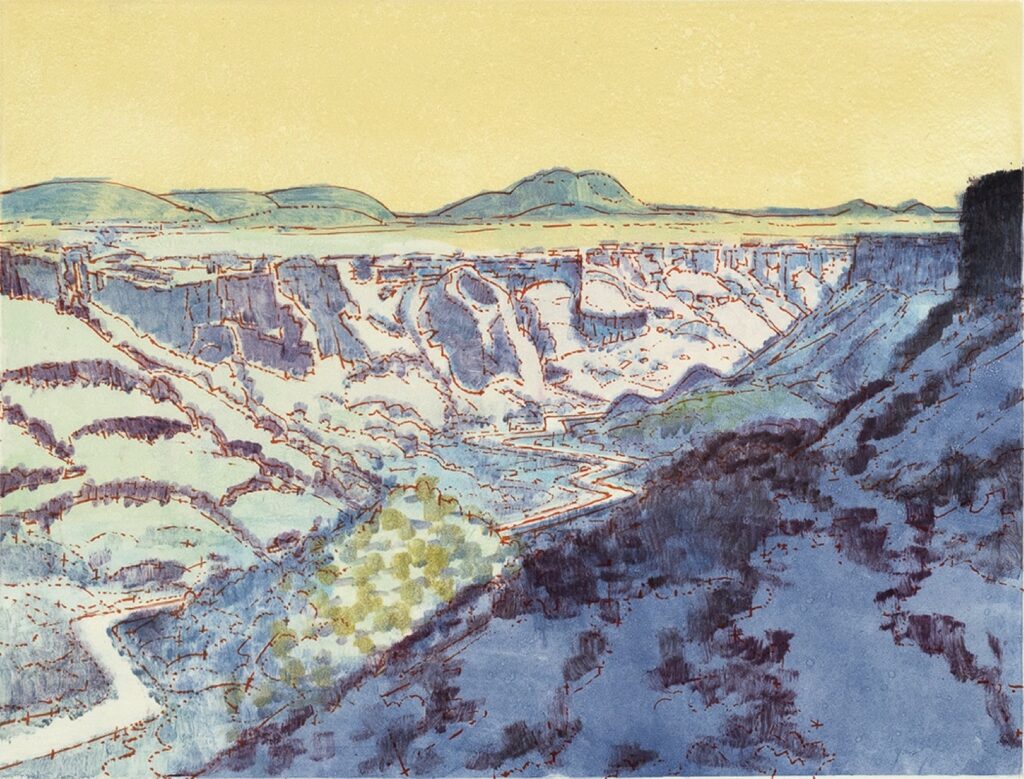
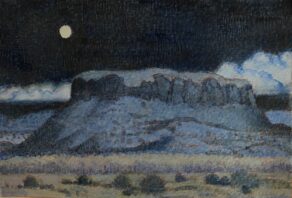
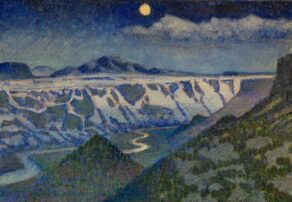
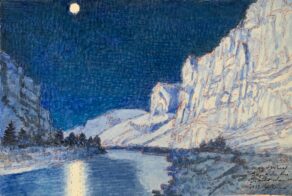
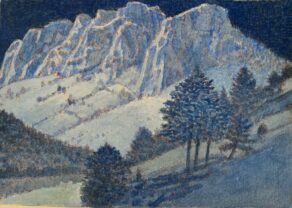
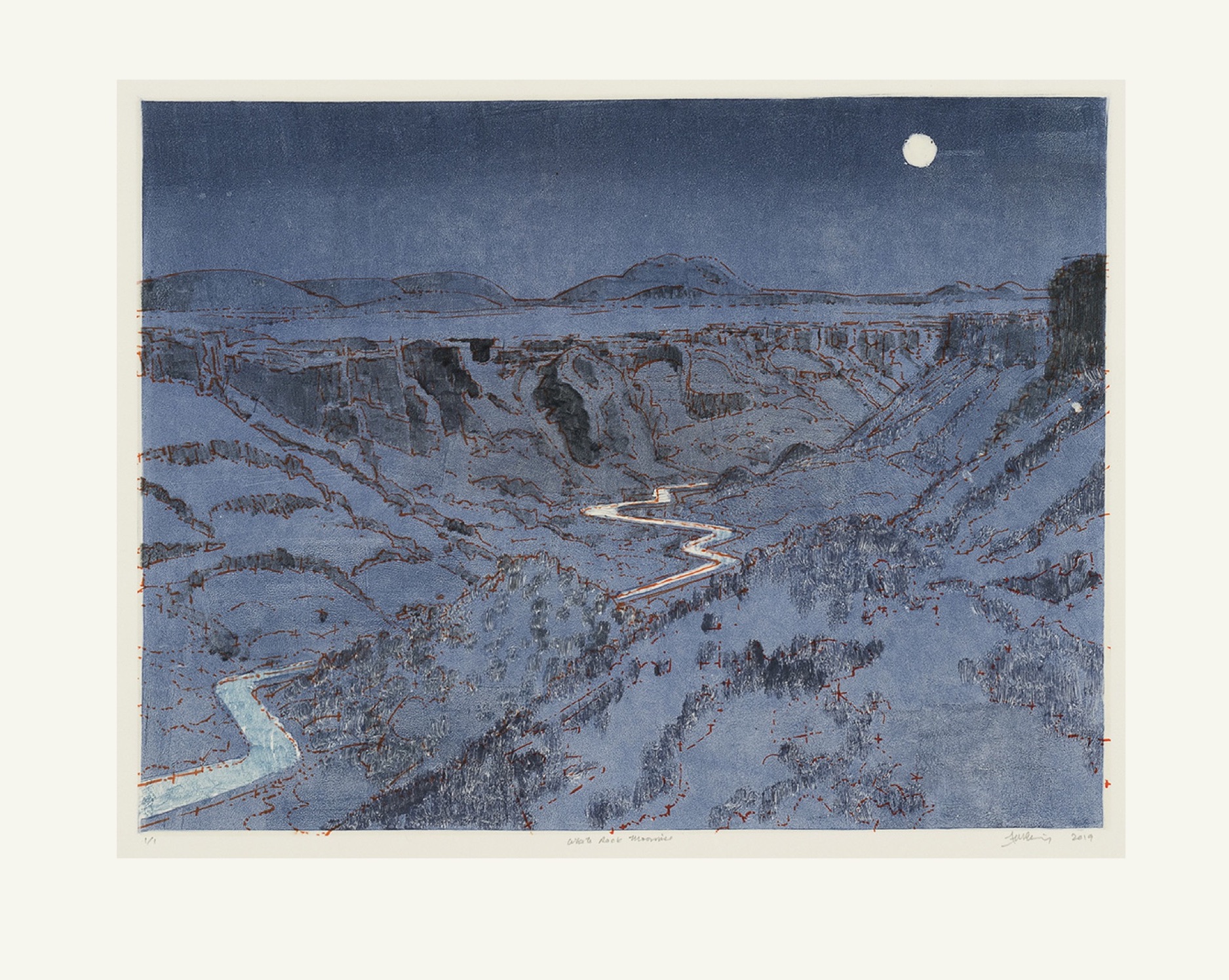
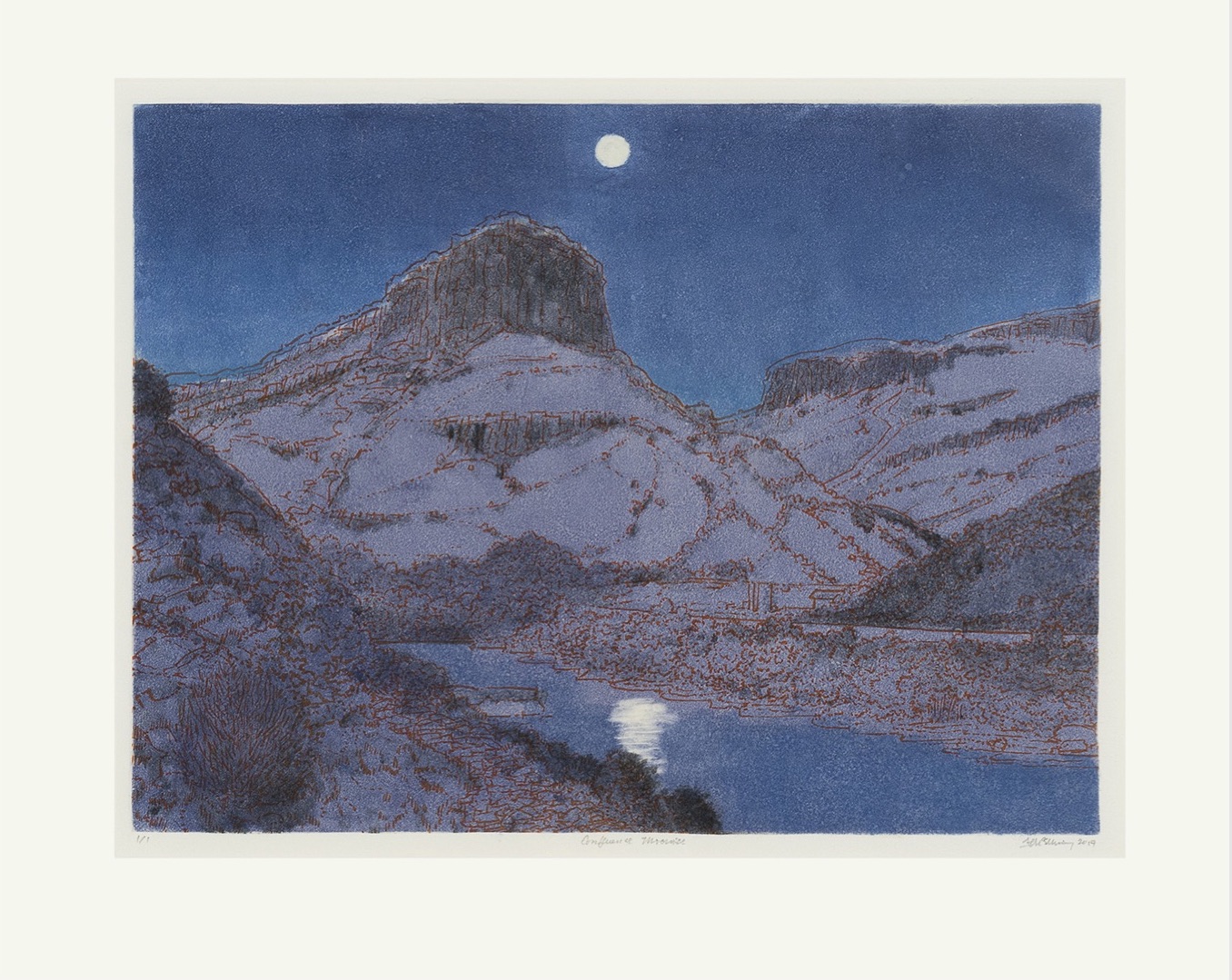
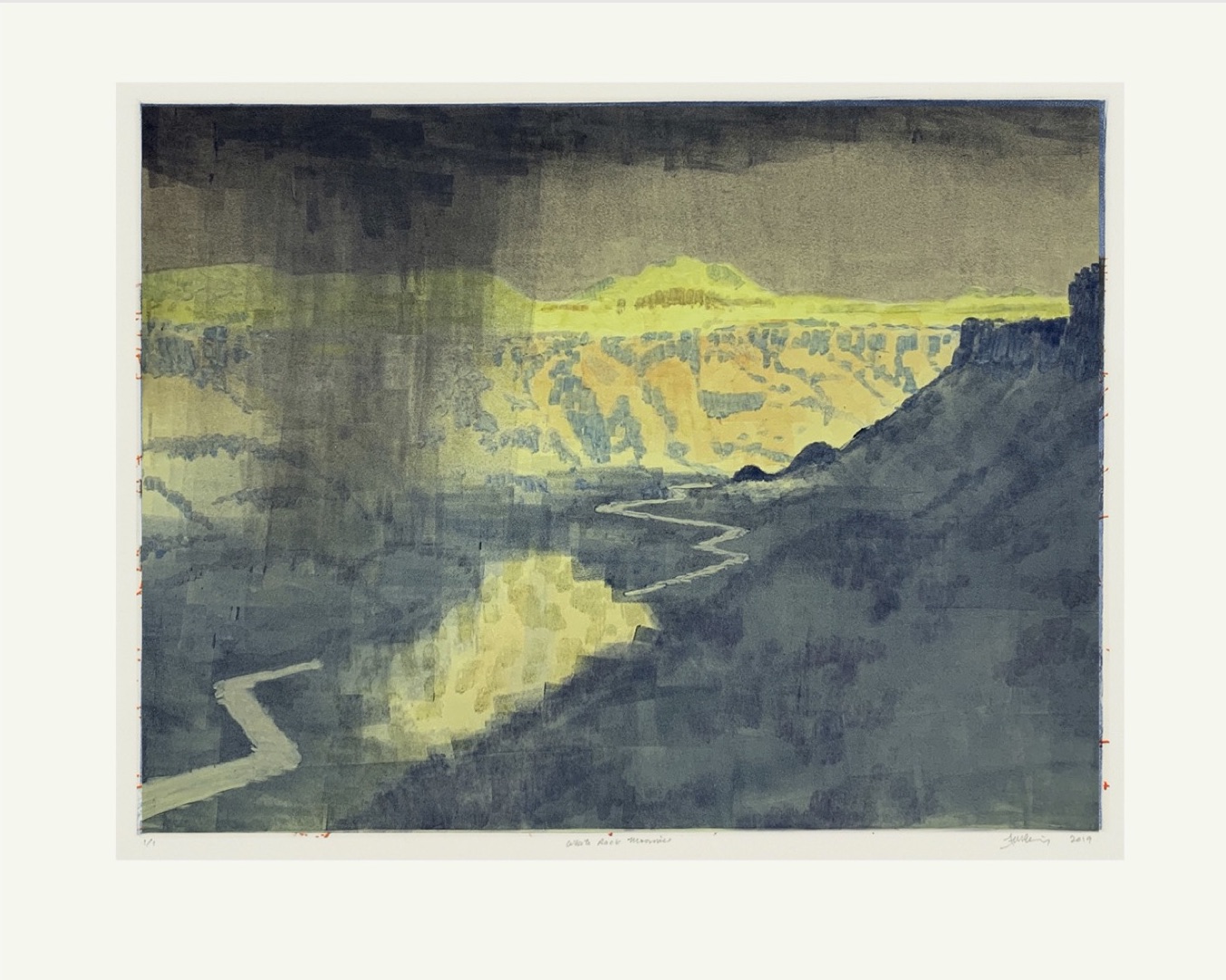
Among those monoprints produced with Michael Costello in 2019, which have been on exhibition at Gerald Peters Gallery, some which resonated most with me were scenes of White Rock Canyon, and Confluence of Rio Pueblo de Taos and Rio Grande, just upstream from Taos Junction Bridge on NM highway 567. Nicknamed “The Land of Enchantment,” New Mexico possesses a certain quality of terrain that never fails to remind me that we are living on a gigantic space-rock. Its raw geology and wide-open spaces deliver breathtaking vistas that can stretch a hundred miles. Factual accuracy and pictorial verisimilitude are never enough to convey the sense of awe, at being consumed by the wondrous, terrible, and unforgiving power of nature. In 2019, I produced a series of monoprints with master-printer Michael Costello of Hand Graphics in Santa Fe. Here are a few of those images:

Moonrise over White Rock Canyon. Image size 14.5 x 19 inches. Sheet size 22 x 30 inches. Monoprint Somerset on Somerset etching paper, with digital Chine-collé on Kitakata-washi

Moonrise over the Confluence of Rio Pueblo de Taos and Rio Grande del Norte. Image size 14.5 x 19 inches. Sheet size 22 x 30 inches. Monoprint Somerset on Somerset etching paper, with digital Chine-collé on Kitakata-washi

Cloudburst: White Rock Canyon. Image size 14.5 x 19 inches. Sheet size 22 x 30 inches. Monoprint Somerset on Somerset etching paper, with digital Chine-collé on Kitakata-washi

Print Santa Fe has organized a monoprint Monothon Print Week, running from April 1-7, 2023.  Michael Costello of Hand Graphics has invited me to participate in the event, during which we will  work together for two days. One print from each session, from all of the participating prints-shops, will be exhibited at the Santa Fe Community Gallery from April 22-May 4, 2023. Proceeds from sales will benefit local print shops, the Community Gallery of Santa Fe, and the nonprofit Partners in Education youth arts programs. I will be updating my blog with daily posts, to report on my activities in Santa Fe, as well as my travels to and from New Mexico. Become a supporter. Receive daily updates. Enjoy access to travel updates and live ZOOM meetings, and other opportunities. Click on the logo below:


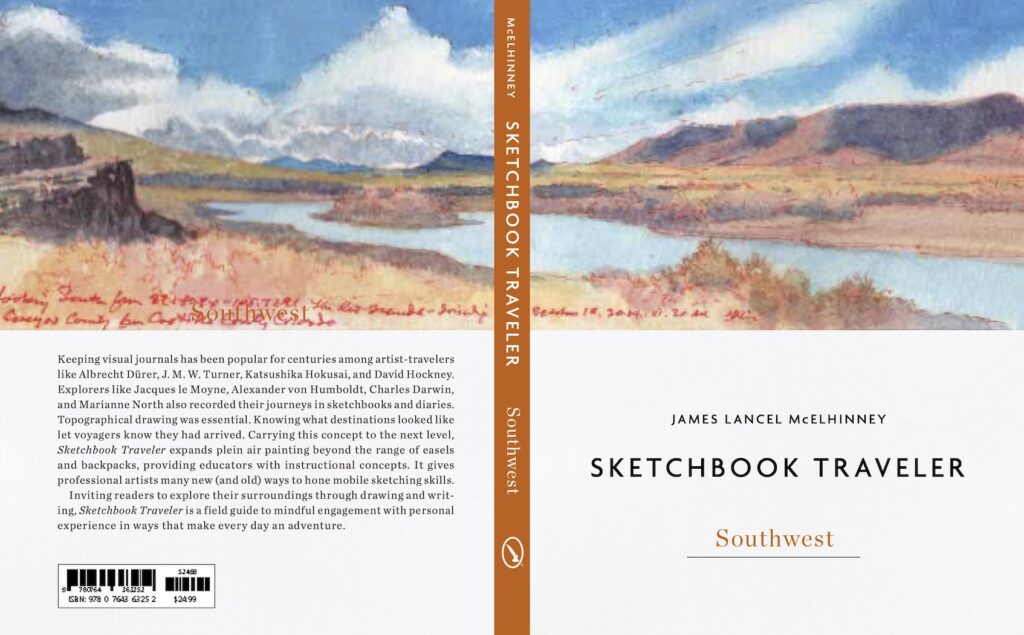
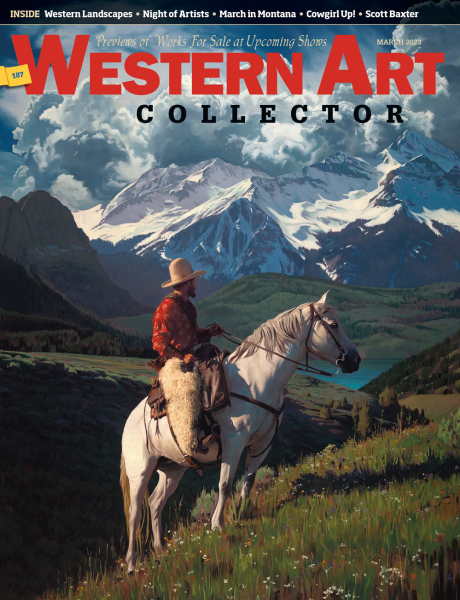
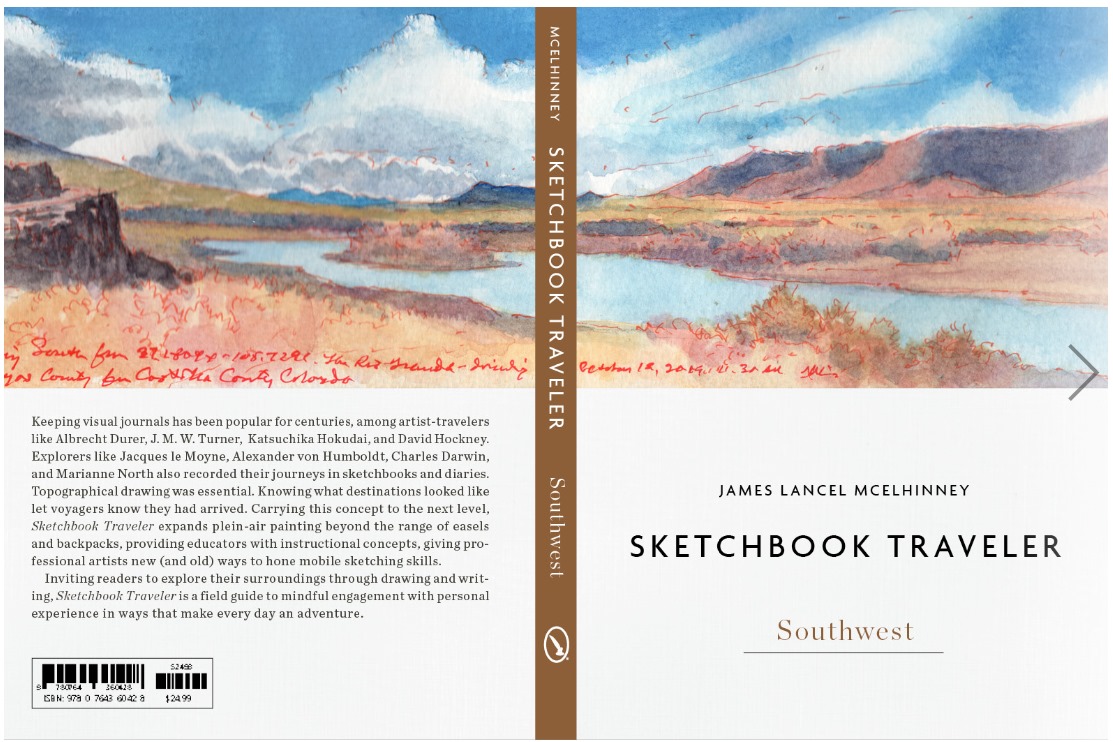
Following the success of Sketchbook Traveler: Hudson Valley, Volume 2 in the series  explores the American Southwest from New Mexico to the Mojave Desert in journal-paintings and field notes by the author. Conceived as a hybrid between a backpacker’s field-guide and coffee-table art book, this compact volume includes lessons in print; a “why-to” guide to expanding one’s wilderness journals , travel diaries, and plein-air painting practice. Blank pages scattered with inspirational quotes are provided for keeping one’s own traveler-sketchbook. Order here: LINK. Read more about Sketchbook Traveler Southwest, in the March 2023 issue of Western Art Collector magazine:

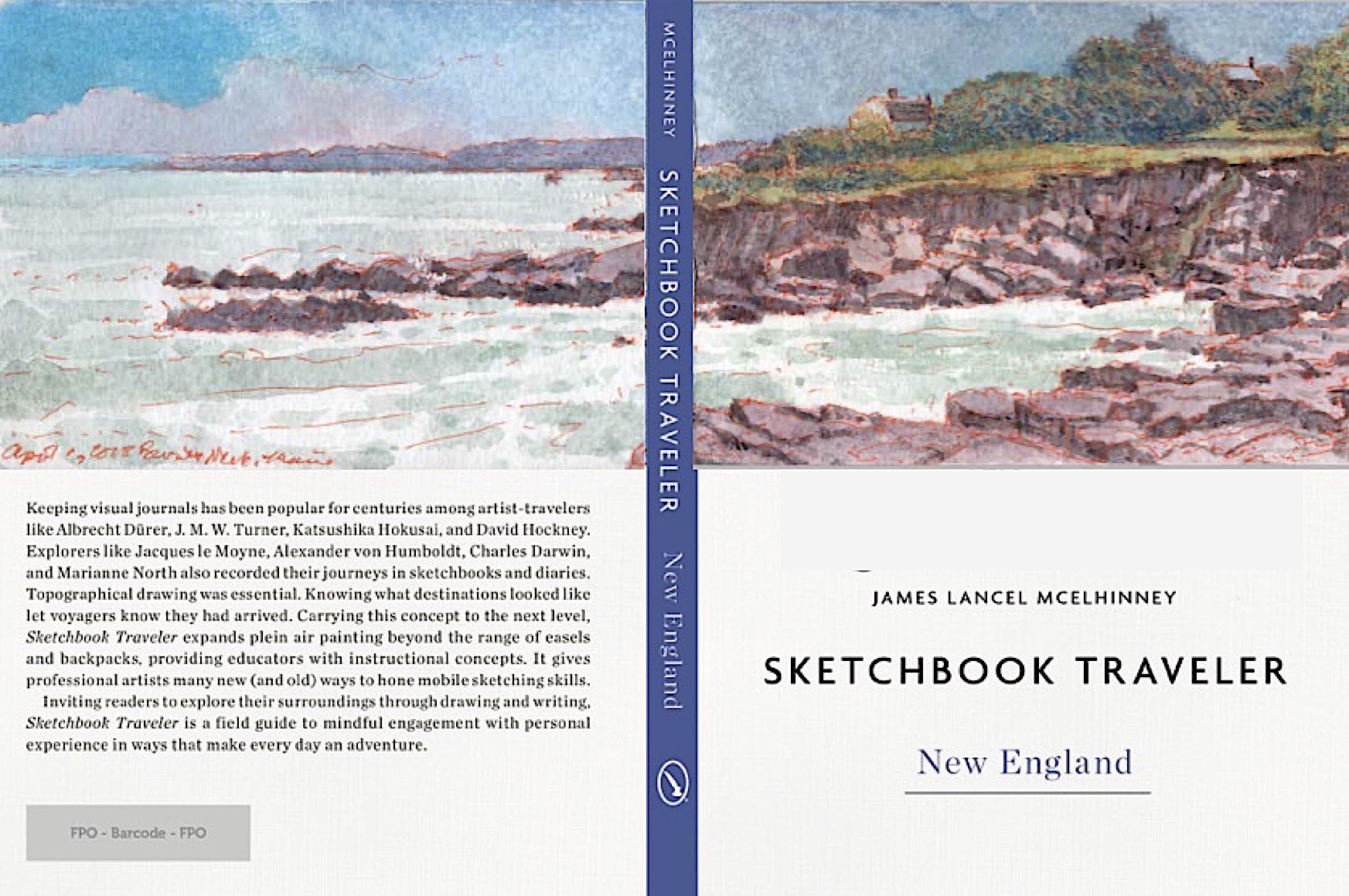
COMING SOON: SKETCHBOOK TRAVELER: NEW ENGLAND. August 28, 2023

NEW AND NOTEWORTHYOrder your copy of the book here: LINK

For information about Needlewatcher Editions, write to

ed******@ne***********.com


Needlewatcher Editions. PO Box 233. Essex, New York. 12936-0233. (347) 266-5652

DECEMBER 30, 2022. Monoprint just placed by Gerald Peters Gallery, Santa Fe

This monoprint was just placed in a fine collection by Gerald Peters Gallery, Santa Fe:

“. . . McElhinney’s paintings and monotypes subtly convey a sense of the changes wrought by time and human activity. Faint lines surround elements of his compositions. These are traces of rocky outcroppings, vegetation, and in some cases, houses. In White Rock Moonrise, for instance, the ghost of a house can be seen along the side of the river, which snakes through the canyon and reflects the silvery white of moonlight. The outline is not colored in, or rendered in any detail. The house may have existed there, or it could be an artistic embellishment. Either way; his landscapes suggest how the landscape may have looked, as opposed to how it looks now. It’s as though McElhinney is combining two views of the landscape into a confluence of past and present.”

“Natural Beauty and the Human Presence: A Fresh Look at New Mexico Landscapes.” Pasatiempo magazine. July 26, 2019 . Review of Reimagining New Mexico” at Gerald Peters Gallery, Santa Fe.

“White Rock Canyon Moonrise”. Monoprint produced in collaboration with Michael Costello @ Hand Graphics Santa Fe, with Kitakata digital Chine-colle produced by Thomas Park, Orion Studios Santa Fe. Sheet size 22 x 30 inches. Image size: 14.5 x 19 inches. Unique image. Signed, dated, with hand-inscribed title; Hand Graphics blind-stamp.

For information about the Grand River series, or to inquire about other works on hand, please contact Maria Hajic, Director. Gerald Peters Gallery. 1005 Paseo de Peralta. Santa Fe, New Mexico 87501.

mh****@gp*******.com


or call +1(505) 954-5769

Sketchbook Traveler. DISPATCH #119: Paul Kane, Canadian Frontier Artist

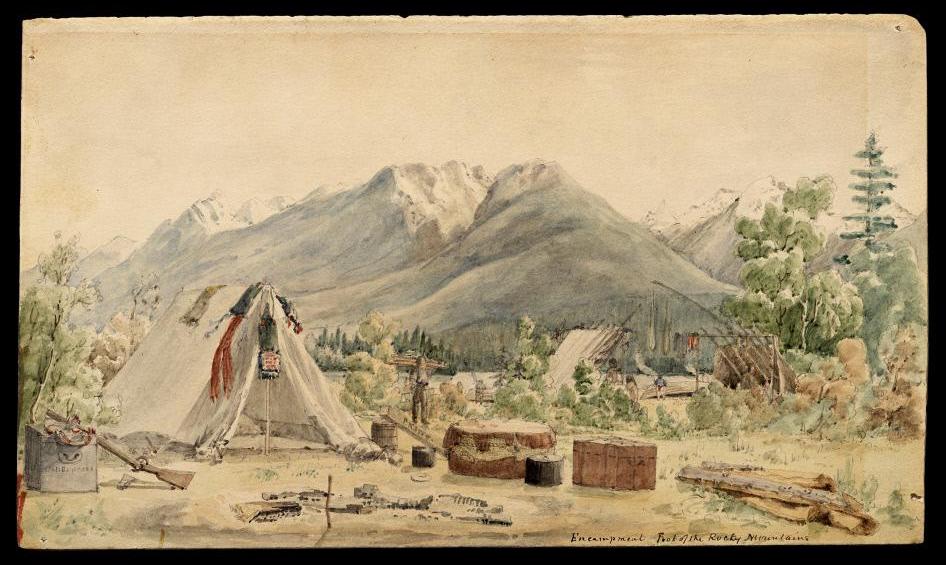
Encampment River Winnipeg. Watercolor. 1846

Paul Kane (1810-1871) was born at Mallow, County Cork, Ireland, and emigrated with his family to York (Toronto) in Upper Canada (Ontario) in 1819. Paul displayed artistic talent at an early age. Trained as a sign-painter and furniture-decorator, he received some formal training from a local professor. In 1836 he moved to Detroit, from whence he embarked on a career as an itinerant portrait-painter; traveling through the Midwest and into the Deep South. In 1841, he sailed from New Orleans to Marseilles to commence a walking-tour of Europe that led to Naples, Rome, Bolzano, Paris and London, where he may have met George Catlin—whose Indian Gallery was then on view at Piccadilly. In 1843, Kane returned to The States, where he resumed his portrait business in Mobile, Alabama. He returned to Canada the following year.


Kane’s exposure to Catlin’s work and ideas about Indians as a “vanishing race” grew into an ambitious project of his own; to travel amongst the First Nations of Canada’s western territories, as Catlin had done south of the border. Like the Group of Seven more than sixty years later, Kane began by exploring the wild margins of the Great Lakes in 1845. With support from the Hudson’s Bay Company the following year, he traveled from Toronto to Fort Vancouver, located in present-day Washington State. The Oregon Treaty of 1846 established the boundary between Canada and the U.S. along the 49th parallel north of the equator. Kane was present during the transition period that spanned several years. In 1848, he returned to Toronto. An exhibition of his works was met with great acclaim. Apart from a stint as an expeditionary artist in 1849, Kane spent the remainder of his life in Toronto; raising a family and elaborating his fieldwork into finished paintings.

(Encampment, Foot of the Rocky Mountains. Journal-painting by Paul Kane, ca. 1846-48)

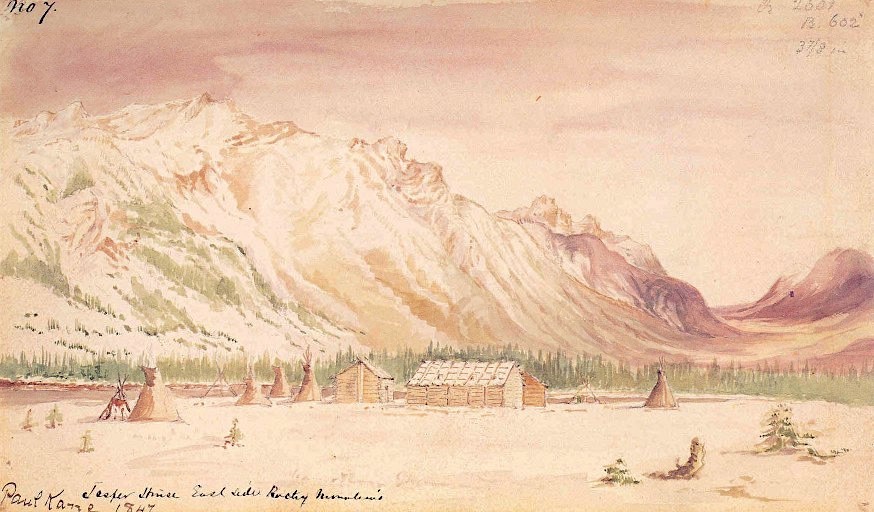
Like Thomas Davies in the 18th century, or Tom Thomson and The Group of Seven at the beginning of the 20th century, Kane’s work is rooted in expeditionary practice. As a traveler-artist, he has been described as the first Canadian tourist. Apart from inspiring eponymous parks, schools, and postage-stamps, Kane’s legacy contributed to the national policies concerning cultural resources. In the late 1950s a cache of Kane’s sketches, watercolors and paintings were put on the market by a member of his family. When the Canadian government passed on the offer, the lot was purchased by Texan art collectors Nelda C. and H.J. Lutcher Stark. These works now reside in the Stark Museum of Western Art in Orange, Texas (opened in 1978). Taking heat for allowing these works to slip through its grasp, the Ottawa government enacted laws prohibiting the possession of artworks deemed national treasures, by foreign owners outside of Canada.

(Jasper House. Journal-painting by Paul Kane. 1847)

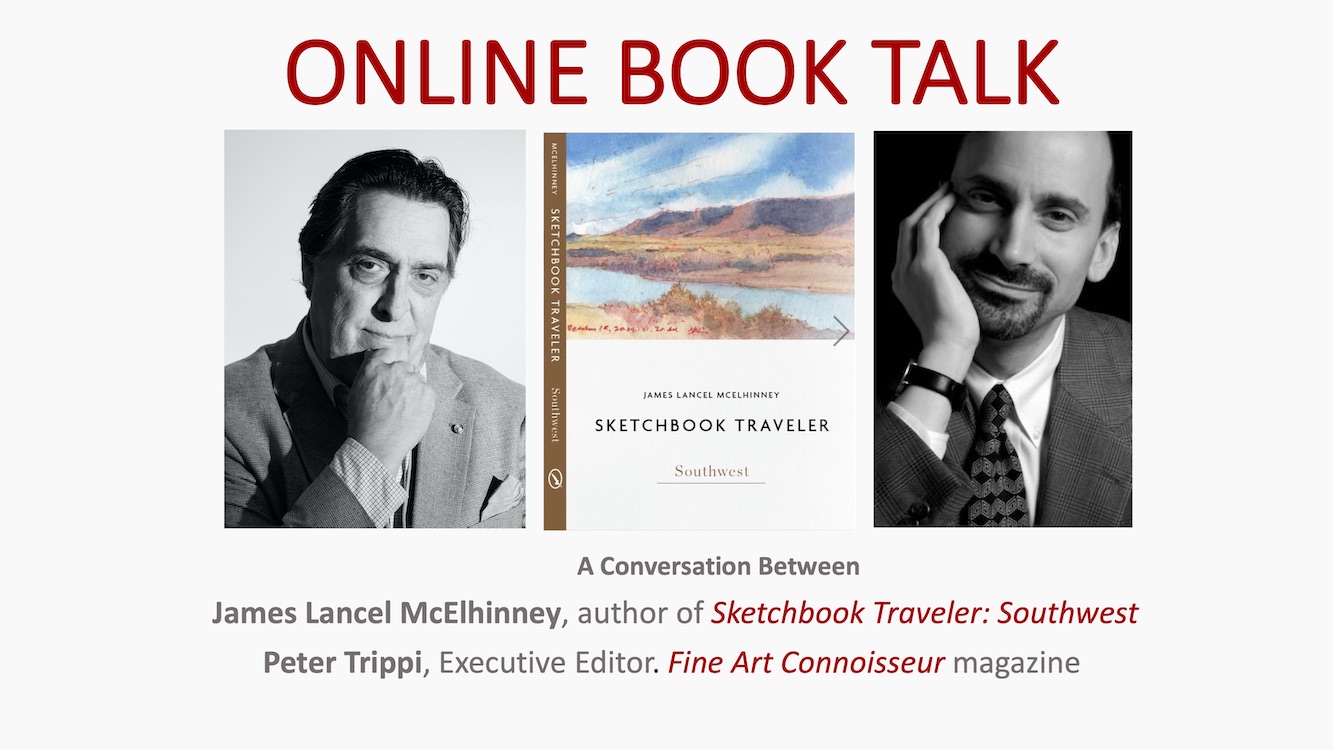
Recorded Online Book Launch of SKETCHBOOK TRAVELER: SOUTHWEST

Click on the image to watch

Praise for Sketchbook Traveler Southwest:

“James Lancel McElhinney has crafted a beautiful work of devotion to the American Southwest. . . featuring the landscape of our wide-open spaces. . . the book has suggestions for photographers and artists who seek to commune with the desert in a way that makes use of math to render its majesty – creating one’s own “golden mean.”

—Deanne Stillman, Author of Blood Brothers: The Story of the Strange Friendship between Sitting Bull and Buffalo Bill, winner of the 2018 Ohloana Prize for Nonfiction

Learn More.   Purchase. 

jo*@sc***********.com


“>  Retailers

NETCAST Consolidation: Conversations with Artists and Curators

Oral history interviews were commissioned by institutions, foundations, universities, and nonprofits. These Netcasts are conversations with artists and curators, conducted in conjunction with specific projects and exhibitions. This process was suspended at the beginning of the pandemic. Plans are to underway to resume shortly. LEARN MORE. Click on tiles.

AUTHOR: Writings, Articles, Essays, and Books

h4 style=”text-align: center;”>COMING SOON: SKETCHBOOK TRAVELER: NEW ENGLAND. Fall 2023

NEW: SKETCHBOOK TRAVELER: SOUTHWEST. Schiffer Publishing. September 24, 2022.  LEARN MORE. Click on the image below


SKETCHBOOK TRAVELER: SOUTHWEST. Schiffer Publishing.
Projected publication date:Spring 2022

First developed by explorers and naturalists, the practice of keeping log diaries and journals has evolved through the centuries, with the growing popularity of travel and tourism.  This sequel to McElhinney’s Sketchbook Traveler: Hudson Valley (see below) follows a similar format; part art-book, part backpackers’ companion, with inspirational texts on blank work-pages for journaling. Inspired by expeditionary artists such as Samuel Seymour, Titian Ramsay Peale II, Seth Eastman and the Kern brothers, this volume explores the American Southwest, visiting locations from the Rio Grande Valley to the Mojave Desert. For the novice, it provides an introduction to traveling light, working outdoors and leaving no trace.  For educators this book unpacks teaching tools and lesson plans, and a refresher course for practicing artists working on the move.  Through drawing, painting, and journal keeping, The Sketchbook Traveler guides readers toward more mindful engagement with the world around them, promotes environmental awareness, and deepens knowledge, while enriching one’s personal experience in ways that make every journey an adventure

Now Available:

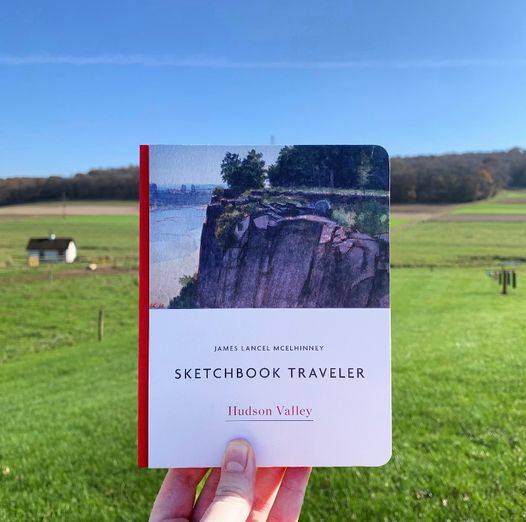
SKETCHBOOK TRAVELER: HUDSON VALLEY. Schiffer Publishing.  2020
The practice of keeping log diaries and journals has evolved through the centuries with the growing popularity of travel for personal enrichment. Five-hundred years ago, artists like Albrecht Durer and explorers like Jacques le Moyne and John White, recorded their journeys in sketchbooks and journals. Picturing exotic locations was part of topographical drawing and cartography. Knowing what a destination looked like helped travelers know they had arrived. The Sketchbook Traveler carries this concept to the next level, expanding the range of plein-air enthusiasts by freeing them from cumbersome easels and wet canvases. It provides the novice with an introduction to traveling light, working outdoors and leaving no trace.  The book unpacks teaching tools and lesson plans for educators, and a refresher course for practicing artists working on the move.  Through drawing, painting, and journal keeping, The Sketchbook Traveler guides readers toward more mindful engagement with the world around them, promotes environmental awareness, and deepens knowledge, while enriching one’s personal experience in ways that make every day an adventure.   LINK 


mapping


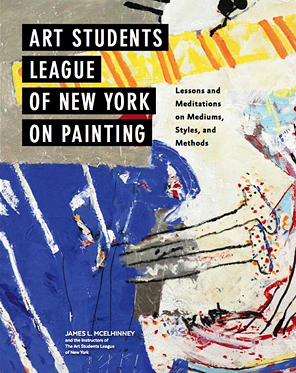
Art Students League of New York on Painting: Lessons and Meditations on Mediums, Styles and Methods

by James Lancel McElhinney. Ten Speed Press. Berkeley, CA. November 2015.
This modern painting guide is a sourcebook for study, teaching, professional practice, and personal enrichment written and edited by league instructor and artist James L. McElhinney in cooperation with the Art Students League of New York, America’s signature art school, run by artists for artists. Founded in 1875, the Art Students League of New York has nurtured students like Jackson Pollock and Georgia O’Keefe. Richly illustrated with artwork from the League’s considerable archives, its instructors, and its students, the book will be a source of inspiration and enrichment for painters of all levels.


language_drawing

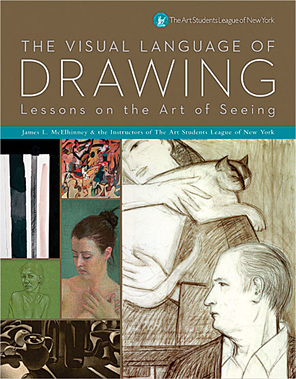
The Visual Language of Drawing: Lessons on the Art of Seeing
by James Lancel McElhinney & Instructors of the Arts Students League of New York. New York: Sterling, 2012.
Featuring the insights of 15 current and former Art Students League instructors, this stunning volume reassesses the art of drawing not as a technique, but as the essential grammar of all visual thinking. In an illuminating introductory essay, James Lancel McElhinney punctures the myth that learning to draw is something for experts only, and presents methods for making, appreciating, and teaching drawing. The 15 contributors then offer a broad range of stylistic approaches and methodologies, accompanied by examples of their own and their students’ artwork. A final section of basic exercises, along with information on materials, techniques, and resources, completes this inspirational study.


classical_drawing

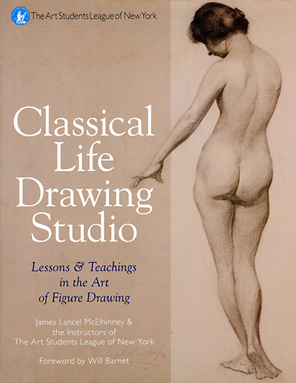
Classical Life Drawing Studio: Lessons & Teachings in the Art of Figure Drawing
by James Lancel McElhinney. Foreword by Will Barnet. & Instructors of the Arts Students League of New York. New York: Sterling, 2010.Classical drawing is staging a comeback. The Art Students League of New York presents a unique and perfect celebration of this revival: a gallery of never-before-published 19th- and 20th-century drawings and invaluable insights from the League’s figurative drawing teachers along, with exemplary works by them and their select students. With a foreword by celebrated artist Will Barnet, this collection is the ultimate volume on the art of drawing.


SKETCHBOOK TRAVELER; Dispatch #118. O.T.W. On the Water: The Schuylkill River from Fairmount to the Falls. New Iterations

Few parcels of American terrain possess a richer palimpsest of enterprise, memory and desire than does a stretch of the Schuylkill River between East Falls and Fairmount Dam. Its waterworks provided the city with a safer source of drinking water, and a Neoclassical bucket-list destination for tourists. Malarial swamps were buried under broad esplanades. Parklands cobbled together from colonial estates protected the water-supply from industrial polluters. Flat water above Fairmount dam gave amateur rowers an ideal venue for training and competition, while inspiring artists from Birch and Calyo to Eakins and beyond.
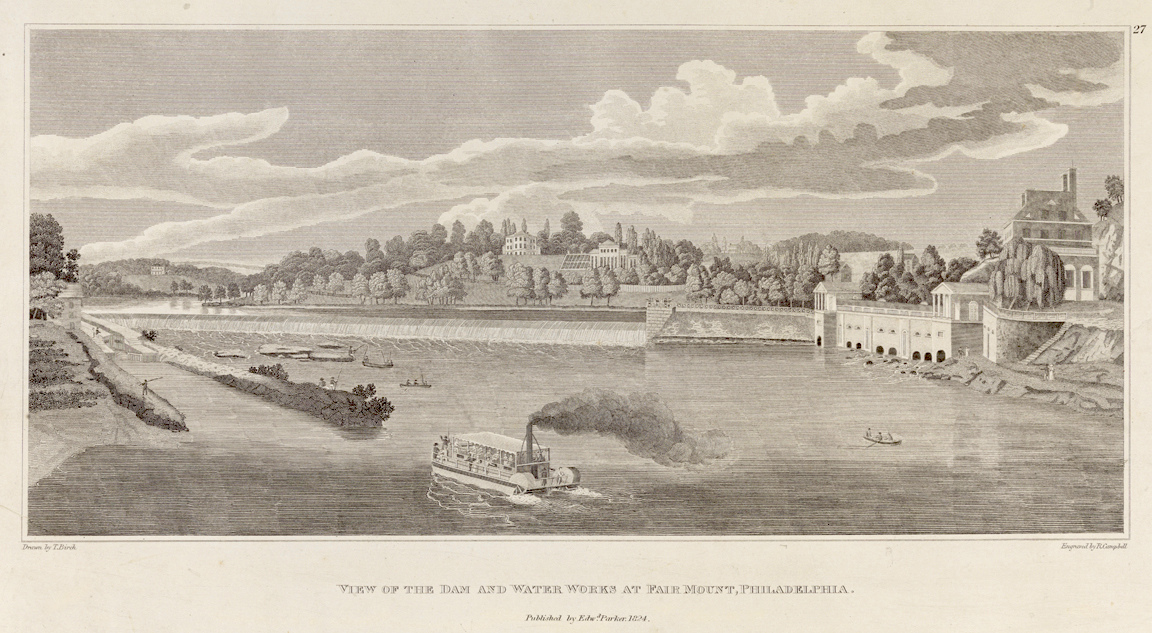

Robert Campbell after Thomas Birch (1779-1851). View of the Dam and Water Works at Fairmount, Philadelphia. Collection of Pennsylvania Academy of the Fine Arts, Philadelphia PA. (Reproduced under Fair Use, etc.) During the late 18th and into the early 19th-century, Philadelphia was the center of art-publishing in the United States. The city remained a significant force in the publishing industry well into the 20th century. Prints like these with descriptive captions reproduced fine art paintings for popular consumption. Contrary to popular belief these were not necessarily created for wall display. Viewed through contraptions like the Zograscope,  used as a form of visual entertainment. The genesis of the American landscape tradition predates the emergence of Thomas Cole as a leading proponent of landscape  painting. Prior to his arrival in New York, Cole honed his skills by working in a Philadelphia engraver’s studio.  The demand for Grand Tour scenery had been established a century prior, as reproductions of landscape paintings by Richard Wilson, Canaletto, and others. Following the French and Indian War, British military officers such as Governor Pownall and Thomas Davies collected sketches of North American topography that were published in various iterations, including Scenographia Americana in 1768.
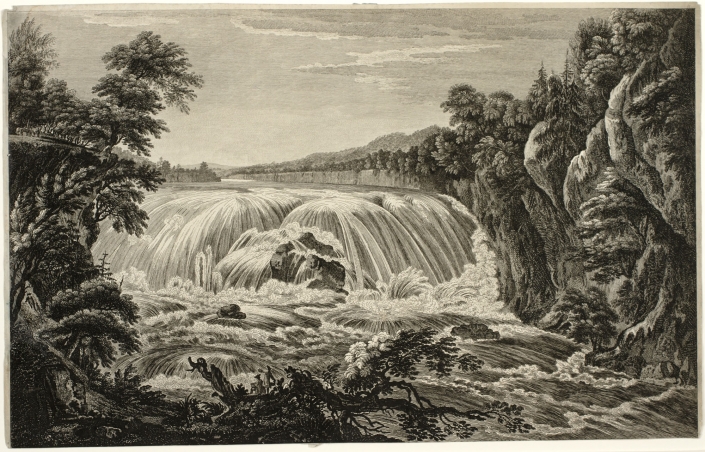

Governor Thomas Pownall and Thomas Sandby. View of the The Falls of Cohoes. ca. 1768. Engraved by William Elliot. Published by Bowles, Bowles, Sayer, Jeffrys & Parker. London. Collection Albany Institute of History and Art. Albany, N.Y.

Following the disruptions of the American war of independence (1776-1783), professional artists emigrated to the new republic to capitalize on its natural wonders. William Birch, Thomas Birch, Joshua Shaw, and Samuel Seymour established themselves in Philadelphia. A Yellow Fever epidemic ravaged the city in 1793, motivating civic leaders to harness the Schuylkill River as a safe source of drinking-water. A dam was thrown across the river, at the foot of a large rocky outcropping dubbed Fair Mount. Pestilential marshes that served as breeding-grounds for mosquitos lined the banks that reached back to East Falls. Many were submerged by the rise in water-level. What remained was later buried under broad esplanades traversed by footpaths and carriage-roads. The course of the river was directed through a series of neoclassical buildings at the foot of Fair Mount, into which had been excavated a vast reservoir. William Strickland’s Water Works, and the nearby Colossus (Spring Garden Street) Bridge became bucket-list tourist attractions.  In 1835, a group fo amateur rowing-clubs held the first official regatta, which led to formation of a world-class venue for competitive oarsmen, and later; women.
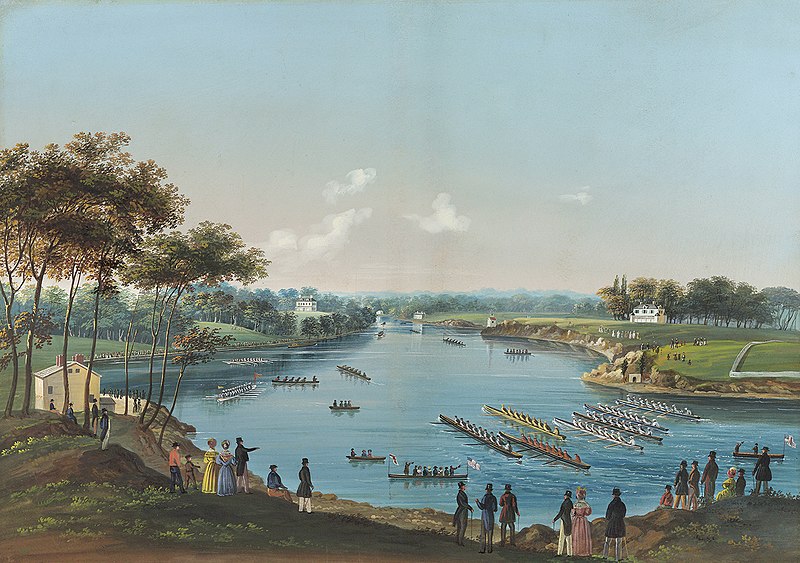

Nicolino Calyo. The First Schuylkill Regatta. Watercolor and gouache on paper. (ca. 1835). Debra Force Fine Art. The painting for many years hung in Castle Ringstetten, the upriver clubhouse of Undine Barge Club, of which painter Thomas Eakins and architect Frank Furness were both members

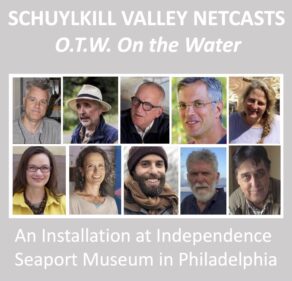
In 2017-18, I filled a painting-journal with sites along the river, from East Falls to Fairmount. These formed the centerpiece of an installation at Independence Seaport Museum at Philadelphia’s Penns’ Landing. Seven of those images were published as a fine press limited edition. Those views and and more are now being unpacked by Needlewatcher Editions as affordable individual archival pigment prints, in the spirit of expeditionary & Grand Tour loose-sheets and bookplates.

—J.L. McElhinney, 2022

These images are drawn from James Lancel McElhinney’s exploration of the Schuylkill River, from Fairmount to the Falls. The fine press limited-edition the centerpiece of the installation O.T.W. On the Water. The Schuylkill River, (below) at Independence Seaport Museum in Philadelphia. October 24, 2018- January 5, 2020.
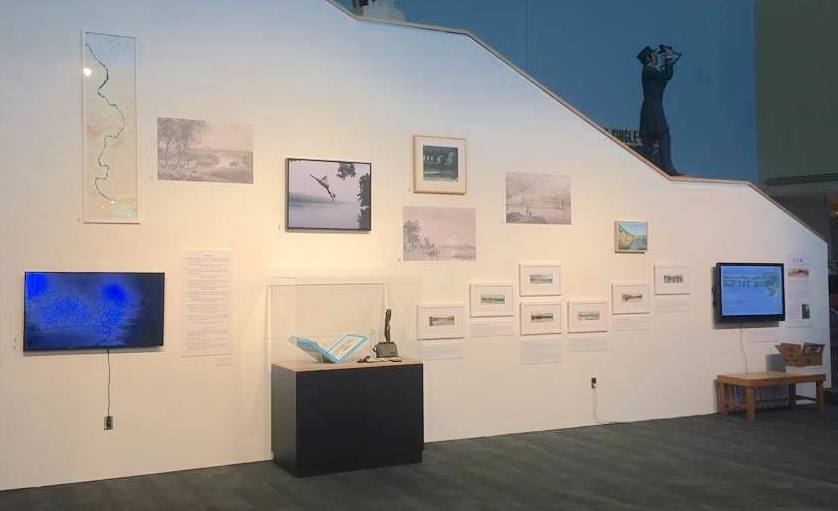
Prints from O.T.W. On the Water. The Schuylkill River  have been installed in the lobby of the newly-renovated Burk-Bergman University of Pennsylvania Boat House, on Philadelphia’s historic Boat House Row (below)
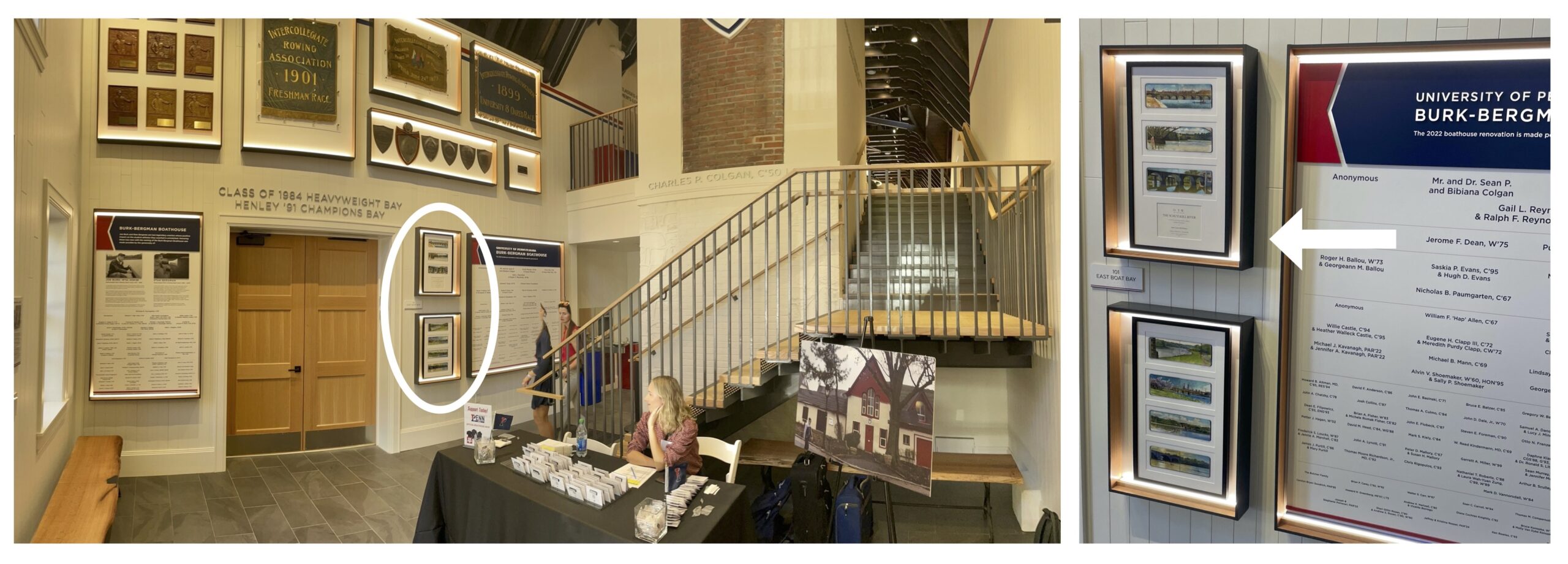
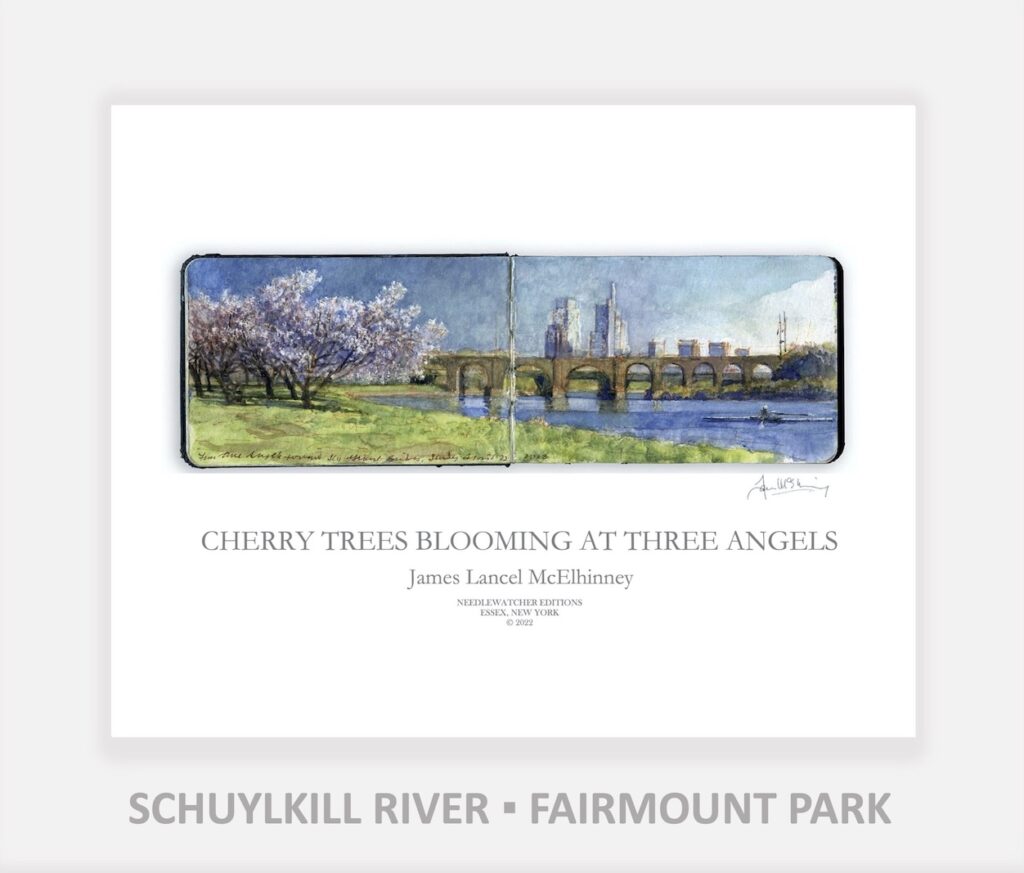
Format: Each archival pigment print is on high-quality acid-free paper. Sheet size: 11 x 14 inches. Image size: 3.5 x 10.5 inches.  Printed by Orion Studios in Santa Fe, New Mexico. Following the traditions of expeditionary art, a descriptive legend is printed below a full-size  facsimile print of one of  James Lancel McElhinney’s  journal paintings; signed by hand below the lower right-hand corner.

EXPLORE THE SCHUYLKILL RIVER

FROM FAIRMOUNT TO THE FALLS

(Scroll down)
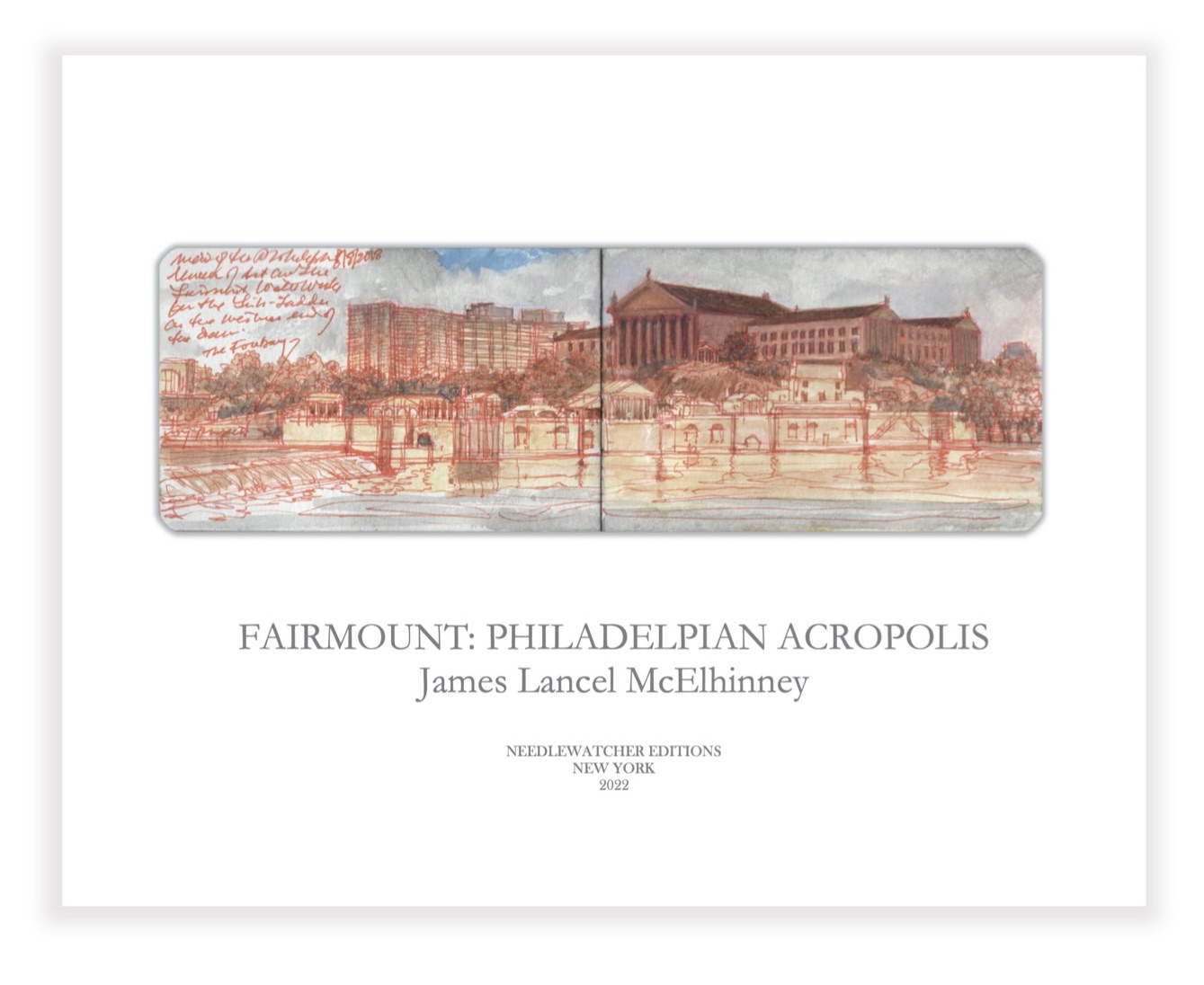
OTW_1. Fairmount Waterworks and Philadelphia Art Museum.
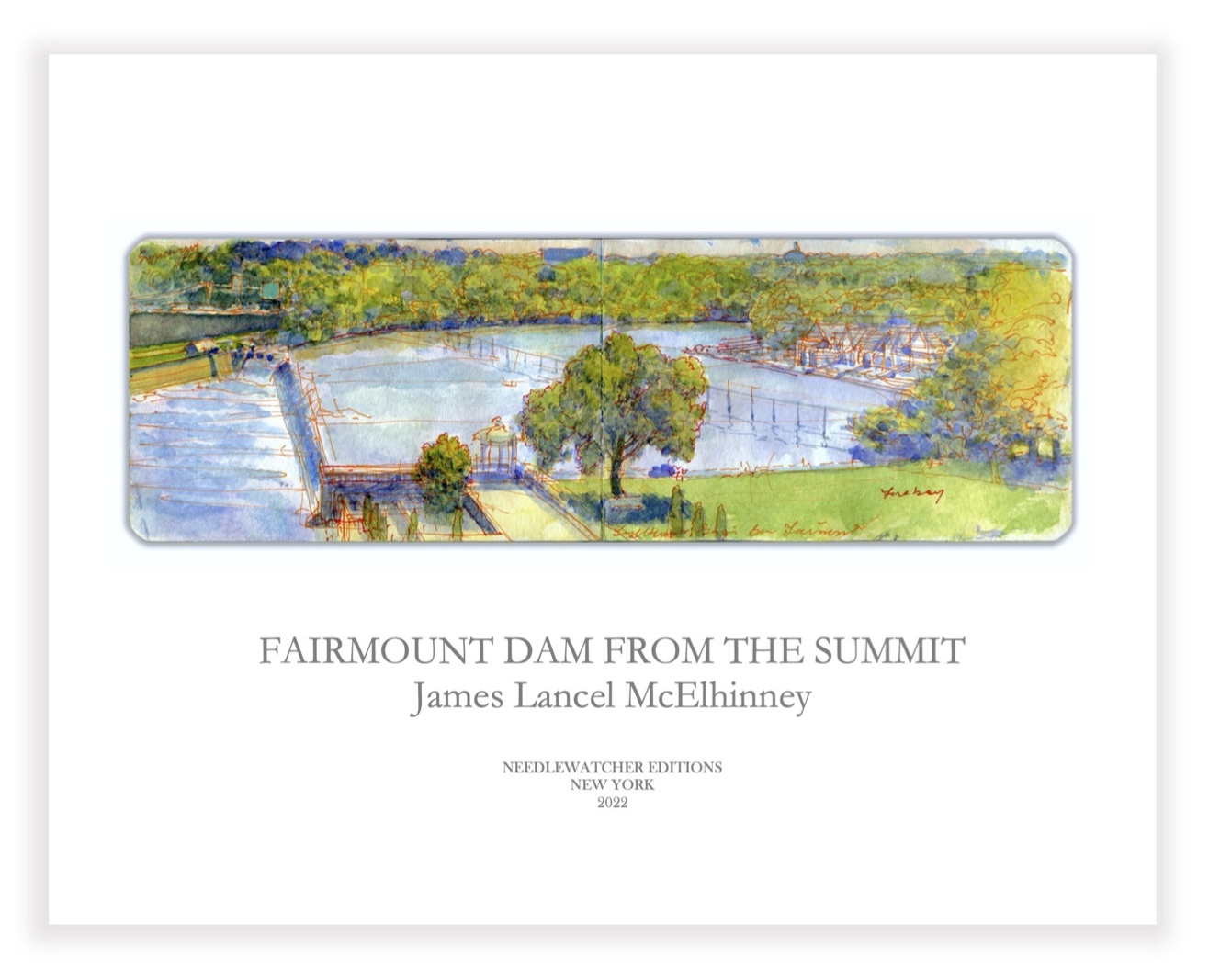
OTW_2. Fairmount Dam from the Summit. $250.00 Purchase now
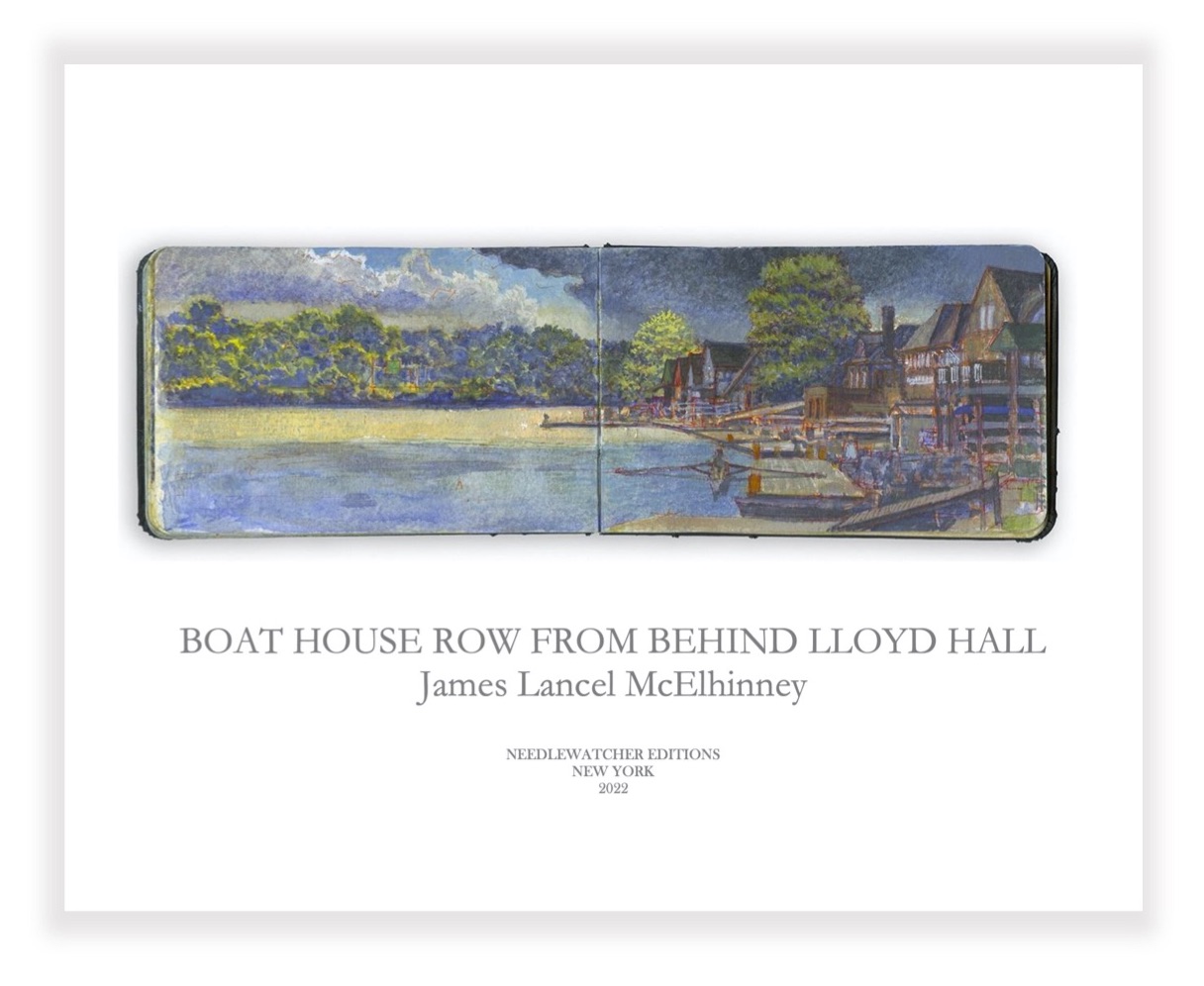
OTW_3. Boat House Row from behind Lloyd Hall. Included in the limited edition O.T.W. The Schuylkill River.
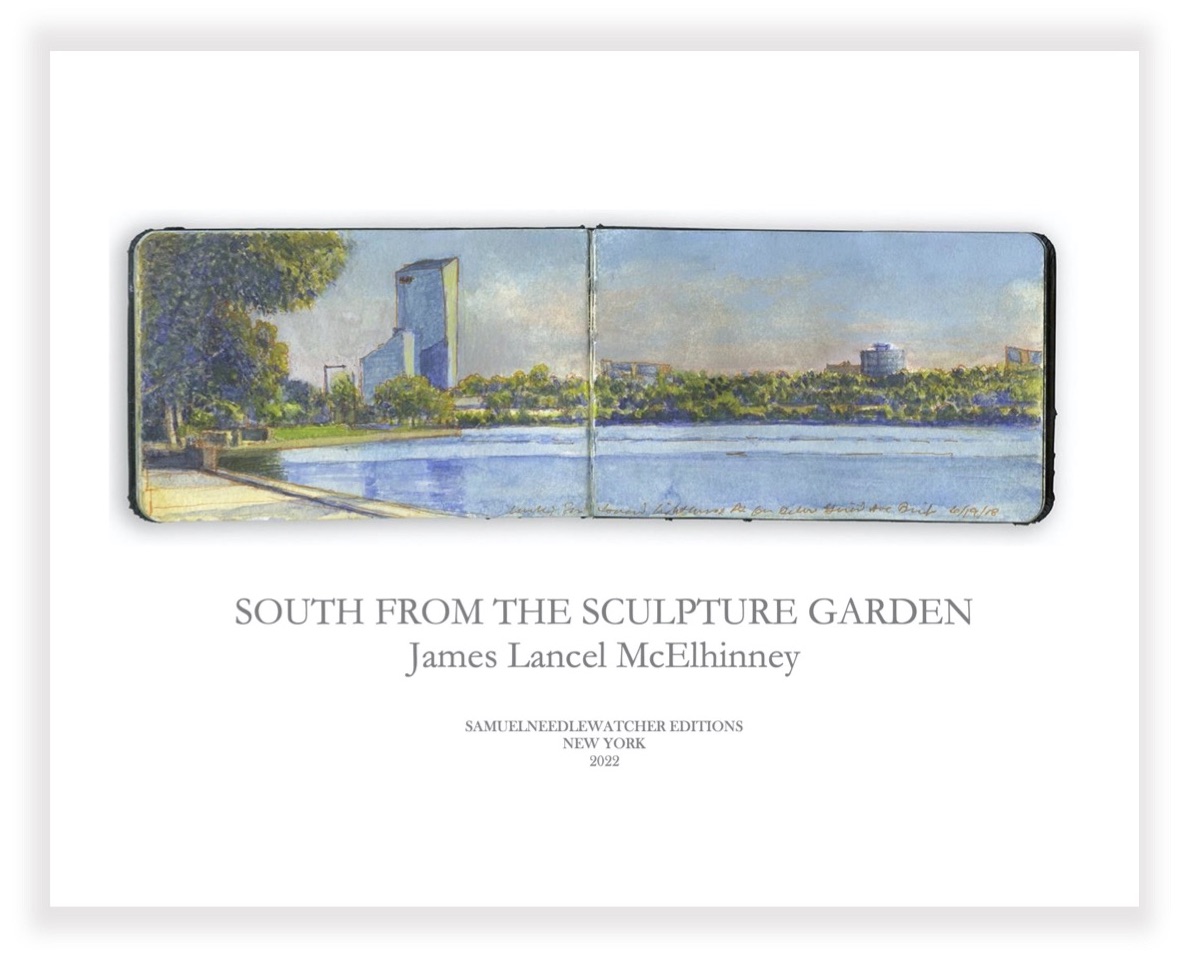
 

OTW_4. Looking south from the Ellen Philips Samuel Memorial Sculpture Garden.
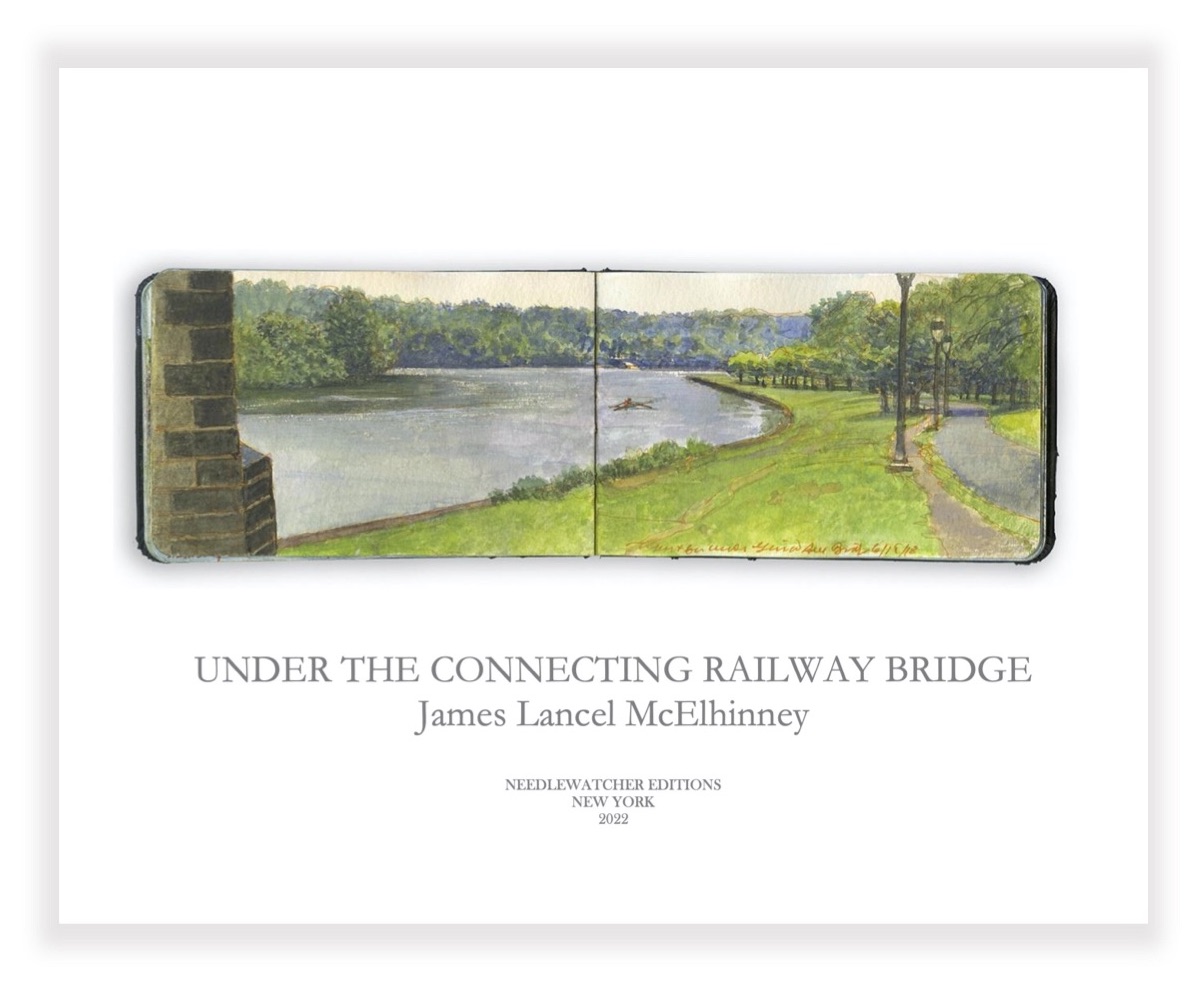
 

OTW_5. North from under the Railway Connecting Bridge. Included in the limited edition O.T.W. The Schuylkill River.
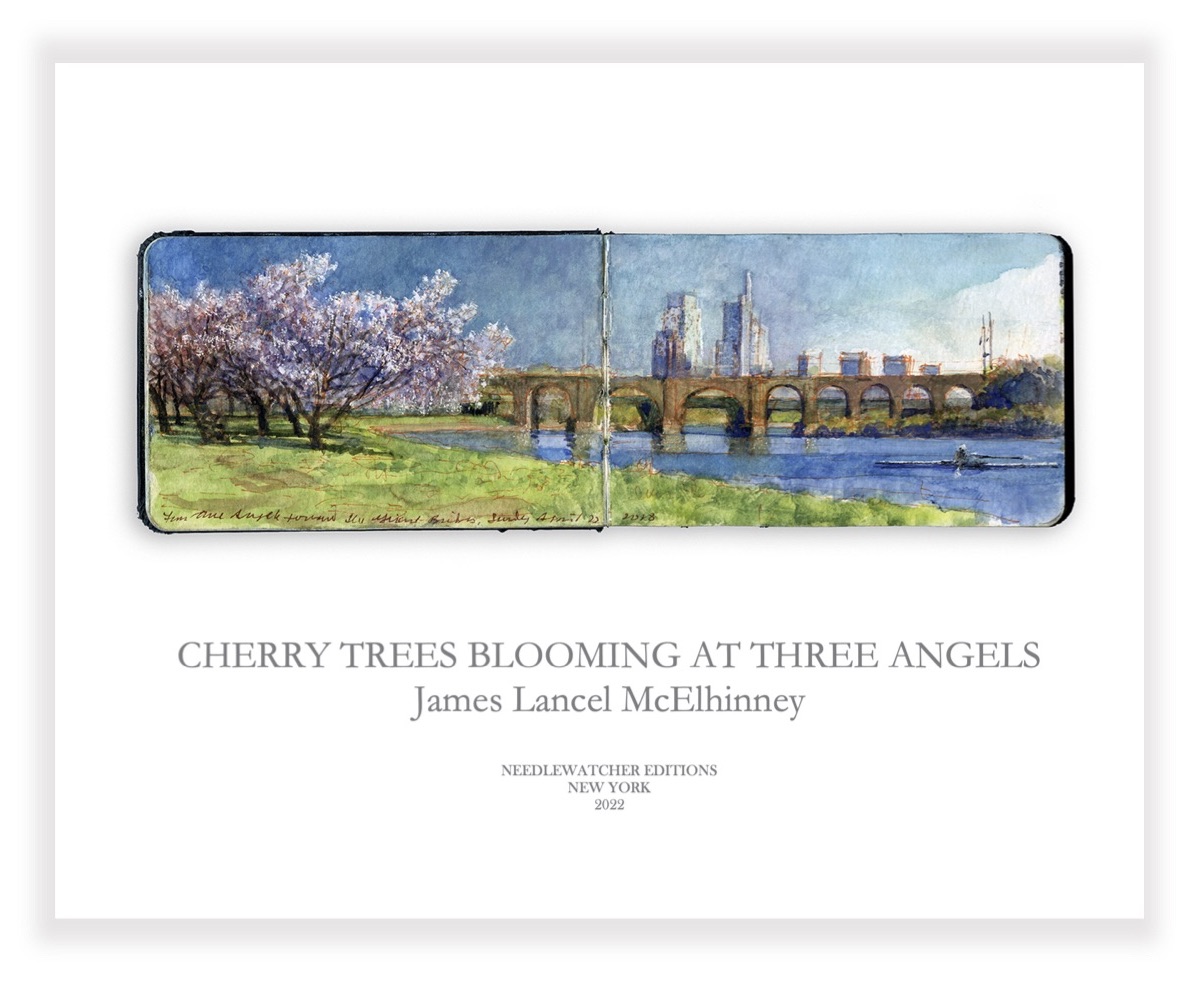
OTW_6. Cherry Trees Blooming at Three Angels. Included in the limited edition O.T.W. The Schuylkill River.:
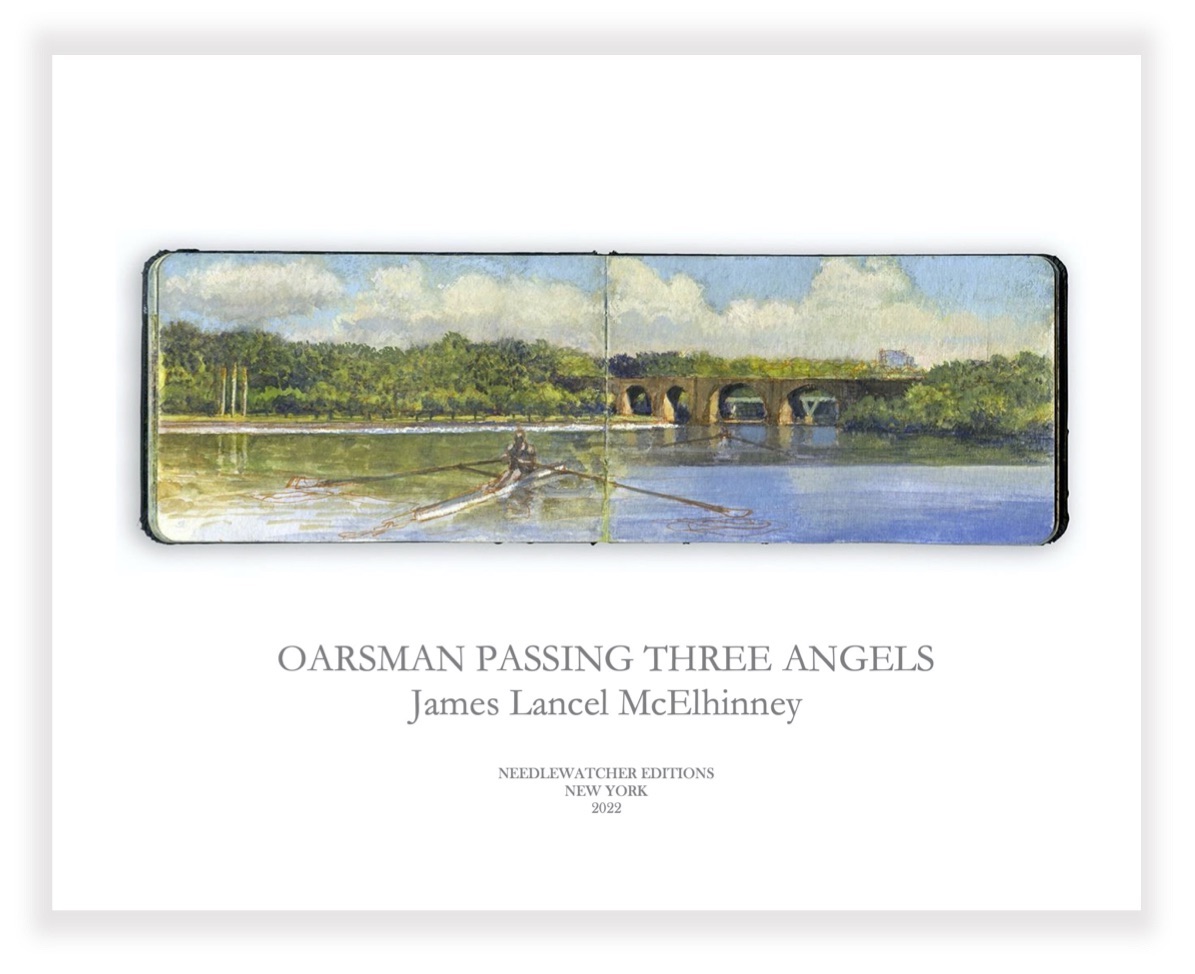
 

OTW_7. Oarsman passing Three Angels.  Included in the limited edition O.T.W. The Schuylkill River.
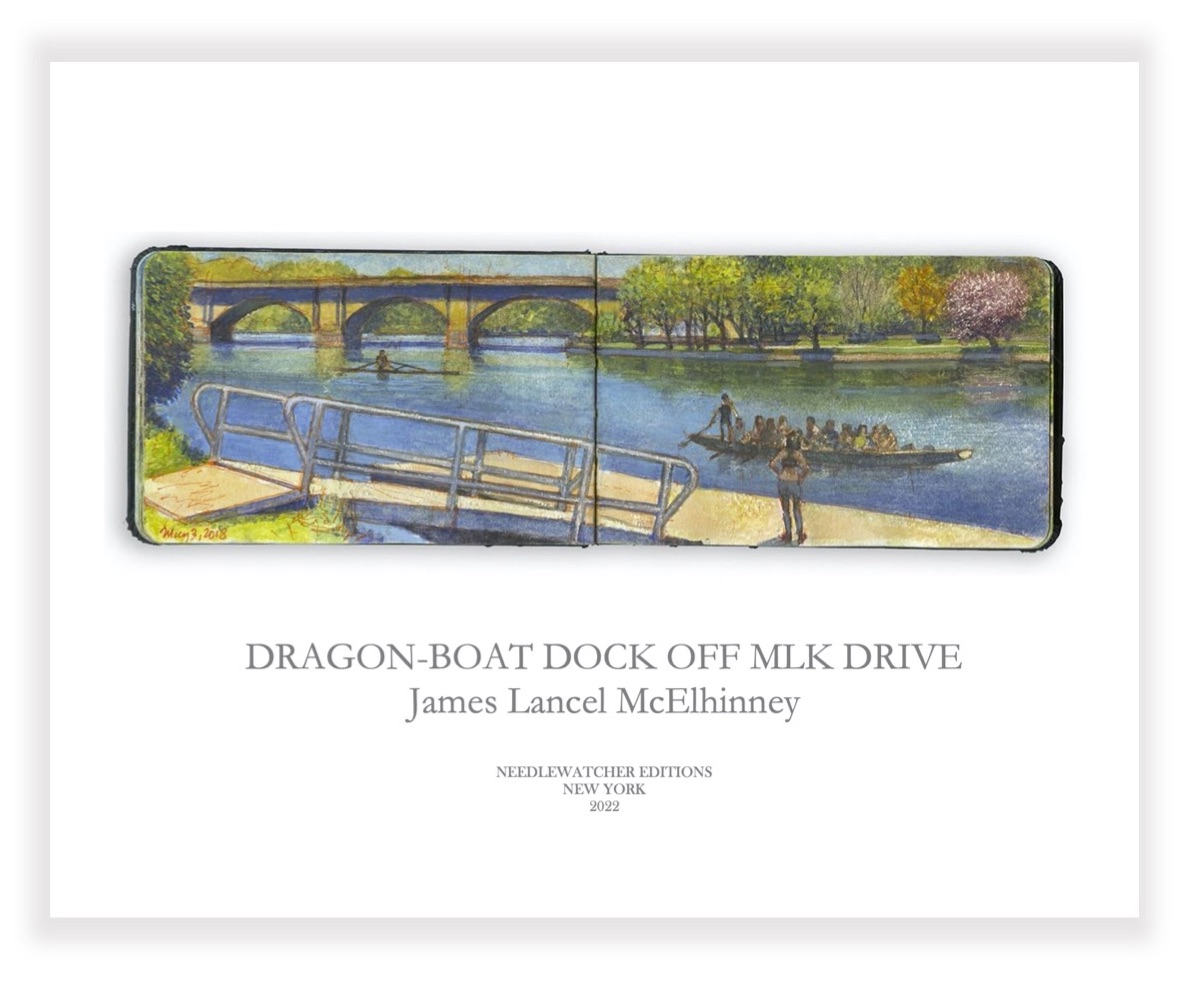
OTW_8. Columbia Bridge and the Dragon-Boat Dock. Price:
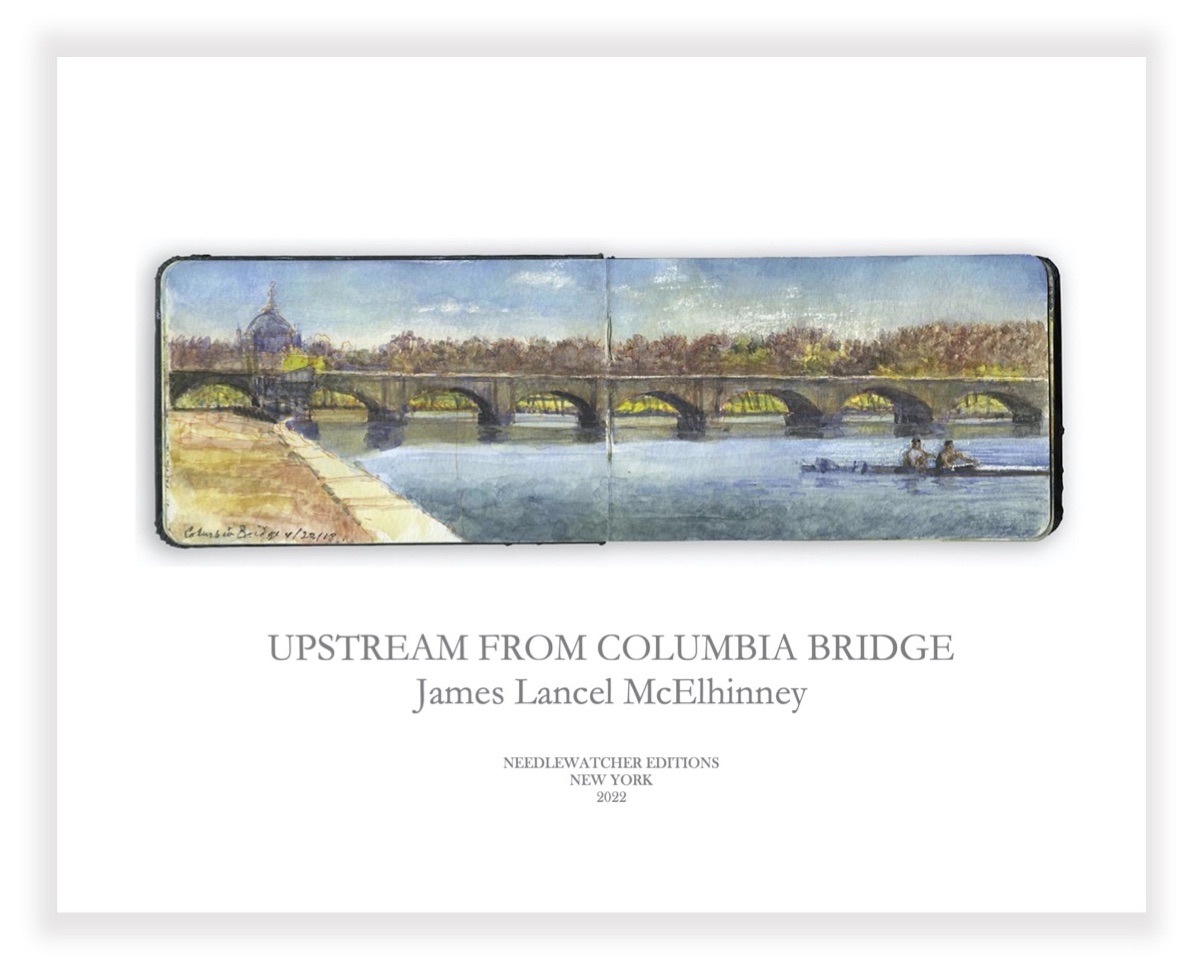
OTW_9. Columbia Double with Memorial Hall.  Included in the limited edition O.T.W. The Schuylkill River.
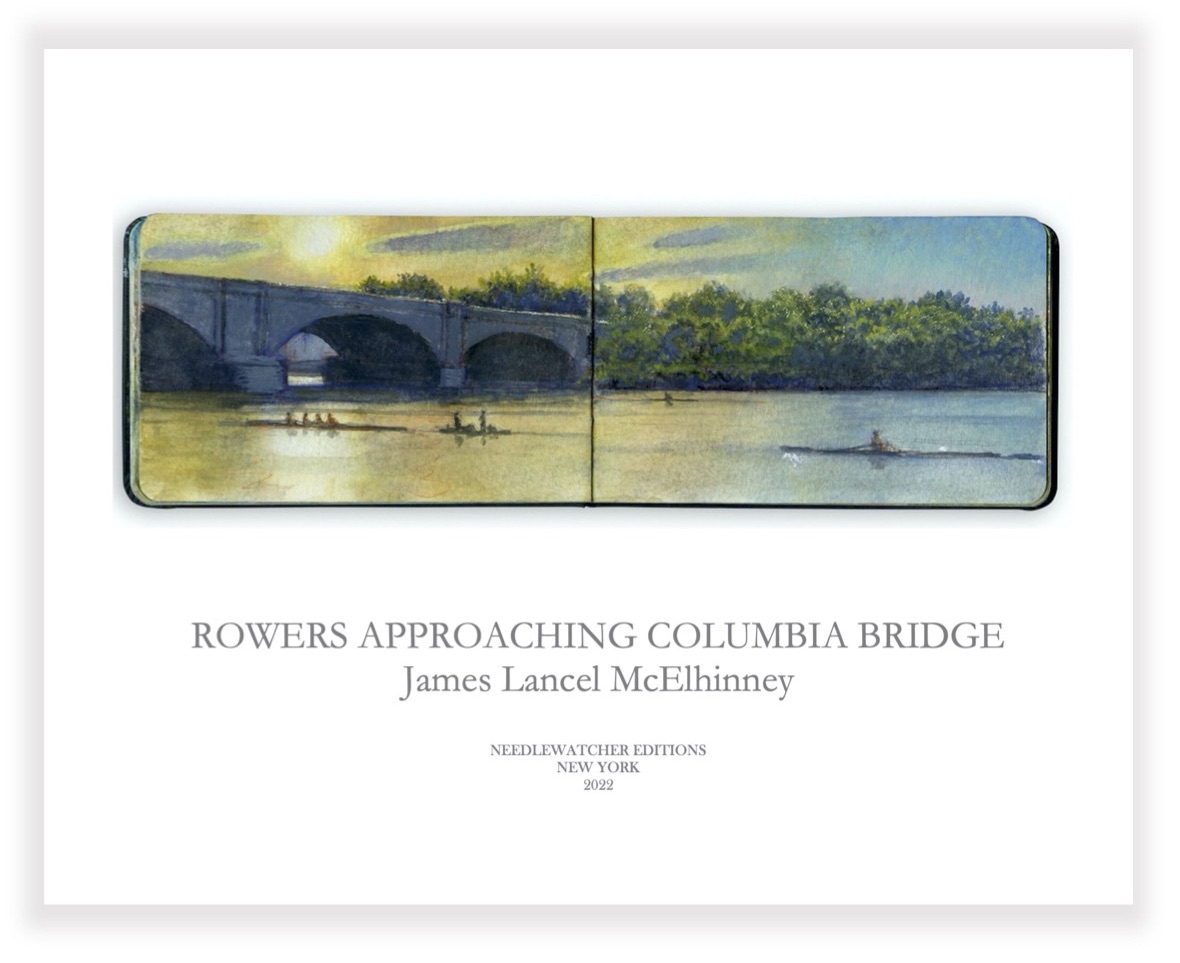
OTW_10. Rowers approaching Columbia Bridge. Included in the limited edition O.T.W. The Schuylkill River.Price:
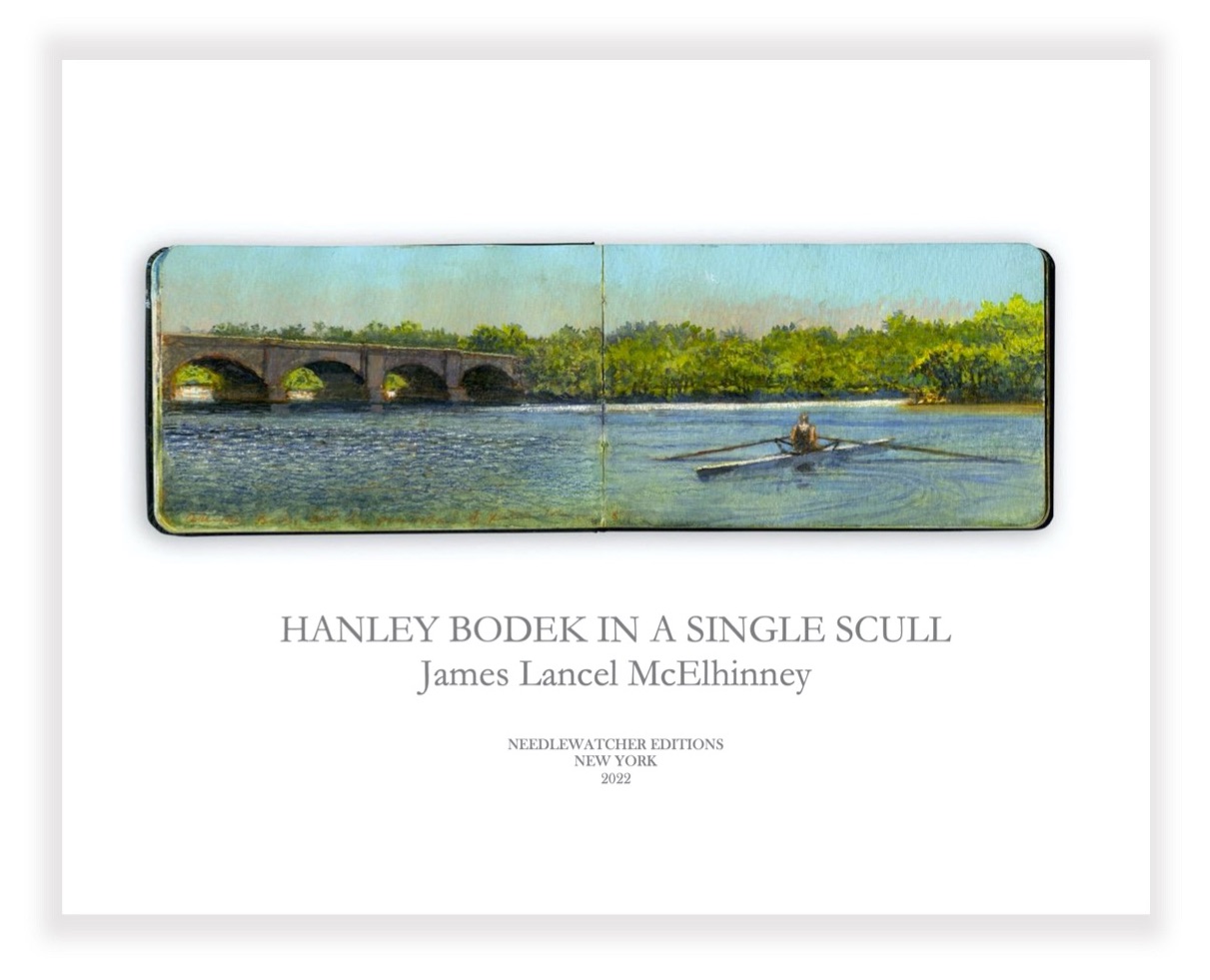
OTW_11. Single. Columbia Bridge. Peters Island.
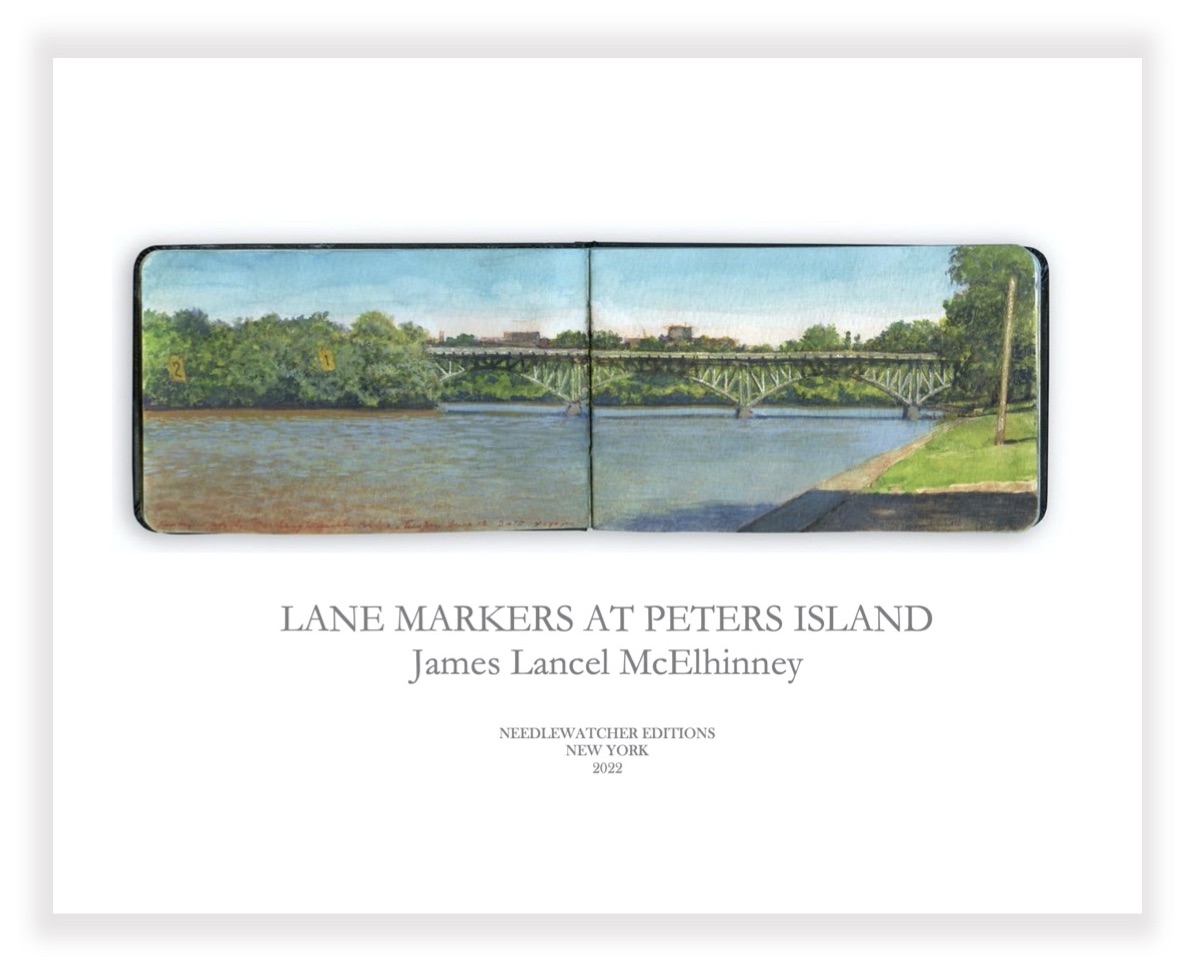
OTW_12. Lane Markers at Peters Island. Price:
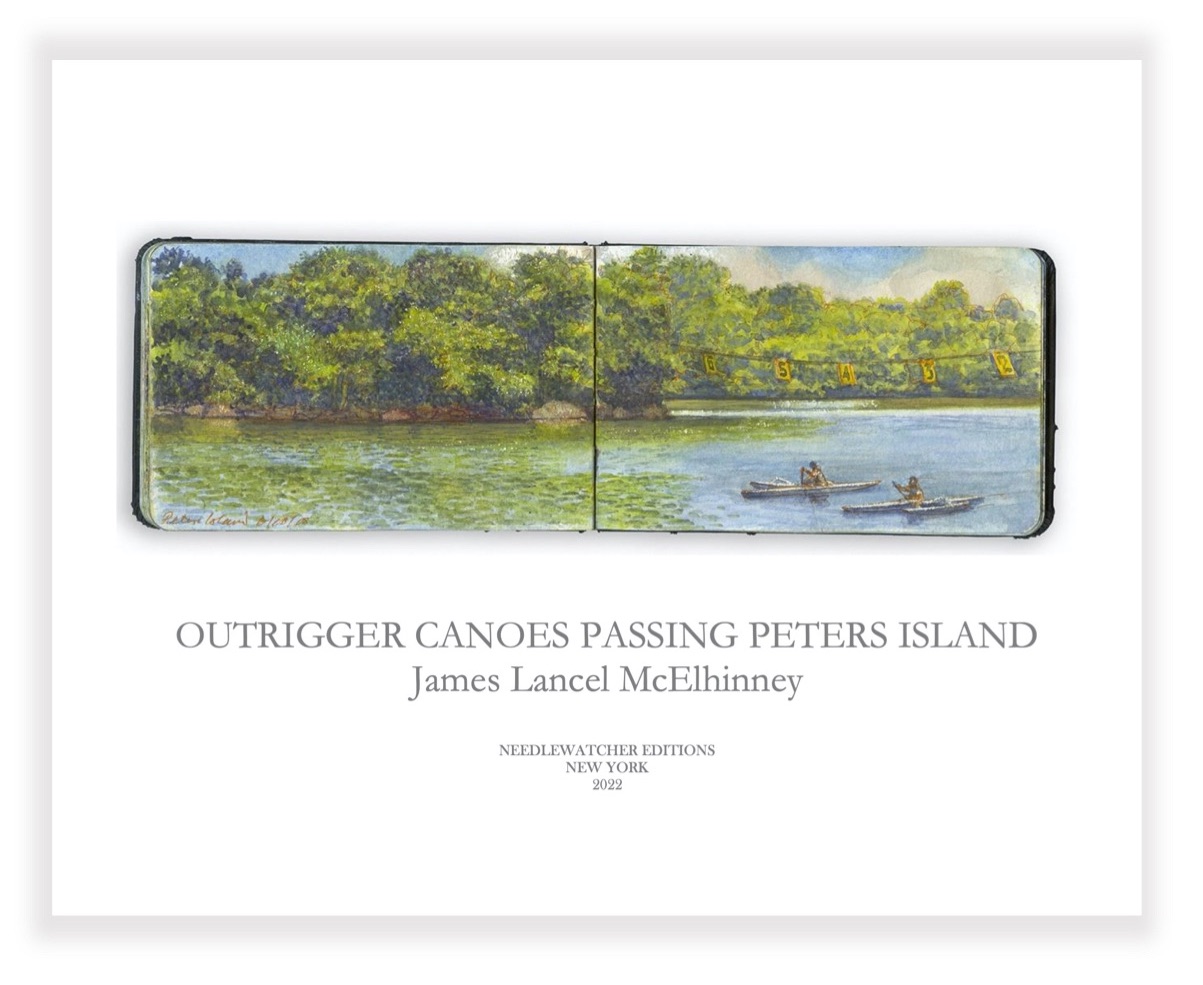
 

OTW_14. Outrigger Canoes Passing Peters Island.
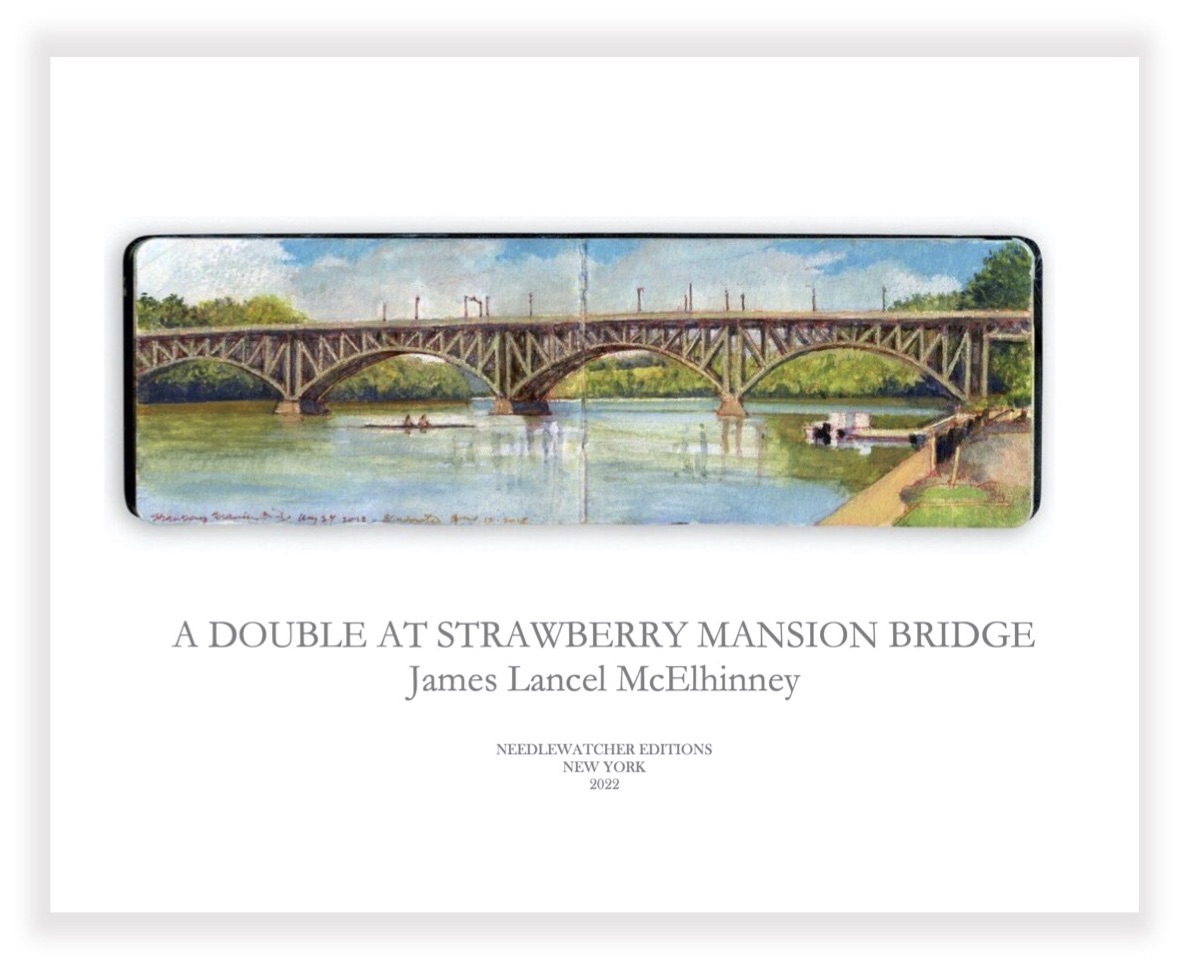


OTW_15. Strawberry Mansion Bridge from Temple Boathouse.
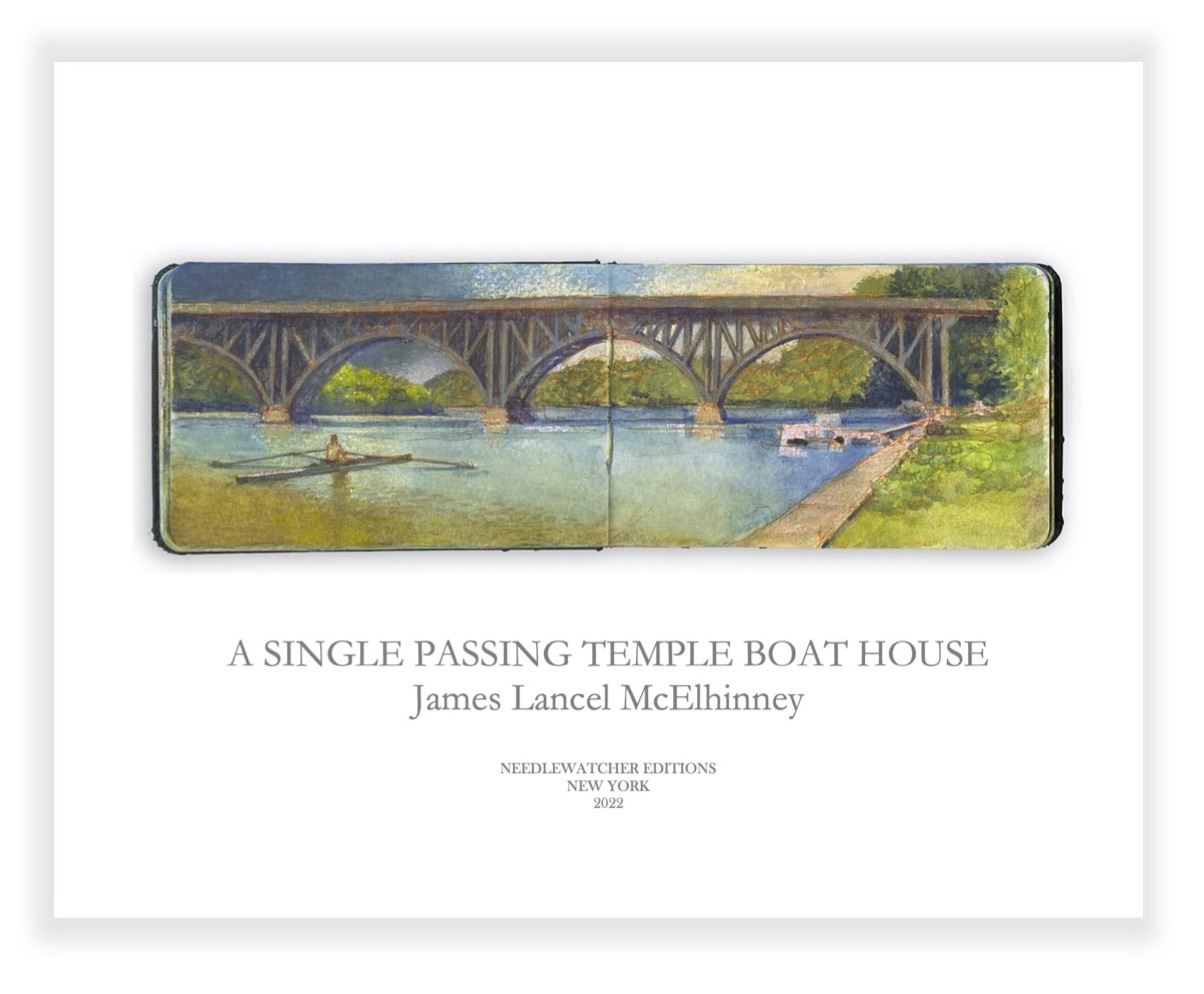
 

OTW_16. Single Scull Passing Strawberry Mansion Bridge.
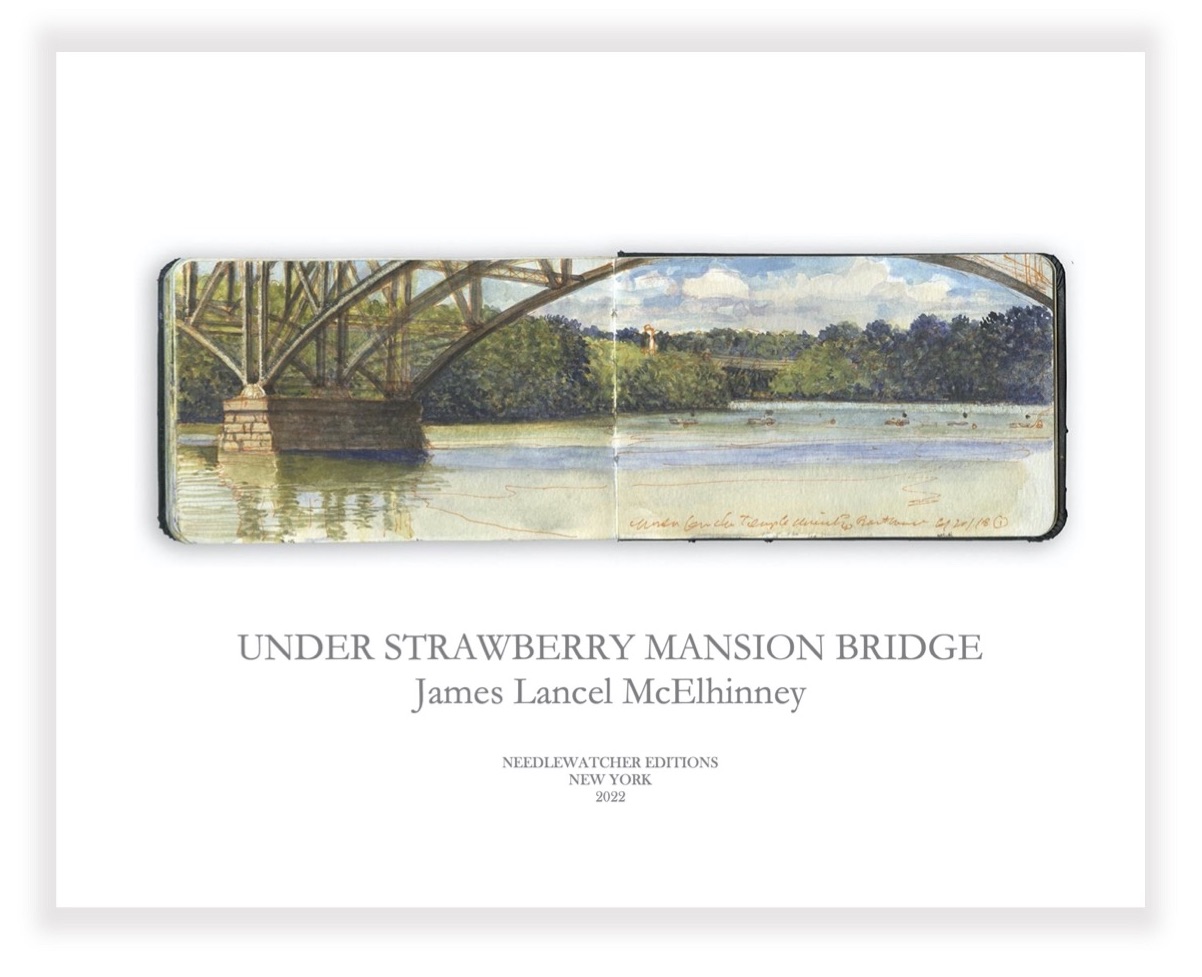
 

OTW_17. Under Strawberry Mansion Bridge. Included in the limited edition O.T.W. The Schuylkill River. 
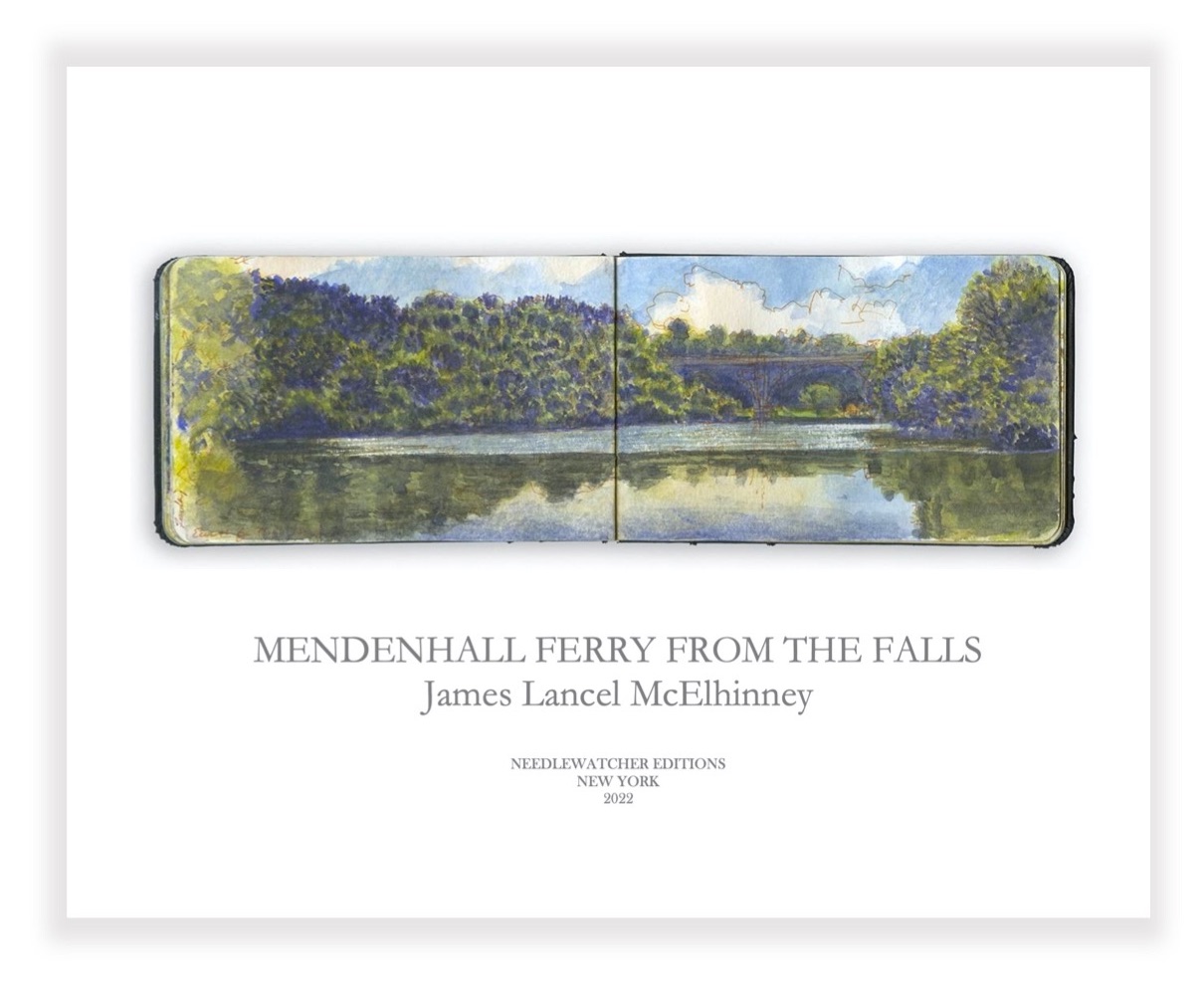
 

OTW_18. Mendenhall Ferry. Below the Falls.
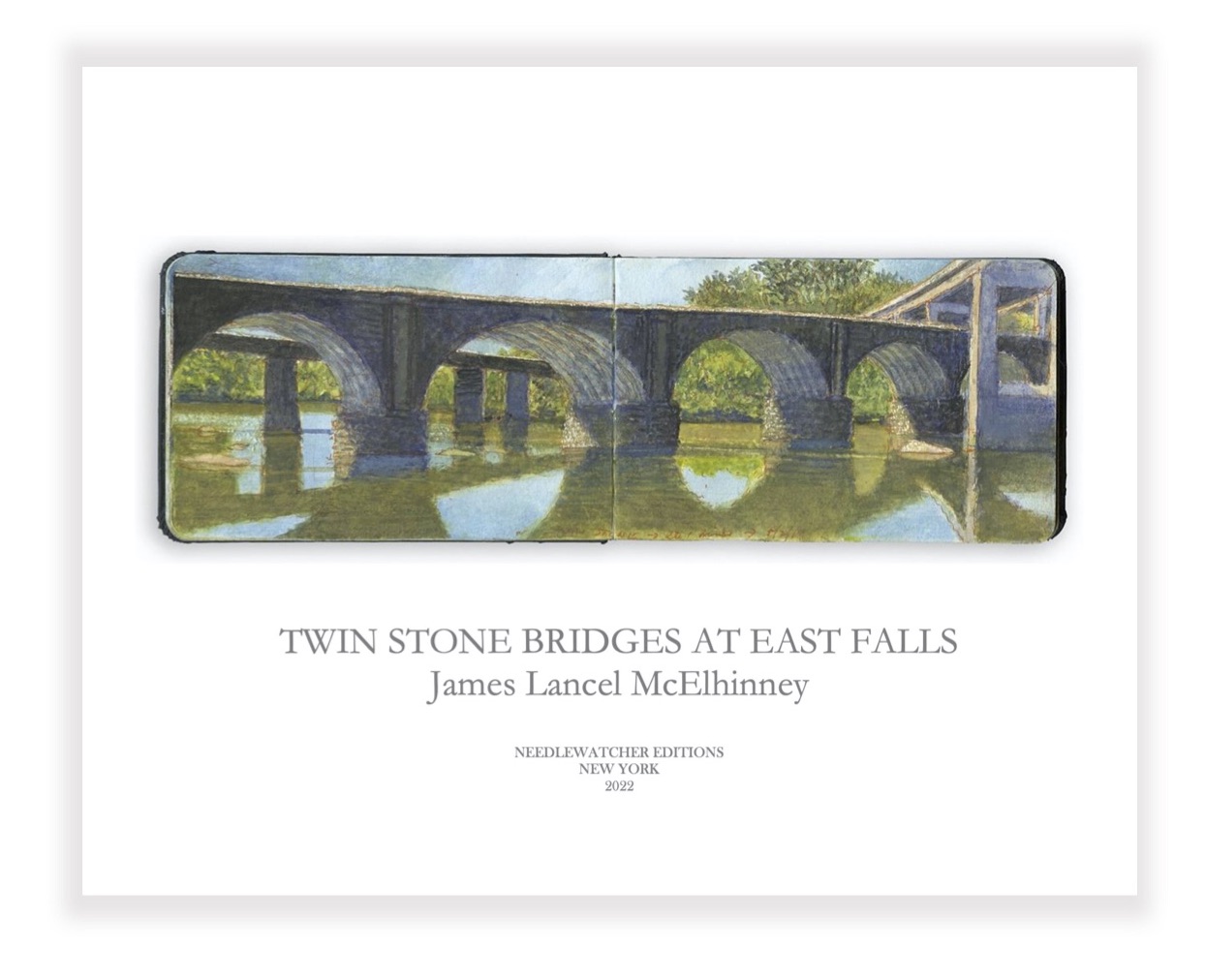


OTW_19. Twin Stone Bridges. East Falls.  Included in the limited edition O.T.W. The Schuylkill River.

PURCHASING OPTIONS (Click on the image below)

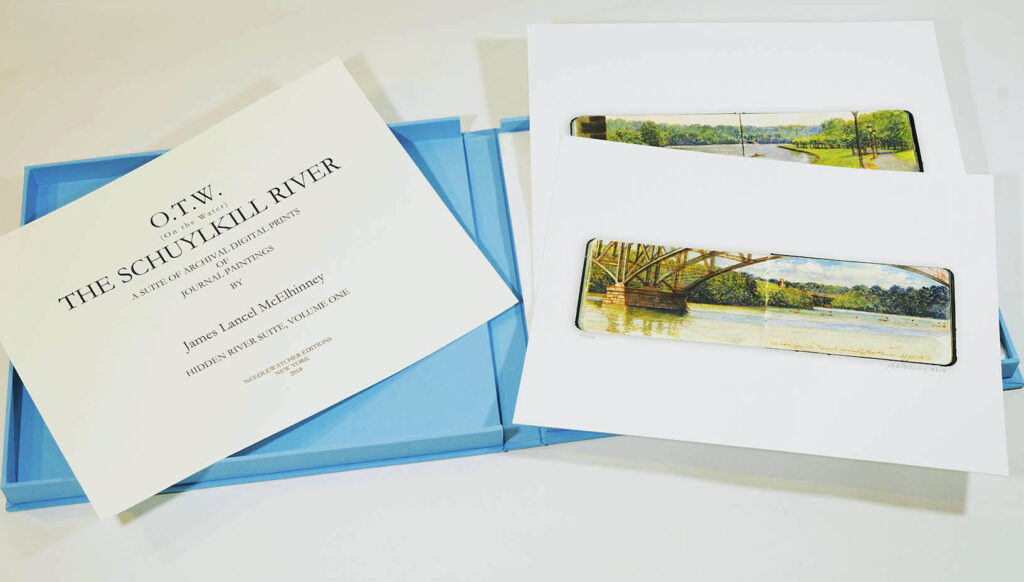
Limited copies of O.T.W. The Schuylkill River are still available: Click on the image below for more details about the fine press limited edition of 50 copies released in 2018.
Return to Top of Page

Return to BOOKSTORE