Since establishing our second residence on the Adirondack Coast of Lake Champlain, Kathie and I have made a concerted effort to visit many of the museums and cultural centers in the region, which presented certain challenges. Unlike western Vermont, The Berkshires and the Litchfield Hills, there is no singular transportation corridor to guide visitors through a daisy-chain of charming villages like Route 7; or US-1, which follows the Maine coast. Within The Blue Line encircling the Adirondack Park roads follow rivers and lakes in circuitous loops that link scattered self-focused municipal inholdings.
Lake Champlain is one link in a chain of waterways that stretches from the Saint Lawrence River in the north, to portages connecting Lakes George and Champlain to the Hudson Valley and the Atlantic seaboard to the south.
The city of Plattsburgh saw a pivotal American victory during the War of 1812, and was home to active military bases until 1995. The State University of New York established a Normal School (teachers’ college) at Plattsburgh in 1889. The college welcomed students the following year, and was ranked as a university in 2023. Its art museum was formed according to Andre Malraux’s concept of “a museum without walls;” exhibiting its a permanent collection of more than 10,000 artworks and artifacts not within a dedicated building, but at various spaces around the campus.

Yesterday I had the pleasure of meeting with Plattsburg State Art Museum director Tonya Cribb, collections manager Kara Jefts, and curator/preparator Walter Early. The reinstallation of the newly-renovated Rockwell Kent Collection is now underway. I was surprised by the diversity of Rockwell’s output; from prints and bookplates to textile designs and transfer-ware. I learned how during the McCarthy era, the local barber in Ausable Forks required Kent to enter and leave through the back door, in fear that he might be blackballed for cutting a known communist’s hair. As an aside, the storefront workspace I just rented had once been that very same barbershop. Another highlight of the visit was a pair of installations unpacking environmental narratives. Climate’s Shipwreck Ballad by Robin Lasser explores how the more than 300 shipwrecks submerged in Lake Champlain “. . .may serve as an iconic metaphor for the current state of the earth.” Transmutation Traces by Marguerite Perret ‘. . . surveys our relationship to water regionally and globally.” The installation includes “. . . casts of anthropogenic debris and recreational boating paraphernalia, laser cut noxious aquatic weeds, and photographs taken with a toy microscope of things found along shorelines at various locations.” An interactive component of the installations were postcards, upon which visitors are invited to write love-letters to water.
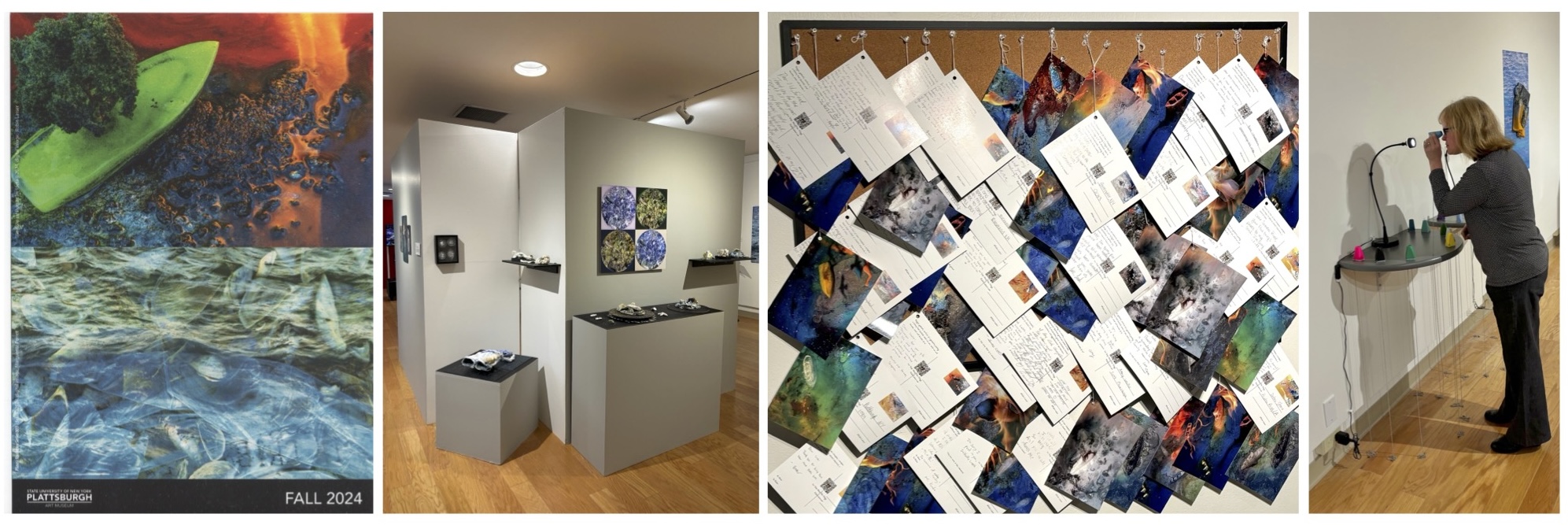 A number of these are pinned on a bulletin-board hanging just outside of the gallery, beside a table filled with books about water for readers of all ages,
Like many university art galleries, the museum at SUNY Plattsburgh has a mission to serve a diverse community of academics delivering degree-track classes to a combination of commuting and resident students. Like many institutions of higher learning focused on preparing students to enter the job market, S.T.E.A.M. can be a tough sell. Many in positions of power are Baby Boomers trained in 20th century silos, and thus resistant to blending the arts, sciences and humanities, to expand critical thinking in ways that enhance creativity. Since the onset of the pandemic, Champlain Valley and the Adirondack region have attracted an influx of cultural professionals. As their numbers grow, linking scattered communities might assemble a critical mass, positioning the Plattsburgh State Art Museum to serve the greater Adirondack region, and beyond. Montreal is just an hour’s drive away. For more about the museum: Click here
—James Lancel McElhinney © 2024
Watch a short video in Robin Lasser’s installation Climates’s Shipwreck Ballad: IMG_2498 (1)