On Friday June 14, 1777 the Continental Congress authorized the design of a new national flag, designed by New Jersey congressman Francis Hopkinson. Representing the number of Britain’s Atlantic North American colonies removing themselves from Crown rule was a field of thirteen alternating red and white stripes. The canton, or upper left-hand section of the field was emblazoned blue, with a constellation that may spell “S U” with thirteen six-pointed stars. Apart from representing Judaism, the six-pointed star is Masonic iconography. Many of the founding fathers were freemasons. It may also pay tribute to the Polish-born Jewish financier Haym Salomon (1740-1785), who with Robert Morris (1734-1806) underwrote the American Revolution. Above the eagle on the verso of one-dollar bills is a Star of David composed of five-pointed stars.

Francis Hopkinson flag. June 14, 1777
Legend has it that Betsy Ross convinced Master-Mason George Washington to let her provide the flag she was to make with five-pointed stars, one suspects to make her task less laborious. Washington’s own headquarters flag is a blue field with six-pointed (masonic) stars.
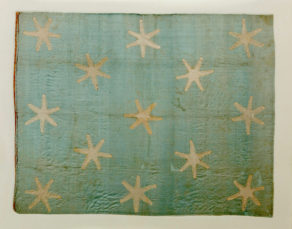
George Washington’s personal position flag. 1777. Reproduced under Fair Use, etc.
Ross also is credited with modifying Hopkinson’s design by arranging the stars in a circle. Her upholstery business was quickly repurposed to produce banners and uniforms for the patriot cause.

Betsy Ross flag. 1777.
This design was by no means uniform, with a range of variations inspired by the official design. But did the design just spring from the imagination of an artsy cousin of Benjamin West? Let’s look at few precedents.
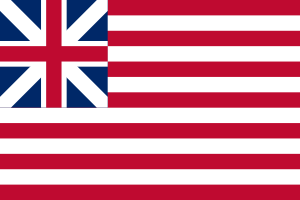
The Grand Union Flag. 1775. Differentiated from the East India ensign by use of a square canton.
The Grand Union flag was adopted, or more correctly appropriated in 1775 as the designating colors of Continental forces in Massachusetts. In every part of the British Empire everyone recognized the design as the ensign of the British East India Company a private corporation that conducted itself like a sovereign state for 274 years.
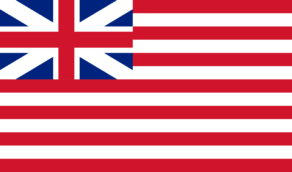
Ensign of the British East India Company (1707-1874) The field of thirteen red and white stripes with a canton emblazoned with the overlapping crosses of Saints George, David, Andrew and Patrick dates to 1707.
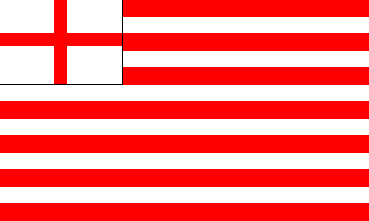
British East India Company Ensign. First pattern. 1600-1668
Its precursor bearing only the red cross of saint George on a white canton had been in use since the formation of the company in 1600. The flag of the progressive Sons of Liberty kept the stripes, sans the tyrannical symbol of British rule.
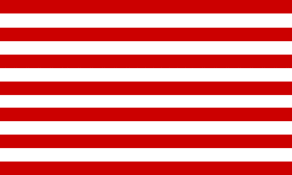
Sons of Liberty Flag. 1765
When the flag was banned by the Crown, the S.O.L. modified the colors to nine vertical stripes, representing the organization’s nine founders. During the War of Independence from 1775-1784, a number of local variants were produced, with and without a starry canton.
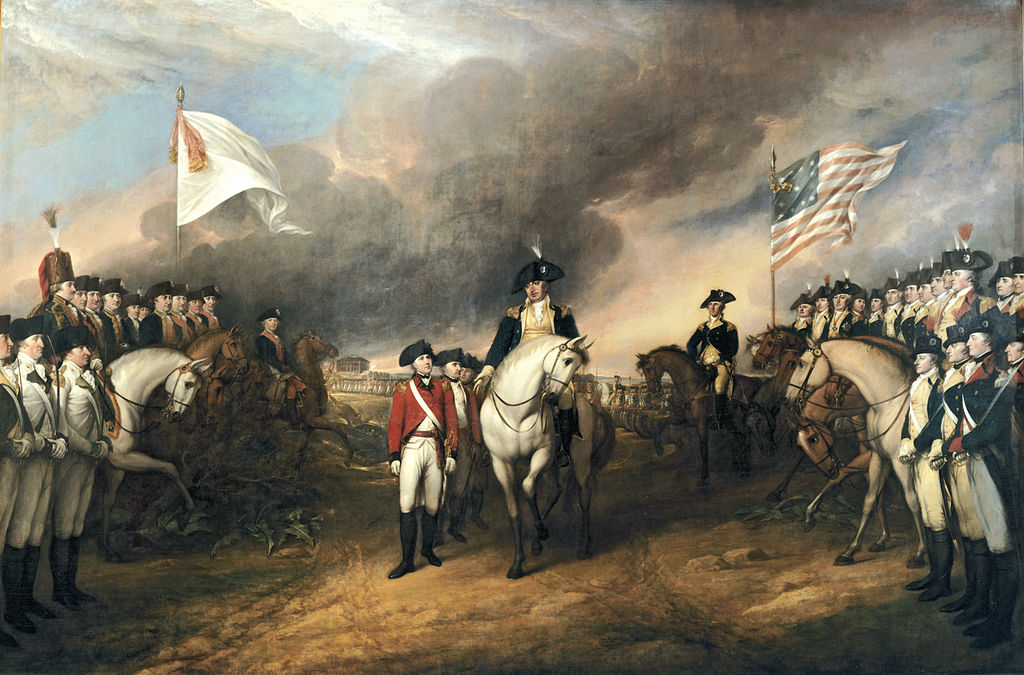
John Trumbull. The Surrender at Yorktown. 1819-1820. U.S Capitol Collection. The national colors portrayed here by a veteran of the war has been called into question. If the object every existed it has never been located. Trumbull’s depiction of twelve stars forming a box around a single central star has never been verified, and deviates from eyewitness sketches of American flags drawn by the British defenders. It nonetheless demonstrates the lack of uniform regulations specifying any single design
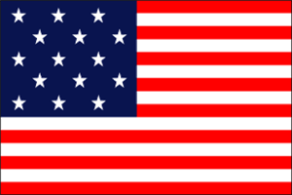
Star-Spangled Banner. Adopted 1795
It was not until after the admission into the United States of Vermont in 1791, and Kentucky in 1792 that a fifteen-star predecessor of today’s national colors became the official flag of the United States of America on May 1, 1795. With so many contenders in the running, why in 1776 did the Continental Congress favor the East India Company pattern flag? Could it have been because that Congress pondered the formation of a sovereign state that could behave like a private corporation? Why were no allegorical figures of Liberty adopted, nor Roman eagles, Phrygian bonnets, nor arboreal devices? The answer may seem obvious. How did Flag Day begin? That is another story.