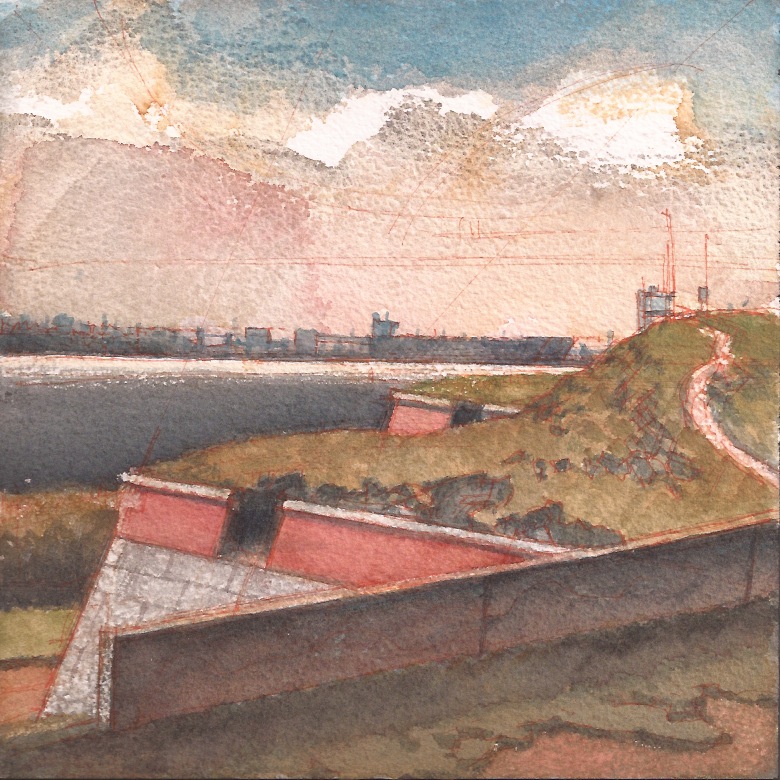
Mud Island Fort, later renamed Fort Mifflin, was built by the British during the French & Indian War. It was later expanded, strengthened and defended by Continental Forces who lost it to the British in 1777 and recovered it the following year. During the Civl War it served as a POW camp, run by artist-soldier Seth Eastman, who later served as commandant of the notorious prison pen at Elmira. In gratitude for his life of military service the House of Representatives gave Eastman a retirement sinecure in the form of a commission to paint America’s historic forts, including Fort Mifflin. The paintings now hang in the hallways outside the House and Senate offices in the US Capitol. Eastman died at his easel working on a view of the North Gate of the Hudson from Land’s End at the U.S. Military Academy at West Point, where as a young officer Eastman wrote and published the academy’s principal text on topographical drawing. He briefly served as interim head of the drawing academy at West Point, before Robert Weir stepped in to rule the roost for the next four decades. Eastman is also the grandfather of Dr. Charles Eastman, a popular writer and a central character in Bury My Heart at Wounded Knee by Dee Brown.