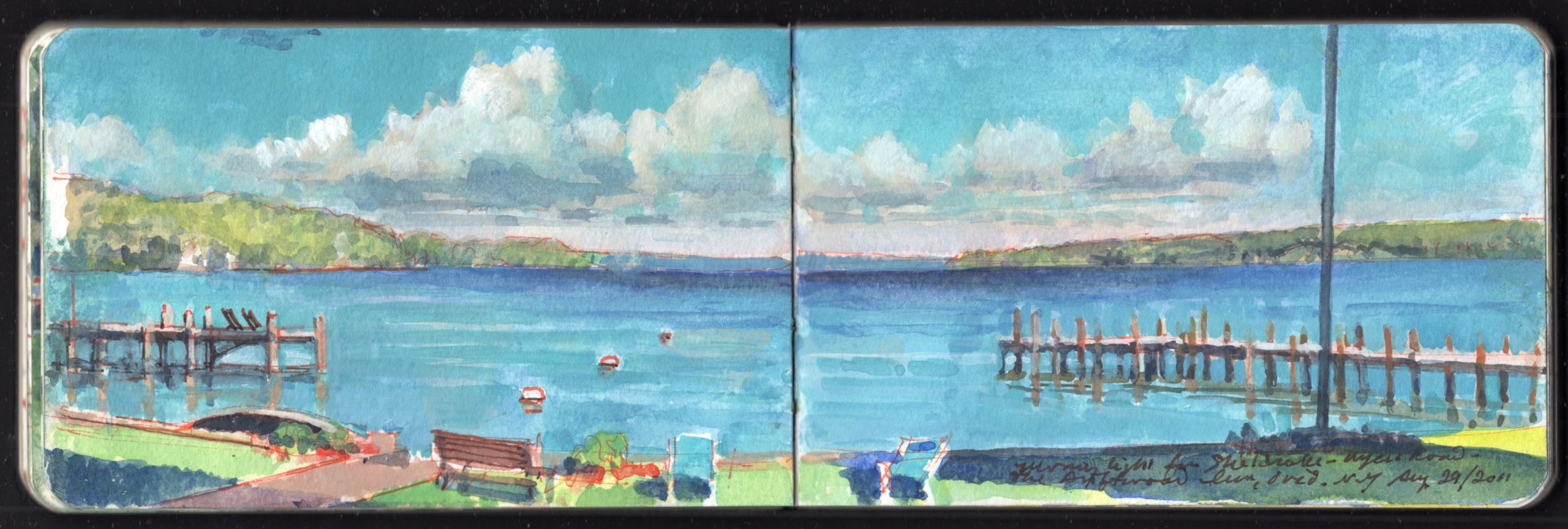
Lake Cayuga from Sheldrake Point August 29, 2011.
Thick clouds rolled across a rosy sky. Puddles sat in the road. Having crossed the lake, the deluge shed the last of its burden on the rolling plains of Upper Canada.
Going online we discovered major road closures between Sackett’s Harbor and New York City. The hurricane had come straight up the Hudson Valley, flooding creeks and downing trees in the Catskills before plowing into the Adirondacks. Its path had stretched from the Berkshires to the Finger Lakes. Fortified by a hot American breakfast, we decided to return home via a circuitous route through Seneca Falls and Ithaca.
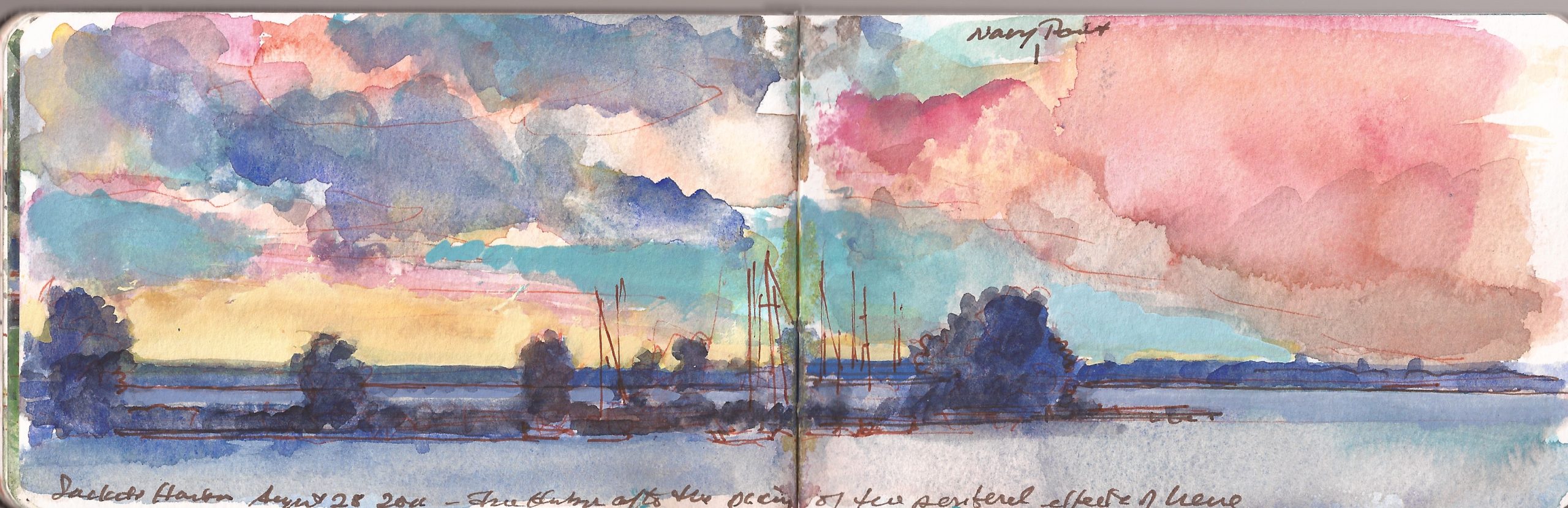
Navy Point and Sacketts Harbor after the passing of Hurricane Irene. August 28, 2011
Following the lakeshore, we reached Oswego. Visiting Fort Ontario, we walked the circuit of its grassy parapet, which afforded wonderful vistas of the lake and city. Our impromptu call was ill-timed for a reunion with Paul Lear—an old friend working as curator at the site.
Dropping down through Hannibal we followed blue highways and rural two-lane blacktop roads through places like Cato. Above Weedsport we reached the Seneca River, in service at that point as a stretch of the Erie Canal. All along the route we noticed a dearth of traffic and a number for trees knocked down by the storm, ripped apart, or deprived of a limb. The rolling terrain offers no barrier to Arctic blasts that mingle with warmer air drifting up from the south to generate heavy deposits of Lake Effect snow.
Crossing the northern end of Lake Cayuga on Highway 20 we arrived at Seneca Falls. Visiting the Women’s Rights National Historic Park—a deconsecrated Methodist church and other buildings where on July 19-20, 1848 the first women’s rights convention was held, resulting in a Declaration of Sentiments. Ninety-nine signers of both genders included Lucretia Mott, Elizabeth Cady Stanton and Frederick Douglass. The centerpiece of the visitor-center was a cluster of bronze figures conveying the effect of a life-sized Rogers-group.
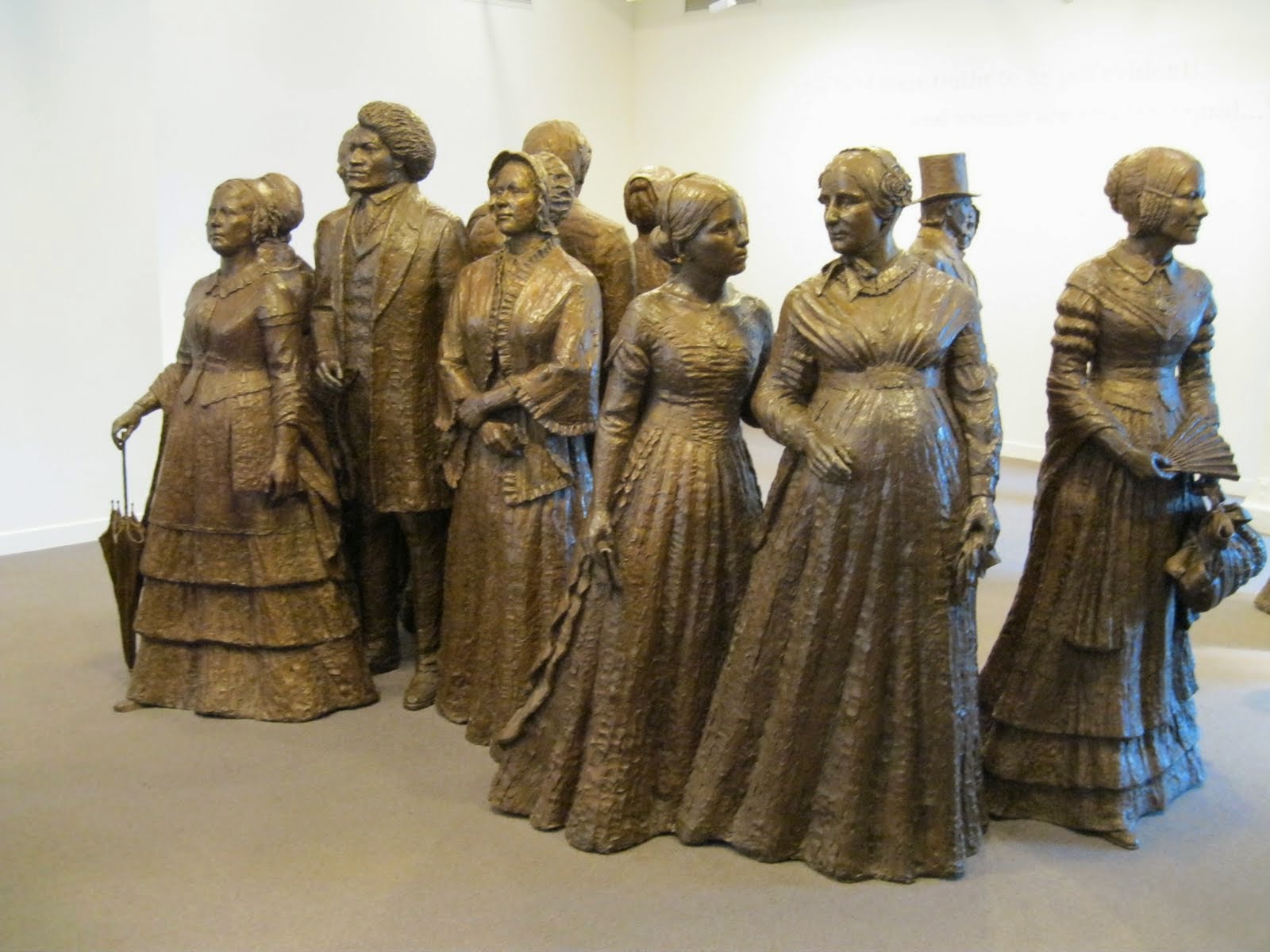
The First Wave. Sculptor: Lloyd Lillie (1932-2020) Women’s Rights National Historic Park. Seneca Falls, New York
Visiting the region in April 2010, we traveled to Leroy, New York–famed as the birthplace of Jell-O. It had also been the location of Adam Pratt’s dry-goods cash-and-carry store. This would mean nothing, were it not for the fact that his sister Eliza Pratt Greatorex (1819-1897) had lived there briefly, and returned on several occasions with her husband to give concerts in a local church. Henry Greatorex would provide the accompaniment for Eliza’s sweet contralto renditions of songs they had written together. One of them became a hit. Ironically, despite Eliza and Henry being ardent abolitionists, Love Me! today is found under the heading of Confederate popular music.
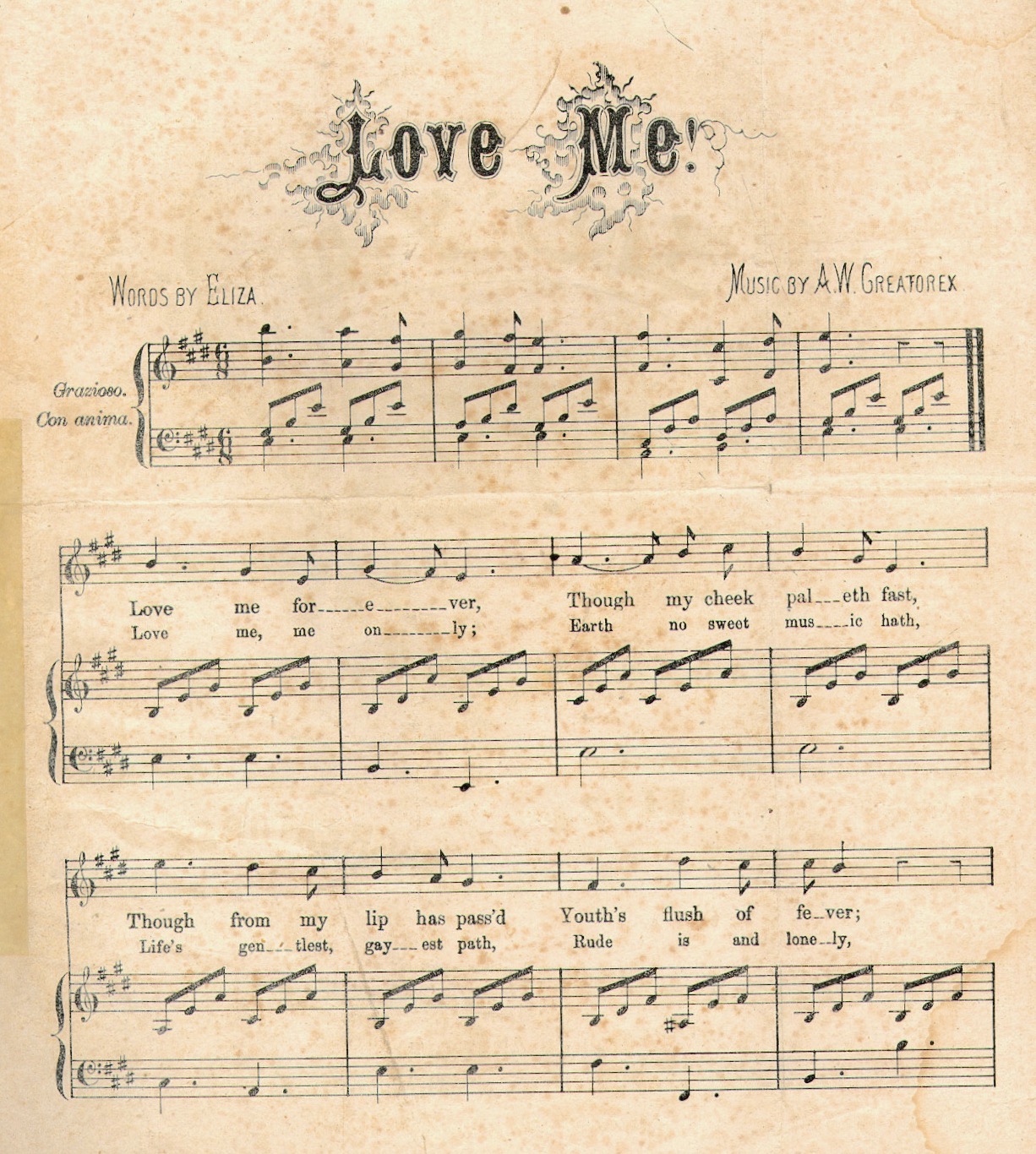
Listen: IMG_4307
East of Le Roy, between Rochester and Canandaigua is a reconstruction of Ganondagan, once a major political center for the Haudenosaunee (People of the Longhouse), where it is believed the Great Law of Peace was proclaimed in either the mid fifteenth or late twelfth century. The so-called Iroquois Constitution spelled out how the original five tribal nations would interact and cooperate, in order to preserve social stability and a sustainable economy. A sixth nation—the Tuscarora were brought into the confederacy in 1722. The oral document was encoded on symbolic beaded belts known as Wampum. It is said to have influenced the composition of the U.S. Constitution. The powers it gave to women did help spark the Women’s Movement of the mid-19th century and inspire the organizers of the 1848 Seneca Falls Convention. Western New York State by 1825 had been traversed by the Erie Canal. It produced a number of charismatic religious leaders, including Joseph Smith, the founder of Mormonism, and the creation of new Christian sects such as the Millerites, aka Seventh-Day Adventists and Jehovah’s Witnesses. Known as The Burned-over District for its religious fervor, it was also a hotbed of political progressivism. Out of the Second Great Awakening came notable figures such as Sojourner Truth, Brigham Young, and Frederick Douglass. Utopian communities were formed. Schools practiced racial integration. A seventy-two-year campaign for universal suffrage was launched, forty miles from Ganondagan.
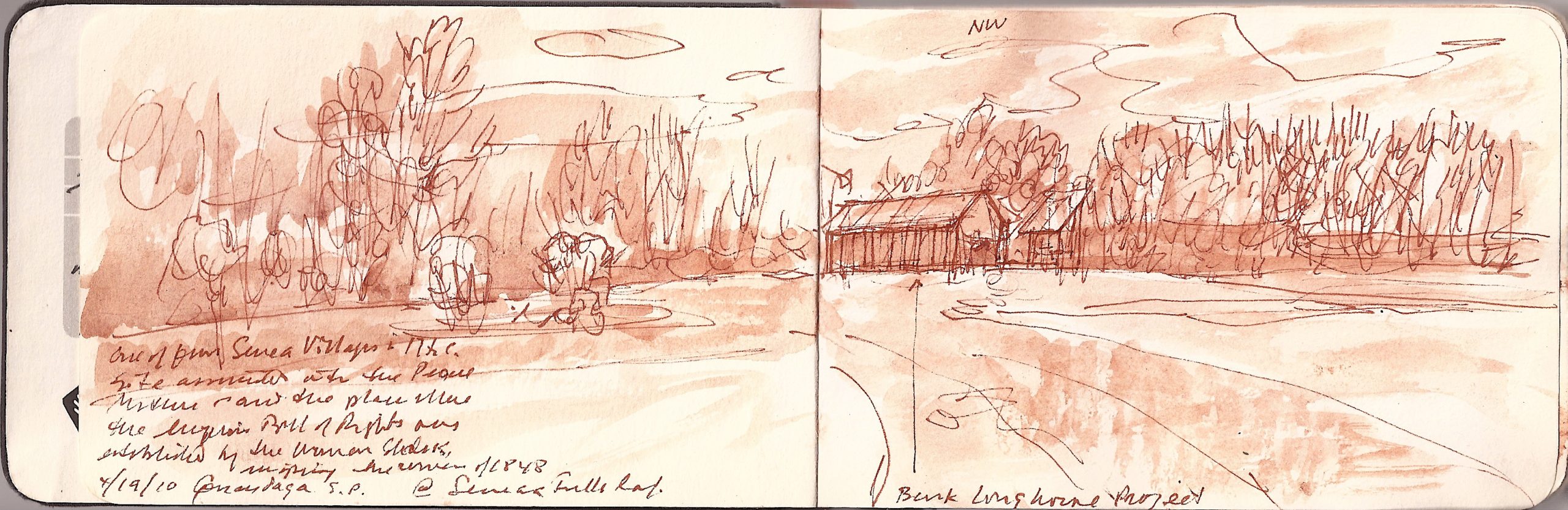
Reconstructed longhouse. Ganondagan State Park. April 19, 2010
We visited the site in 2009, when Governor David Patterson was threatening to close state parks as a cost-savings measure. The site supervisor and his wife were both members of the Seneca Nation. I asked what they would do it the state shut them down. On the 135th anniversary of rthe battloes of Lexington & Concord, I liked their reply.
“We’ll wait a day or two, cut off the padlock and raise the Seneca flag, take back the land.”
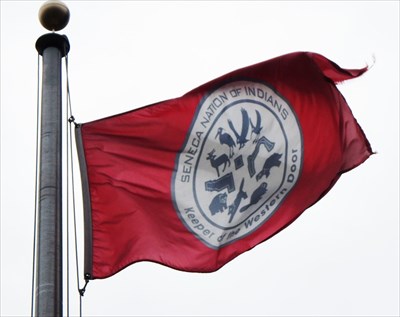
Flag of the Seneca Nation (Haudenosaunee Confederation)
After lunch we drove from Seneca Falls to Sheldrake Point, on the western shore of Lake Cayuga. Accommodations were not plentiful, but we found a comfortable roost at the Driftwood Inn, run by a woman named Tammy and her husband Jim. The great-grand-daughter of the couple who built the inn in 1912, Tammy was petite, fit and pretty—like an Olympic gymnast, with the efficient bearing of a sergeant-major. One of their sons worked at a nearby restaurant. Wrapping around the house was a veranda, with a sweeping north-facing view of the lake beyond. A small beach met the water at the far edge of the lawn. Road closures continued to be reported between Ithaca and Binghamton, as well as points further south. As we had been made to feel so welcome, and found our lodgings agreeable, we decided to stay another night.
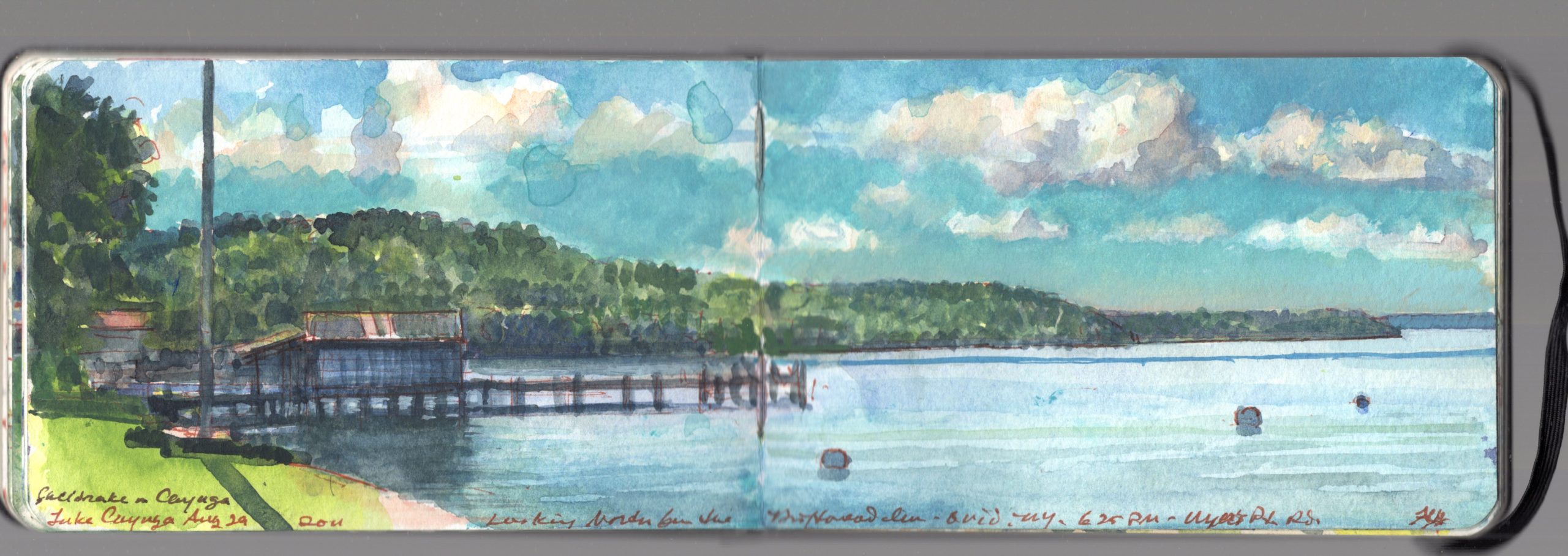
Lake Cayuga from Sheldrake Point. August 29, 2011.
The following day we determined to return to Manhattan by whatever route was open, regardless of how circuitous it might be. Following the lakeshore road (County Road 153) to Highway 89 we headed south toward Ithaca through pastoral countryside. Crossing Trumansburg Creek, we noticed a sign for Taughannock Falls. My maternal grandfather had gone to Cornell (Class of 1916). He always spoke fondly of his time there, and of the various gorges in and around Ithaca. A story he told about his college days involved a fraternity hazing ceremony demanding trust-fall. The new pledge would be led blindfolded to the edge of a gorge and told by his brothers to jump. The victim would be unaware that he had been turned to face the landward side of the path, and thus in no danger. On one occasion a mistrustful pledge went in the opposite direction, leaping to his death at the foot of a cliff. Reluctant to let facts stand in the way of a ripping yarn, my grandfather never verified the tale.

Like many well-groomed natural wonders, Taughannock Falls Overlook offers plenty of parking and masonry escalade leading down to the belvedere. The creek drops 215 feet into a rocky wooded glen, rimmed by Devonian limestone. The falls are twenty-five feet higher than Niagara. I was reminded of Kaaterskill Falls, which descends across the mouth of a cavern. Taughannock’s waters lick the cliff-face rising above the pool. As I stood drawing, a steady stream of visitors arrived. Snapping one or two shots of the falls, and perhaps a selfie or two, they climbed back up the steps to their cars. I calculated that most of the sightseers spent no more than thirty seconds, a minute at most beholding the scene.
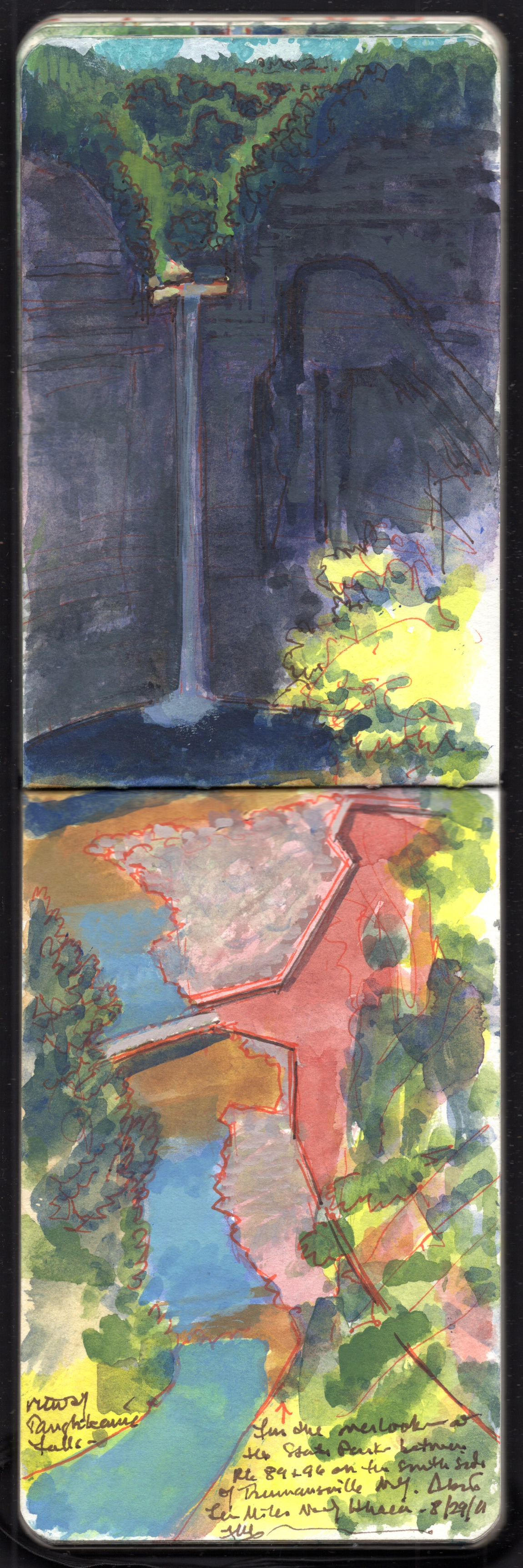
Taughannock Falls, Trumansburg New York. August 29, 2011
We could have weathered Irene in Manhattan but the storm had set us in motion. It had driven us to explore new places, and to discover things previously unknown to us. I could drive for days and be happy. Perhaps this wanderlust can be traced back to my New Bedford ancestors, hunting oil-rich Leviathans in the Pacific, or to Kathie’s seafaring Lusitanian roots. We Americans retain an immigrant gene—that restless impulse to get beyond the horizon, to risk it all on an uncertain future in unknown lands. Hearing third-generation nativists describe newcomers as invaders, I am tempted to chasten them furiously with my Mayflower pedigree. But that is nothing, compared to the dozens of millennia indigenous people had made homes in this land. Their names and words are written on modern maps; Taughannock, Cayuga, Oneida, Seneca, Oswego, Owasco, Otsego, Adirondack, Ticonderoga, Taconic and Manhattan. Over the years I have come to identify with all of these places as a guest. Material possessions beyond one’s knowledge are illusions, when we all must travel one day to an undiscovered country. The only way to own something is to honor it with our attention. The only way to encounter new things is to set oneself in motion. As Mark Twain wrote in The Innocents Abroad: The New Pilgrim’s Progress (1869)
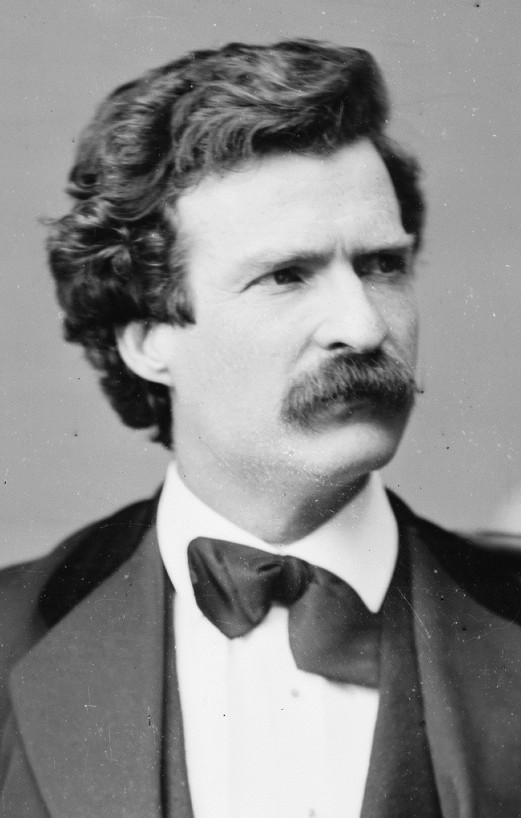
“Travel is fatal to prejudice, bigotry and narrow-mindedness”