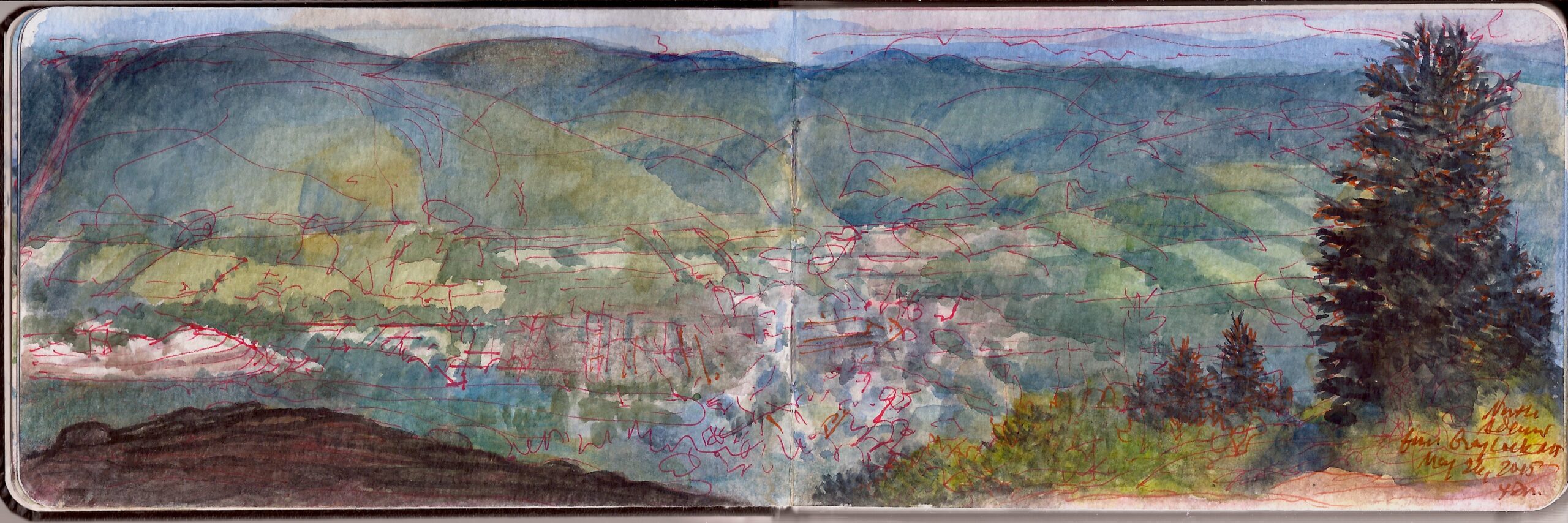
“But since the majestic mountain, Greylock—my own more immediate sovereign lord and king—hath now, for innumerable ages, been the one grand dedicatee of the earliest rays of all the Berkshire mornings, I know not how his Imperial Purple Majesty (royal-born: Porphyrogenitus) will receive the dedication of my own poor solitary ray.”
–Herman Melville. Pierre, or The Ambiguities. 1852
Looking up from his Pittsfield desk in the dead of winter, Melville beheld the snowy summit of Mount Greylock at a distance of twenty miles. To the writer’s imagination, the long mountain looming above rolling hills resembled the scarred back of a great white whale. Herman Melville (1819-1891) devoted an entire chapter of Moby Dick to the color white, which resonates today, as people of color become targets of bigotry. Having recently re-read Moby Dick, I had forgotten how much of it meanders through a pre-Joycean stream of consciousness; digressions ranging from whaleboat mechanics to a field-guide to hunting, killing, butchering and rendering the wild leviathan into spermaceti and ambergris. Pale illumination and seductive scents were fruits of bloody slaughter. Racially speaking, the whaleship Pequod was a world turned upside down. Seldom present, under the spell of a mysterious Mohammedan, the monomaniacal captain seemed mindful of his moral conundrum, yet incapable of conquering his addiction to the chase. Apart from Starbuck and Stubb, the stars of the ship’s company were the harpooneers. These were people of color; a Pacific Islander, an African, and a Gay Head Wampanoag. Ordinary Americans today may not imagine such diversity truly existed at that time. Yet a century or more before the novel is set, every seafaring tongue from around the globe was spoken on the waterfronts of New Bedford and Nantucket, where in 1716, the Quaker Meeting declared that slavery was “not agreeable to Truth.”
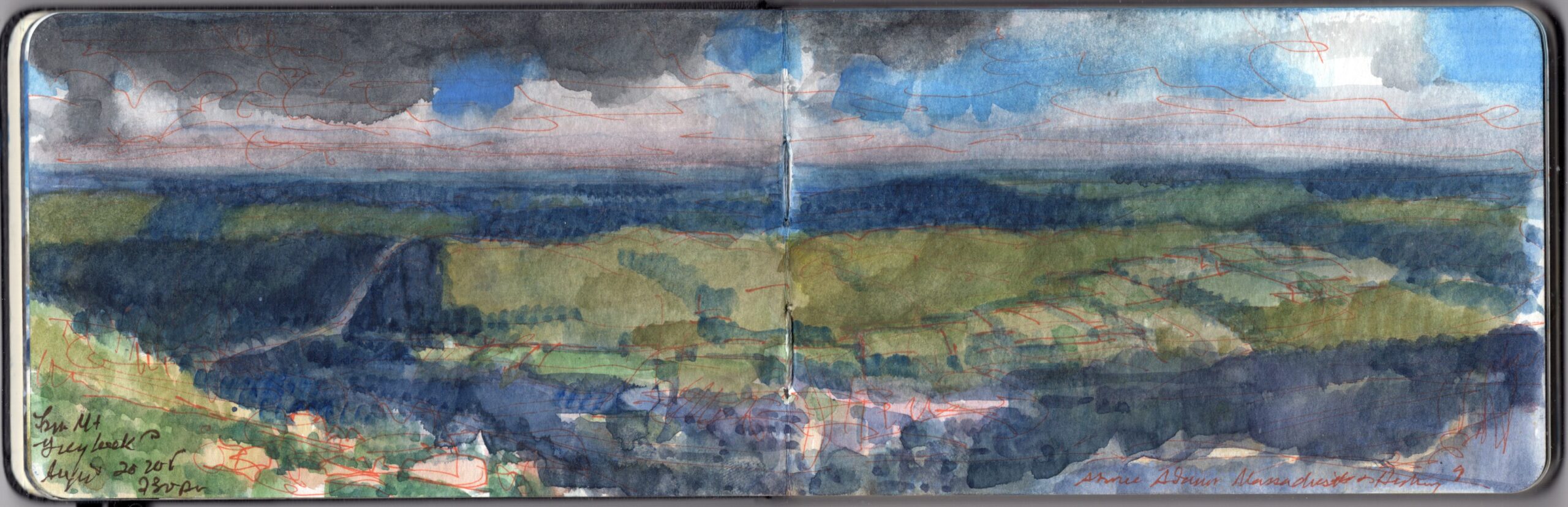
At 3,491 feet above sea-level, the summit of Mount Greylock is the highest point of elevation in Massachusetts. Traversing the Hoosic floodplain at the foot of its northern slopes, the Mohawk Trail was established as an overland east-west trading-route between the Connecticut River and the Hudson Valley. Its remoteness made for excellent hunting-grounds. Bloody clashes between competing native communities intensified with the arrival of Europeans. By the time Melville chronicled the pursuit of Leviathan, many Berkshire County forests had been cleared for farmland. Rivers harnessed for water-powered mills were straddled by towns populated by workers, merchants and service professionals. Logging, quarries and limekilns whittled away whatever wild tracts remained. Denuded of woodlands for lumber and paper-mills, Greylock suffered landslides and wildfires.

Concerned citizens purchased land for a park in 1885. Twelve years later Massachusetts set into motion a process that would protect the mountain within its first state forest preserve. Nathaniel Hawthorne hiked its slopes. The mountain became an object of pilgramge for literary lights of the day such as William Cullen Bryant. Henry David Thoreau spent a night on the mountain in the summer of 1844. When he awoke, a thick fog covered the summit.
“As the light increased I discovered around me an ocean of mist, which by chance reached up to exactly the base of the tower, and shut out every vestige of the earth, while I was left floating on this fragment of the wreck of the world, on my carved plank in cloudland; a situation which required no aid from the imagination to render it impressive.”
–Henry David Thoreau. A Week on the Concord and Merrimack Rivers. 1849
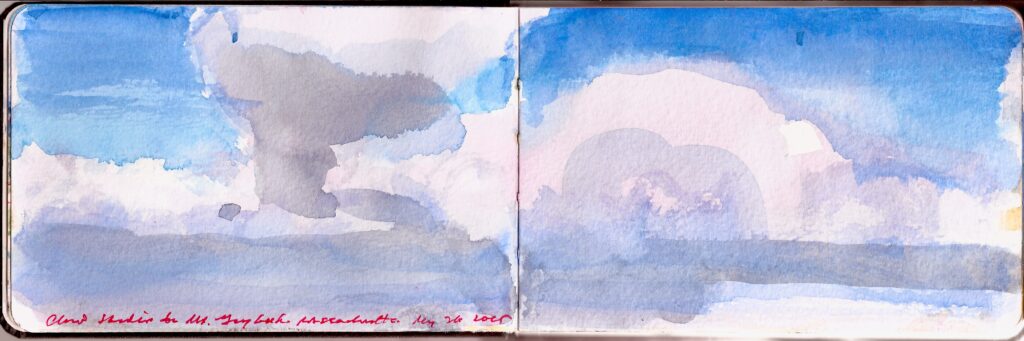
On one occasion I found the summit of Mount Greylock blanketed with cool, damp clouds. Gazing across the Hoosic Valley, I saw a bright pathc of light strike the distant ridge, and then another, and another. Moments later I was warmed by bright sunlight, as dark clouds scattered beneath a glorious blue sky.
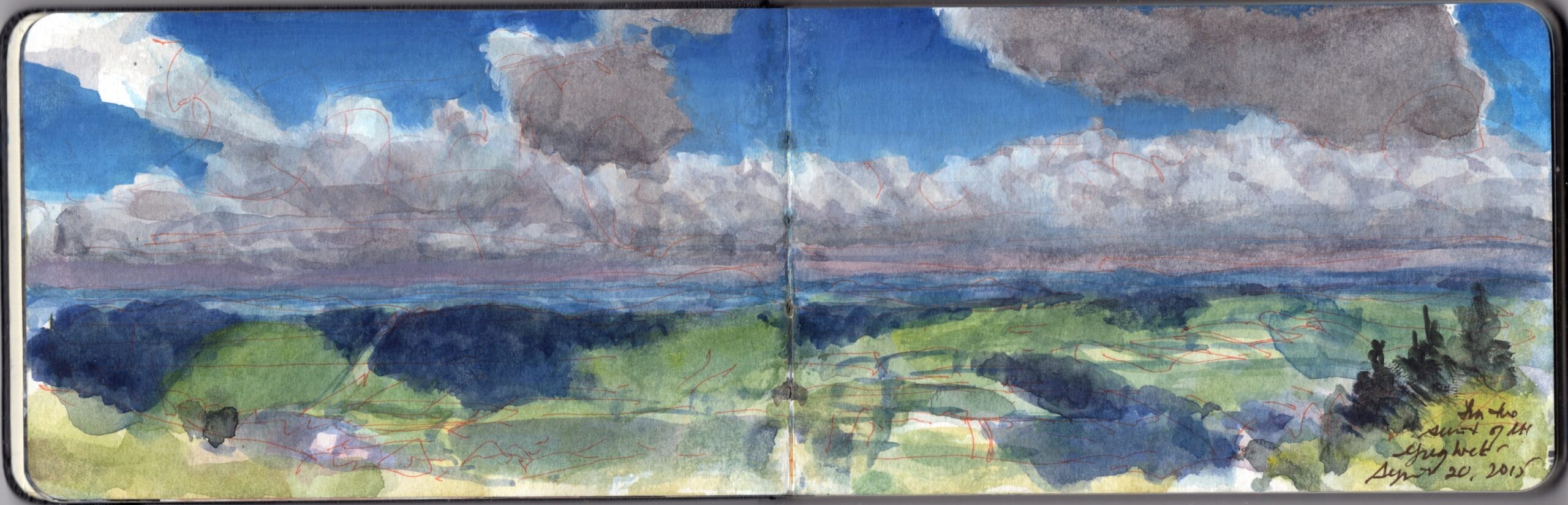
Large sheets of rock lie exposed at the summit. The bell-shaped Veterans Memorial Tower marks the highest point of elevation in Massachusetts. Its beacon marks the location at night. The northern end of the mountain faces Williamstown, North Adams, and the Mohawk Trail—Route 2, which runs between Troy, New York and Boston. Below to the east. the Hoosic River flows northward, entering the Hudson River near Stillwater. Mill-towns like Adams Massachusetts, the birthplace of women’s rights activist Susan B. Anthony; centers of light industry flourished during the nineteenth-century. A century later it had fallen into decline and economic hardship. Today the Hoosic Valley is enjoying a revival. Berkshire County has become a popular destination for weekenders from New York and Boston, as well as a magnet for cultural tourism, with numerous museums and performing arts centers.
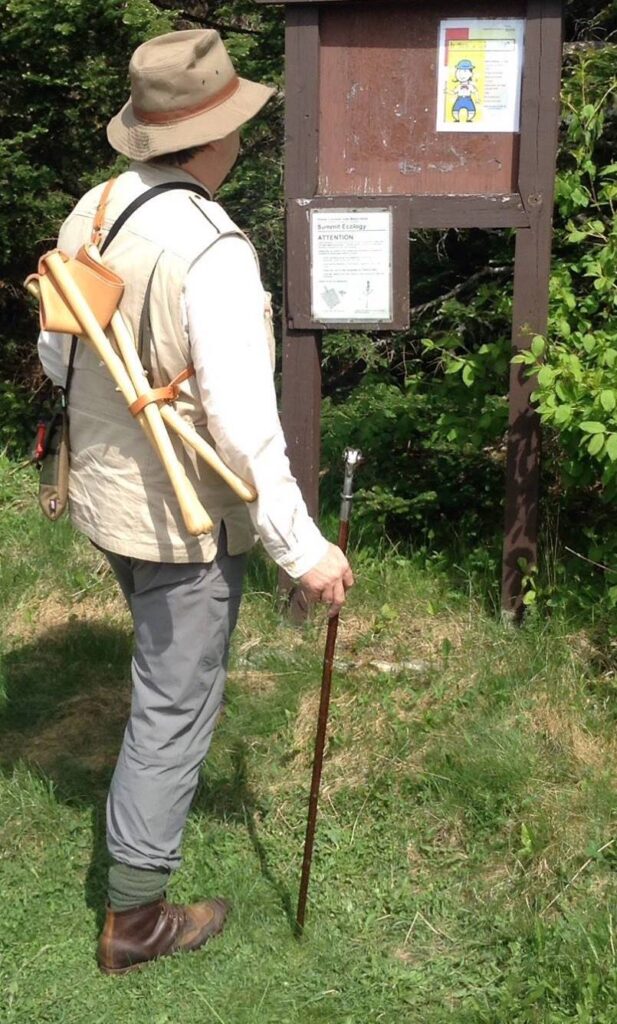
Below: James McElhinney at Mount Greylock.
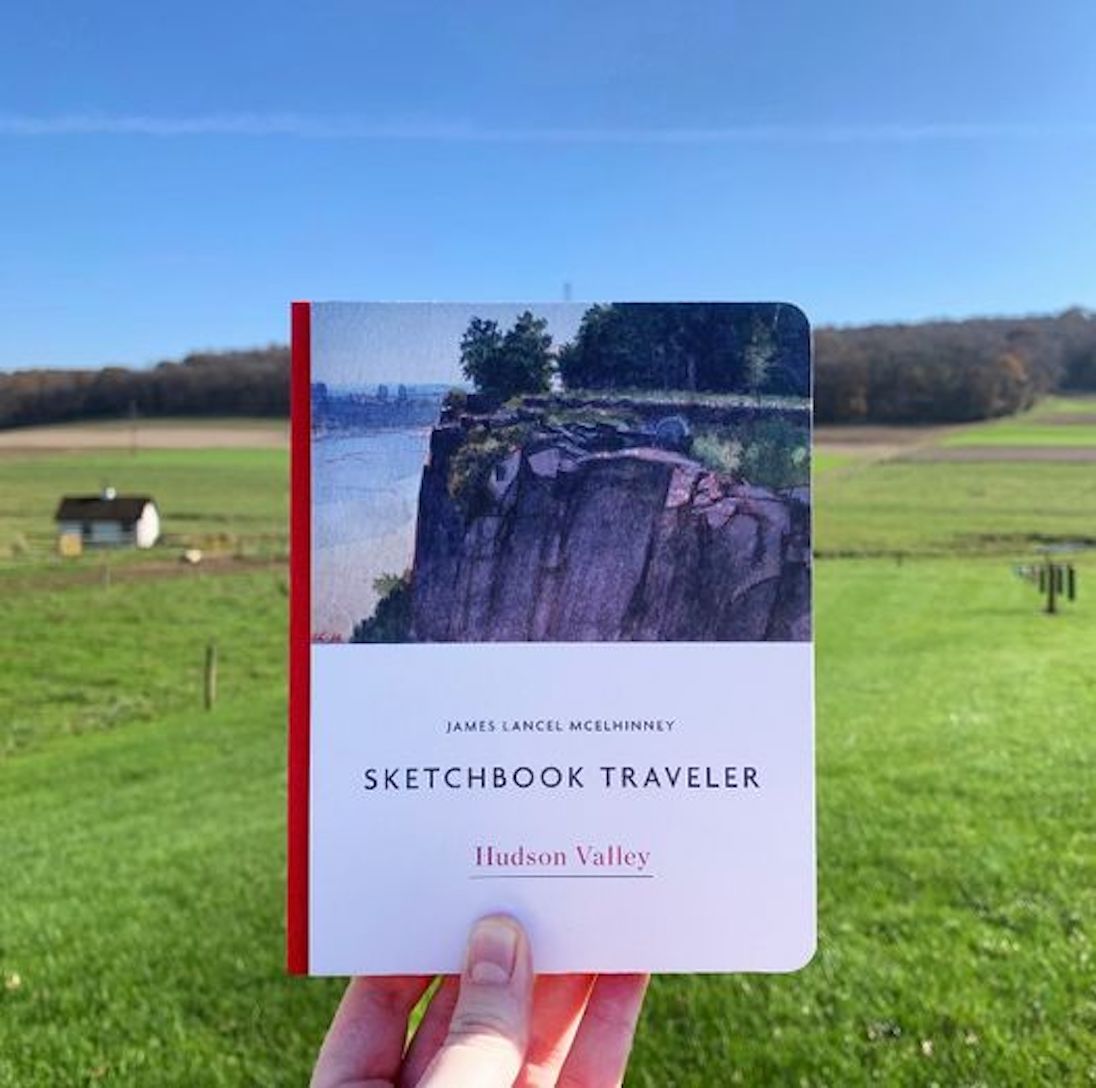
Now available to own: Sketchbook Traveler: Hudson Valley
Explore my Quaranteam Dispatches, from April 1-June 8, 2020