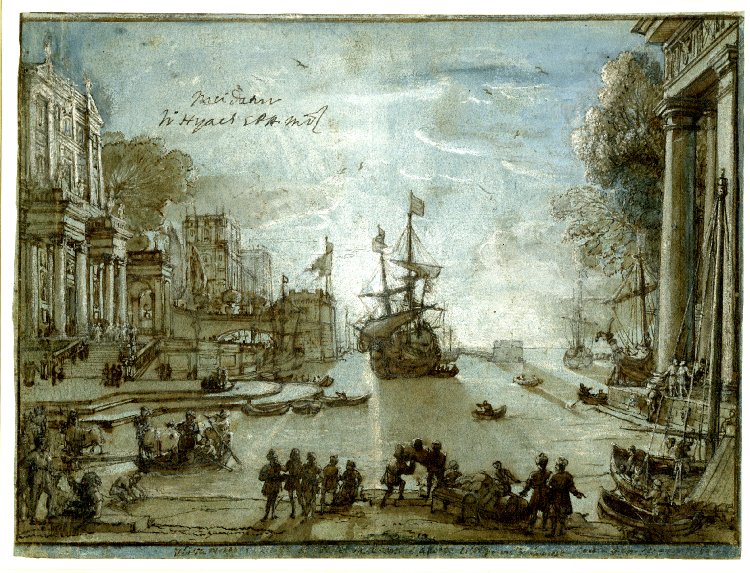
Page from Claude Lorrain’s Liber Veritatis. ca 1630-1682. Collection British Museum
Claude Gellée, dit “Le Lorrain” (1600 to 1682) lived and worked in Rome. Having once developed a successful practice, Claude began to keep records of his sales in pictorial form. This was done partly to establish some means of authentication, and to protect his reputation from forgeries and imitators. Referring to this project as Liber Veritatis, his “book of truth” functioned as a living catalogue-raisonné. Apart from drawings of completed paintings, the book included a complete list of Claude’s works detailing when they were made and to whom they were sold. Following his death in 1682, the book passed to his illegitimate daughter Agnese. When she passed away in 1716, Claude’s nephew took possession of it. Many of Claude’s customers were British. Sometime in the 1720s the book was acquired by William Cavendish, second Duke of Devonshire. It remained in the family until 1957, when the Liber Veritatis was received by the British government, as an in-kind payment in lieu of unpaid taxes. It now resides in the British Museum.
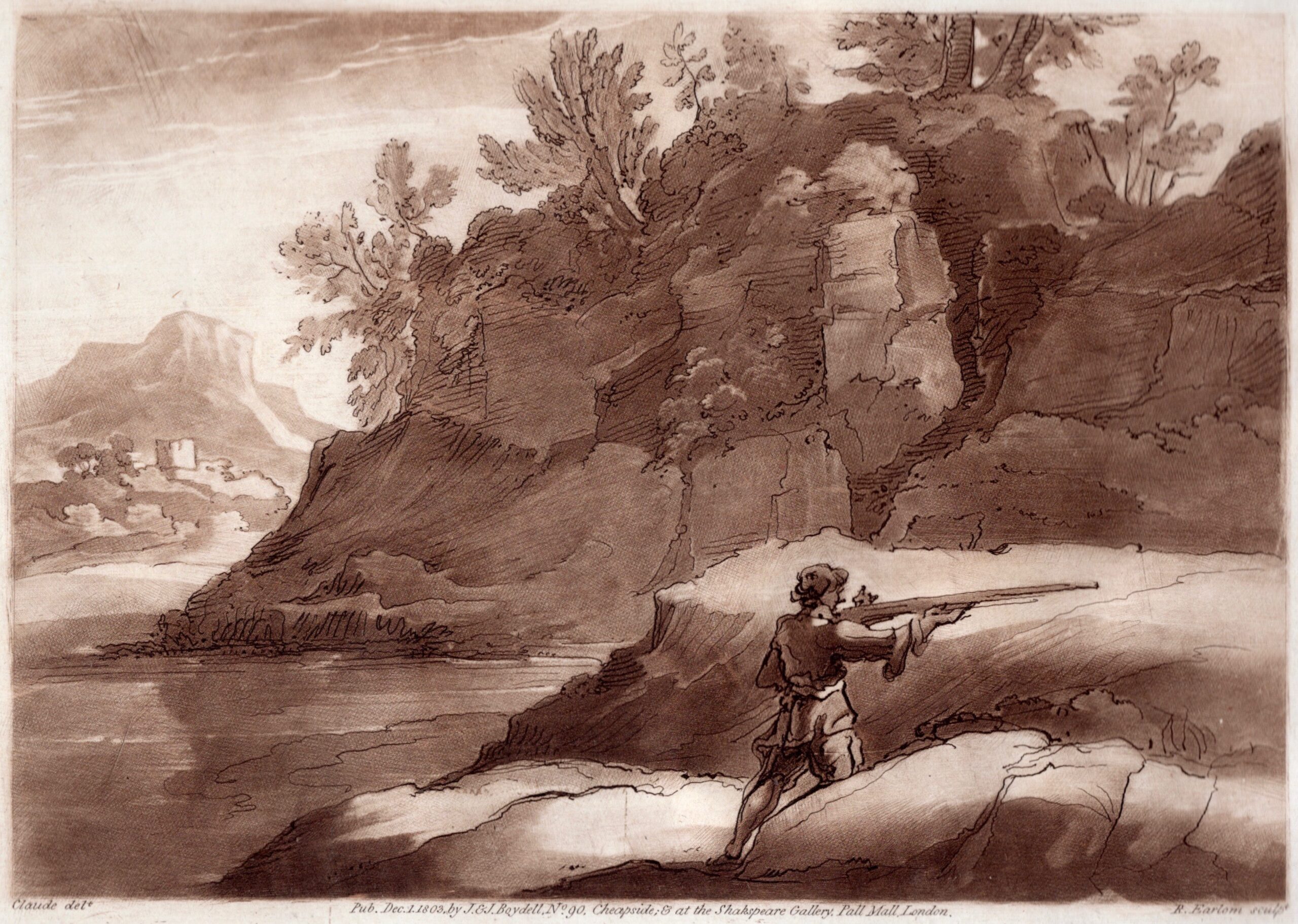
Plate from Claude Lorrain’s Liber Veritatis. Engraved by Richard Earlon. Publishing by John Boydell. Published December 1, 1803. Private Collection
Readers today may be unaware that public art museums as we know them today did not exist in the eighteenth century. The only way for artists and art-lovers to gain access to masterworks would be to find them in churches or government buildings, or to gain access to the private homes of wealthy elites. Claude’s work had a profound effect on younger British artists like Richard Wilson (1714-1782), who had been lucky enough to encounter Claude’s paintings abroad, and in the private collections of aristocratic patrons. Like his contemporary Claude-Joseph Vernet (1714-1789),
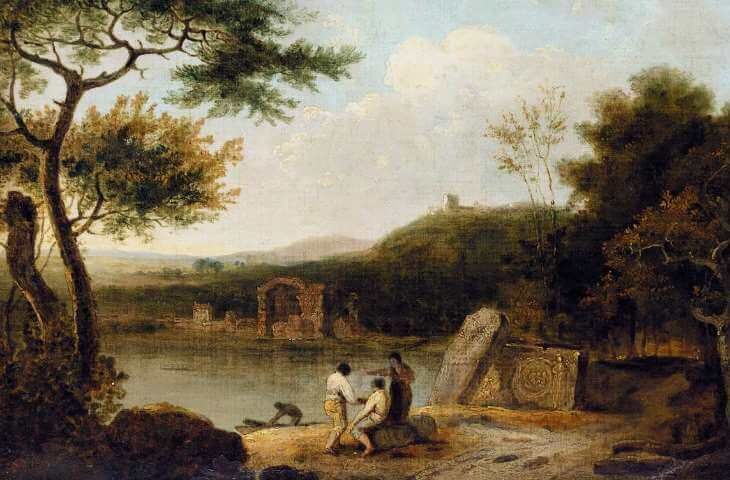
Richard Wilson. Lake Avernus. On on Canvas. 1765
Wilson absorbed Claudian concepts while studying landscape-painting in Italy, where they found patrons among privileged travelers embarked on The Grand Tour. By the mid-eighteenth century, scenic vistas of faraway places were much in demand, as were paintings of the parks and great houses owned by wealth patrons. Print publishing made it possible to purchase works of art at affordable prices. A growing middle-class clamored for scenic engravings. Following the cessation of hostilities during the French and Indian War (1754-1763), British military officers Captain Hervey Smyth, Elias Durnford, Lieutenant Archibald Campbell and Massachusetts Royal Governor Thomas Pownall (1722-1805) traveled through the British possessions of North America, from Canada to the Caribbean, sketching picturesque views “on the spot” that were elaborated by professional artists like Paul Sandby (1731-1809), engraved by William Eliot, Paul Benazech and others, and published to great acclaim in 1768 by John Bowles and a consortium of printing-industry entrepreneurs.
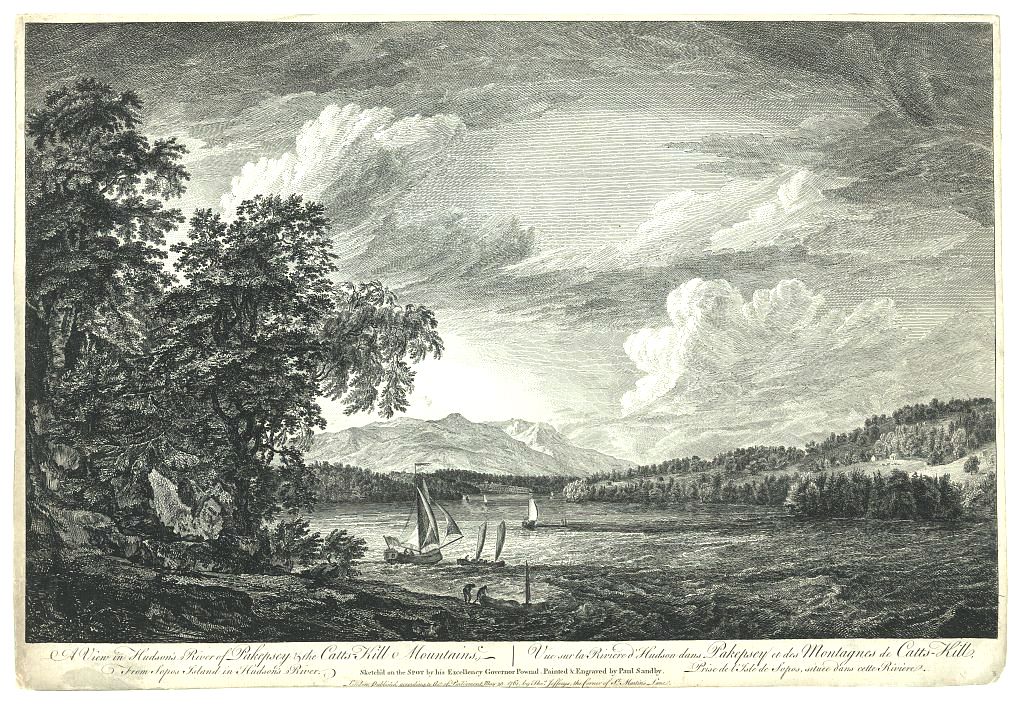
A view in Hudson’s River of Pakepsey & the Catts-Kill Mountains, from Sopos Island in Hudson’s River Vue sur la Riviere d’Hudson dans Pakepsey et des Montagnes de Catts-Kill, prise de l’Isle de Sopos, situee dans cette riviere. sketch’d on the spot by his excellency, Governor Pownal; painted & engraved by Paul Sandby. 1761
Scenographia Americana was nothing less than a flag-waving celebration of Britain’s triumph over the French, declaring the insular kingdom’s new status as an imperial power. In the wake of its success, with a boom in art-publishing underway, the young fifth Duke of Devonshire (1748-1811) allowed the drawings from Claude Lorrain’s Liber Veritatis to be engraved by Richard Earlom and published in serial form by John Boydell. When Earlom’s prints first appeared on the market in 1774, their effect was to electrify and reinvigorate the practice of landscape painting. The task of reproducing Claude’s Book of Truth was completed by 1778. Over the decades that followed, a number of new editions were released, exerting a considerable influence on the practice of landscape-painting that only waned with the advent of photography and the rise of Impressionism.
From a modernist perspective, one might argue that Claude’s Liber Veritatis first proposed the notion that pictorial design was as much the subject of any painting as whatever else it portrayed. The early works of Kandinsky and Mondrian demonstrate how the genesis of abstract art is rooted in the landscape tradition.
Were we to consider the possibility that Scenographia Americana and the topographical tradition helped Claude make a comeback, we would broaden the narrative to include explorers, naturalists, military topographers and printmakers, standing shoulder-to-shoulder with poetic visionaries.
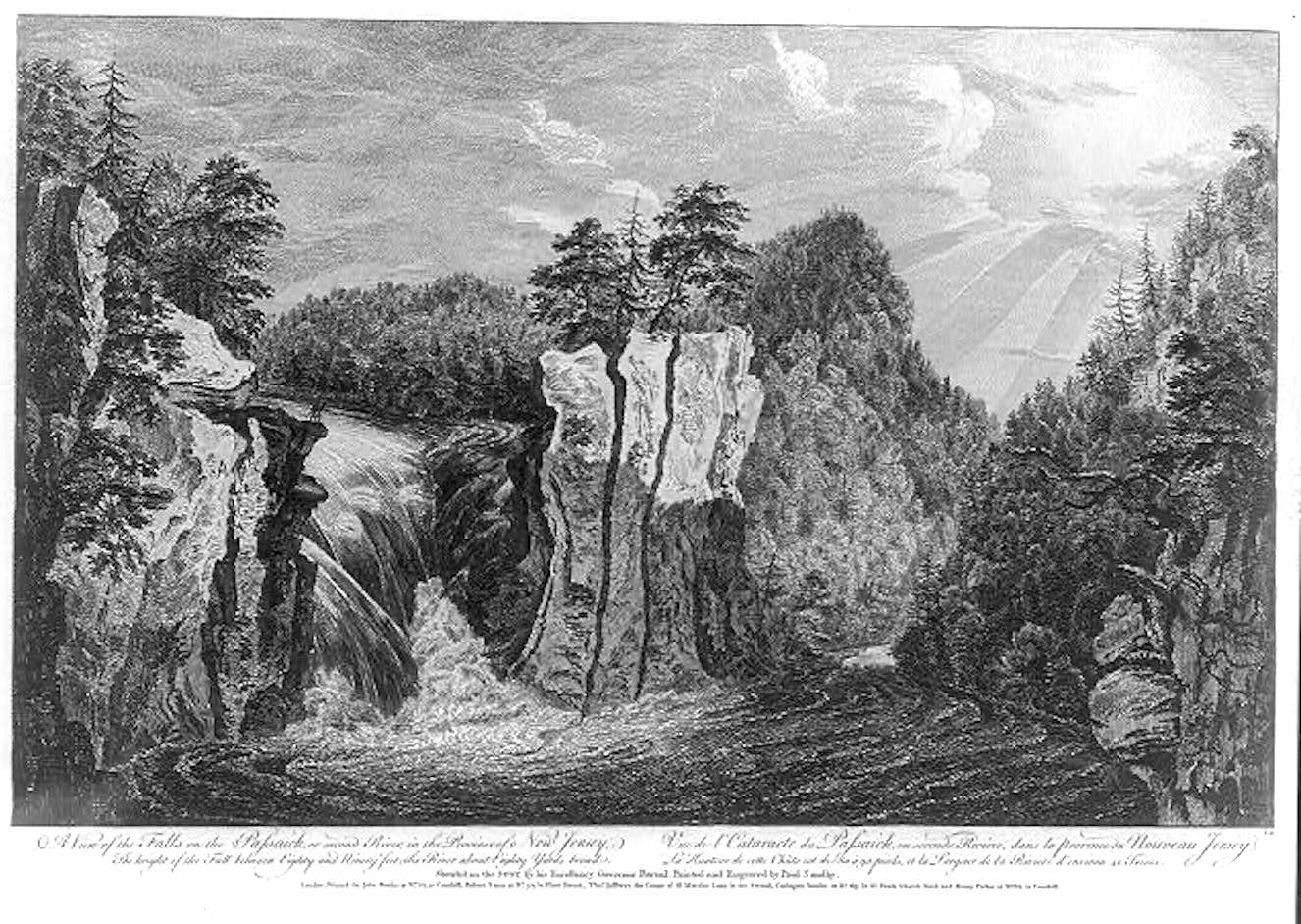
A view of the falls on the Passaick, or second river, in the province of New Jersey Vue de l’cataracte du Passaick, ou seconde riviere, dans la province du Nouveau Jersey / / sketch’d on the spot by his excellency, Governor Pownal ; painted & engraved by Paul Sandby. The height of the fall between eighty and ninety feet; the river about eighty yards broad = La hauteur de cette chŭte est de 80 à 90 pieds, et la largeur de la riviere d’environ 40 toises.1761
Now available to own: Sketchbook Traveler: Hudson Valley
Explore my Quaranteam Dispatches, from April 1-June 8, 2020