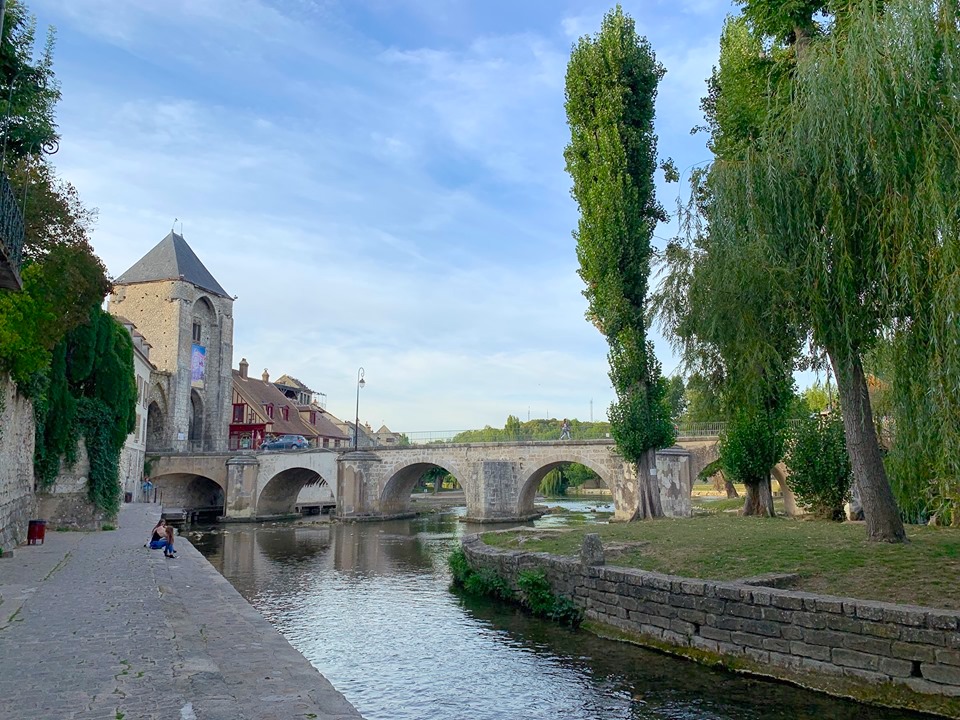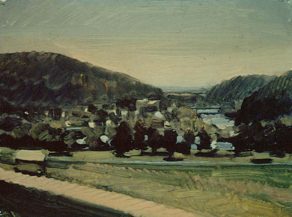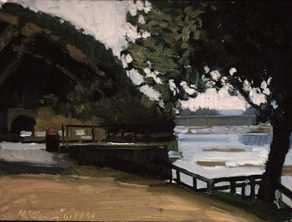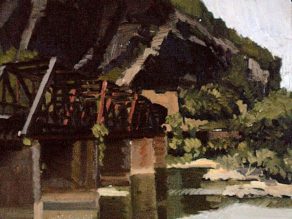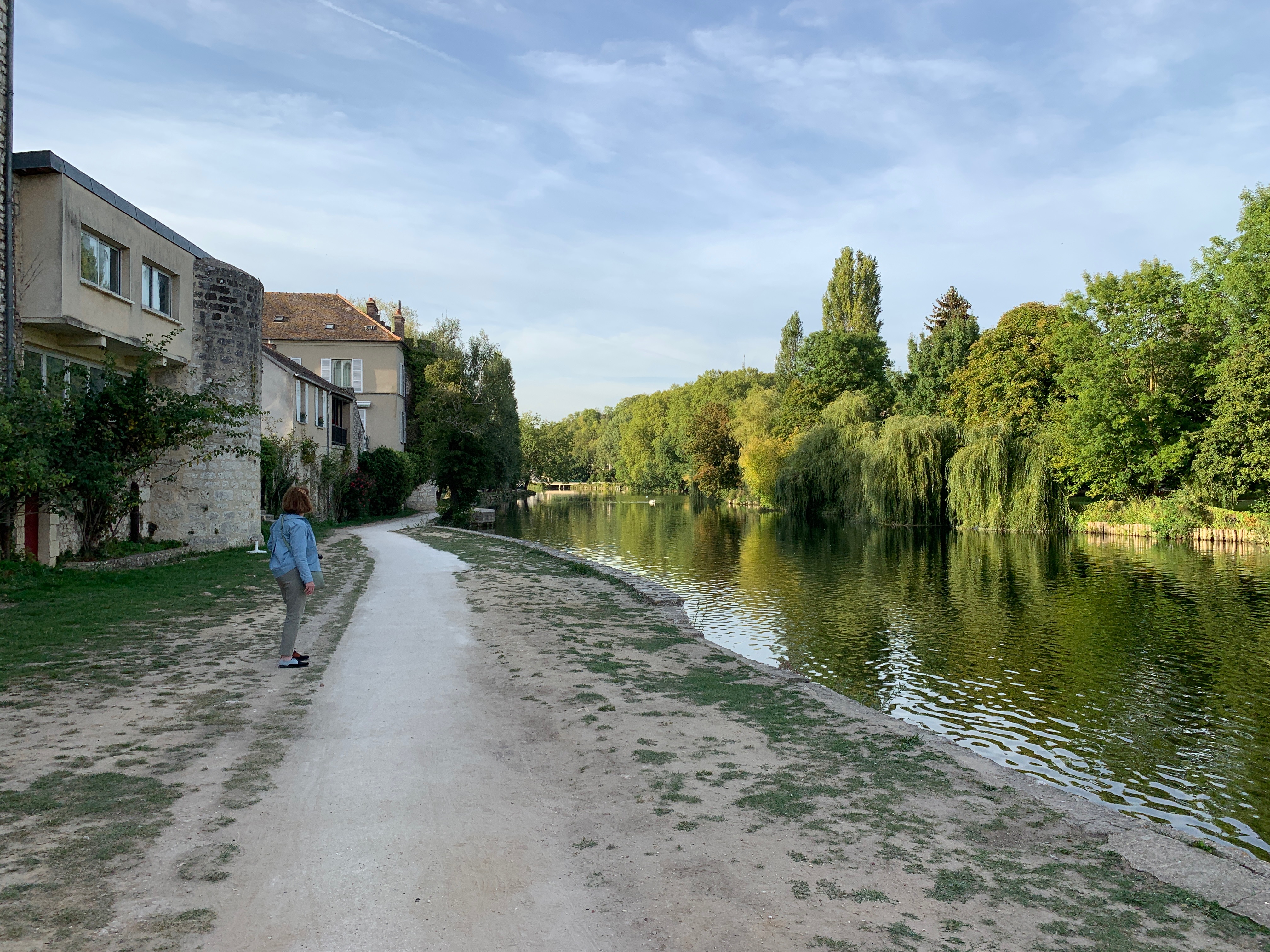
Kathie Manthorne on the esplanade along the left bank of the Loing River, bordered by fragments of medieval defensive fortifications. September 16, 2019.
Eliza Pratt Greatorex (1819-1897) was a remarkable individual, celebrated during her lifetime as “the first artist of her sex”. Shortly after her death in Paris, a Chicago newspaper named her among the greatest women in American history. The story was published in syndication around the United States. Today she is all but forgotten. That is about to change.
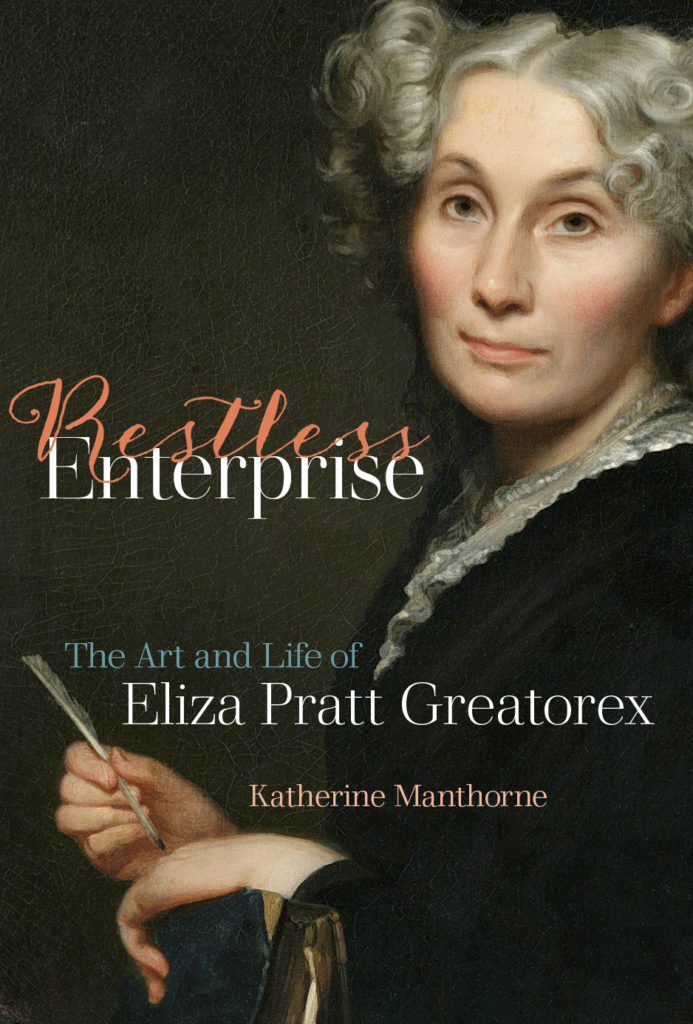
The following text describes our trip to Moret-sur-Loing, from September 16 to 18, 2019, to locate the final residence of Eliza Pratt Greatorex and her daughters. Kathie’s forthcoming biography Restless Enterprise: The Life and Art of Eliza Pratt Greatorex, from University of California Press, reveals that Greatorex seemed addicted to travel, always on the go, moving from place to place. It was no secret that Eliza hated writing letters, which forced her biographer to excavate her life from public sources like newspaper articles and papers of those who knew her. We found the graves of her father and sister at Green-Wood Cemetery in Brooklyn. None bear headstones. The same is true of the rural cemetery outside of Pettigoe in Donegal, where graves in her family-plot are marked only by lumps and depressions in the soggy turf. Elusive to the end, she passed away at her apartment in Paris in Feburary of 1897. Eliza’s coffin was removed to the train station, where it mysteriously disappeared. Our only clues to the location of her home in Moret were sketchy descriptions of the property found in a few letters and the mailing-address “Ramparts”, which promised no help in a town encircled by medieval walls. Tracking her down in just two days seemed like a long shot.

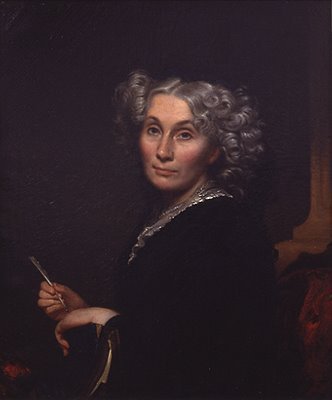
Eliza Pratt Greatorex (1819-1897) by Thomas Boyle. 1869
Collection National Academy of Design, New York.
(Reproduced under fair use, etc.)
Backstory. Born into a large family, the daughter of a Methodist circuit preacher in the north of Ireland, Eliza Pratt demonstrated a talent for drawing at an early age. During the great famine, her brother Adam emigrated to New York State. Opening a dry-goods store in the town of Leroy, known today at the birthplace of Jell-O, Adam thrived. Family members followed. Traveling in steerage from Liverpool, Eliza Pratt landed in Manhattan, where she was welcomed by the city’s Irish elites. She later met and married Henry Greatorex, s a popular composer of church music and soon of the organist at Westminster Abbey. While on tour in Charleston, South Carolina, Henry Greatorex succumbed to Yellow Fever. Eliza was suddenly a widow, with four young children to raise. Drawing support from her brother Adam Pratt, and sister Matilda Despard, Greatorex traveled to France, studied with Barbizon painter Émile Lambinet, returned to New York, where she began to exhibit her work. Garnering some acclaim, she became the second woman elected to the National Academy of Design. Displaying both musical and artistic talent, when her children reached adulthood she brought them into her restless enterprise of art-making and print-publishing, which required her to travel to Europe, North Africa and the American West. Developing close relationships with leading feminists, her female friends included Susan B. Anthony, Mary Louise Booth, Charlotte Cushman, Grace Greenwood and Helen Hunt Jackson. Later in life, as her health began to fail she and her daughters left New York, moving to the small medieval town of Moret-sur-Loing, where all three ended their days.
Kathie Manthorne began researching Greatorex decades ago, picking up the thread now and then between other books and projects. The process was vexing in part because Eliza left no paper trail in her wake. No collection of papers, no letters, fewer documents and a handful of dog-eared photographs. Her life had to be reconstructed by mining the public record—chiefly newspaper articles reporting her comings and goings. Kathie and I have retraced Eliza’s peripatetic existence from Manorhamilton, County Leitrim, where she was born—to Pettigoe, County Donegal, where she was raised. We tried to identify her various domiciles in Manhattan, Hoboken, Jersey City, Bay Ridge, Leroy, and Cragsmoor. Following her progress to Milwaukee, Denver, Manitou Springs and Fairplay, Colorado, in Oberammergau and Munich we found a few traces of Eliza. Apart from Tangier, only one place remained for us to investigate—her final residence at Moret-sur-Loing.
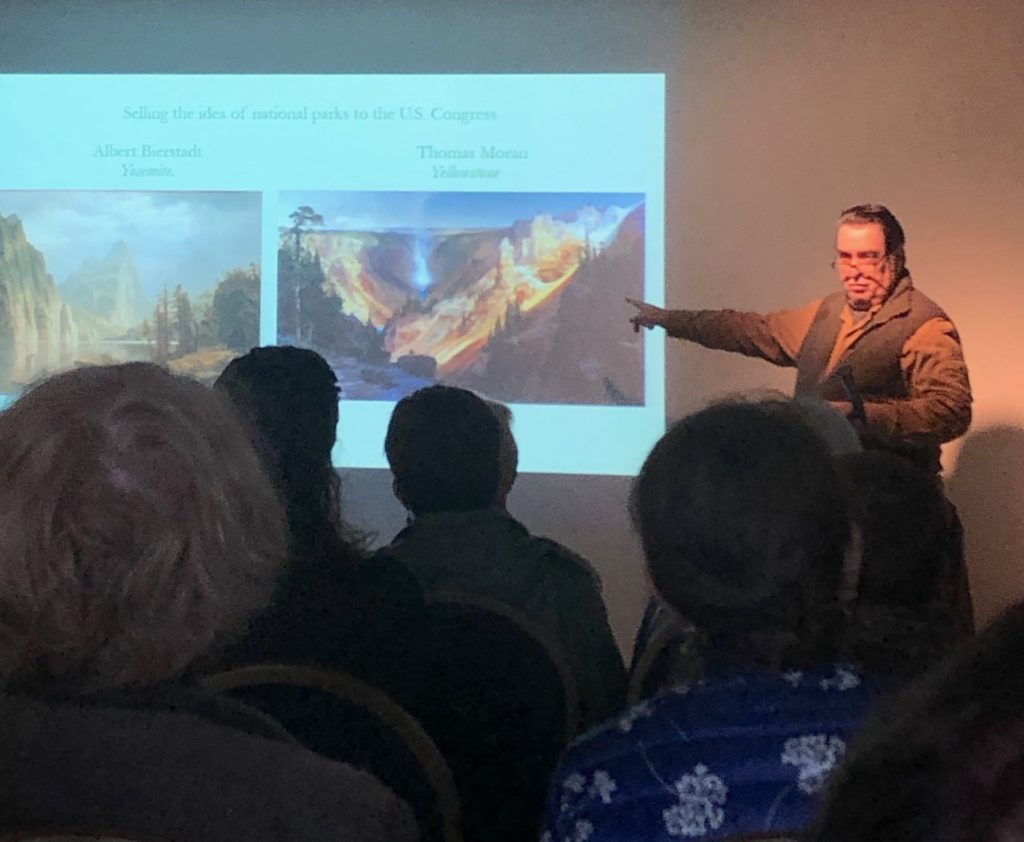
Last year Kathie completed the first biography of Greatorex, using Eliza’s life as a kind of prism through which to illuminate the lives of other American art-women at work in an age of promise. University of California will publish the book later this year. Pompidou Center and the Musee d’Orsay jointly organized a conference in October 2019, focused on artistic training for women in nineteenth century Paris. Kathie was invited to deliver a paper on Greatorex and her daughters at the Faire/Oeuvre symposium, hosted by the Centre George Pompidou and Musee d’Orsay.
We decided to arrive a few days in advance of the conference. Landing at Aerogare Charles de Gaulle in Roissy on Monday September 16, we were delivered to Moret by Michaal, a driver hired by our hotel. Beyond Melun we entered Fontainebleau Forest—the vast tract preserved today as a national park. I was struck by the condition of the understory—a tangle of brambles and ferns that reminded me in a way of the loving neglect I had observed in German woods, even in official parks like Berlin’s Tiergarten. Theodore Rousseau and other Barbizon school painters had raised public awareness to the threat of new development, nibbling at the margins of Fontainebleau Forest. In 1863, public outcry and Rousseau’s ceaseless harangue led Napoleon III to declare the forest a national park—the first in the world
Driving past a very plump, forty-something woman in yoga-pants setting up a lawn-chair, parasol and cooler along the shoulder of the road, Michaal explained that she was a sex worker. Men pull over, she gets in their car, does her business. Clients then drive away. Les flics lie in wait to pull them over, handing out hefty fines for public lewdness. It’s a racket, Michaal explained. The whore pays off the cops, who fine her clients. I told him about going to a pub in Ramelton with my cousins in Donegal. Parking a quarter mile away, we walked along dark streets to the town center. At closing time, we all stumbled out of the pub into the Bahamian sunshine of Garda headlights. I turned to my cousin ansd said, “So, that’s why you parked at the far end of town.” He just smiled and replied, “Let’s go get some chips”
Driving past the entrance to the Chateau de Fontainebleau, through another stretch of woods to Veneux-les-Sablons, the outskirts of Moret. after ninety minutes on the road we arrived at Hostellerie du Cheval-Noir in Moret, a charming nineteenth century structure on the northwest corner of the Place de Samois. Across the street to the east stands a monument, honoring the town’s most famous resident—the Impressionist painter Alfred Sisley. Our hotel is run by a married couple whom we later discovered are avid aeronauts, who met through ballooning.
We were greeted by Anne Bourdeau, who checked us in, then led us up the winding stair to select a room. Kathie had booked the Sisley room, decorated with copies of the master’s work by a local artist. For a few Euros more, Anne told us, we could have the larger Monet room.
We took it. Both had decks facing north, with en-suite bathrooms. Dragging our bags up the wooden staircase, we closed the curtains and collapsed for an hour.
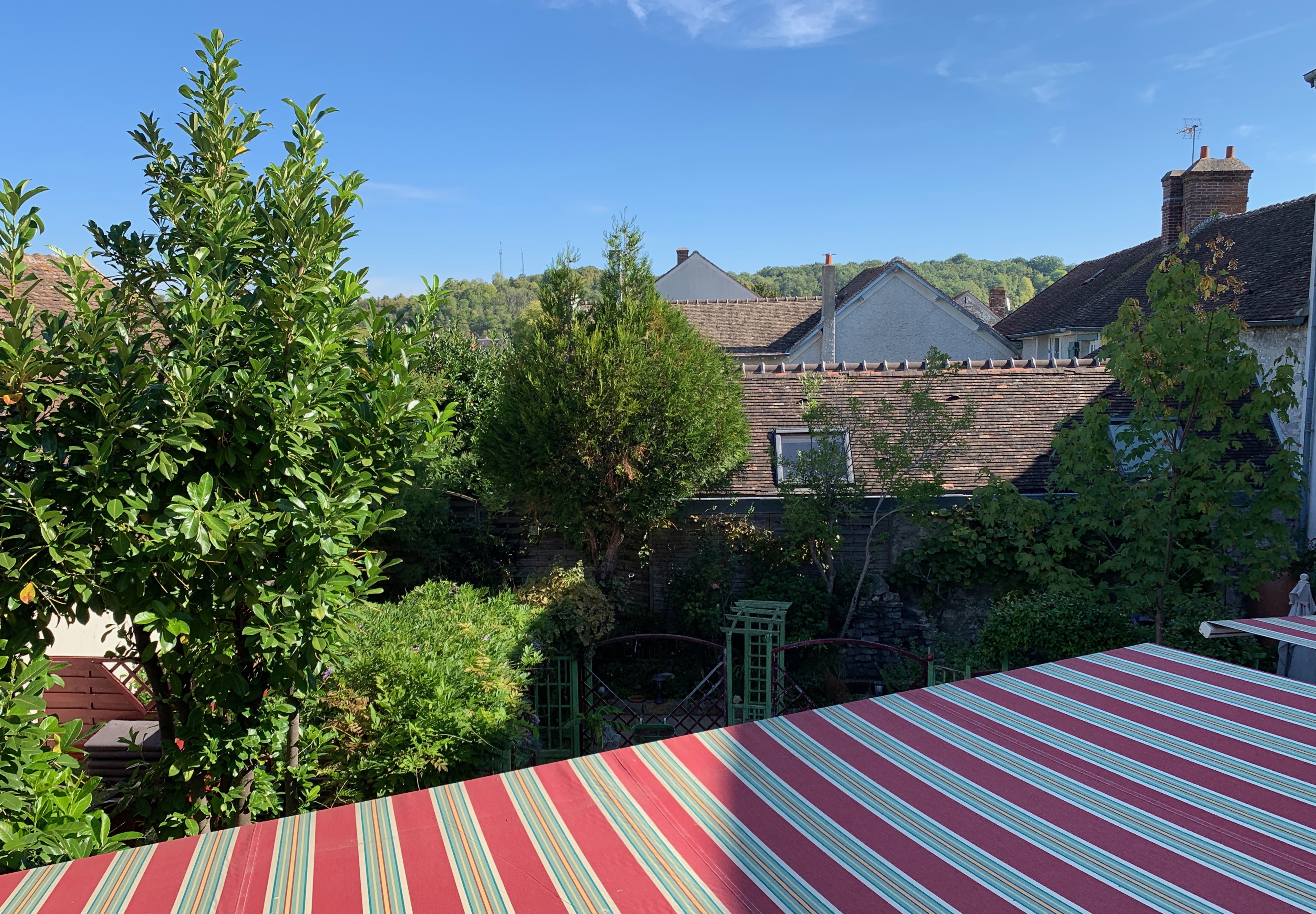
The view from our deck off Chambre Monet, at Hostellerie du Cheval Noir, Moret-sur-Loing
Opening onto the roof-deck, the large window welcomed a cool breeze into our room. Waking from our nap just around eleven in the morning, we gathered our wits, debouched from a side-door at the hotel, to enter Place de Samois—a modest square consisting of wooded car-park to the south, and a medieval tower to the east, pierced by an arch through which passed Rue Grande—the only straight road in the town.
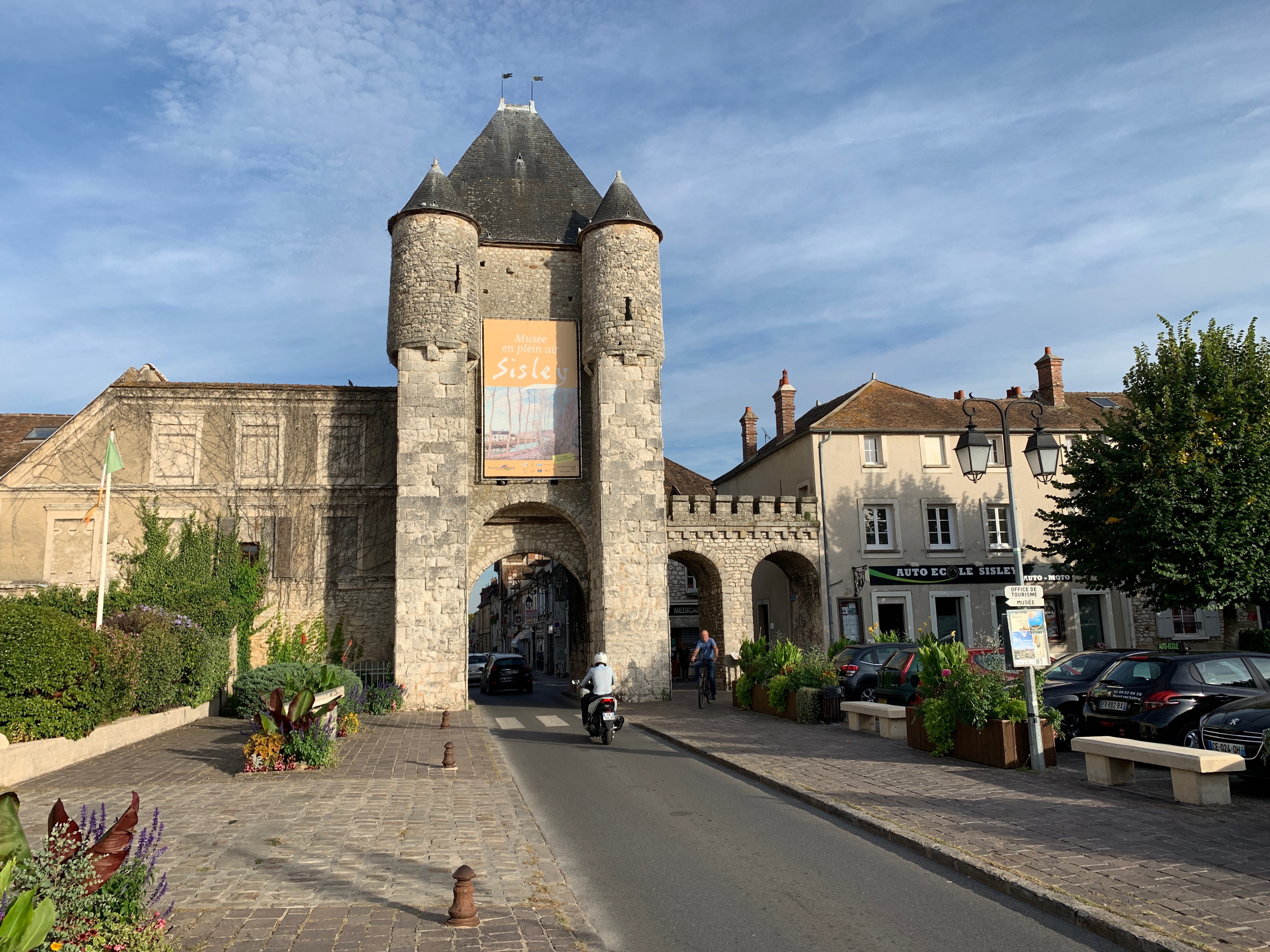
Port de Samois, Place de Samois. Moret-sur-Loing. Ile de France
We had come to Moret, stalking Eliza, hoping to locate her final abode. With few clues to follow, our prospects seemed grim. A letter written in 1909, by an American woman to her sister, recounts calling on Eliza’s daughter Kathleen Honora, with a brief description of the property. The other clues were a few brief comments by Kathleen’s sister Eleanor, who had died in 1908. Surviving letters from the Greatorex sisters bear the return address of “Ramparts”. As we soon would discover, most of the old town is enclosed by twelfth-century walls, punctuated at regular intervals by cylindrical towers. With less than two days to solve the mystery, we commenced our search at the nearest café.
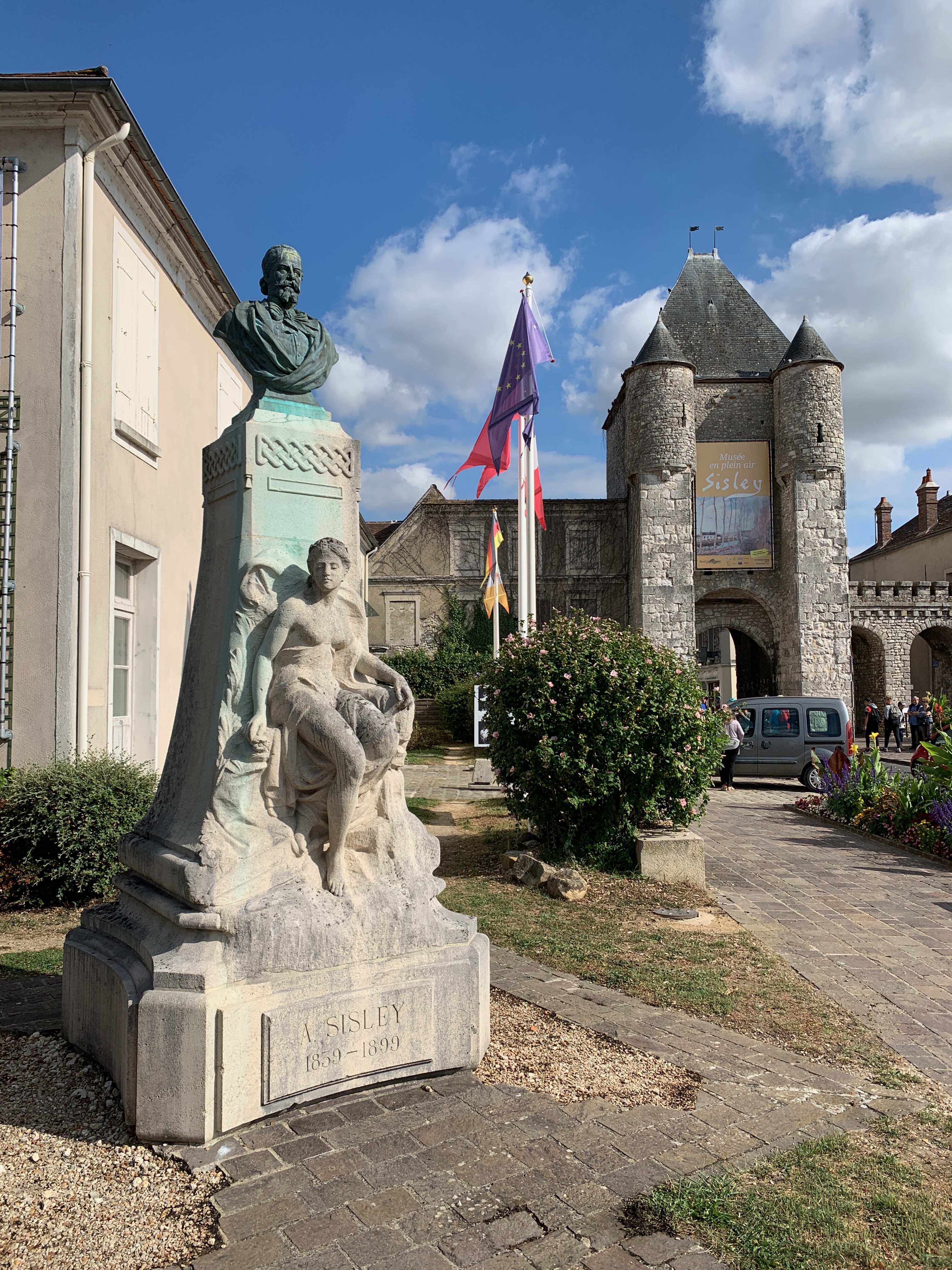
Monument to Alfred Sisley, Place de Samois. Moret sur Loing
Being Monday in France, many shops and most of the restaurants were closed. Approaching noon, those that happened to be open were about to close. We stopped at Le P’tit Moret, a creperie on Rue des Granges. The door was open. Music was playing. Chairs were set out on a deck across the narrow street. Calling out to see if the place were open, a young man emerged from the kitchen, telling us they would not be serving until noon. Wandering eastward, we drifted into Place de l’Hotel de Ville—a wide, open square with a gentle incline rising to the south, paved with broad flagstones. The city hall resembled a large stone house, next to which stood a timbered building with a glazed storefront, the headquarters of Les Amis de Sisley, a local society dedicated to promoting the legacy of the Impressionist painter who had lived and died a few blocks away. Along Rue Grande, we noticed people sitting at a cluster of umbrella-tables consuming what appeared to be food. Beside them rose a monument to the Great War; a sandstone private standing at parade rest, honoring the battle-dead of Moret.
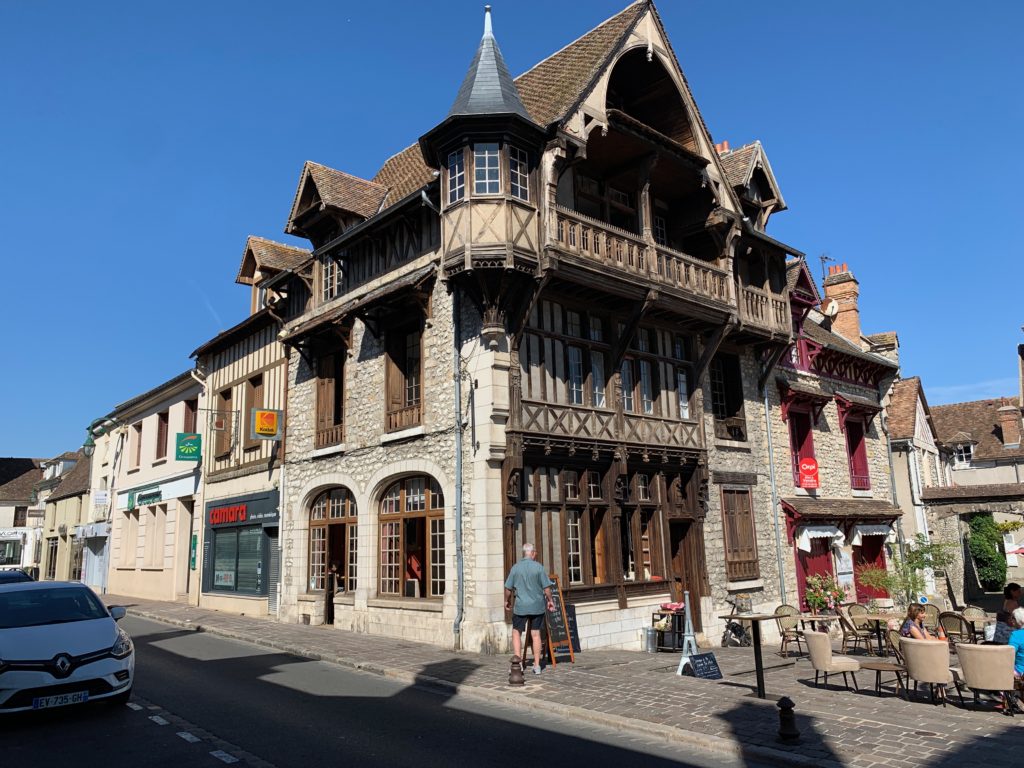
La Maison des Arts, Place de l’Hotel de Ville, Moret sur Loing-et-Orvanne
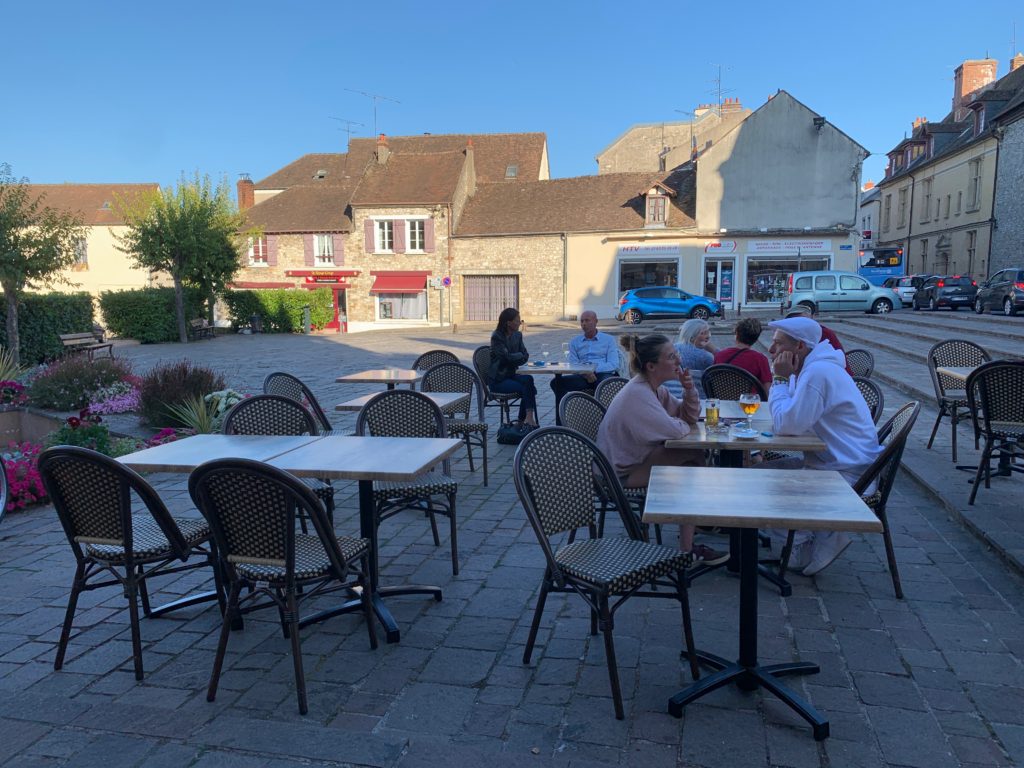
Place de l’Hotel de Ville, Moret. Exterior seating for La Maison des Arts
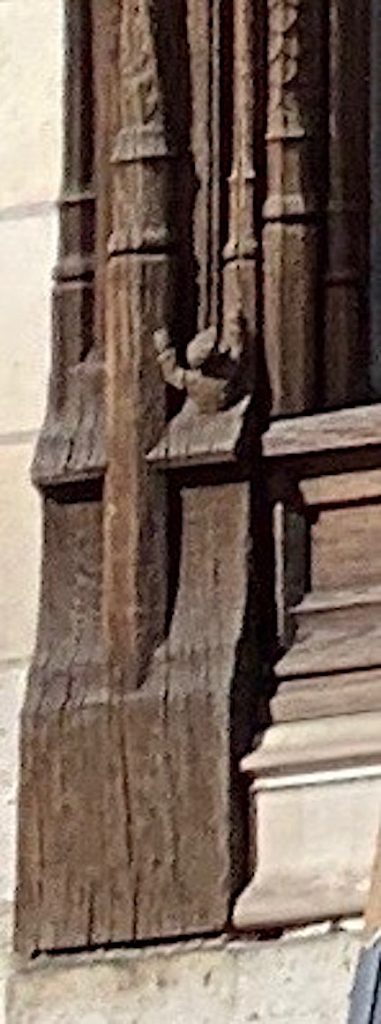
We took a seat. Wearing his hair long, with a man-bun, the young, lanky waiter brought us menus. No food would be served until noon, he explained, but the bar was open. I looked at my watch. At that very moment, it would be happy-hour in New York. I ordered a draft beer, and a Chardonnay for Kathie. Consumed with gusto, the first round disappeared. We ordered another, reveling in pre-prandial decadence. At the stroke of twelve, the waiter materialized, pencil in hand. There was nothing to do, but order the charcuterie plate and another round of drinks. La Maison des Arts is notable in part for the building—half-timbered medieval-revival, built at the turn of the penultimate century. The woodwork, inside and out, was the handiwork of a master carver/cabinetmaker named Racollet. His personal logo was a rat dipping its tail in a glue-pot, a jeu-des-mots on his surname. In French, rat is pronounced with a silent “t”. Combined with coller, “to paste”, a homonym of collet, we have Racoller, or Racollet. The artist whittled a humorous self-portrait onto one of the wooden pilasters on the façade. Moretains had given Racollet a lot of work, including a commission to carve the marvelous staircase of the Hotel de Ville. We later were to learn that Racollet had been responsible for a marvelous staircase in the city hall. Lingering over lunch, we reviewed our notes and ordered another round. Pretty soon we might need another nap.
Like many towns in France, shops in Moret close at noon and reopen at three or four in the afternoon. On Mondays, some never open at all. Strolling back to the hotel, I ducked into the tourism office to obtain a map. The young woman behind the counter knew a little about Sisley but never heard of Greatorex. She pointed me toward the Sisley monument, a bronze portrait-bust atop a tapering stone pedestal, from which emerged a comely female nude, perhaps his muse. Meanwhile, back at the hotel, Anne expressed concern about finding us somewhere to dine on a Monday night. She offered to call around to find us a reservation. We thanked her, went upstairs and collapsed. After a catnap, our reconnaissance resumed. Returning to Place de l’Hotel de Ville along Rue des Granges, we turned left at the post office and passed through the 17th-century northern gate, crowned with a pitched roof and cupola.
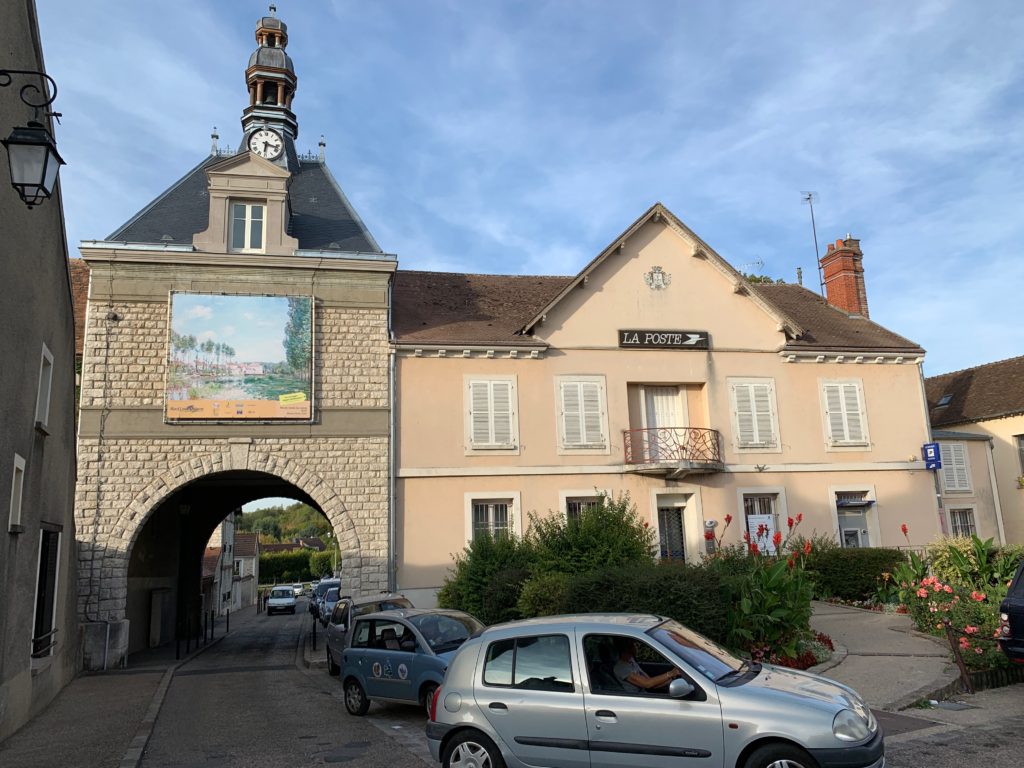
The North Gate, Moret sur Loing
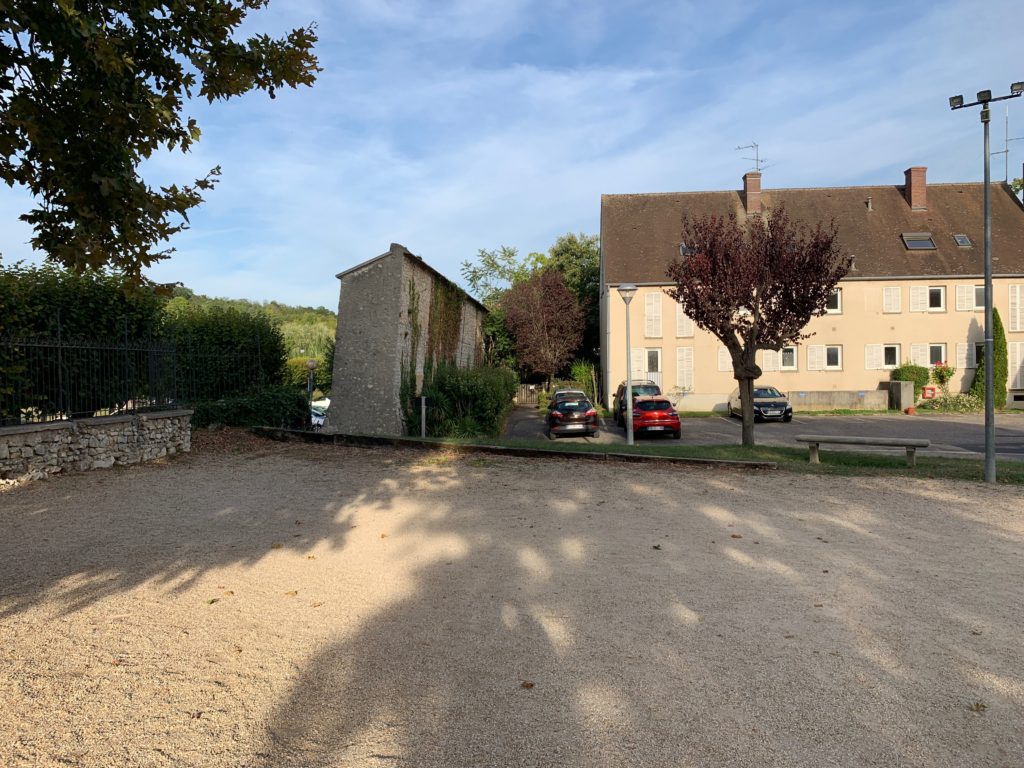
Sandy lot behind the post-office, with a fragment of the ancient wall.
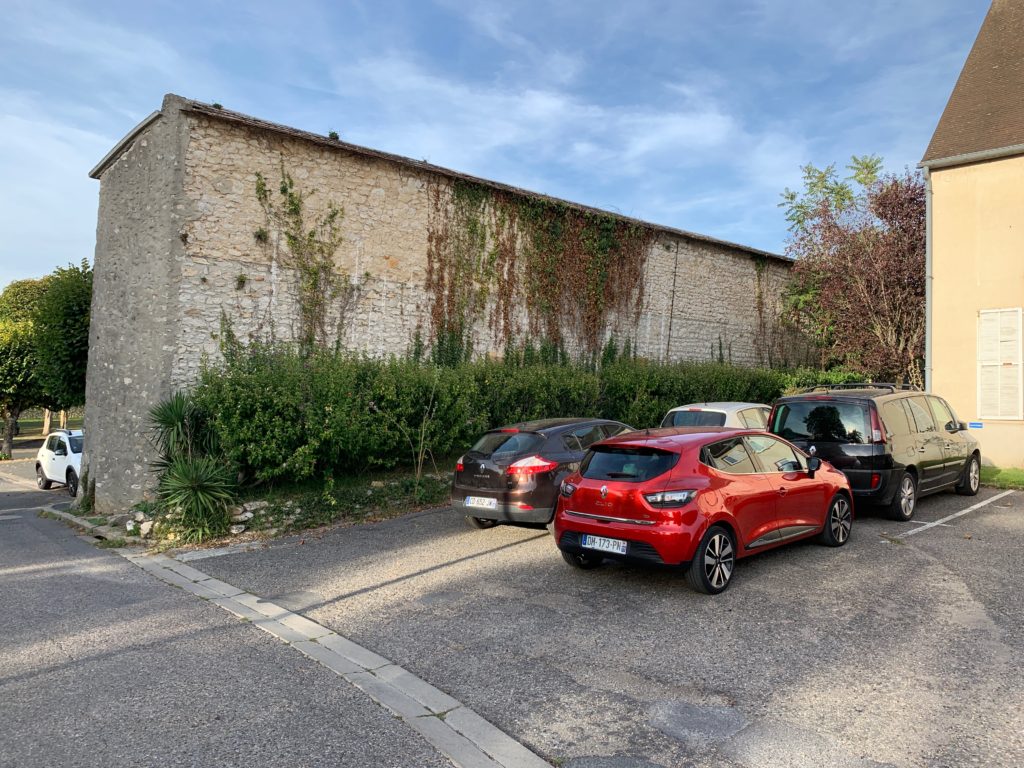
12th-c. perimeter wall, Moret sur Loing
Rue Cour de Couvent, led us to Rue du Peintre Zanaroff, named for local artist Prudent Pohl Zanaroff (1885-1966). A parking-lot extended eastward, an extension of an unpaved car-park behind the post office and fire company. Beyond a narrow grassy margin, an orderly tree-rimmed green park lay across the street. Running parallel to Rue Zanaroff, on the near side of the street, stood a section of the twelfth-century wall, dressed at one end like it had been sliced clean through with a razor. We had found the ramparts.
Examining the medieval wall, we were stunned to find they were not more solidly built; more of a barrier than a defense. Shortly after their construction, a timber walkway would have run behind the parapet, where defenders would stand in repelling attacks. Below that perhaps one might have found modest shops, ateliers and dwellings. Nothing remains today except for the wall itself, covered with ivy.
At its interior base, a gravel driveway led back to a residential garden where a young woman stood talking on her mobile. Because the Greatorex women had lived near ramparts, I saw no harm in asking a local if she had ever heard of three American women living nearby. Kathie stood by the wall. I walked up the driveway. A man on a motorbike drove up behind me. His protective demeanor out me on guard, realizing that he must be connected in some way to the woman in the garden. Explaining to them the nature of my quest, both replied that neither had any knowledge of such a tale. They knew only of Sisley.
Thanking them, we followed the wall, peering into gardens, comparing what we beheld with the few scribbled lines describing the Greatorex property as being near ramparts, with a small stone tower and a large studio building, which the daughters once sought to lease to Rodin.
At the river, the walls turn sharply to the right, continuing in a southerly direction.
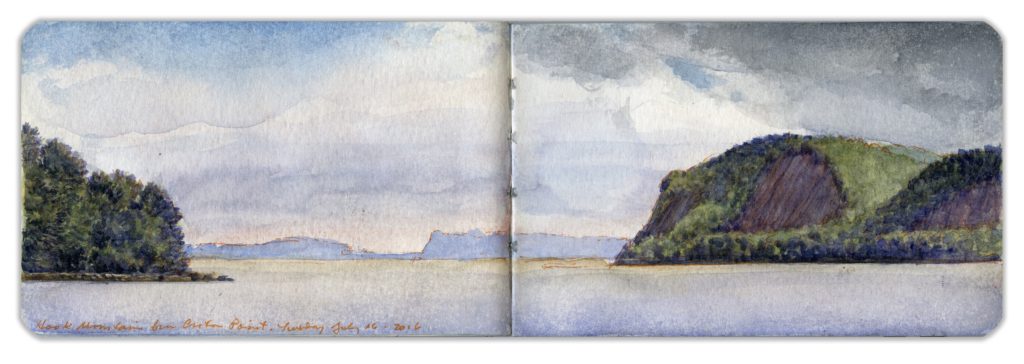
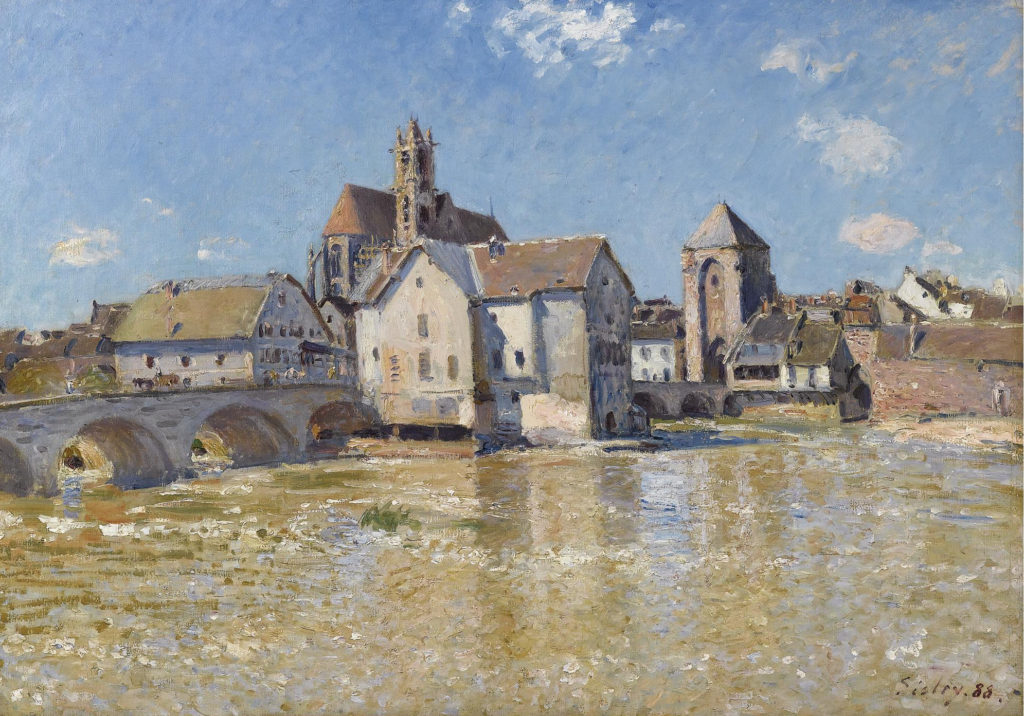
Walking south along the bank, we passed a number of properties that could have fit the bill. On a riverside path in a park known as Le Pre Magaron, we passed on round tower after another before reaching the stone-arch bridge and Porte de Bourgogne, featured in paintings by Corot, Sisley and others.
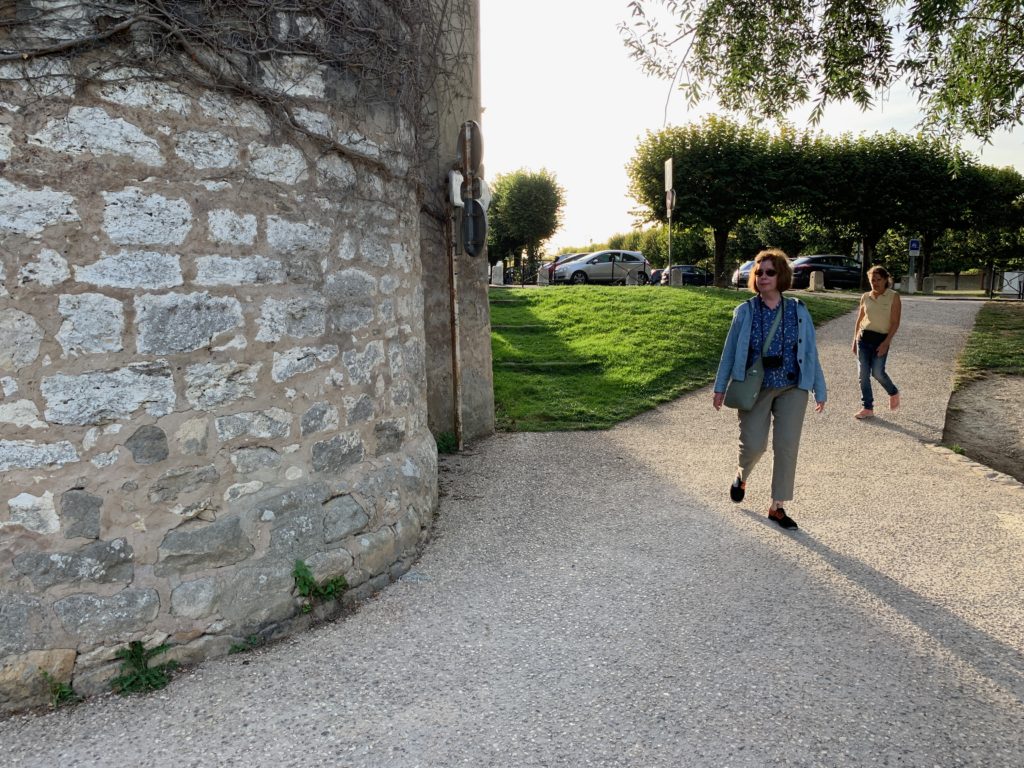
Kathie entering Le Pre Magaron
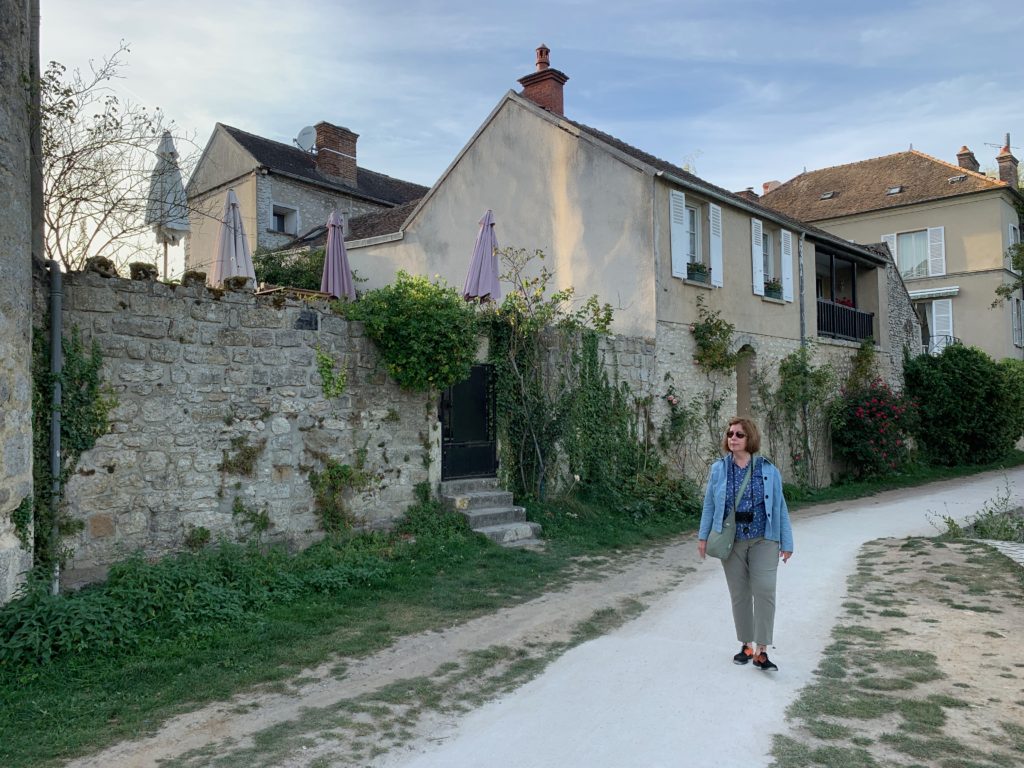
Houses built into the perimeter wall along Le Pre Magaron
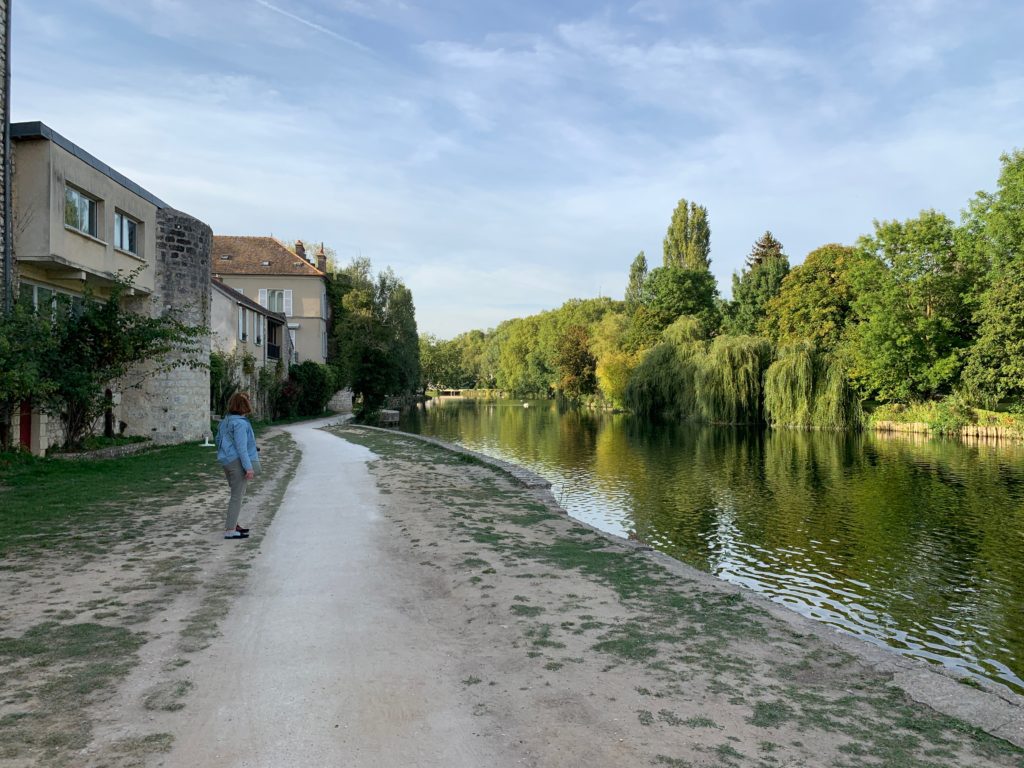
The scholar pauses to reflect
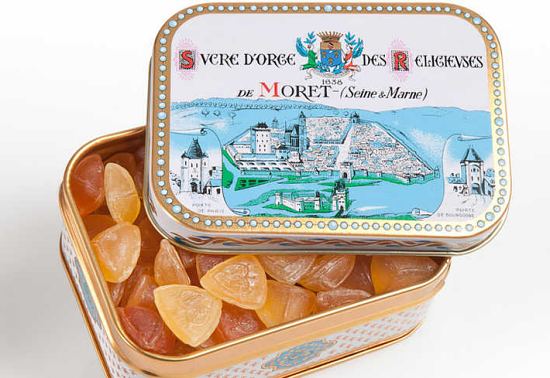
Subtle differences in the masonry indicated parts of the bridge that had been blown up by German troops abandoning the town in 1944. Two ancient mills on an island in the Loing were also postwar reconstructions. The larger Moulin Graciot stands north of the bridge. South side of the bridge, Moulin a Tan has been refurbished to serve as an art gallery. Another mill beside it houses the Musee du Sucre d’Orge des Religieuses de Moret (Museum of Barley-Sugar of the Religious Moretains). A shop selling the candies stands opposite l’Eglise du Notre Dane de la Nativite (Church of Our Lady of the Nativity), on Rue du Puits du Four.
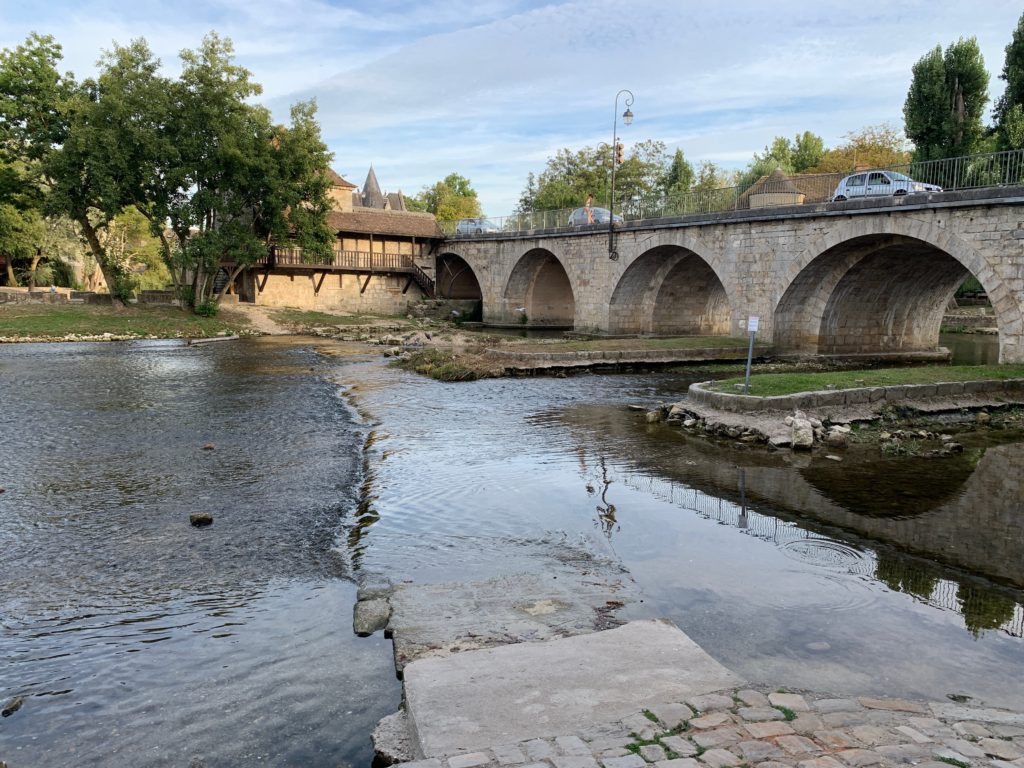
Moulin Gratiot and Pont de Moret
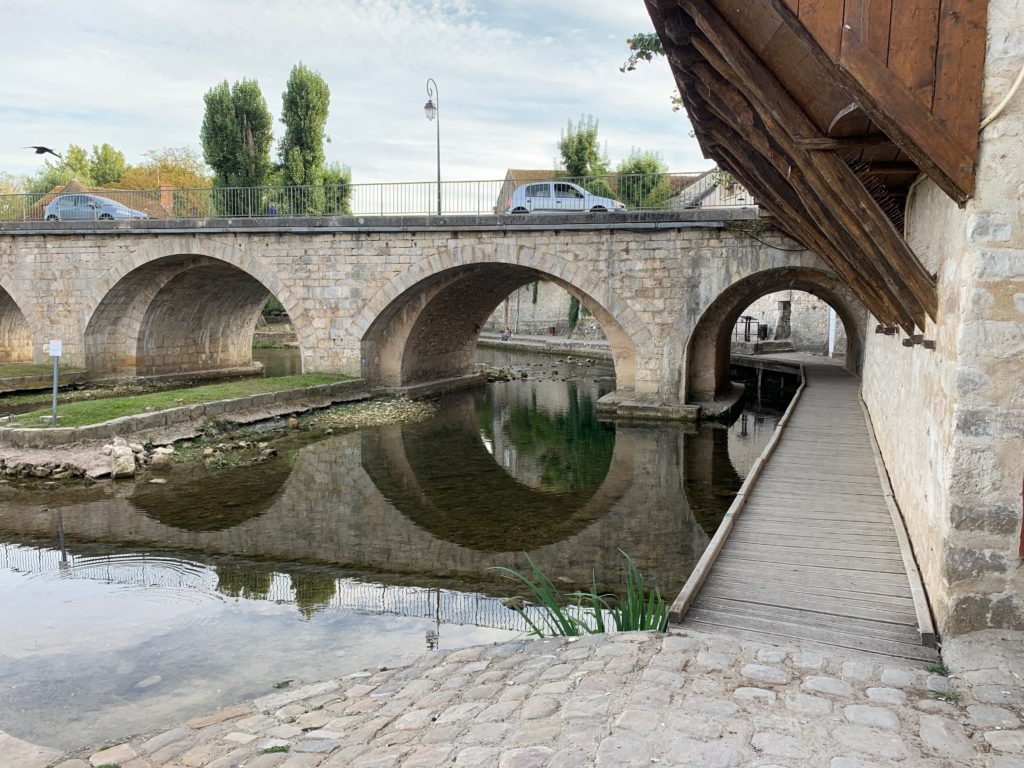
Looking west beneath the bridge to the Quai des laveuses, the low doorway to the staircase beyond
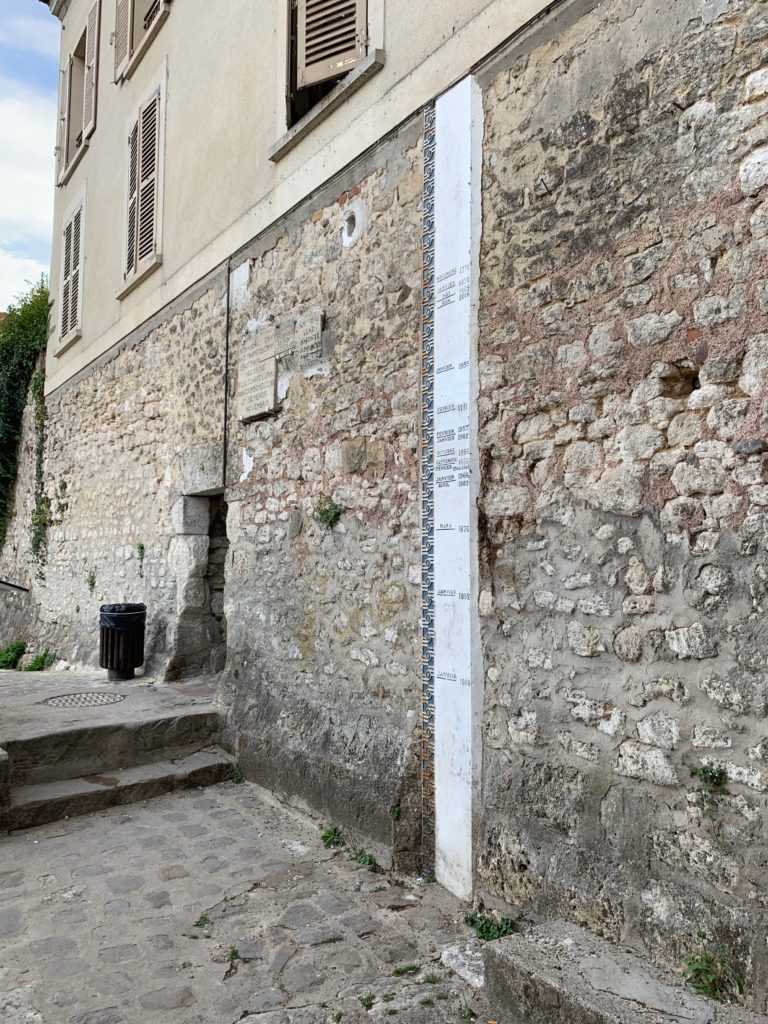
High-water marks recording various flood levels over the century, Quai des Laveuses
Passing below the bridge, we came to a series of small waterpower dams, shaded by a canopy of trees. To our right, the city wall now soared overhead. Two young women sat huddled at the water’s edge, speaking in whispers. The paved esplanade known as Quai des Laveuses (Laundress dock) narrowed to its terminus, at the edge of private property, where an elderly lady sat lost in thought. Retracing our steps back toward the bridge, we came to a low opening in the base of the wall. Nearby, water-levels from past floods were marked on the wall. Ducking into the doorway, we entered a covered way. Leading upwards, the staircase was illuminated by another doorway at the top. Dingy stucco walls were tagged here and there with graffiti. Calling it art might be a stretch.
.
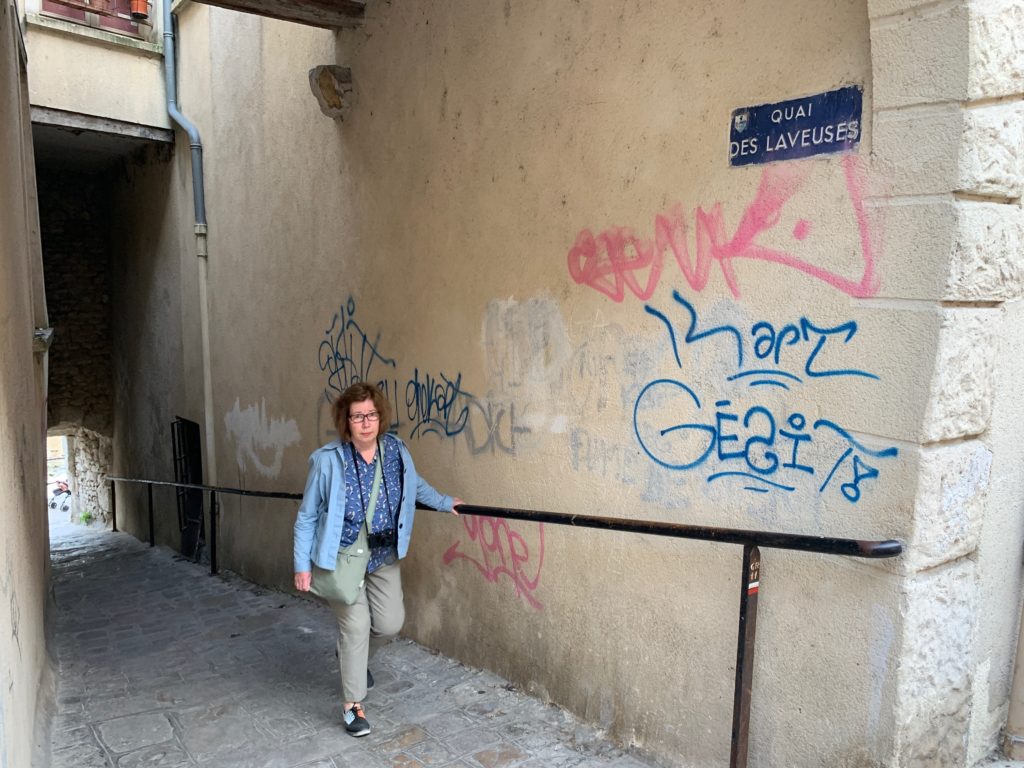
Kathie on the stairs at Quai des Laveuses
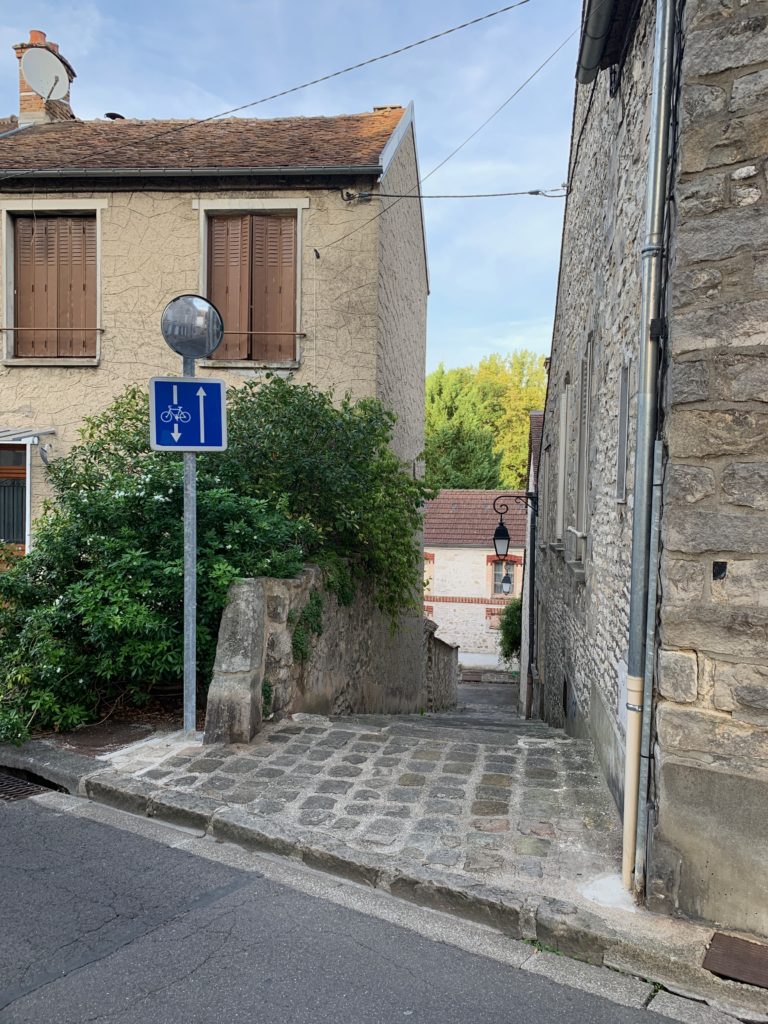
Escalier Royal, between Rue de Tannerie and Rue du Donjon, Moret sur Loing.
We emerged from the tunnel onto Rue da la Tannerie (Tannery Street). Walking south, we considered the possibility that any of these properties might be the one described by Eleonore Greatorex, or her friend Miss Hallowell. Reaching a dead end, we found another narrow escalade, ascending in the gap between two buildings. In contrast to Quai des Laveuses, Escalier Royal was open to the heavens. Upon reaching Rue du Donjon (Castle Street), we turned south to investigate the keep, which we discovered is private property. Satellite views show formal gardens and other structures behind the walls. The whole town had been built to function as a fortress. Located on the Loing River, a kilometer south of its confluence with the Seine, Moret held a strategic position. This massive tower was once its beating heart, a final refuge in the event of a siege. Built between 1128 and 1154 in the Roman style, it resembles some Norman keeps found in the British Isles.
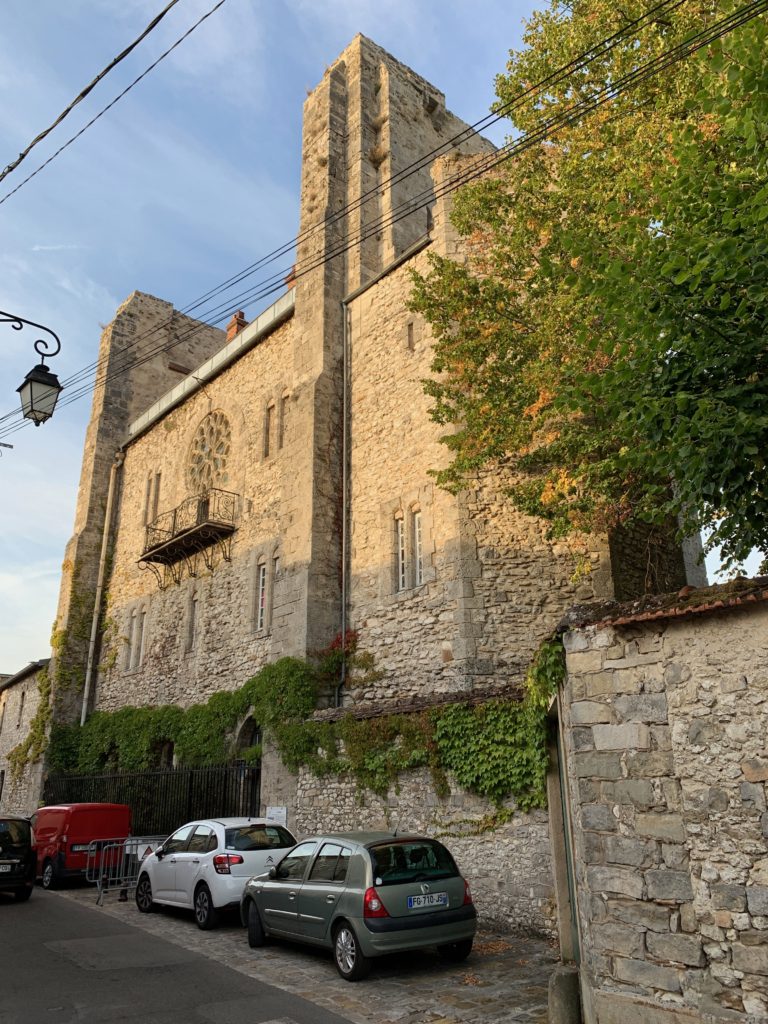
The western facade of the Donjon de Moret
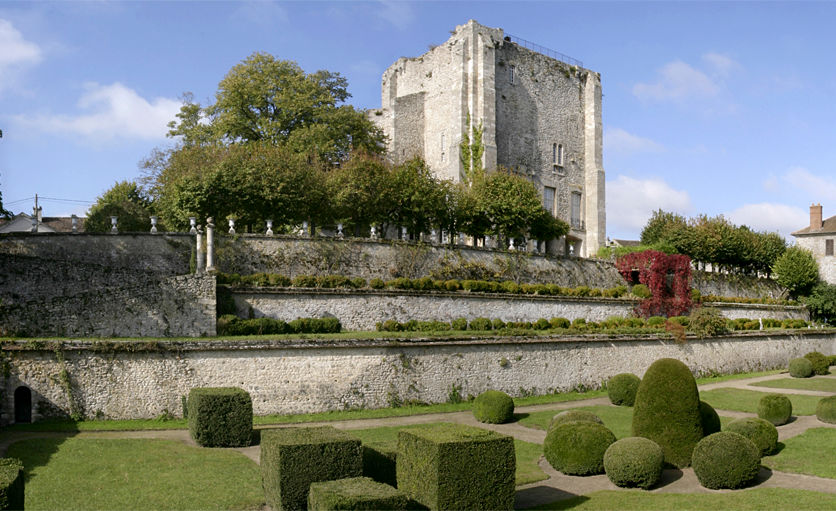
Eastern facade of the Donjon de Moret, from the garden
During the 17th century, the castle had served as a prison. Following his arrest by d’Artagnan, Louis XIV’s disgraced finance minister Nicholas Fouquet was incarcerated here, within its walls. Descending precipitously beyond the donjon, the street led to another cul-de sac. Reversing direction, we reached Rue Monmartre. To our left, a tall house rose up behind a ten-foot wall, upon which hung a plaque identifying the home of Alfred Sisley. Continuing onward, we drifted into a maze of alleyways, many no wider than a domestic hallway
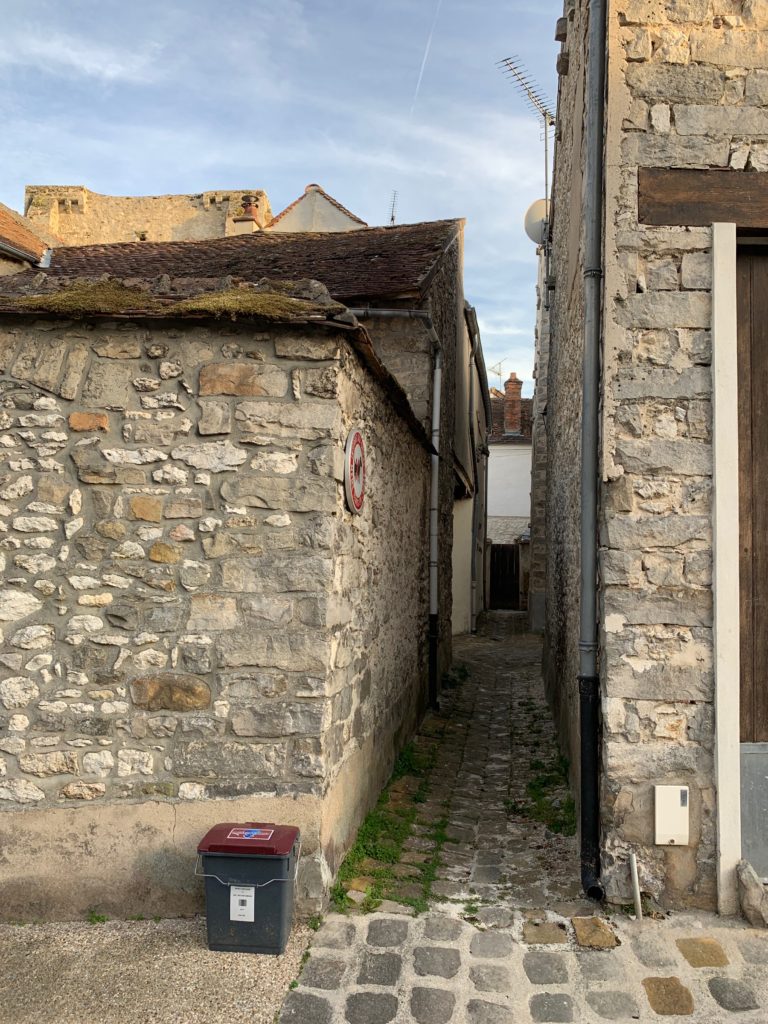
Alleyways, Moret sur Loing
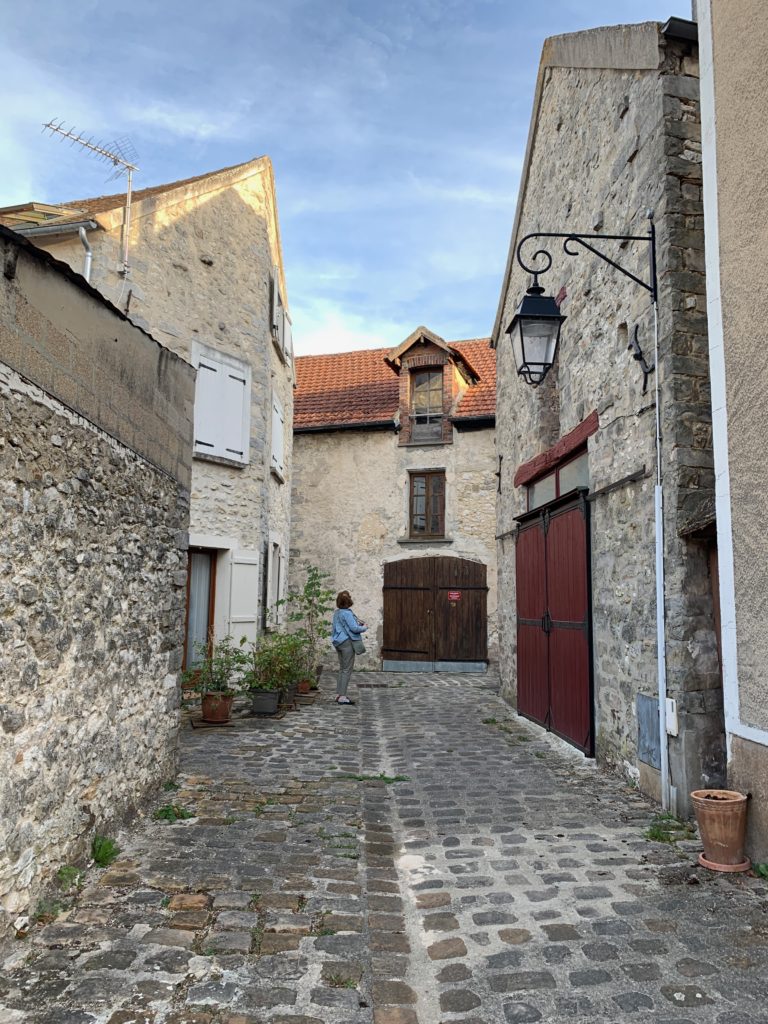
Alleyways, Moret sur Loing
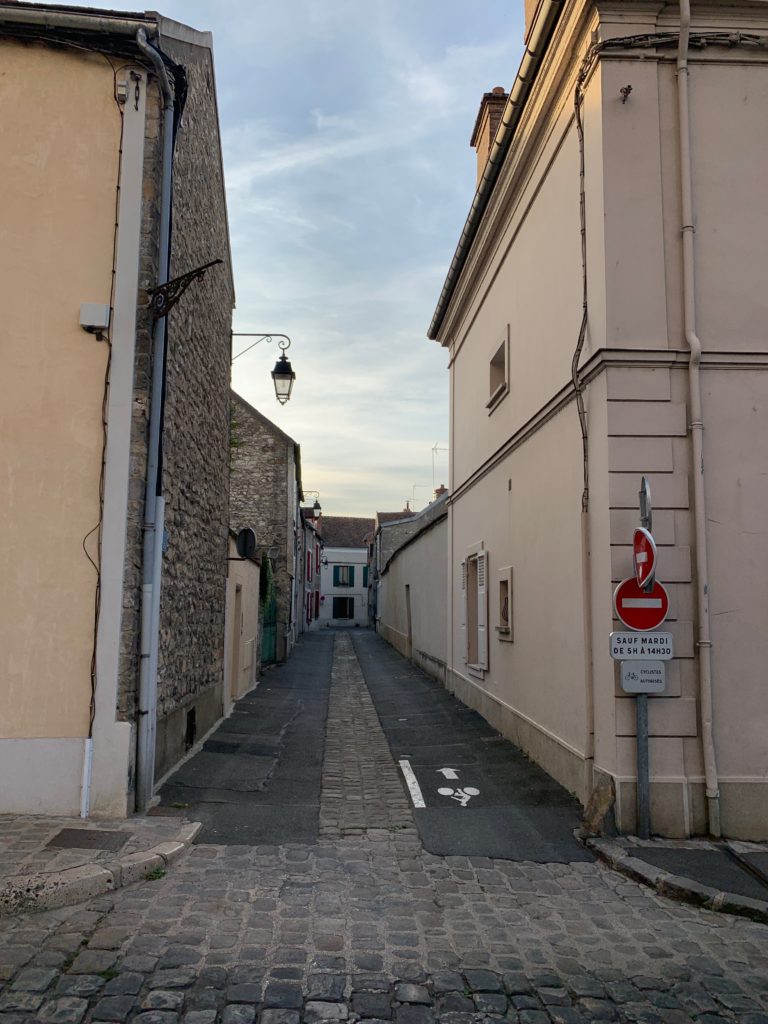
Alleyways, Moret sur Loing
Low stone houses stood shuttered and silent. Making our way back to Rue de l’Eglise (Church Street), we had an hour to kill before dinner. Anne had made us a seven o’clock reservation at a Brazilian restaurant, the only place in town open on Monday night.
Kathie decided it was time for a snack, then disappeared into a patisserie; l’Echoppe aux Douceurs. I peered through the window of an art-gallery across the street.
On the corner of Rue Grande, we sat on a bench and devoured several rolls. Looking back toward Porte de Samois, I noticed a woman set up a sandwich-board on the sidewalk.
Under darkening skies, we proceeded west on Rue Grande to L’Entre 2 Ports, (Between Two Gates) a small restaurant specializing in Luso-French cuisine. Kathie and I were seated on a small deck, perched along the side of the road. Chubby white lights dangled from electrical wires, beneath a blue canvas canopy. Thirty minutes earlier the streets had been deserted.
At seven o’clock, the street had come alive. Within a quarter-hour, our lonely deck was full, abuzz with conversation. Cigarette-smoke swirled around us. Evoking a sense of Déjà-vu, its acrid sweetness carried us back in time.
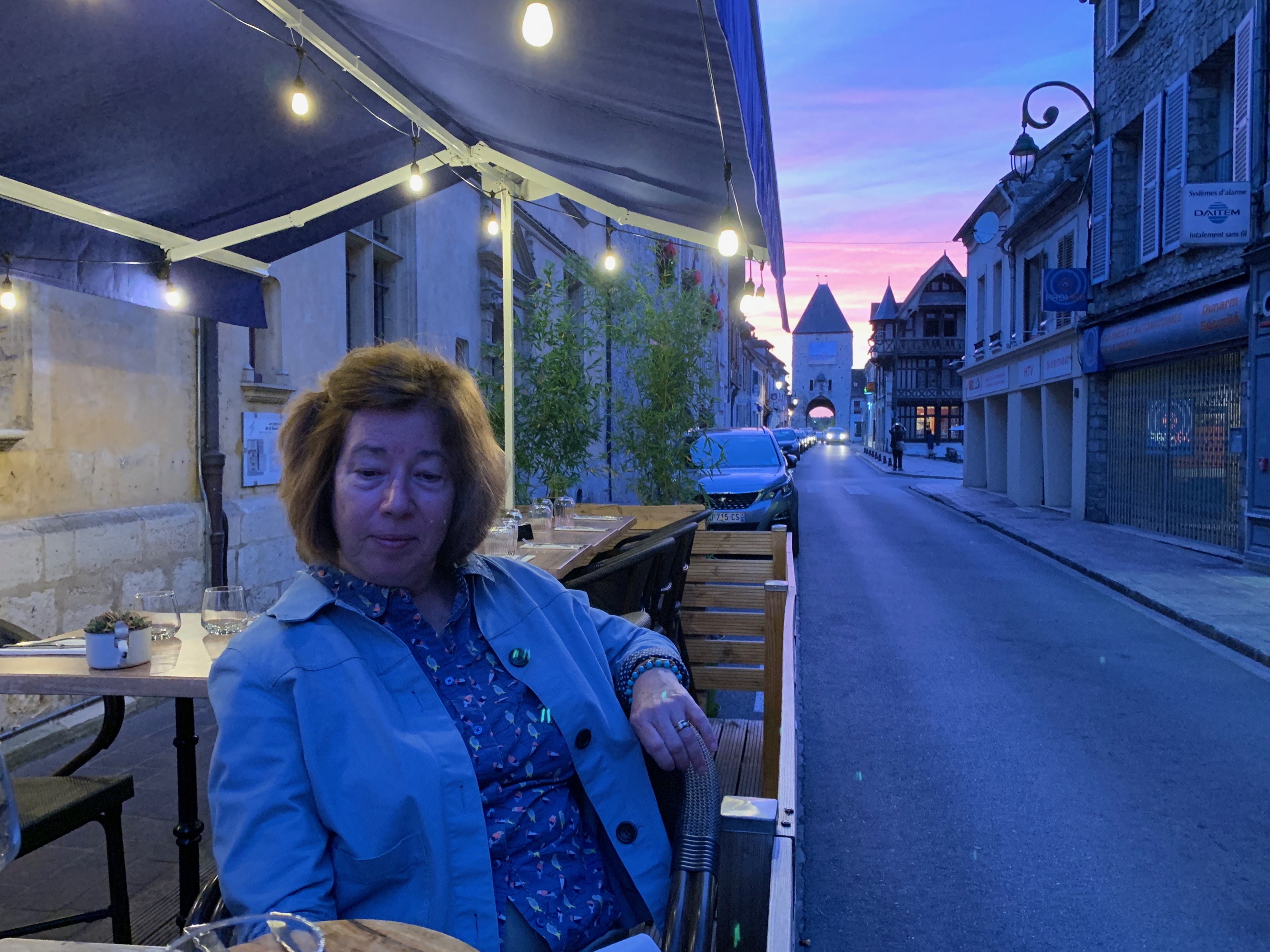
Sitting down to supper at Entre 2 Ports, at the close of a very long day in Moret-sur-Loing
Chubby white lights dangled from electrical wires, beneath a blue canvas canopy. Thirty minutes earlier the streets had been deserted.
At seven o’clock, the street had come alive. Within a quarter-hour, our lonely deck was full, abuzz with conversation. Cigarette-smoke swirled around us. Evoking a sense of Déjà-vu, its acrid sweetness carried us back in time.
Taking our orders, the woman whom I watched set out the sign stood in the street, as cars crawled past her backside. The sky deepened to azzurro Giottesco. Our meals arrived. Sharing a bottle of young Portuguese wine, Kathie had the trout. I dined on salade de poulpe and maigret de canard. Porte de Samois stood in silhouette, against a rosy glow. Above, the heavens turned from Lapis to garnet, the horizon aflame in red and violet. People came and went. Cigarettes were lit. Our served dodged cars crossing the street, a tray on one arm, a bottle in the other. We lingered awhile, pondering the task ahead.
Sisley, Eliza and her daughters had trodden these very stones. All that remained was to find the property where the peripatetic Greatorex women had finally settled down. The last of them—the beautiful Kathleen Honora–breathed her last in 1942 at the age of ninety-one. It was not unthinkable that at least one Moretain might remember her, or perhaps even knew her.
After struggling with the plastic punch-card key, the door finally gave way. Our conversation may have been silenced by sleep, or carried on in our dreams. When we awoke, it was the first thing on our minds.
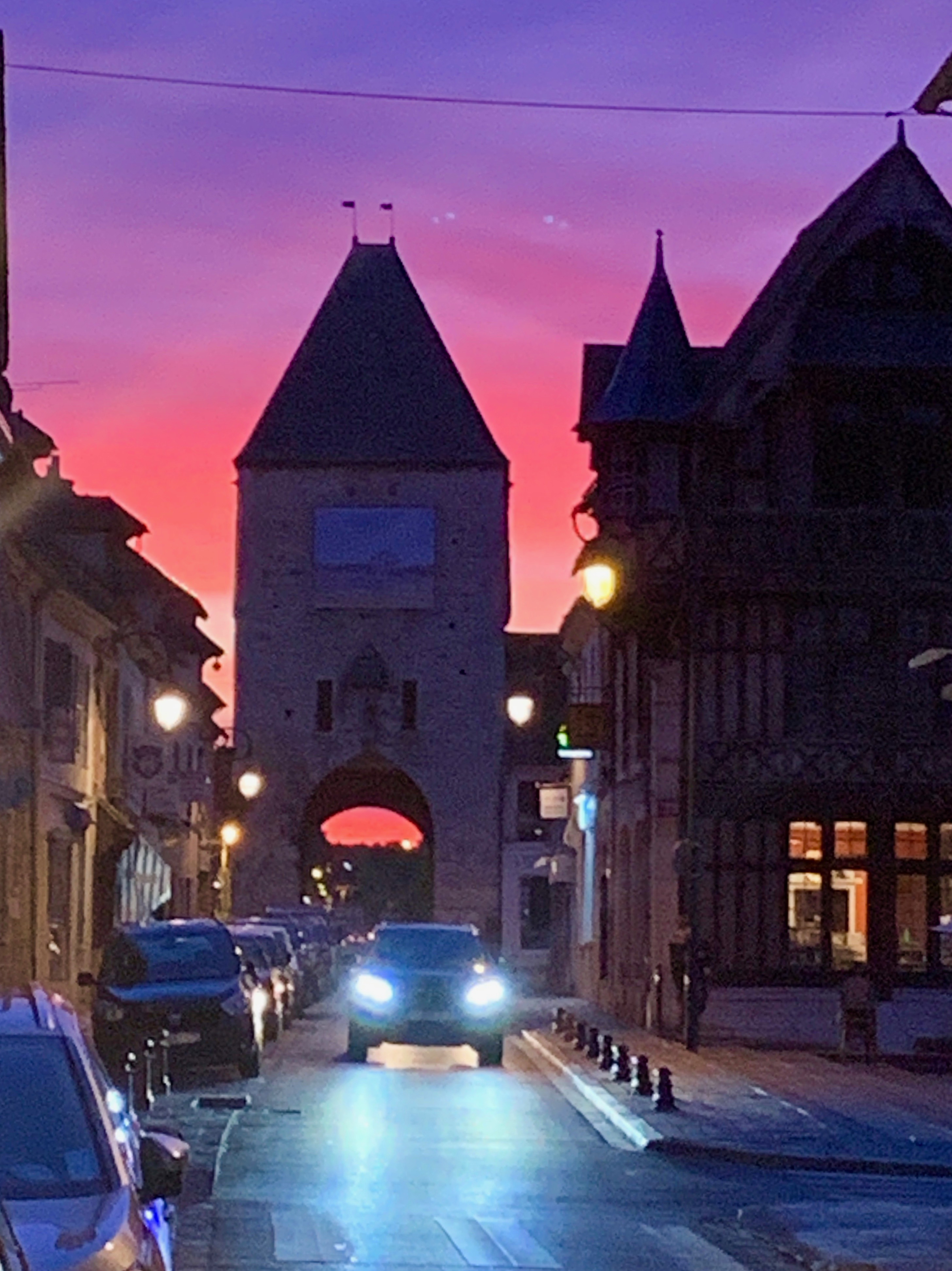
Porte de Samois at Sunset
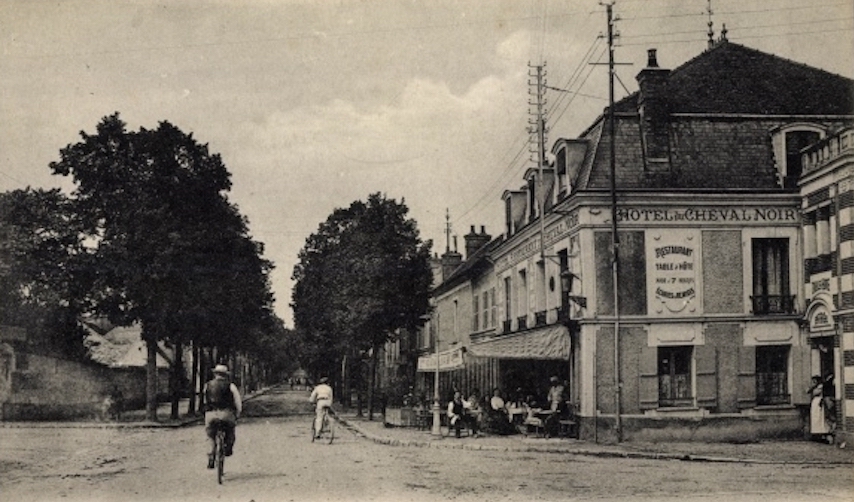
Early postcard of Le Hostellerie du Cheval Noir, Moret. ca 1910
Light crept through a crack between the heavy drapes. Numbers glowing on a digital clock confirmed that we had slept like the dead, missing our petit-dejeuner. Entering the small breakfast-room, we were greeted by Père de Crick. We never caught his given name.
Laid out in lavish quantities were croissants, sans et avec chocolat, fresh baguettes, butter, crêpes, fresh fruit, yogurt, fromages et charcuterie and strong coffee, all composed in anticipation of perhaps a dozen people or more, yet we seemed to be the only guests in the hotel. Anne arrived as we finished our meal, to inform us that she had left a message of one of the officers of Les Amis de Moret and Les Amis de Sisley, hoping to arrange an appointment for us all to meet on the following day.
We left the hotel by the side door on Rue du Peintre Zanaroff, the only door granting twenty-four access to guests of the hotel. If the building was historic, our keys were retro—white plastic perforated punch-cards from the Disco era. The eponymous painter Zanaroff was a late Impressionist named Prudent Pohl (1885-1966), who took the Russian-sounding moniker for reasons as yet unknown to us, and is remembered by the town of Moret by a street bearing his name. Beyond the crosswalk stand the monument to Sisley. Following the painter’s death from throat cancer in 1899, friends of the artist decided to raise a monument in his honor. Sisley’s daughter contacted Auguste Rodin, who agreed to undertake the task, but the committee disliked Rodin’s proposal and instead hired the lesser-known Simeon-Eugene Thivier (1845-1920).
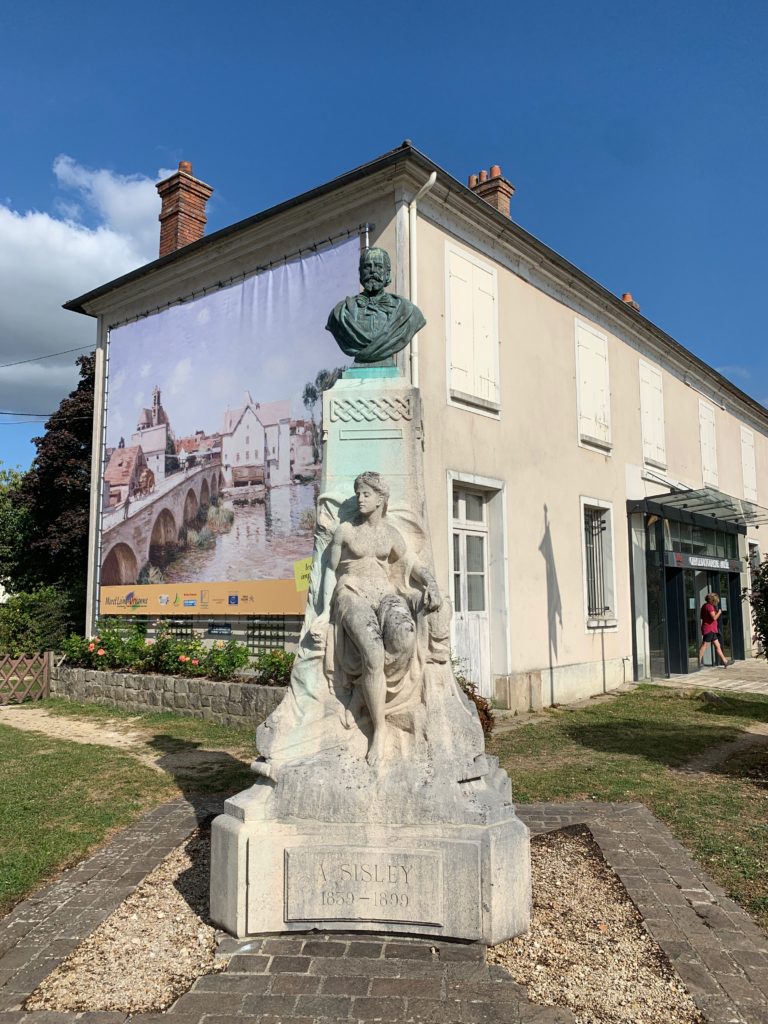
A bronze portrait-bust of the painter crowns a tapering stone pedestal, out of which is seen to emerge a comely semi-nude young woman representing Sisley’s muse. By the time we had revisited the tourism office, acquired a few more maps and brochures, it was approaching midday. Passing through Porte Samois, we proceeded to the Hotel de Ville (city hall) to inquire about how we might research property records. Kathie had determined that both Eleonore and Kathleen Greatorex had lived at a place known only as “Ramparts”, which seems to have been acquired prior to their mother’s death in 1897. After her passing they had tried to entice Rodin into renting a studio on the property, but he ultimately declined. The studio ultimately was leased to the American sculptor George Grey Barnard, who today is famous for the collection of medieval art now housed at The Cloisters in northern Manhattan. Art dealer Sarah Hallowell purchased a property from the Greatorex sisters, where she lived with her mother and niece Harriett. Armed with these tidbits of information, and a few written descriptions of the property by Eleonore and visitors, the trail of breadcrumbs had led us to Moret, but no further.
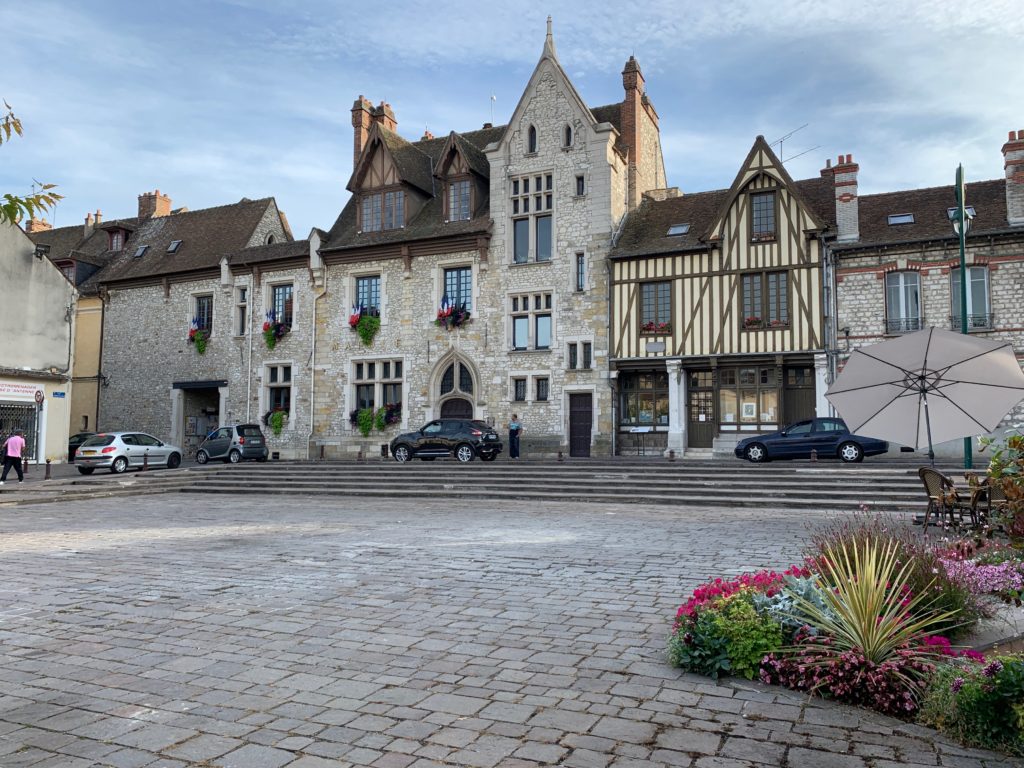
l’Hotel de Ville from Place de l’Hotel de Ville, Moret-sur-Loing. The half-timbered building to the right houses the Sisley Museum, run by Les Amis de Sisley.
The city hall was abuzz with activity as the town made ready for a European Heritage festival to be held over the weekend. Our landlords Anne and Gilles were distracted by preparations for anchoring a hot-air balloon in a soccer-pitch across the river. A young man took interest in our plight, explaining to the receptionist what we were hoping to accomplish. With a wave of her hand she directed him to a pile of books under the window. One of them was a history of Moret. At the top of one page was the headline “Quelques Moretains eminents parmi beaucoup d’autres” (Some eminent residents of Moret, among many others). Three names leapt off the page:
Eleonore Greatorex (1854-1909) Rue du Pave Neuf. Peintre
Georges (sic) Grey Barnard (1863-1938) Rue des Fosses. Sculpteur
Harriett Hallowell (1820-1913) Place de Samois. Peintre
Kathie noticed immediately that some of the dates were wrong, and that neither Eliza nor Kathleen Greatorex received a mention. Harriett Hallowell was the niece of the prominent American curator Sarah Tyson Hallowell (1846-1924), who had curated the French art exhibited at the Columbian Exposition in Chicago. A new biography of Hallowell by Carolyn Kinder Carr was published by The Smithsonian Scholarly Press in July 2019.
In a letter to a friend dated 1909, Hallowell describes a property she is buying from Kathleen Greatorex as a “…quaint old house, built within the historic walls of beautiful Moret”, mentioning that “Miss Greatorex has her home on the extremity of her property…”
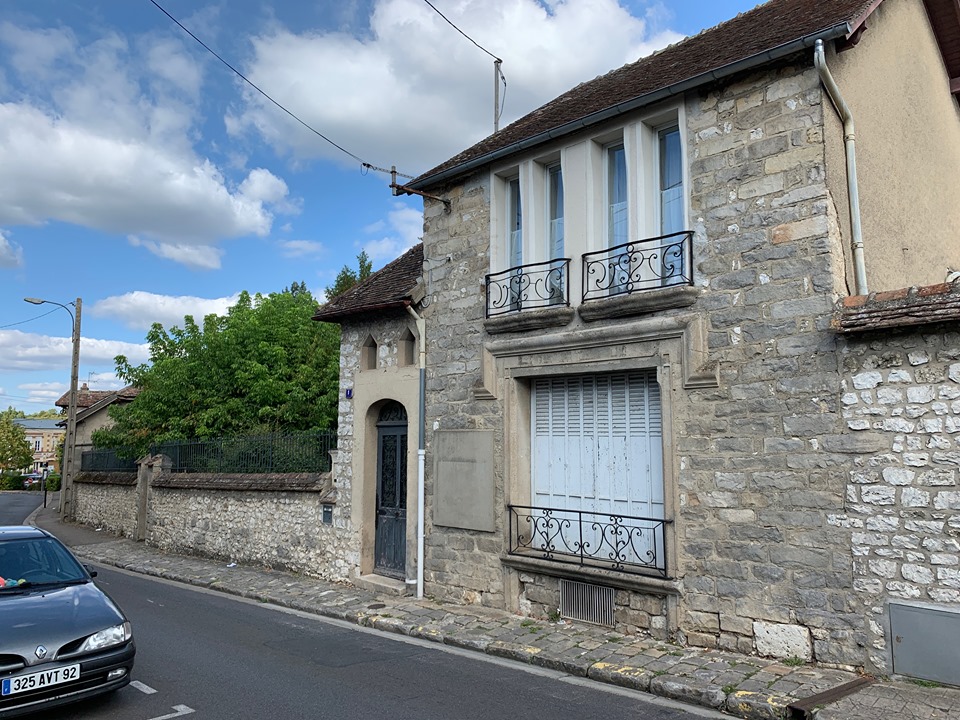
The Hallowell dates published on the Moret notables-list agrees with those of Sarah’s mother, Mary Morris Tyson Hallowell (1820-1913). Despite these errors, we had fresh clues to follow. Writing down the addresses, Kathie and I offered our thanks and crossed Rue Grande, taking a table at the now familiar La Maison des Arts. I spread out a map. Kathie took out her notebook. Locating the Greatorex-Barnard-Hallowell addresses on the map, we quickly realized that all were adjacent to one another, or more likely within the same compound. The narrative about a single Greatorex property that had been broken up between 1890 and 1942 suddenly made geographic sense. We were stunned to learn that what we sought had been at our doorstep all along, across Place de Samois from our hotel. Finishing our lunch, we paid the check and returned to the Hotel de Ville. To the left, a passageway led to a parking-lot. Beyond to the south, running east-west is Rue Pave Neuf (Newly-paved street), presumably one of the first streets in the town to be covered with flags or cobbles.
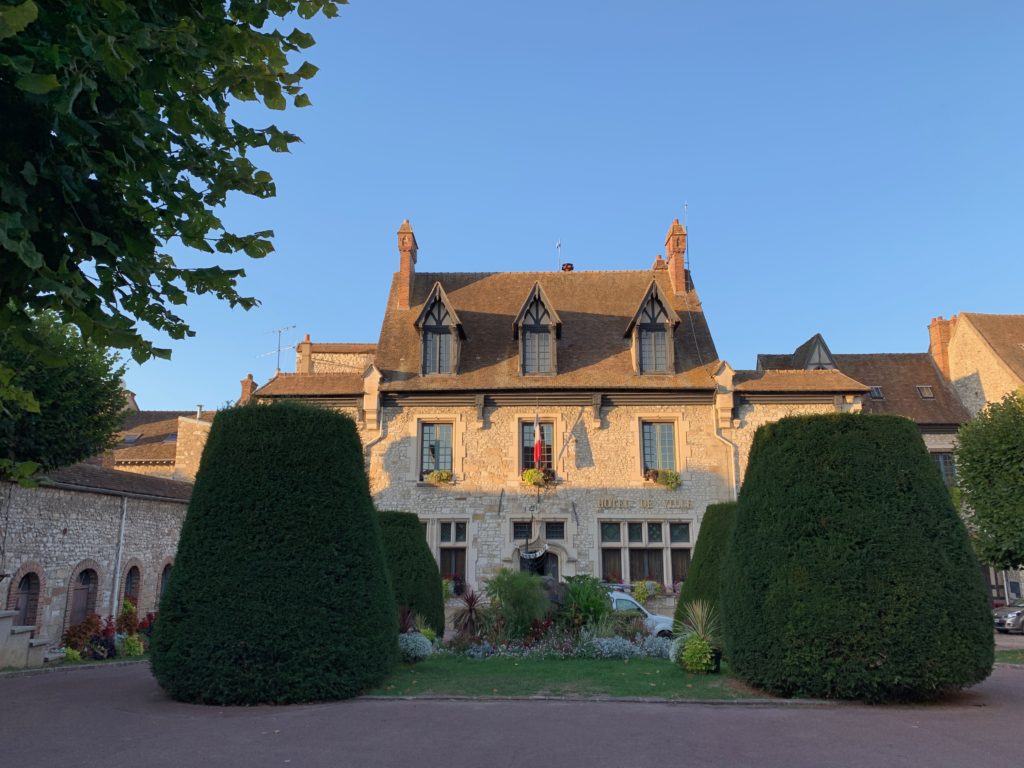
l’Hotel de Ville, Moret-sur-Loing, from Rue Pavé Neuf
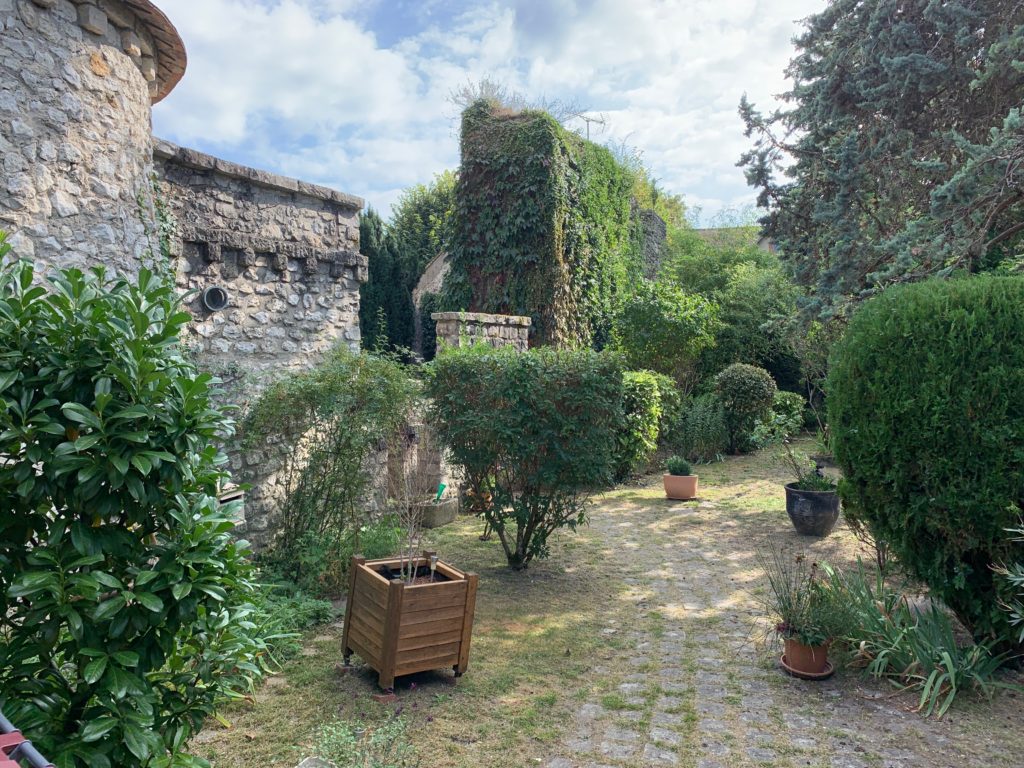
Private garden suspected of once having been the property of the Greatorex women
The city hall’s stately Façade François le 1eme faces the street, suggesting that the other side of the building facing Place de l’Hotel de Ville may have been its back door. Walking west along Rue Pave Neuf we passed small, shuttered stone row-houses, like those we had seen near the church. After a hundred meters the street turns ninety degrees to the right, leading us back to Porte de Samois. Passing through the gate we turned left, onto the pavement along the western edge of Place Samois. Dead ahead, a driveway led to a heavy, green wooden gate. Behind it we could see a garden, with yet another fragment of the old city walls. Ivy crept up the side of a round tower. Had we reached our goal?
The setting matched the descriptions. Published addresses had brought us to this place, but somehow it did not feel like enough. Ramparts were everywhere. A postal-carrier would need to be psychic to know to which rampart a letter is addressed. At the western end of Place de Samois, Rue des Fosses was George Grey Barnard’s published street address. As we stood on the curb, a man emerged from the house on the corner. I politely shared that I had a question, then asked if he had ever heard the name Greatorex, or stories about American women living in Moret before the Second World War. He paused, thought for a moment, then replied that he recalled something about American living here a time long ago. He knew someone, who might be able to help.
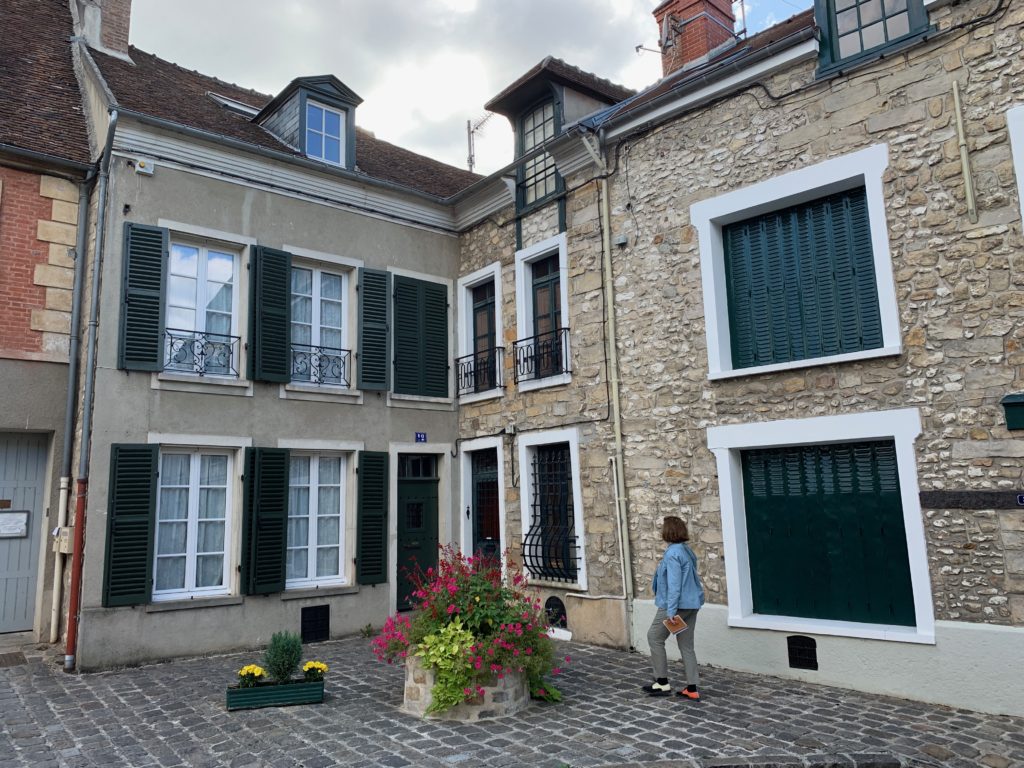
Kathie looking at the houses along Rue Pavé Neuf
We followed him back to Rue Pavé Neuf. He knocked on the door of one of the stone houses. The top half of the door swung open. Describing our mission to the elderly woman, she replied “Bien sur!”
Her parents had purchased the house from Harriett Hallowell sometime around the Second World War. Hallowell and another old American woman had been living together, but both had died during the war.
All the pieces began to fall into place. Kathleen must have taken possession of the house when Eleonore died in 1909, and then sold it to Sarah Hallowell. Like her collection of paintings by Alfred Sisley, Kathleen Greatorex must have raised funds by breaking up the property over the years, before entering into a domestic arrangement with Hallowell. Nothing is known about their lives under the Nazi occupation. On her death certificate, the date of Kathleen’s passing is given as May 6, 1942, the cause given as “old age”. She left everything to Harriett Hallowell, who died the following year. We knew we were close. All that remained was to find their home, “the Ramparts”, or whatever remained of it.
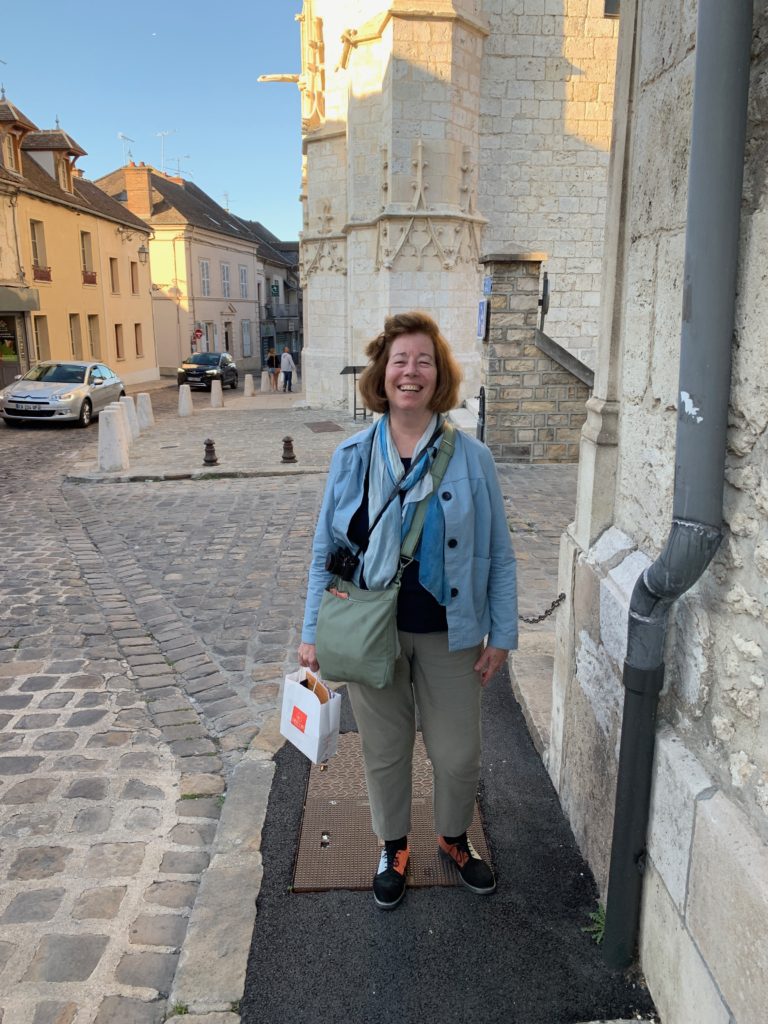
Kathie Manthorne. Boots-on-the-Ground art historian, with a bag full of barley candies. Since people will ask, the polychrome Oxfords are by Camper, acquired in June at On Your Feet in Santa Fe, New Mexico
Backtracking past the city hall, we retraced our steps along Rue Pave Neuf. Kathie suddenly decided that we urgently needed to acquire a supply of the famous local barley-candy for future use as gifts. The day before the, shop had been closed.
Turning right onto Rue de l’Eglise, we walked uphill a few blocks to the church. Just beyond it on Place Royal we beheld our objective which, lo and behold, was open for business. A painted stone cameo framed in carved heraldic scrollwork, announced that Sucre d’Orge Religieuses de Moret had been in business since 1638. These particular sweets were first produced in Moret by Benedictine nuns, although their origins date to a much earlier time. De Lis Chocolat has preserved its historic appearance as a half-timbered store-front. Varnished wooden shelves and countertops were piled high with sucker-candies, packaged in everything from small sacks to colorfully-painted tins. An attractive matron stood at the ready, ready to help shoppers rid themselves of filthy lucre.
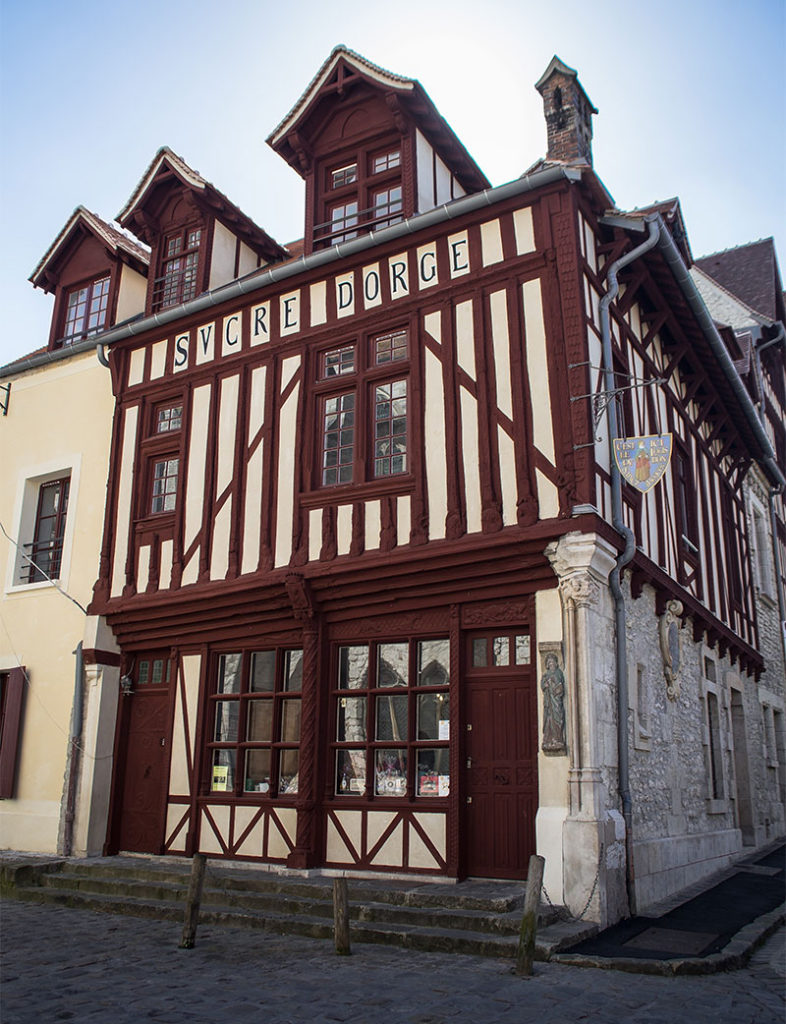
Des Lis Chocolat.Boutique Sucre d’Orge des Religieuses de Moret. Rue de l’Eglise and Place Royale, More sur Loing, Ile de France.
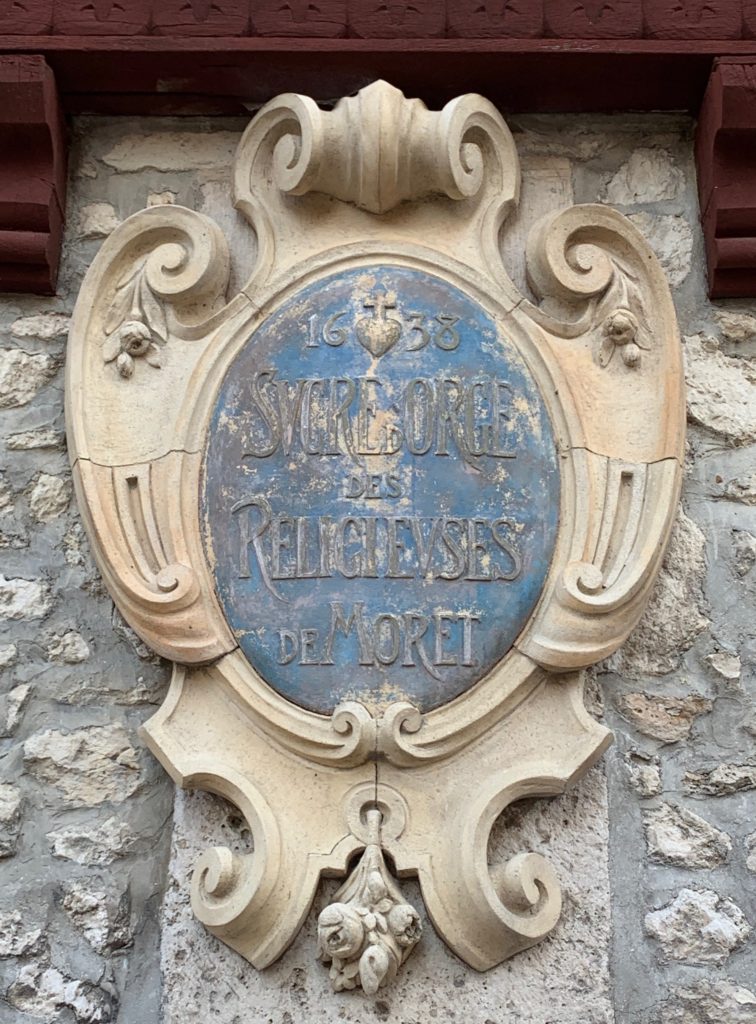
Mission accomplished, we crossed the road to find the church door open, entered and lit candles in memory of the recently departed.
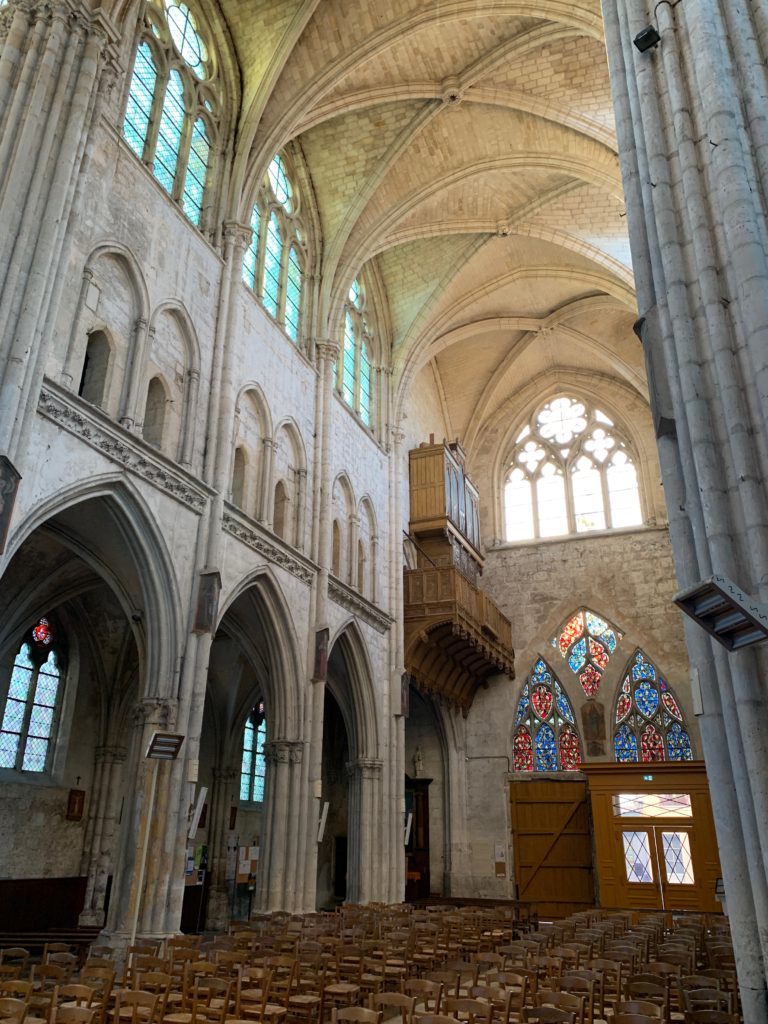
Notable for its historic pipe-organ, l’Eglise de Notre Dame de la Nativite is a cathedral in miniature. Vaults soar above light-flooded spaces. Built by Louis VII, around the same time as the Donjon and city walls, the church was dedicated by Saint Thomas a Becket in exile.
Suffering desecration, damaged during the revolution, the building was appropriated for a variety of secular functions before its re-consecration as a house of worship.
It famously appears as a subject for a number of paintings, including one by J.B.C. Corot, and later by Alfred Sisley, whose house stands nearby. The church today serves an active congregation. For the general community, it provides a concert venue.
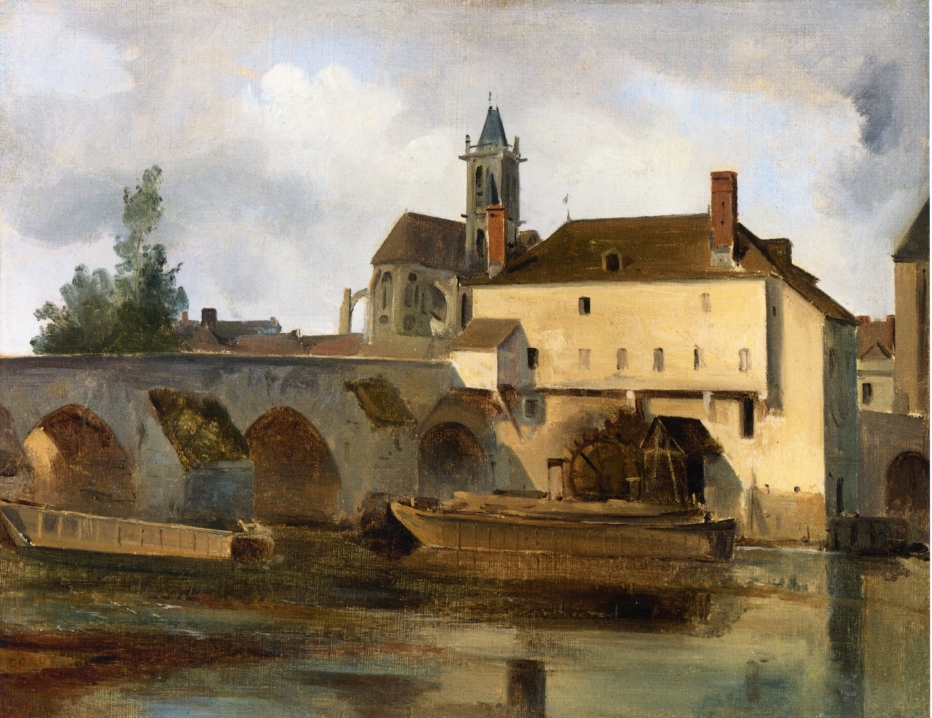
View of Moret by J.B.C. Corot. 1822
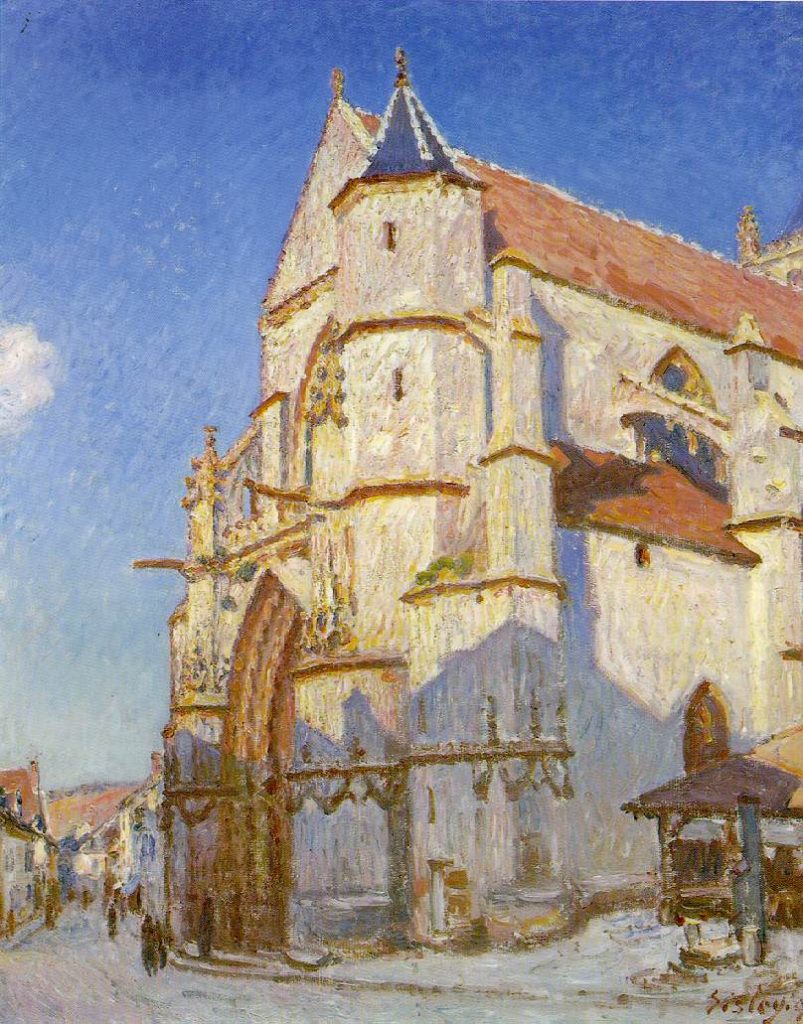
The Church at Moret by Alfred Sisley. 1894. The view is from the corner of Place Royale looking north along Rue de l’Eglise, next to Boutique Sucre d’Orge
According to Kathie’s research, Eliza’s daughter Kathleen Honora Greatorex (1851-1942) had developed a close friendship with Sisley near the end of his life, amassing a considerable collection of works by the artist in exchange for financial support. No evidence exists to support them having amorous relations. Sisley was married, with grown children. Kathleen was noted for her great beauty, refinement, charm and allure. Their twelve-year age-difference would not have presented much of an obstacle, had hearts been willing. Little is known about the private lives of the Greatorex women. Eliza had a deep and loving relationship with her husband before his untimely death, but she never remarried. As a widow, she had close relationships with other men, none of them openly romantic. If she was anything like the stereotypical domineering Irish matriarch, her daughters didn’t stand a chance. I witnessed this behavior for myself, in my Donegal grandmother’s dealings with her two younger sisters. Eliza’s stepson stayed in Florida after the Civil War, while the brother of Kathleen and Eleanor moved to Colorado. One might regard this as two young men putting great distances between themselves and a controlling parent. This was not an option for their sisters. Eliza and her daughters traveled in sororal circles inhabited by spinsters and Boston marriages, all socially acceptable disguises of lesbianism. Each of them accomplished artists, Kathleen and Eleanor seem to have done much of their mother’s grunt-work like framing, embellishments, calligraphy and secretarial chores. They did break away on their own from time to time, with commissions for decorative painting at the new Dakota apartment building on Central Park West. Eleanor illustrated a popular biography of celebrity scout Kit Carson, but Eliza kept them both on short leashes.
One wonders how three protestant women from the United States would have fared in a predominantly Catholic community in France. Kathleen’s grandfather had been a Methodist circuit-preacher. In spite of that, and her own Episcopalian upbringing, she and her sister must have shared their mother’s ambivalence about sectarianism. Eliza Greatorex once had an audience with Blessed Pope Pius IX, and formed a close friendship with the parish priest in Oberammergau. Contemporary accounts characterized her beliefs more as spiritual than religious. No doubt she and her daughters would have found comfort in these surroundings.
Riding shotgun with Kathie on research trips, we stalked the Greatorex women from Manhattan and Brooklyn, to Cragsmoor, Donegal, Bavaria, Manitou Springs, Virginia, Leroy, New York and now finally, Moret-sur-Loing.
We stood in the nave. Light streamed through the windows. A chill ran down my back. For a moment, I had the feeling that were I to turn around, there they would be. Nowhere else had I felt their presence so palpably.
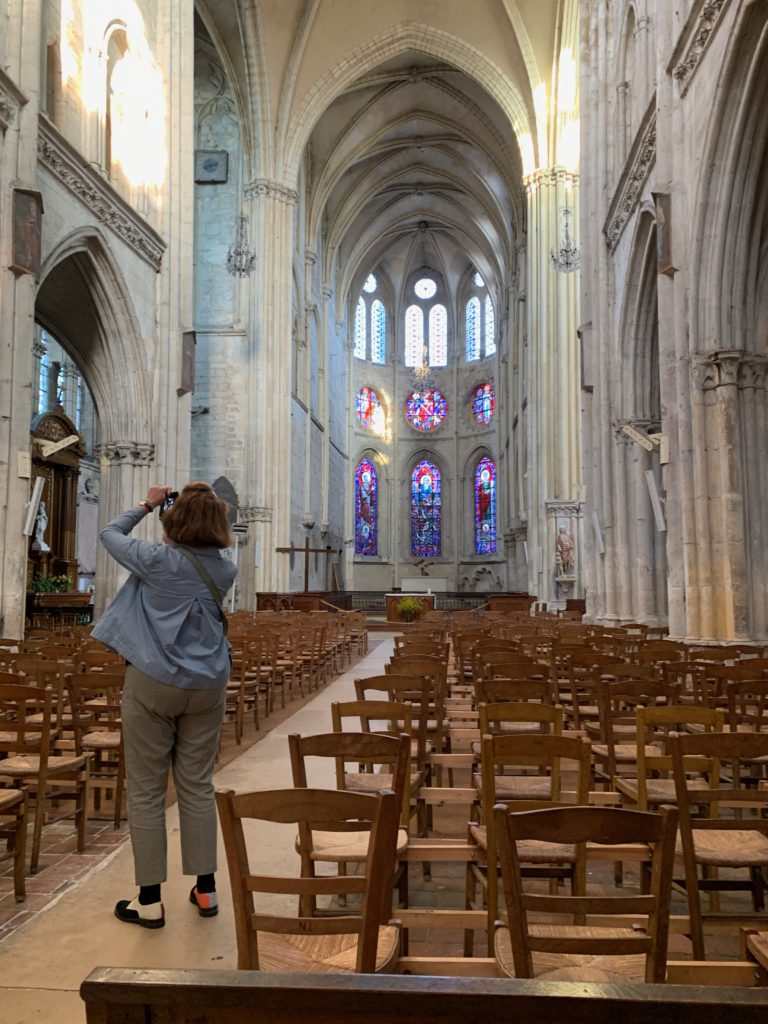
Throughout the process of reassembling their lives into a coherent narrative, Kathie had faced challenges at every turn. Eliza Greatorex once said, “I hate to write letters”. What personal correspondence she left behind is scattered through a variety of private and public collections. Much of the factual details had to be drawn from newspaper articles and accounts left by others. We had come here to do a bit of housekeeping. Having come this far, we decided to make a final attempt to confirm the location of their residence. Upon leaving the church we turned left, walked south up Rue de l’Eglise, to the intersection at the top of the hill with Rue des Fosses. Here we turned right, heading back toward Place de Samois and our hotel. A mixture of residential and commercial buildings lined the street. I brought up a map on my phone, selecting the satellite view. A blue dot marked my location. Behind the buildings to my right, I could see on the screen a series of gardens, but there was no opportunity to glimpse what lay behind the walls. The only confirmation we had received so far concerned was a modest house, at the angle of Rue Pave Neuf. Questions remained. Where was George Grey Barnard’s studio, the building that almost was rented by Rodin? Where was the sunken garden, described a letter by Eleanor? Where were the boundaries? What was the extent and configuration of the property? Passing Rue du Clos Blanchet, leading back to the labyrinth of alleyways we had explored on Monday, Rue des Fosses veered to the right. At the foot of the hill, I recognized the now familiar Place de Samois, our final destination. This was it. No more second chances.
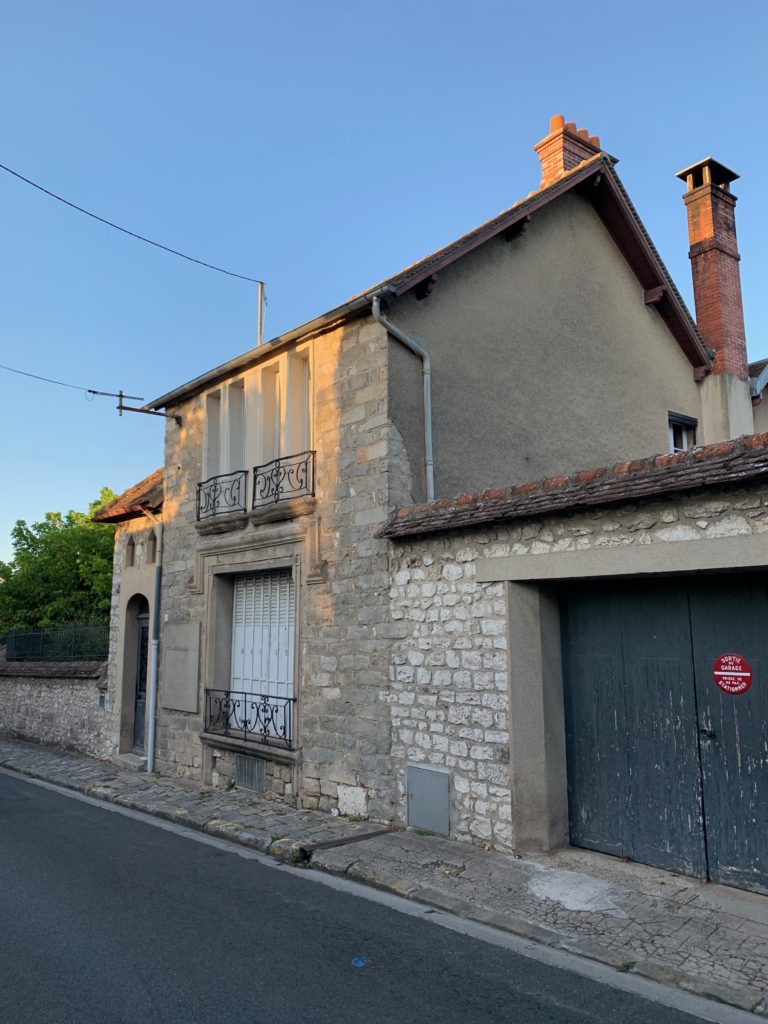
Rooftops were washed in golden light, like the church painted by Sisley. Across the street, a woman collected her mail. We asked if she knew anything about a group of American women artists living nearby, long ago. She shook her head. When I mentioned the word “ramparts” she replied. “la”, pointing to a rough stone wall with a garage-door, painted green.
Next to it stood a shuttered building with pitched roof and brick chimney that might be considered a cottage. In a letter to a friend in 1909, Sarah Hallowell mentioned that “…Miss (Kathleen) Greatorex has her home on the extremity of her property”. Had she sold the house on Rue Pave Neuf to the Hallowells, and was renting buildings to the likes of George Barnard, where had her residence been located? Could that be it?
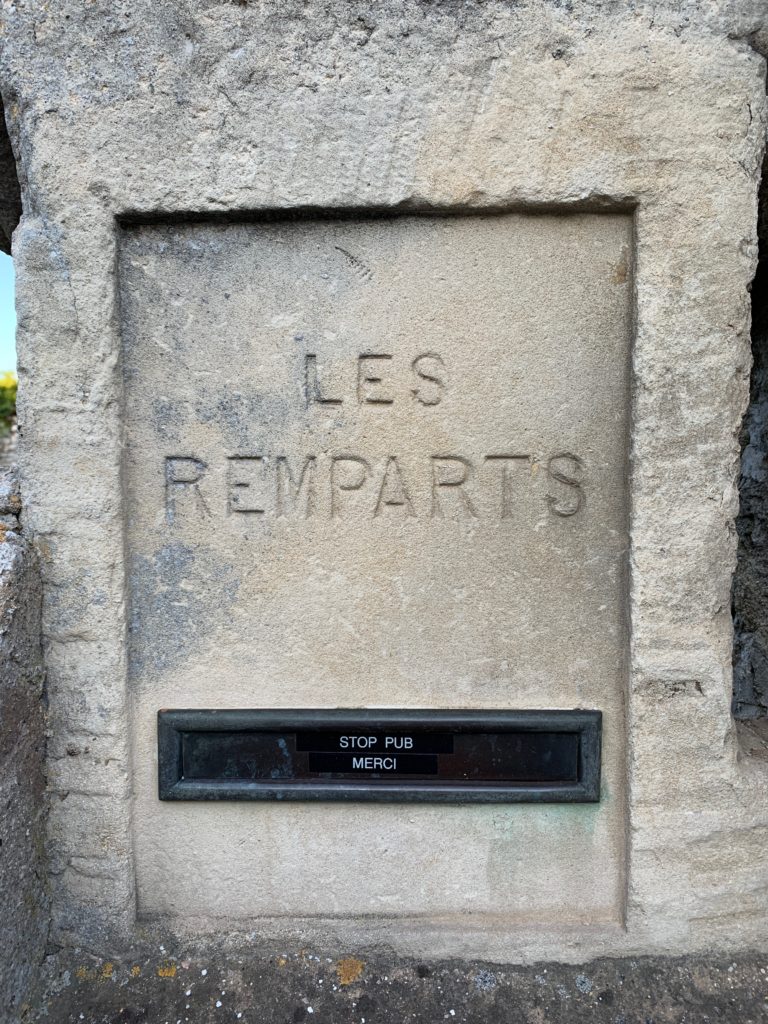
At the far end of the facade was small arched doorway. Just beyond, a long stone wall runs follows the sidewalk to the next building. Tree-branches reached over the wall. I crossed the street. Next to the doorway was a small stone plaque, into which a mail-slot was set.
On its metal flap was inscribed “STOP PUB MERCI” (No junk-mail please).
Just above, carved into the stone, in large block letters were two words.
LES REMPARTS (The Ramparts)
Standing on tiptoe, I peered over the wall to behold a beautiful sunken garden. On the far side stood a small tower, and a stretch of the old city walls, exactly as Eleonore had described in her letter as feeling like an amphitheater. At the south end of the garden stood an elegant home, tucked up behind the smaller building that faced Rue des Fosses. The street was on the same level with the first floor of the main house, with the ground floor being at garden level.
Buoyant with this discovery, we marched down to the Cheval Noir, where Anne informed us that a meeting had been arranged for us the following morning with Les Amis de Moret and Les Amis de Sisley. Anne then made a dinner reservation for us as the creperie next door. With a couple of hours to kill we returned to our room, opened the bottle of wine we had been saving, settled ourselves on the deck, and took stock of the day.
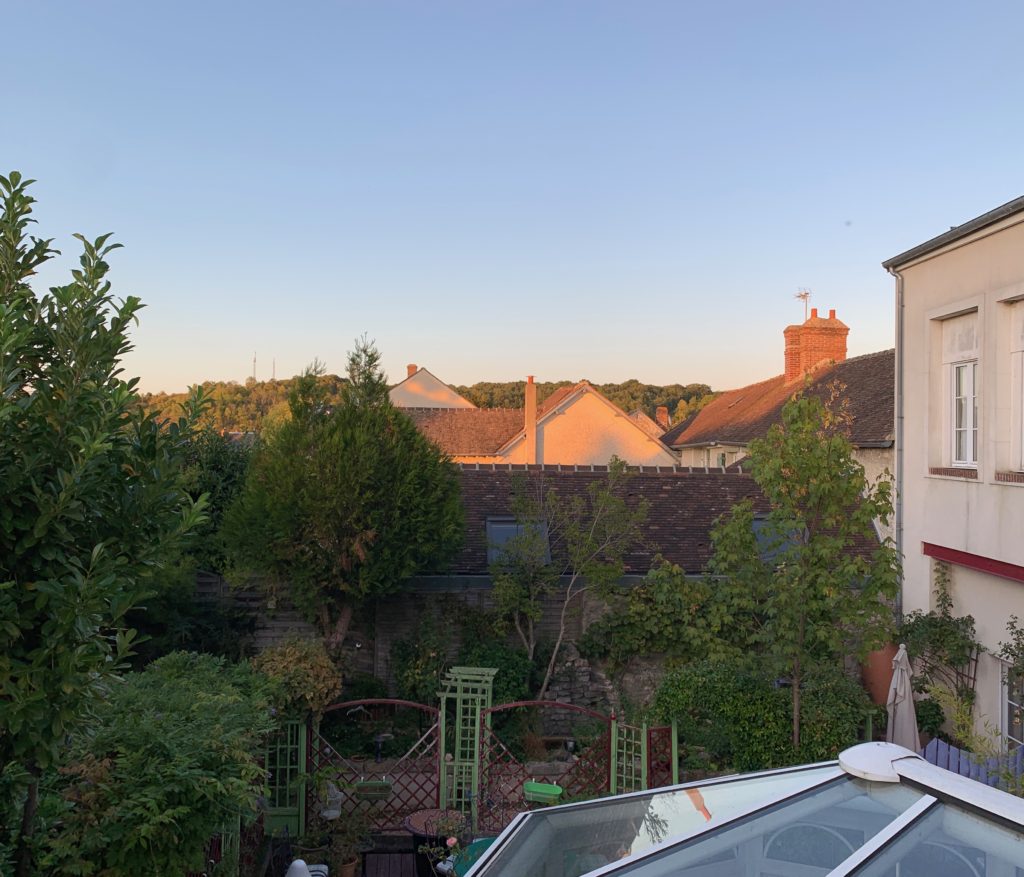
Rooftops of Moret at Sunset, from the deck behind the Chambre Monet above Courtyard of Hostellerie du Cheval Noir
Our final day in Moret began with another fabulous breakfast at Hostellerie du Cheval Noir, followed by a meeting with three gentlemen representing Les Amis de Moret and Les Amis de Sisley. None had ever heard of Eliza Greatorex or her daughters. We shared our research with them, and were informed that according to local lore, a number of medieval statues, and a capital from a column in one of the nearby churches had been purchased by an American artist and were now on view in a New York museum. Kathie explained that the artist in question was Greatorex tenant George Grey Barnard, (1863-1938) whose collection now forms the core of the Met Cloisters. We unpacked the tale of finding Les Remparts, diplomatically inquiring if the present owners of the property might welcome a visit. We were discouraged from pursuing the idea, as the homeowners treasured their privacy.
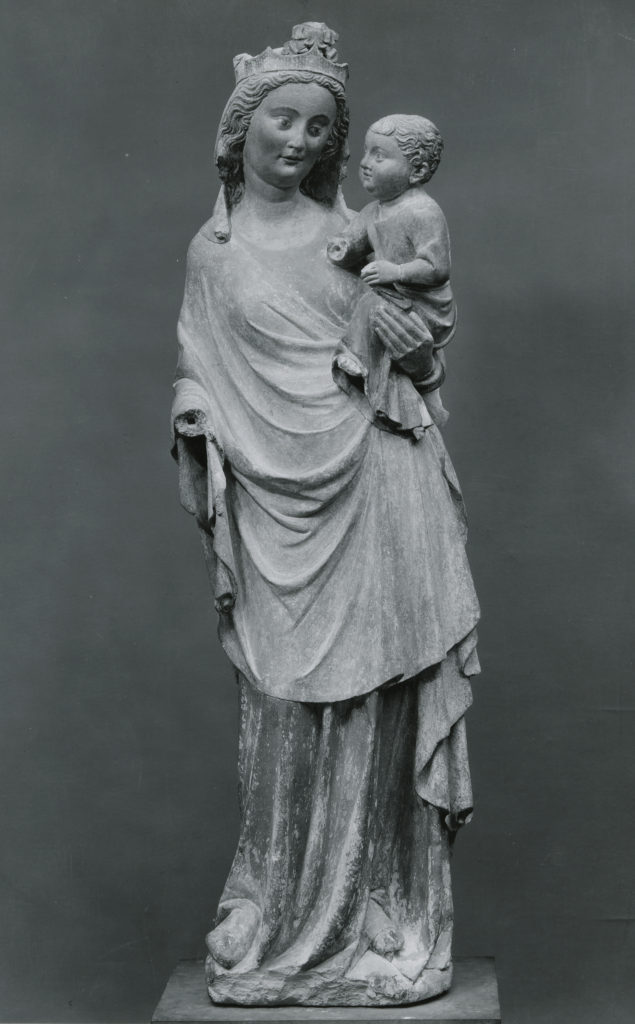
Standing Virgin and Child. France (Moret sur Loing). ca 1300-1350. Met Cloisters, New York.
Christian Lecoing, who spoke very good English, expressed interest in learning more about Greatorex, not only because of her daughter Kathleen’s friendship with Alfred Sisley. but because of her activities as part of the plein-air etching movement. Kathie shared that Eliza not only kept a place in Paris, near the Luxembourg Gardens, but that she had also embarked on sketching excursions to Cernay-la-Ville, and Chevreuse, today a ninety-minute drive from Moret. It seemed that the town of Sisley might have yet another artist to feature along the Routes des Peintres, a project celebrating the travels of Impressionist painters. We learned that apart from establishing partnerships with towns along the Impressionsims Routes, Moret operated an artist residency program through a cultural exchange with Szechuan, China. The story goes that one day a Chinese painter set up an easel on the banks of the Loing and one thing led to another. Everyone was under time constraints as the whole town was busy getting ready for the annual European Heritage festival on the weekend, and we had a train to catch. Following an exchange of contact information, we crossed the street for a photo opportunity at the foot of the Sisley monument. Luc drove us to the station. We all promised to keep in touch. Arriving in Paris, we discovered our hotel reservation (and those of others scheduled to speak at the symposium) had, through some administrative mishap, been cancelled by Centre Pomidou. How Musee d’Orsay came to our rescue is a tale for another day.
(End of text)
COMING SOON:
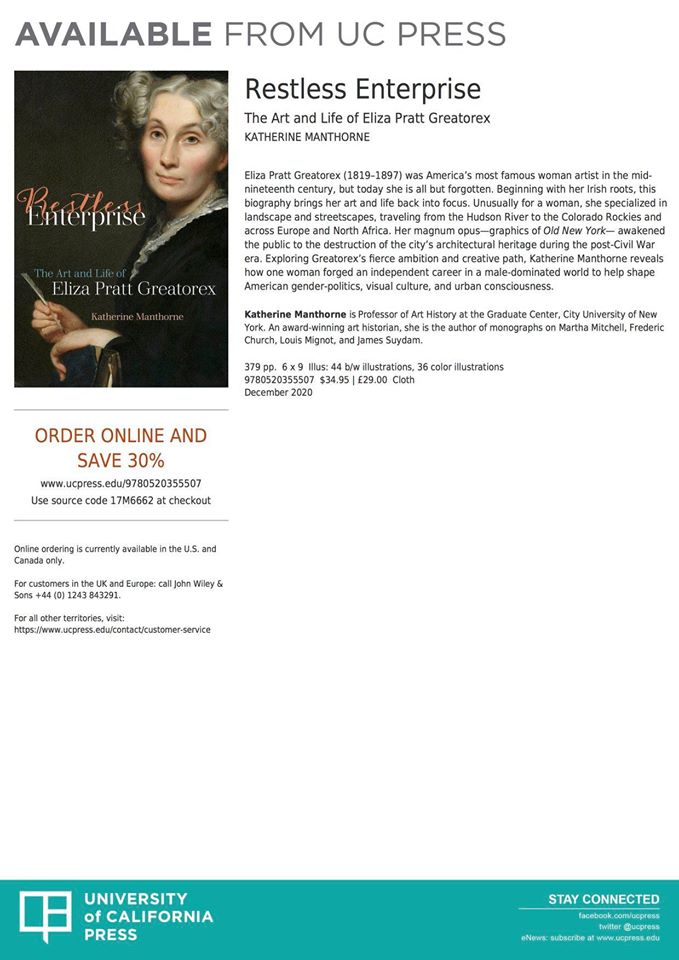
RESTLESS ENTERPRISE: THE LIFE AND ART OF ELIZA PRATT GREATOREX, BY Katherine Manthorne. University of California Press
This inspiring book rewrites the history we thought we knew about women artists in 19th-century New York. Rediscovering a life once described in the national press as among the most important women in American history, the author also brings other lesser-known women into the canon. Unlike privileged woman like Mary Cassatt, Greatorex was born in Ireland, the daughter of a Methodist circuit-preacher, who through personal industry and restless entrepreneurship managed as a widow to raise four children, while building a stellar career as the foremost American woman-artist of her age. In researching this book, Kathie retraced Eliza’s journey from Ireland to New York, to Munich, Oberammergau, Colorado and Paris. Having been on a number of these expeditions, and having read every page more than once, I can say that many surprises await the reader. This is not just an academic biography. It’s a page-turner. I know these are cliches, but Eliza’s story will have you cheering. You will laugh. You will cry. You will be inspired. If this sounds like a movie trailer, it would not surprise me if one day it is. Pre-order a copy online now, and receive a 30% discount.