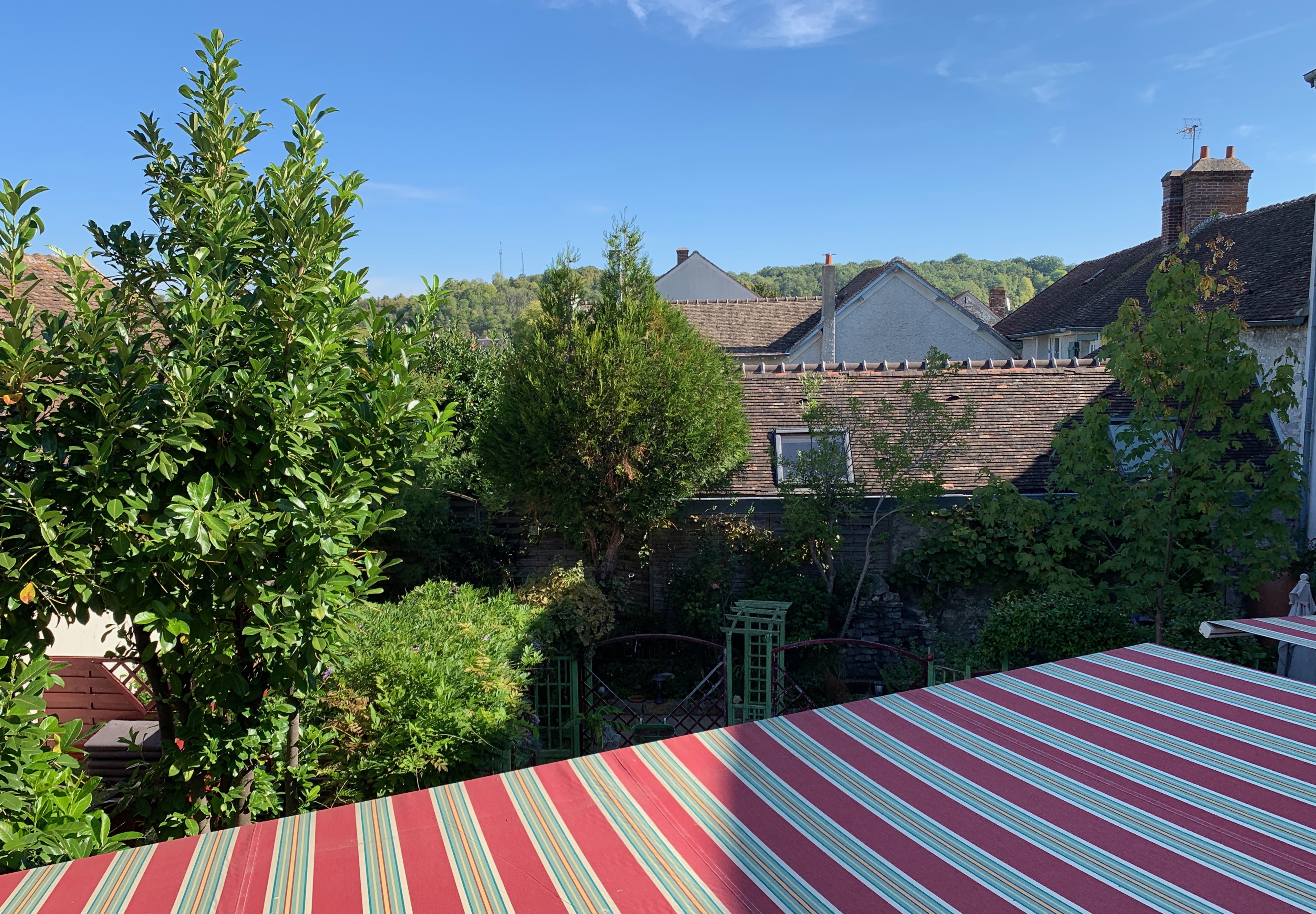
Opening onto the roof-deck, the French window welcomed a cool breeze into the room. We awoke from our nap just around eleven, on the twenty-four-hour clock. We gathered out wits and debouched from Hostellerie du Cheval Noir into Place de Samois—a small square consisting of small wooded car-park to the south, and a medieval tower to the east, pierced by an arch through which passed Rue Grande—the only straight road in the town.
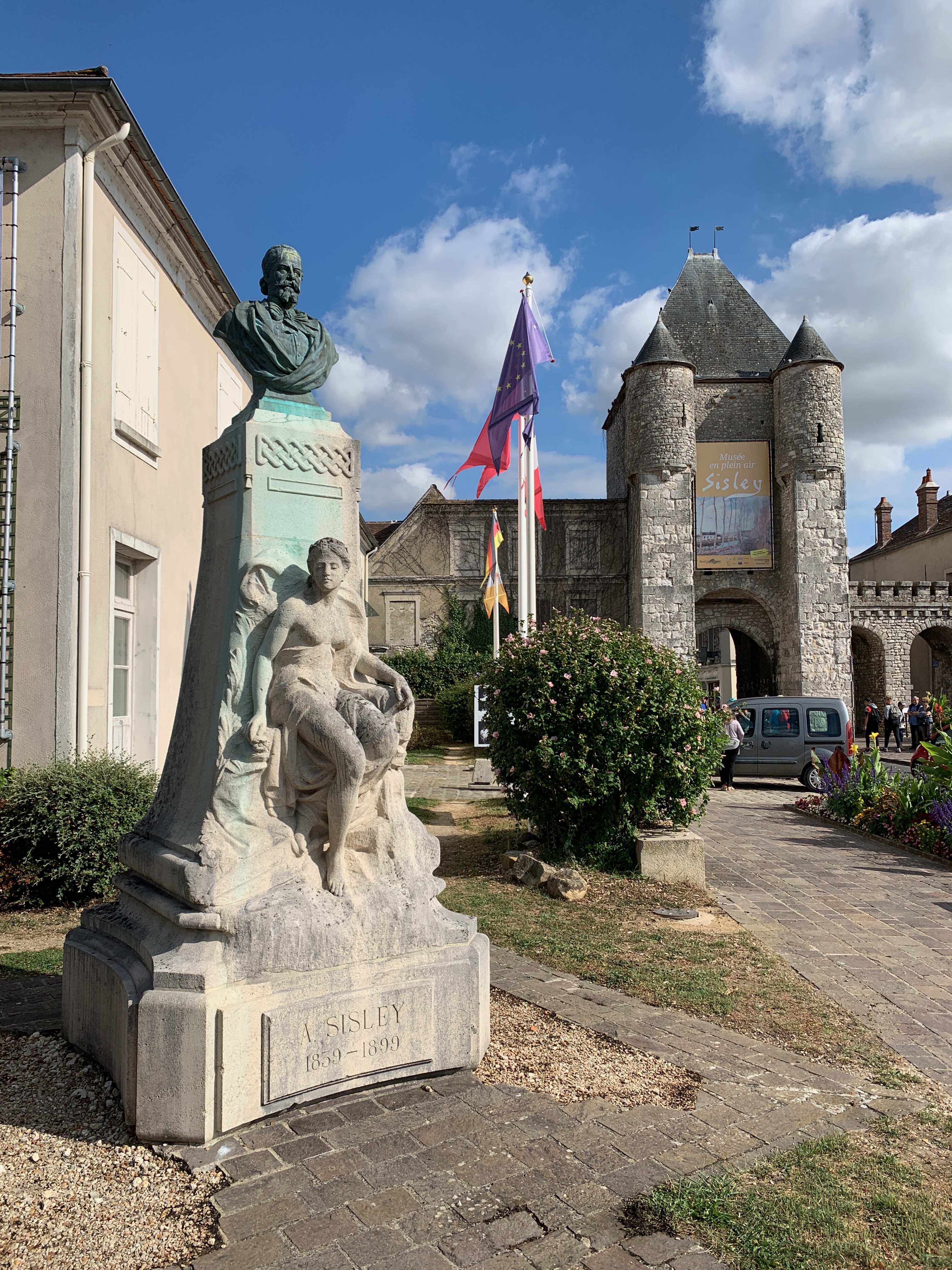
Monument to Alfred Sisley, Place de Samois. Moret sur Loing
It was Monday. At midday, every shop was closed. We stopped at Le P’tit Moret, a creperie on Rue des Granges. The door was open. Music was playing. Chairs were set out on a deck across the narrow street. Calling out to see if the place were open, a young man emerged from the kitchen who told us they would not be serving until noon. Wandering down the street, we emerged onto Place de l’Hotel de Ville—a wide, open square with a gentle incline, paved with flagstones. The city hall resembled a large stone house, next to which stood a timbered building with a glazed storefront, occupied by Les Amis de Sisley, a local society celebrating the legacy of the Impressionist painter who lived and died in Moret. Along Rue Grande, we noticed people sitting at a cluster of umbrella-tables consuming something. Beside them rose a Great War monument—a sandstone private standing at parade rest, honoring the battle-dead of Moret.
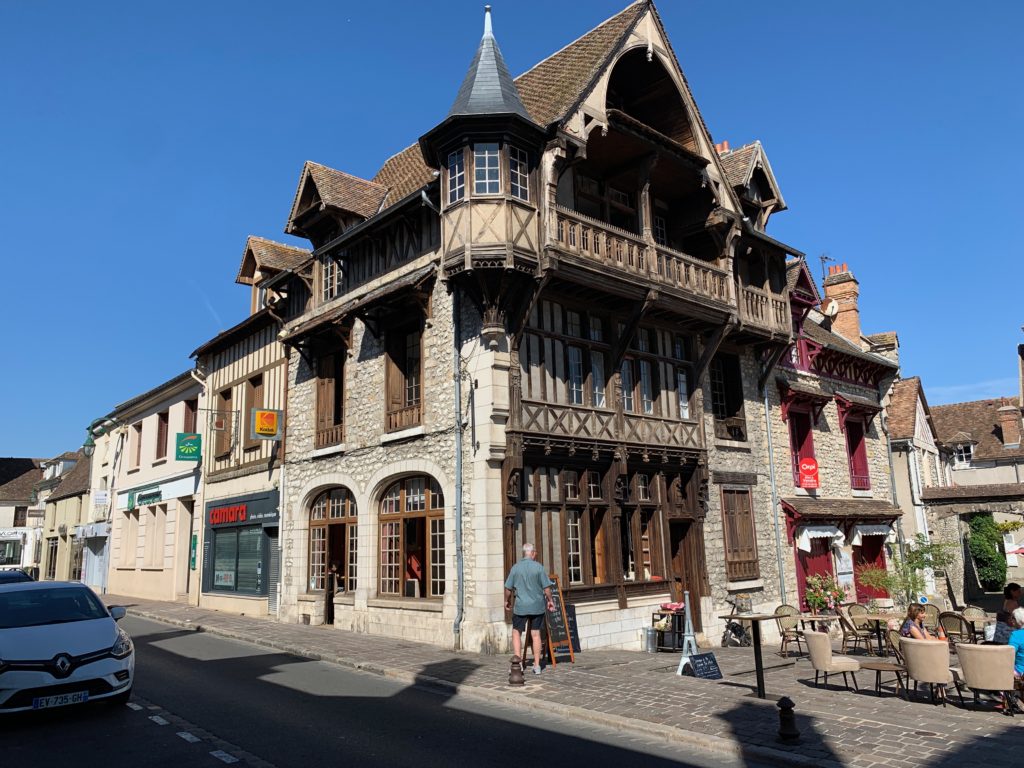
La Maison des Arts, Place de l’Hotel de Ville, Moret sur Loing-et-Orvanne
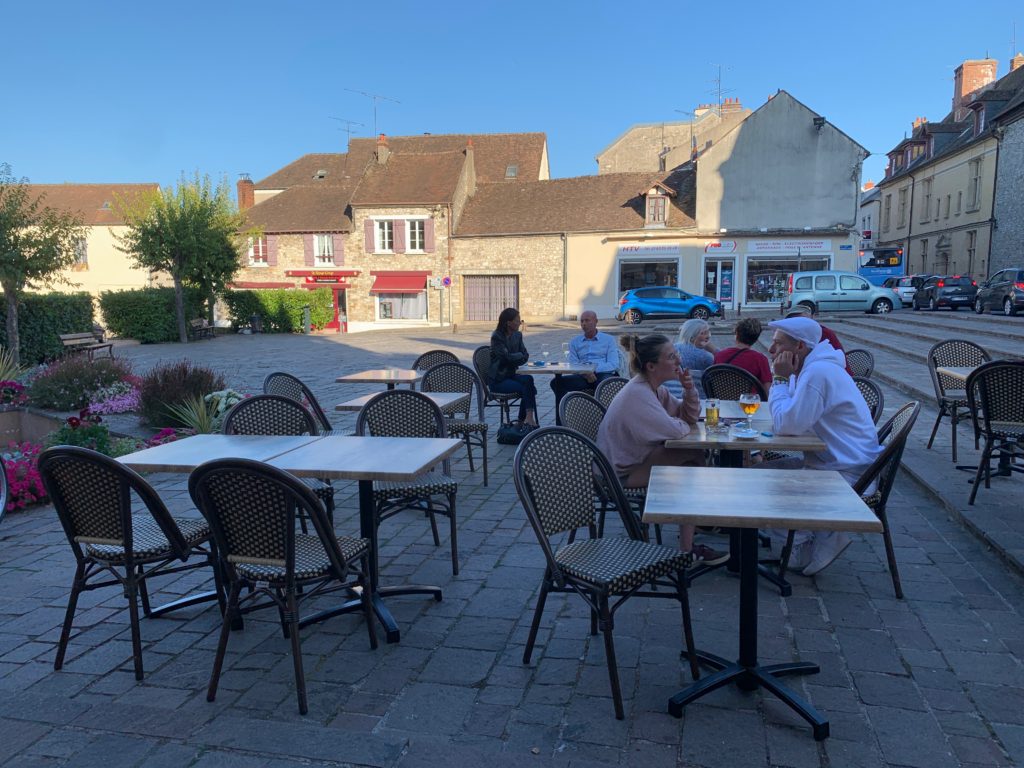
Place de l’Hotel de Ville, Moret. Exterior seating for La Maison des Arts
We took a seat. The young, lanky waiter wore his hair long, with a man-bun. He brought us menus, explaining that while no food is served until noon, the bar was open. At that moment, it would be happy-hour in New York. I ordered a beer for me and a Chardonnay for Kathie. Consuming the beverages with relish, we reveled in pre-prandial decadence. At twelve the waiter reappeared, pencil in hand. We ordered a charcuterie plate and another round of drinks. La Maison des Arts is notable in part for the building—a half-timbered medieval revival, built at the turn of the penultimate century. The woodwork, inside and out, had been done by a master carver and cabinetmaker named Racollet. His personal logo was a rat dipping its tail in a glue-pot, a jeu-des-mots on his name. In French, rat is pronounced with a silent “t”. Combined with coller, “to paste”, a homonym of collet, we have Racoller, or Racollet. The artist carved a humorous self-portrait onto one of the wooden pilasters on the façade of La Maison des Arts.
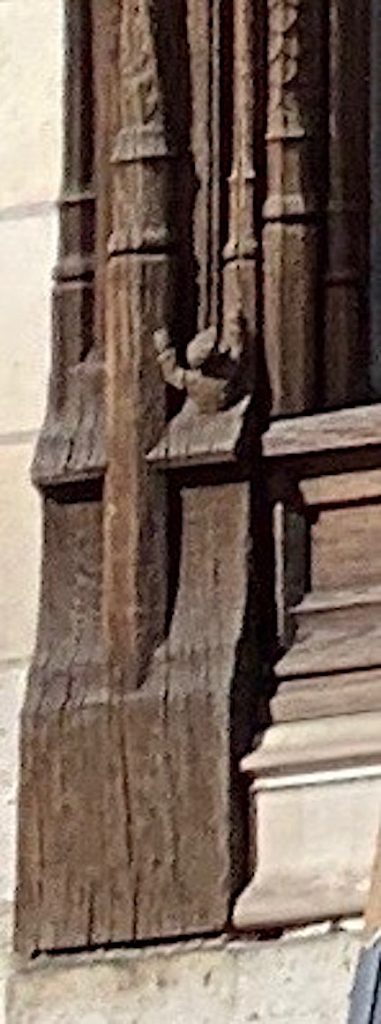
We later were to learn that Racollet had been responsible for a marvelous staircase in the city hall. Lingering over lunch, we reviewed our notes and ordered another round. Like many towns in France, shops in Moret close between noon and 15:00. Here on Mondays they seem never open at all. Strolling back to the hotel, I ducked into the tourism office to obtain a map. The young woman behind the counter knew a little about Sisley but had never heard of Greatorex. She pointed me toward the Sisley monument, a bronze portrait-bust atop a tapering stone pedestal, from which emerged a comely female nude, presumably his muse. Back at the hotel, Anne the proprietress expressed concern about us finding someplace to dine, it being Monday. Her offer to make a reservation for us we graciously accepted. After a catnap, we resumed our reconnaissance by returning to the Place de l’Hotel de Ville along Rue des Granges. Next to the post office we passed through the northern gate, which was crowned with a pitched roof and ornamental cupola.
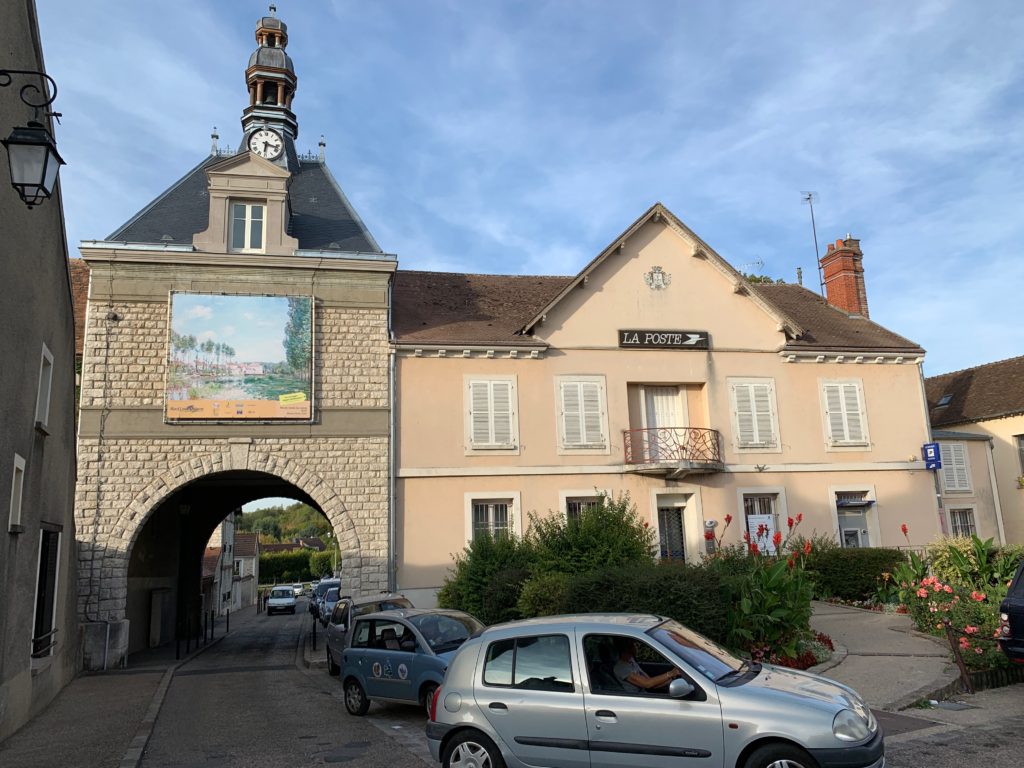
The North Gate, Moret sur Loing
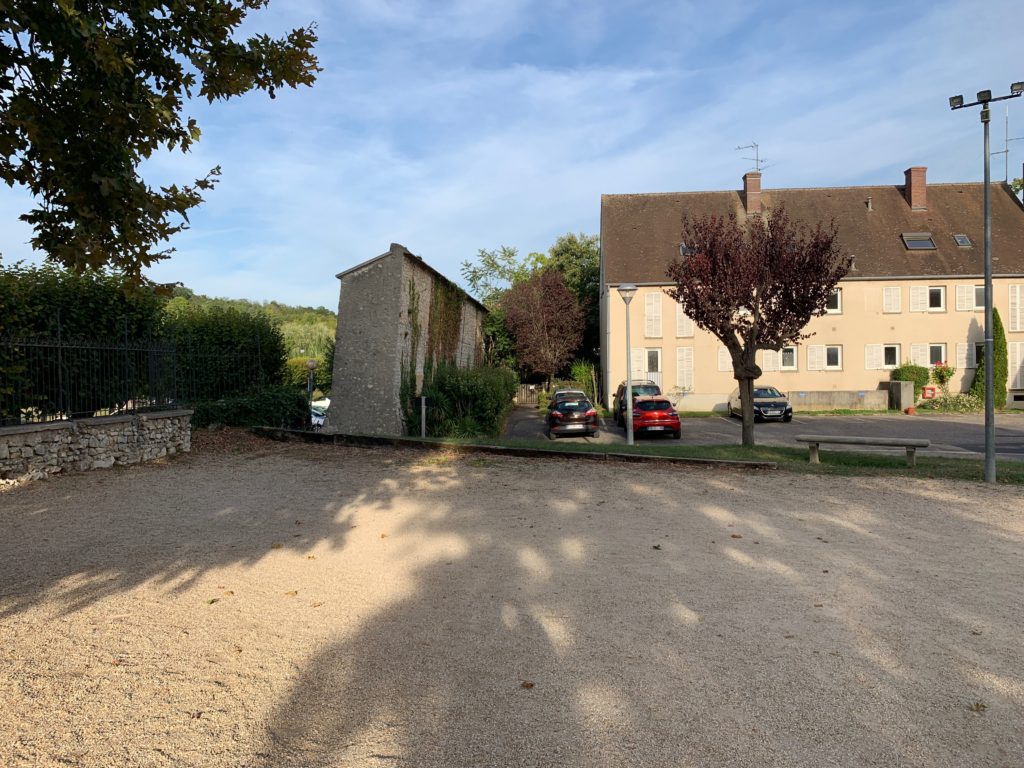
Sandy lot behind the post-office, with a fragment of the ancient wall.
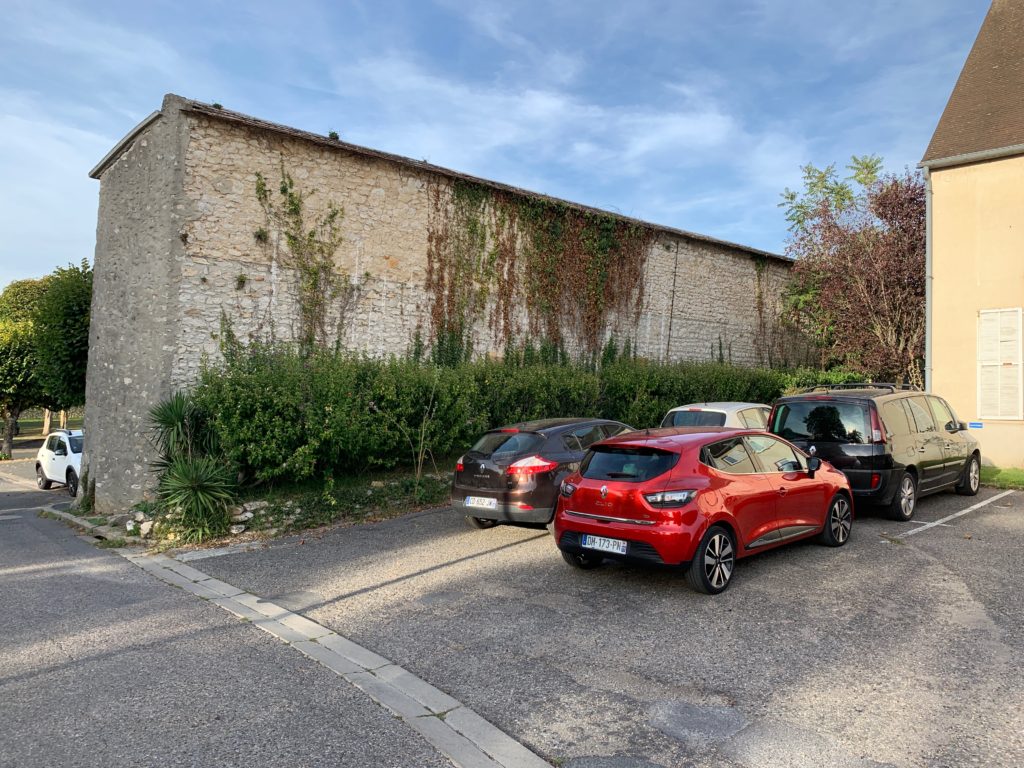
12th-c. perimeter wall, Moret sur Loing
The street—Cour de Couvent, led us to Rue du Peintre Zanaroff, with a car-park across the street, with a park off to the right. Running parallel to Rue Zanaroff on the near side of the street stood a section of the twelfth-century wall, dressed at one end like it had been sliced clean through with a knife. We had found the ramparts. Examining the medieval wall, we were stunned not to find them more stoutly built. Shortly after their construction, the structure would have had a timber walkway near the top, for defenders to occupy in repelling attacks. Below that perhaps one might find modest shops, ateliers and dwellings. Nothing remains today except for the wall, covered with ivy.
At its interior base, a driveway led back to a residential garden where a woman stood talking on her mobile. As the Greatorex women had lived near the ramparts, I saw no harm in asking a local if they had any knowledge or oral tradition remembering three American women living nearby. As I walked up the driveway, a man on a motorbike came up behind me. I explained the nature of my quest, but neither had ever heard tell of American artists living in town. Only Sisley. We continued to follow the wall, peering into gardens, comparing what we beheld with the handful of lines describing the Greatorex property as being by the ramparts, with a small tower nearby, a large studio building which they once tried to rent to Rodin. We walked toward the Loing, around yet another round tower, into a riverside park known as Le Pre Magaron.
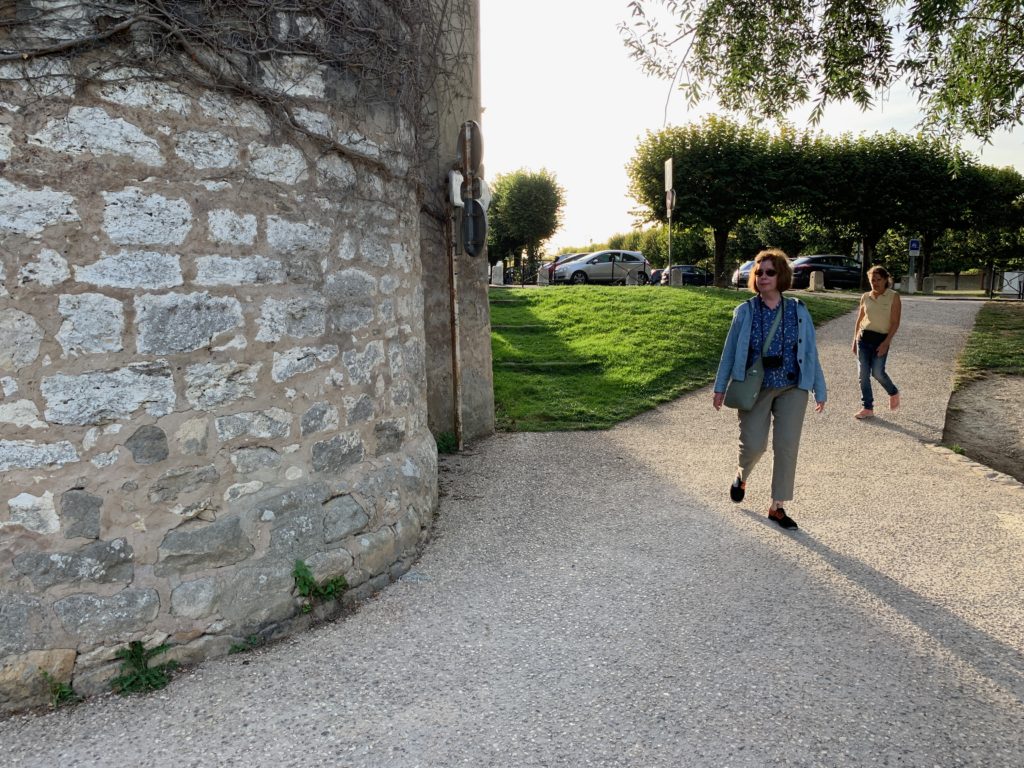
Kathie entering Le Pre Magaron
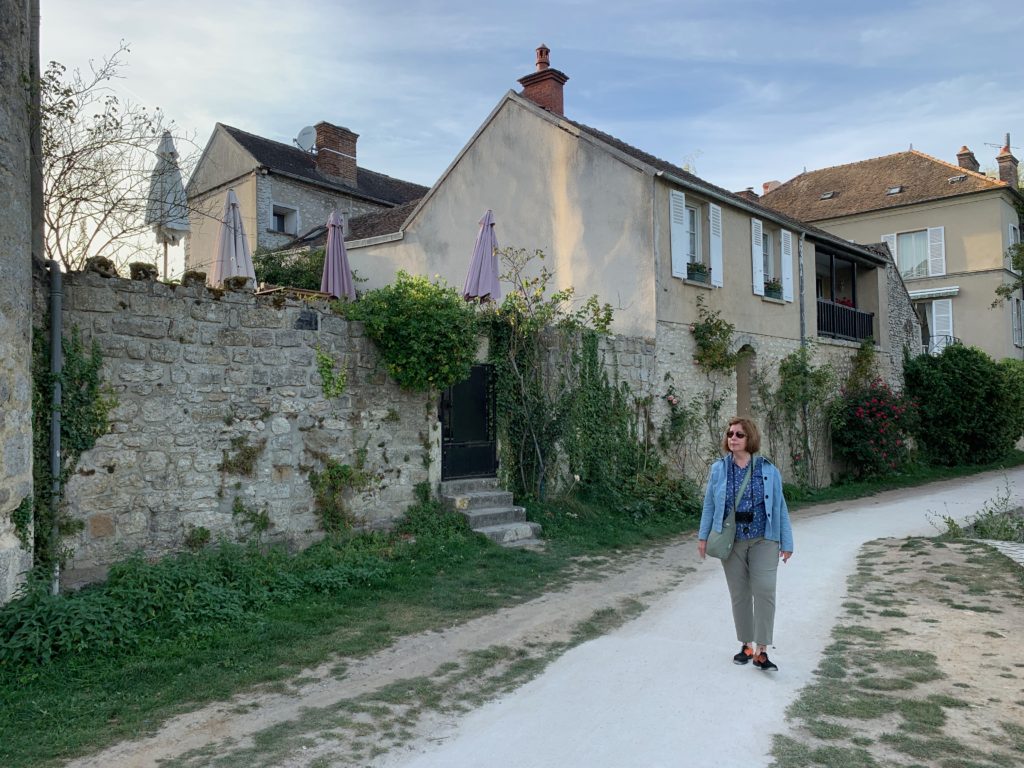
Houses built into the perimeter wall along Le Pre Magaron
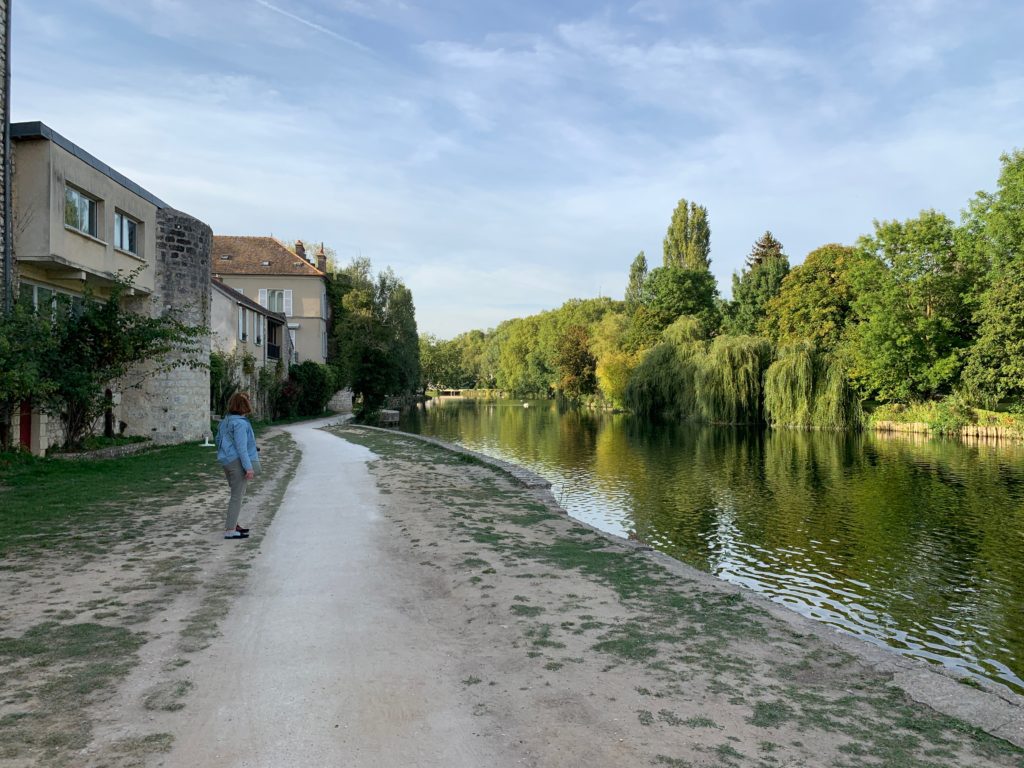
The scholar pauses to reflect
Here the enclosing wall stretched southward, toward the bridge and the Porte de Bourgogne. A number of properties could have fit the bill. Many were built into the remnants of the old city wall. East across the river stood the reconstructed mill. The river Loing empties into the Seine about a kilometer to the north. In the middle of the span is an island, upon which stands a reconstructed mill. The original Moulin Graciot, which had stood for hundreds of years was blown up, along with several arches of the ancient masonry bridge, when German troops withdrew from the town in August of 1944. Another mill along the south side of the bridge—Moulin a Tan has been refurbished to serve as an art gallery, while yet another mill now houses the Musee du Sucre d’Orge des Religieuses de Moret (Moret Museum of Barley-Sugar of the Religious). The shop selling the candies stands opposite the Church of Our Lady of the Nativity (l’Eglise du Notre Dane de la Nativite), on Rue du Puits du Four.
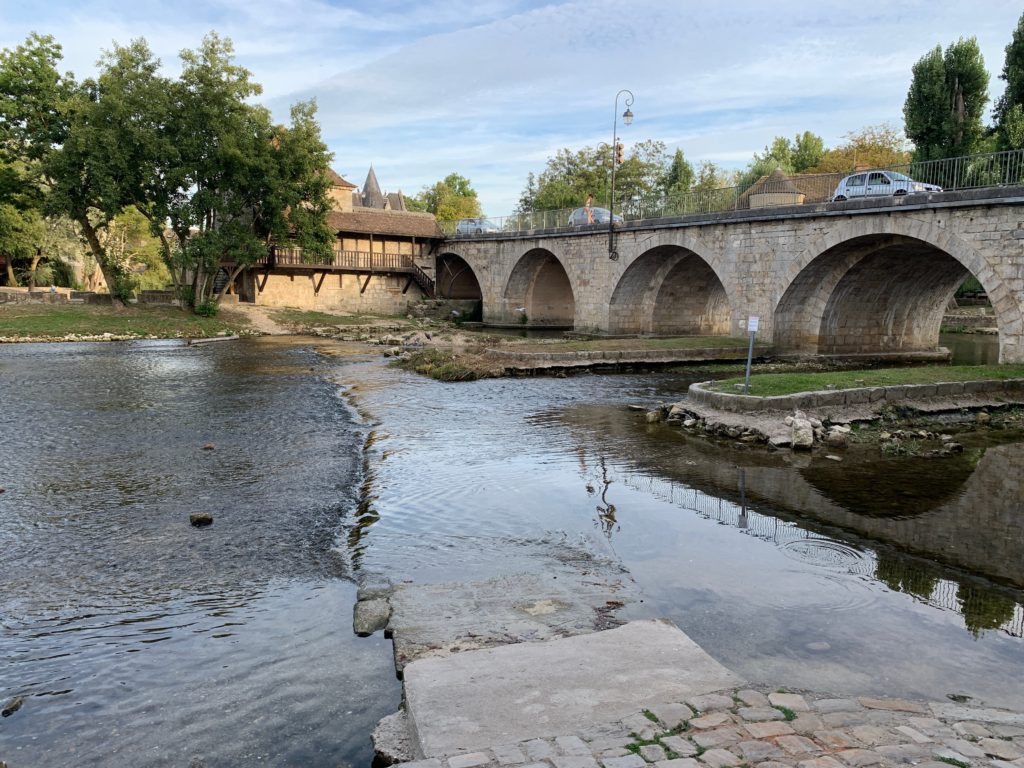
Moulin Gratiot and Pont de Moret
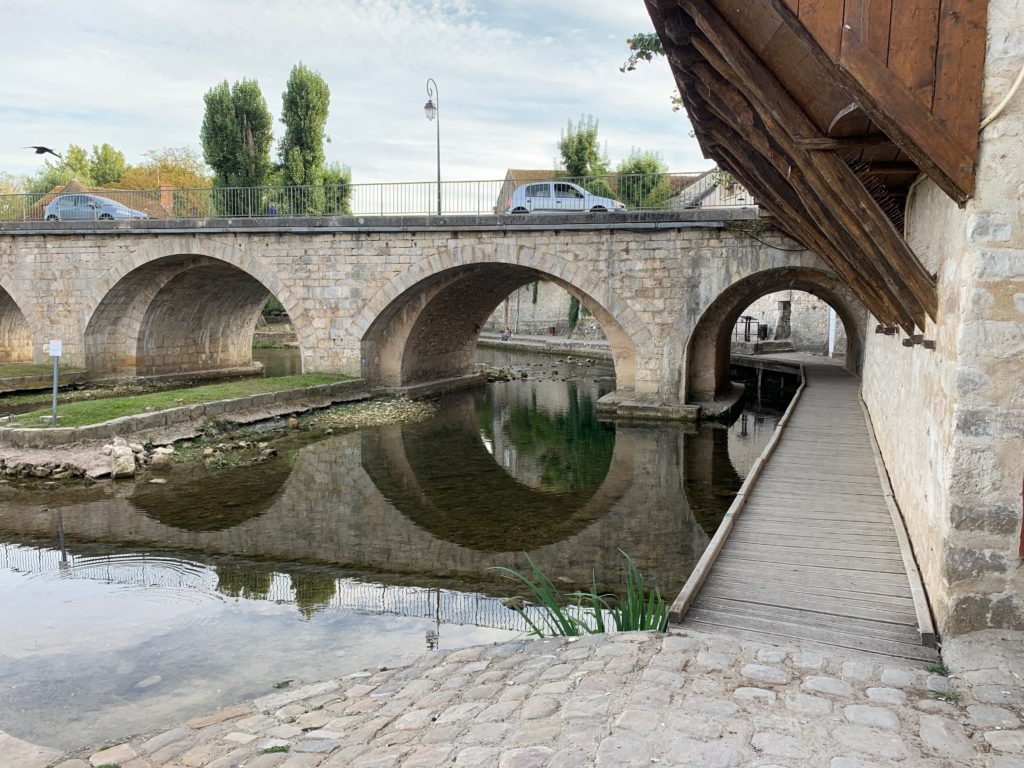
Looking west beneath the bridge to the Quai des laveuses, the low doorway to the staircase beyond
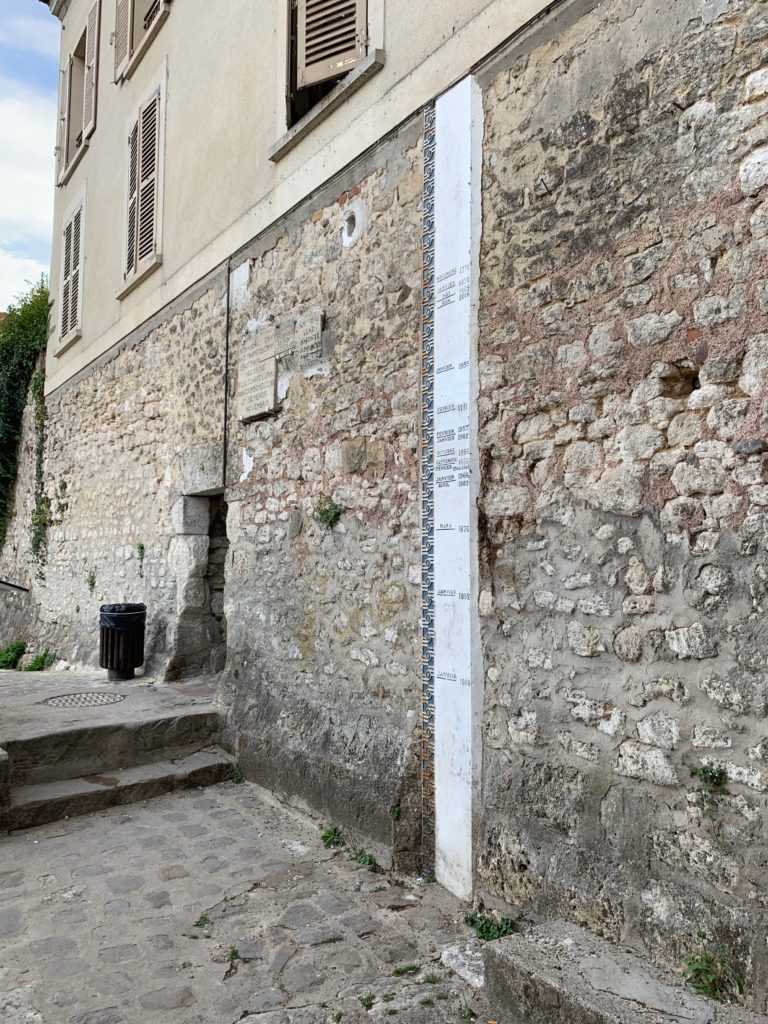
High-water marks recording various flood levels over the century, Quai des Laveuses
Passing below the bridge we came to a series of small waterpower dams, beneath a canopy of trees. The city wall soared overhead. A couple of young women sat huddled at the water’s edge. The paved esplanade known as Quai des Laveuses narrowed to its terminus, where an elderly lady was seated, lost in thought. Backtracking, we came to a low opening in the base of the wall behind a large stone. The doorway gave access to a covered way in which a stairway inclined steeply upwards. A gap between two buildings covering the stairs admitted some light. Aerosol paint tags on the passageway’s dingy yellow stucco walls may be graffiti, but calling it art would be a stretch.
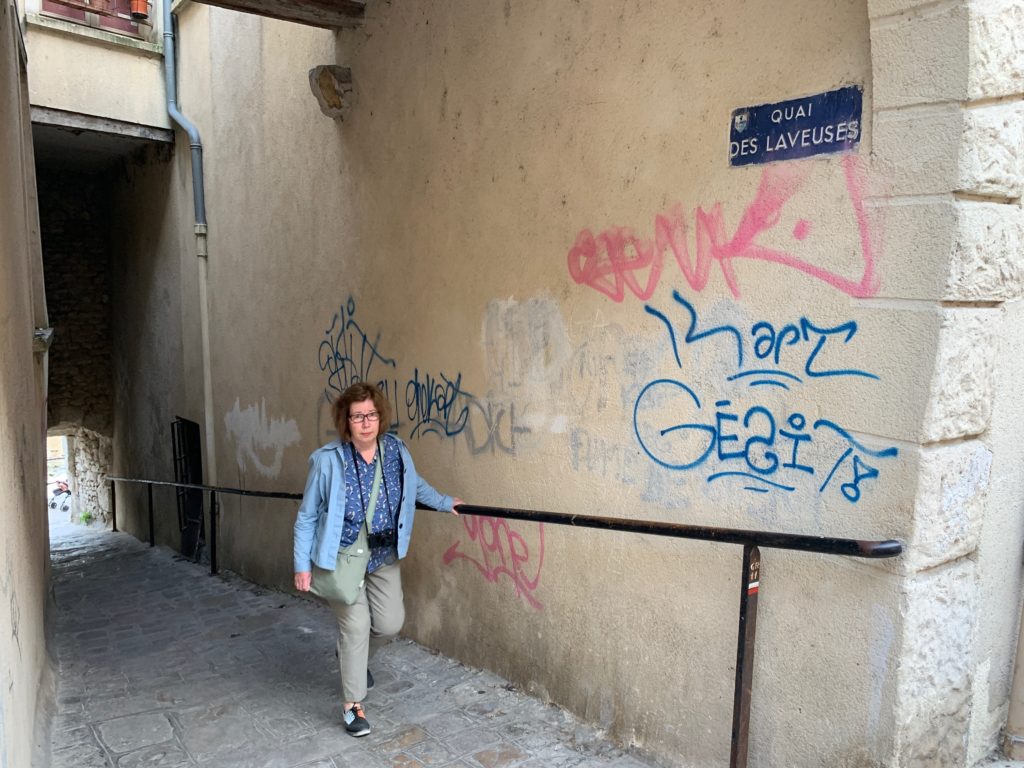
Kathie on the stairs at Quai des Laveuses
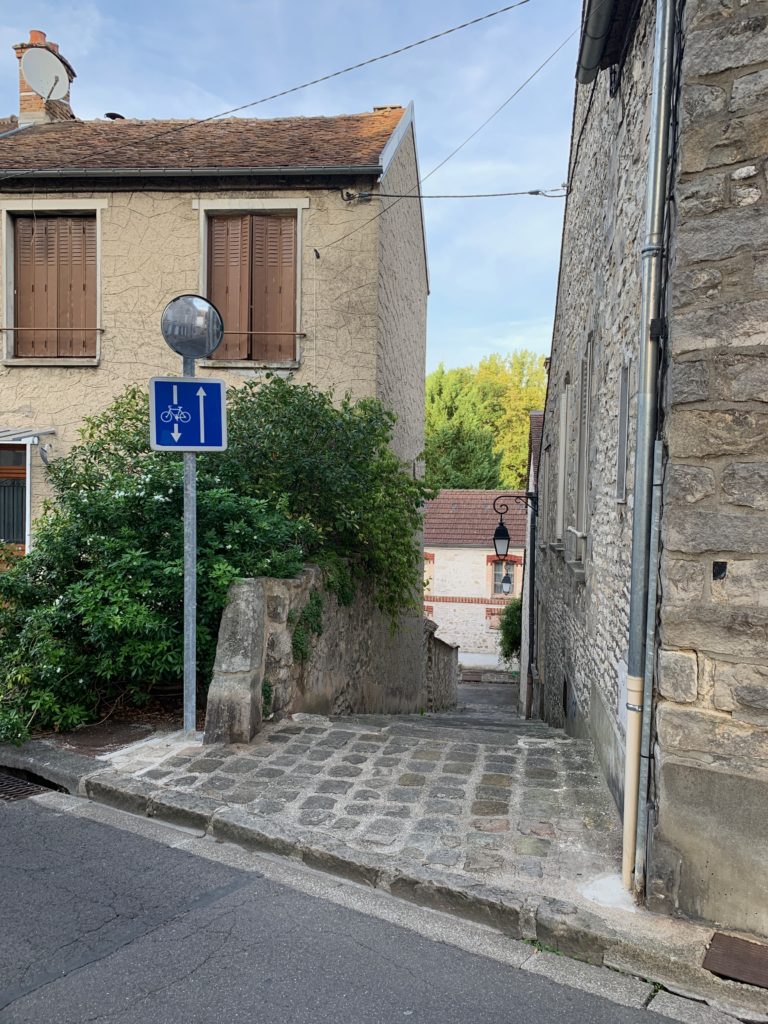
Escalier Royal, between Rue de Tannerie and Rue du Donjon, Moret sur Loing.
We debouched from the tunnel onto Rue da la Tannerie. Walking south we considered the likelihood that any of these properties was the one described by Eleonore Greatorex, or her friend Miss H. Coming to a dead end, we undertook another narrow ascent. In contrast to Quai des Laveuses, Escalier Royal was open to the heavens. Climbing the steps to Rue du Donjon, we turned south to approach the castle-keep. Satellite views show formal gardens and other structures behind the walls. The whole town had been built to function as a fortress, and this massive tower was once its beating heart, a final refuge in the event of a siege. Built between 1128 and 1154 in the Roman style, it resembles some Norman keeps found in the British Isles.
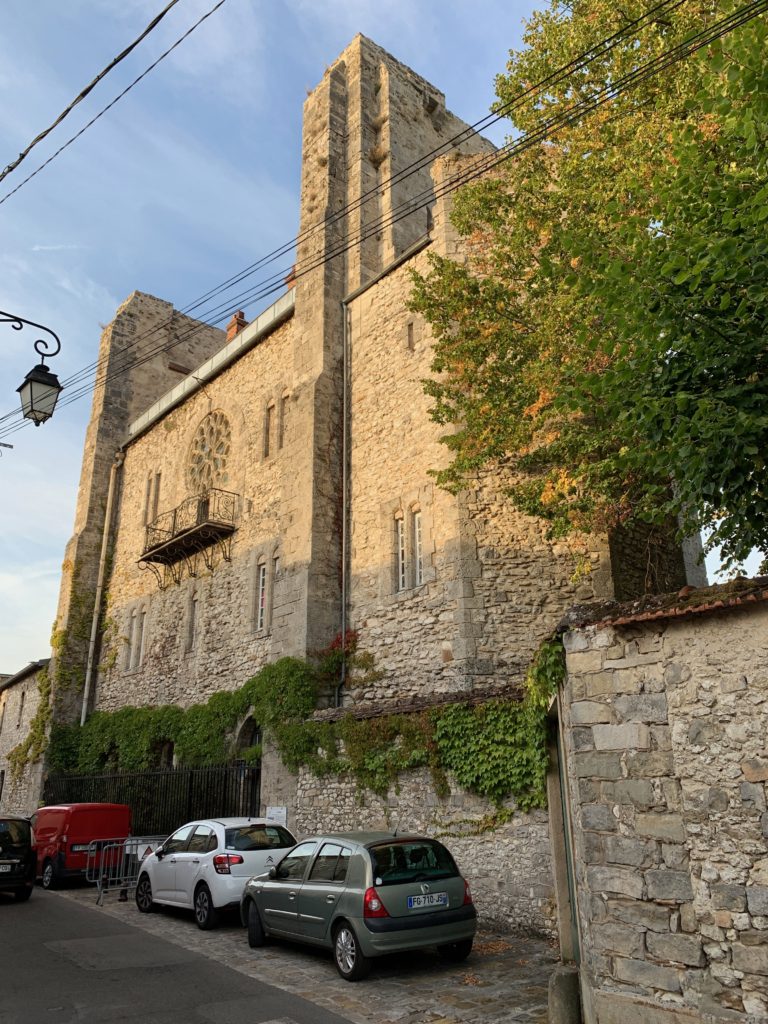
The western facade of the Donjon de Moret
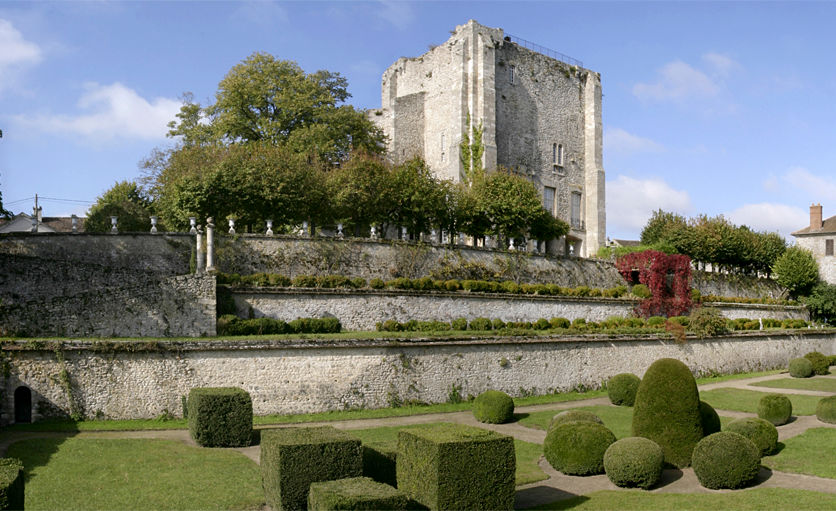
Eastern facade of the Donjon de Moret, from the garden
During the 17th century, it served as a prison. Having been arrested by d’Artagnan, Louis XIV’s disgraced finance minister Nicholas Fouquet was incarcerated here at Moret. Beyond the donjon, the street descended precipitously to another cul-de sac. Reversing direction, we came to Rue Monmartre, finding to our left a tall house set back behind a ten-foot wall upon which hung a plaque, identifying it as the residence of the painter Alfred Sisley. Descending Rue du Donjon toward the church, we drifted into a maze of alleyways—some of them no wider than a domestic hallway.
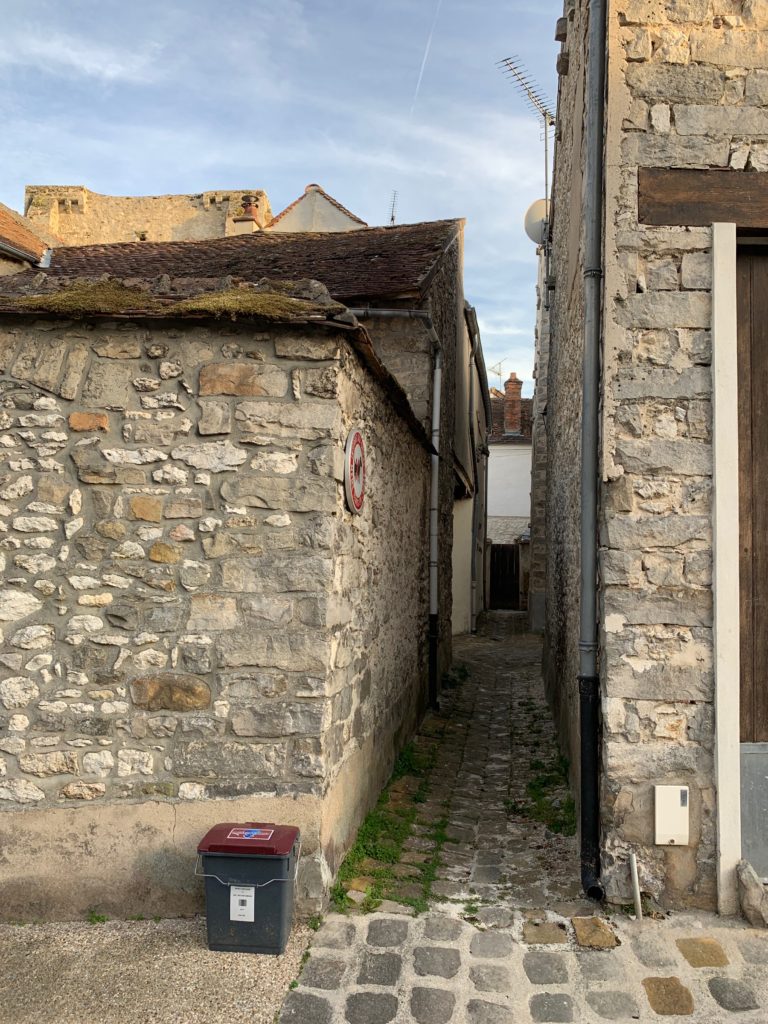
Alleyways, Moret sur Loing
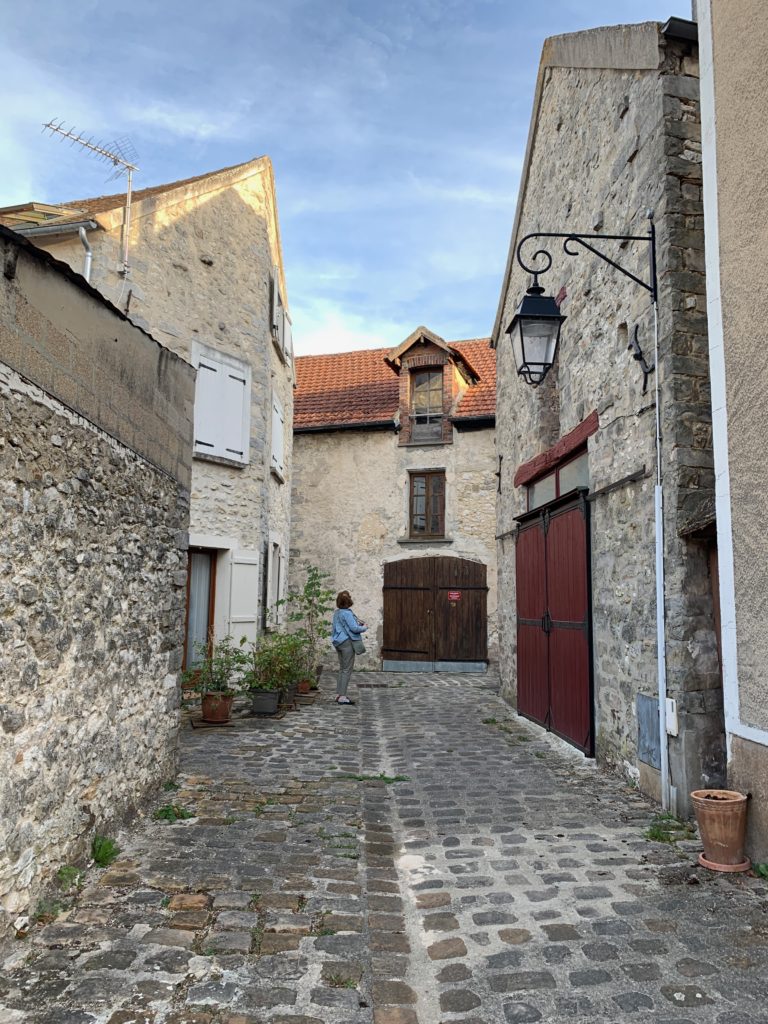
Alleyways, Moret sur Loing
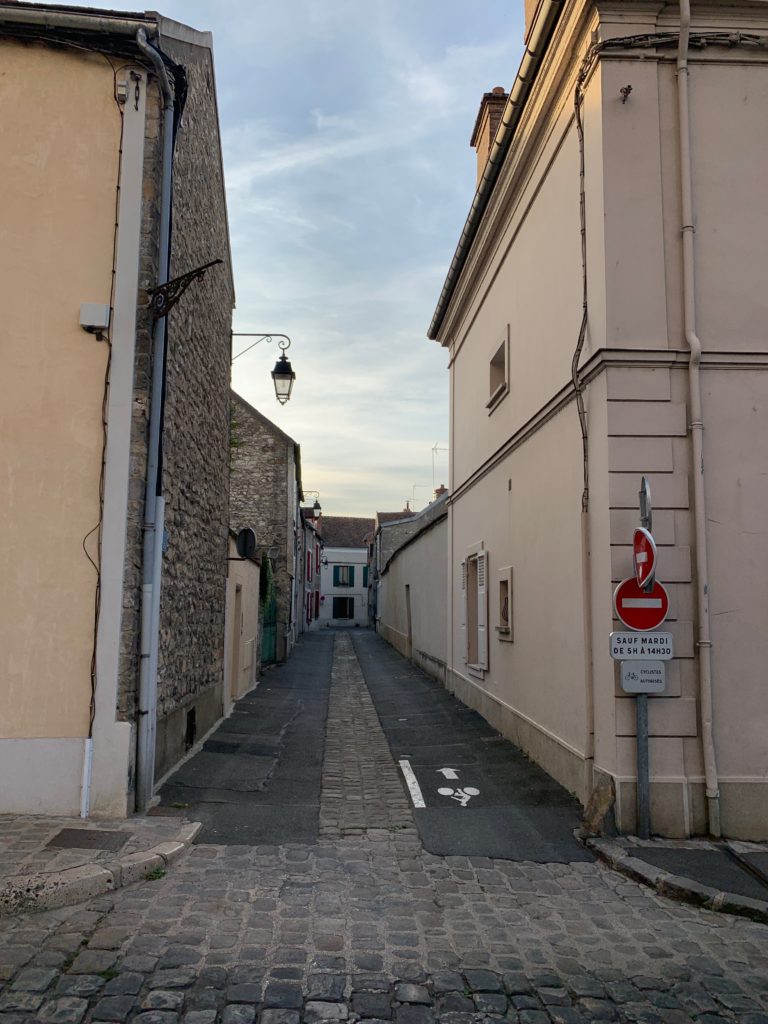
Alleyways, Moret sur Loing
Low stone houses flanking stone stood shuttered and quiet. Returning to Rue de l’Eglise, with an hour to kill before dinner Kathie decided it was time for a snack. She entered l’Echoppe aux Douceurs, a patisserie, while I peered into the window of an art-gallery across the street. At the corner of Rue Grande, we found a bench, where we sat and devoured several rolls. Looking back toward Porte de Samois I saw a woman set out a sandwich-board on the sidewalk. As the sky darkened we made our way back down Rue Grande to L’Entre 2 Ports, a small restaurant specializing in Luso-French cuisine. Kathie and I took our seats on a small deck, perched along the side of the road.
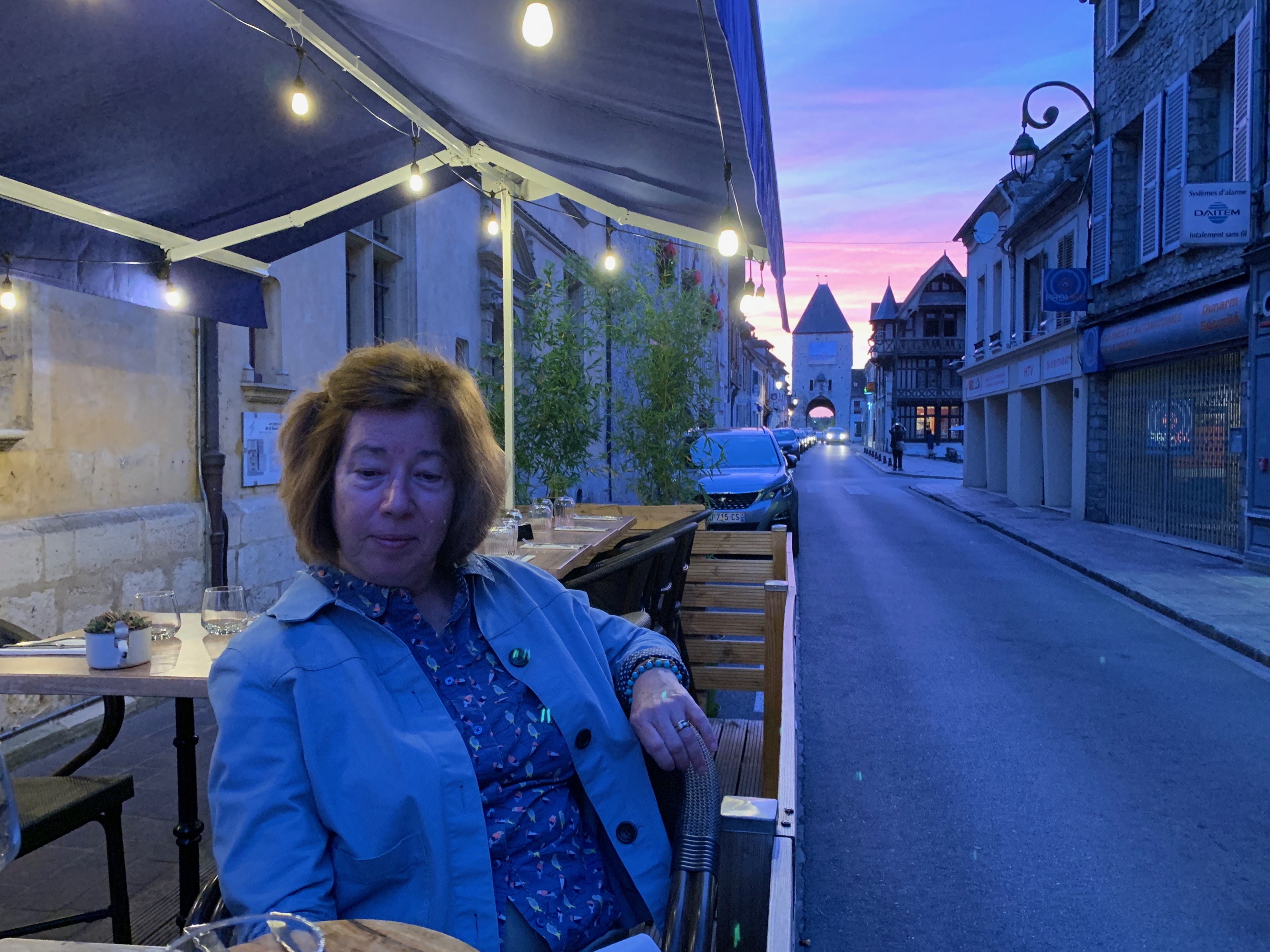
Sitting down to supper at Entre 2 Ports, at the close of a very long day in Moret-sur-Loing
Beneath a blue canvas canopy, plump white lights dangled from electrical cords overhead. Half an hour before, the streets had been deserted. At seven o’clock, small groups of people were seen making their away to one destination or another. Within fifteen minutes the deck that once was ours alone was full of lively conversation. To take our orders, the woman serving us had to stand in the road as cars crawled past behind her. As the sky deepened to an azzurro giottesco our meals arrived. The whole experience conveyed some sense of time-travel. Not because we were dining in a medieval town, or inches away from voitures en passant, but because nearly everyone was smoking, and doing it constantly. Sharing a bottle of light Portuguese wine, Kathie had fish, while I dined on salade de poulpe and maigret de canard. Behind the Porte de Samois the sky assumed first a rosy hue, before blue shifted to a deep purple, above a glorious horizon, glowing red-violet. Walking back through the Place de l’Hotel de Ville we pondered the task ahead, imagining Sisley, Eliza and her daughters treading these very stones, all that remained was to find the place where the peripatetic Greatorex women had finally come to stay, and where the last of them—the beautiful Kathleen Honora–would breathe her last in 1942 at the age of ninety-one.
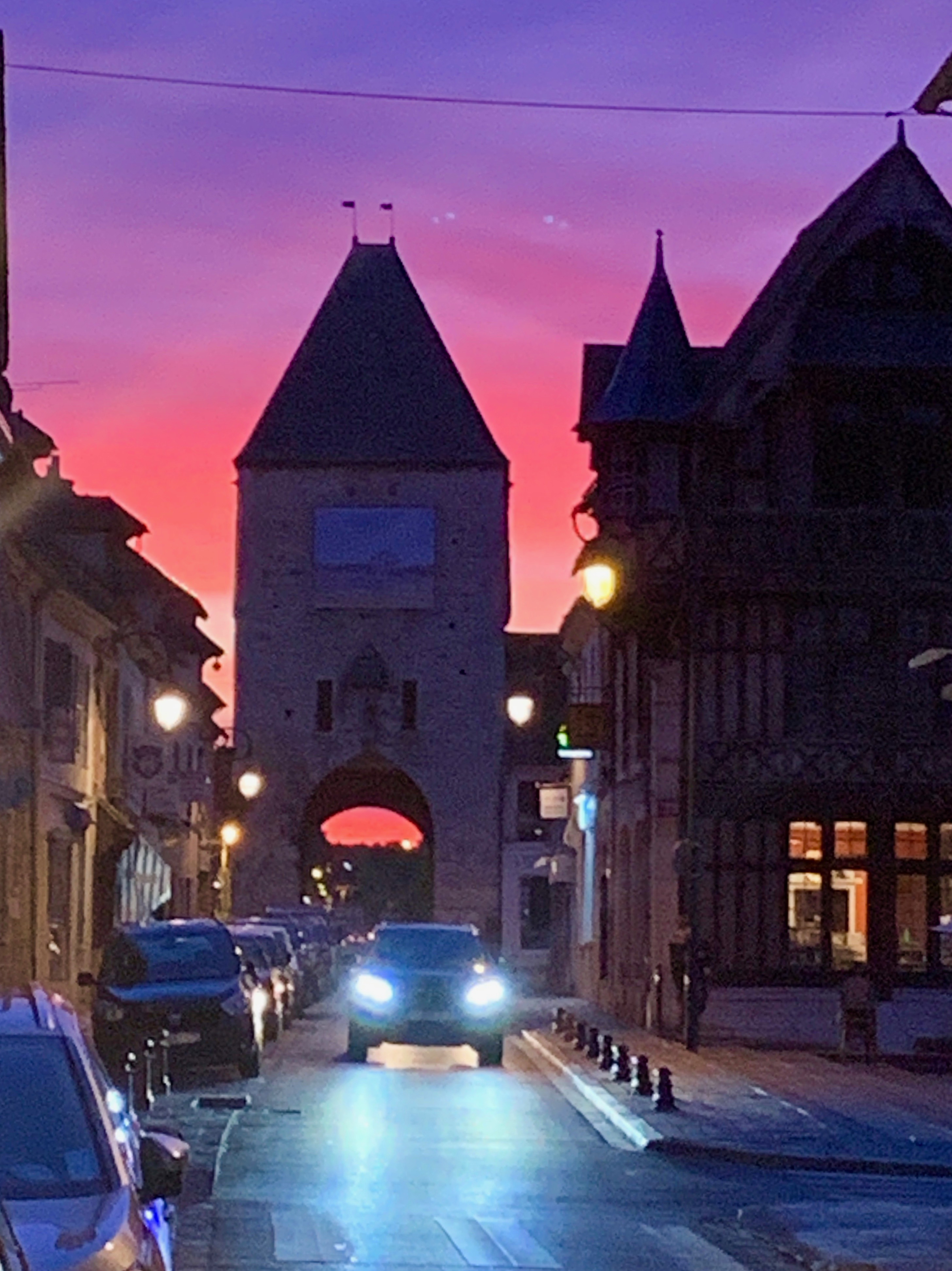
Porte de Samois at Sunset
(To be continued)