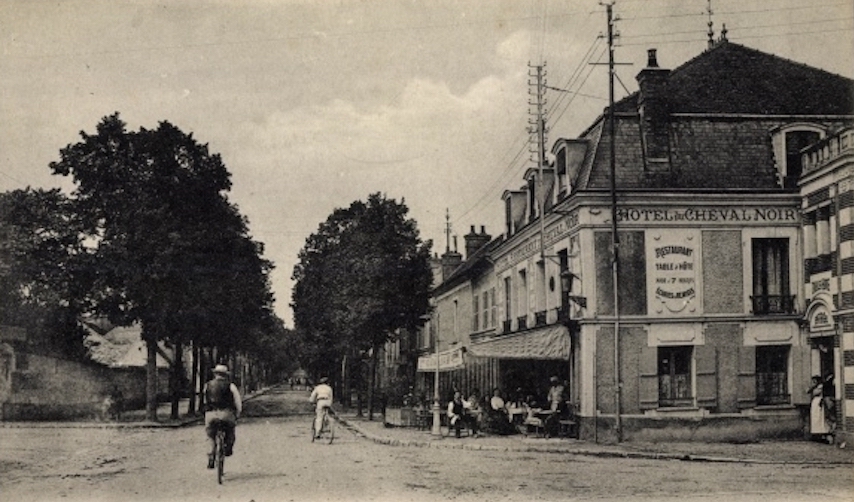
Early postcard of Le Hostellerie du Cheval Noir, Moret. ca 1910
Light crept through the gap in the heavy drapes, announcing the new day. Glowing numbers on a digital clock confirmed that we had slept like the dead, well beyond a polite hour for breakfast. As we entered the small dining-room we were greeted by Père de Crick, Gilles’s father. We never caught his given name. Laid out in lavish quantities, our petit-dejeuner was comprised of croissants, sans et avec chocolat, fresh baguettes, butter, crêpes, fresh fruit, yogurt, fromages et charcuterie and strong coffee, all composed in anticipation of perhaps a dozen people or more, yet we seemed to be the only guests in the hotel. Anne arrived as we finished our meal, to inform us that she had left a message of one of the officers of Les Amis de Moret and Les Amis de Sisley, hoping to arrange an appointment for us on the following day. Thanking her we returned to the room, to see to our ablutions and get organized for the day. We left the hotel by the side door on Rue du Peintre Zanaroff, the only door granting twenty-four access to guests of the hotel. If the building was historic, our keys were retro—white plastic perforated punch-cards from the Disco era. The eponymous painter Zanaroff was a late Impressionist named Prudent Pohl (1885-1966), who took the Russian-sounding moniker for reasons as yet unknown to us, and is remembered by the town of Moret by a street bearing his name. Beyond the crosswalk stand the monument to Sisley. Following the painter’s death from throat cancer in 1899, friends of the artist decided to raise a monument in his honor. Sisley’s daughter contacted Auguste Rodin, who agreed to undertake the task, but the committee disliked Rodin’s proposal and instead hired the lesser-known Simeon-Eugene Thivier (1845-1920).
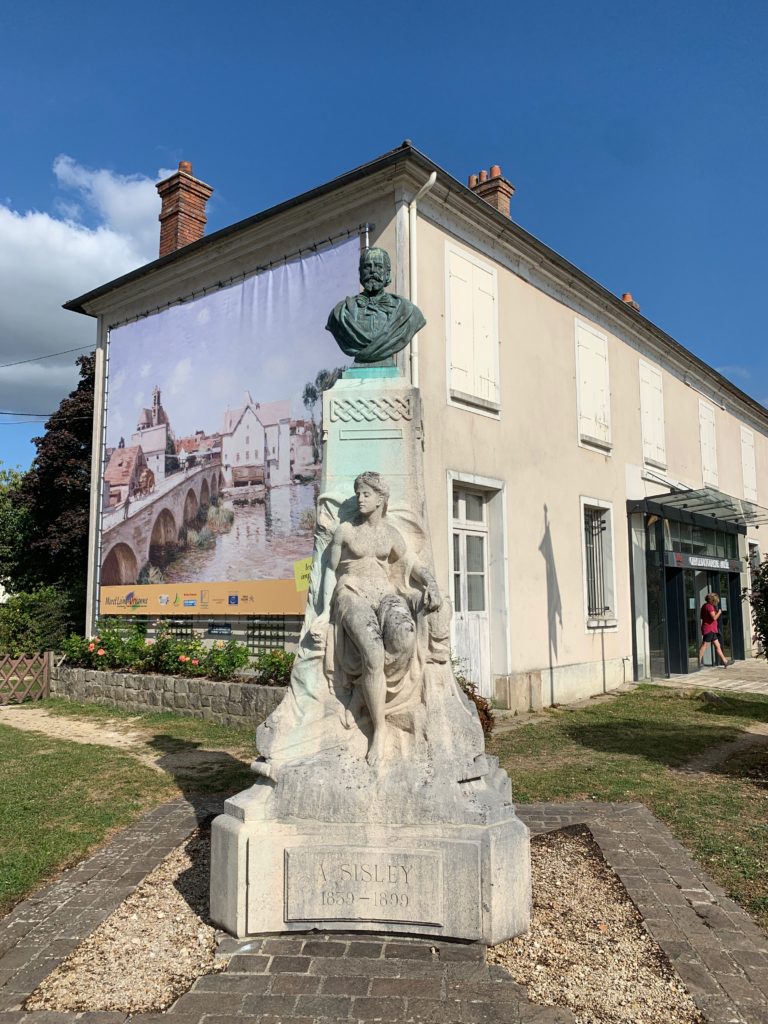
A bronze portrait-bust of the painter crowns a tapering stone pedestal, out of which is seen to emerge a comely semi-nude young woman representing Sisley’s muse. By the time we had revisited the tourism office, acquired a few more maps and brochures, it was approaching midday. Passing through Porte Samois, we proceeded to the Hotel de Ville (city hall) to inquire about how we might research property records. Kathie had determined that both Eleonore and Kathleen Greatorex had lived at a place known only as “Ramparts”, which seems to have been acquired prior to their mother’s death in 1897. After her passing they had tried to entice Rodin into renting a studio on the property, but he ultimately declined. The studio ultimately was leased to the American sculptor George Grey Barnard, who today is famous for the collection of medieval art now housed at The Cloisters in northern Manhattan. Art dealer Sarah Hallowell purchased a property from the Greatorex sisters, where she lived with her mother and niece Harriett. Armed with these tidbits of information, and a few written descriptions of the property by Eleonore and visitors, the trail of breadcrumbs had led us to Moret, but no further.
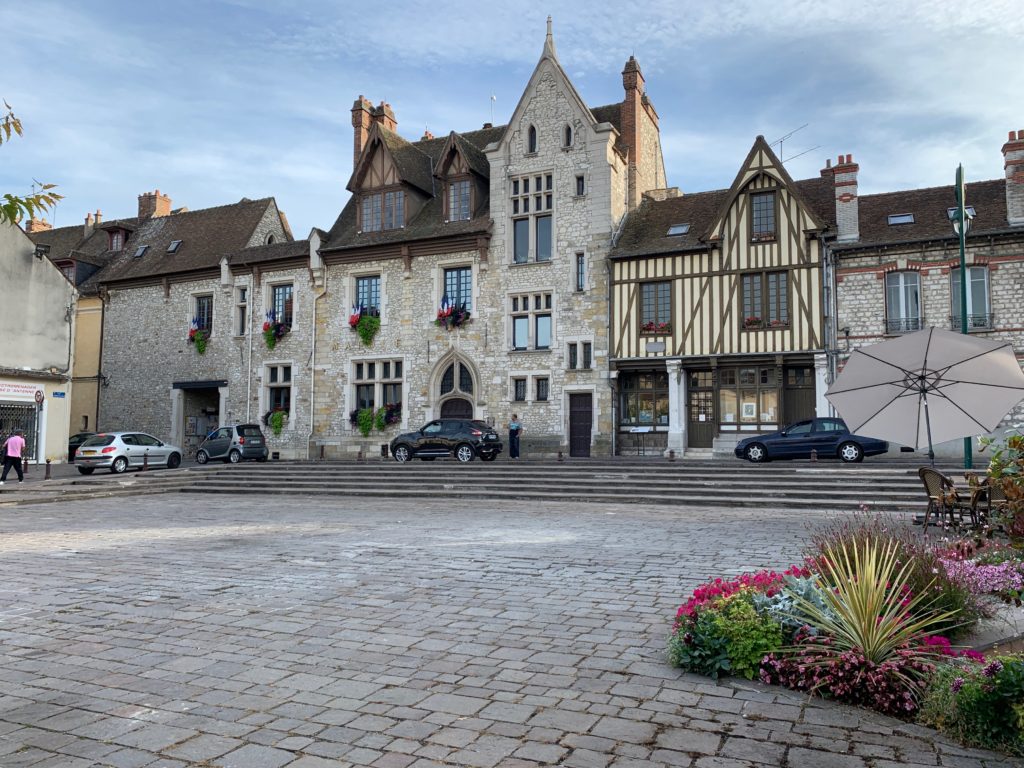
l’Hotel de Ville from Place de l’Hotel de Ville, Moret-sur-Loing. The half-timbered building to the right houses the Sisley Museum, run by Les Amis de Sisley.
The city hall was abuzz with activity as the town made ready for a European Heritage festival to be held over the weekend. Our landlords Anne and Gilles were distracted by preparations for anchoring a hot-air balloon in a soccer-pitch across the river. A young man took interest in our plight, explaining to the receptionist what we were hoping to accomplish. With a wave of her hand she directed him to a pile of books under the window. One of them was a history of Moret. At the top of one page was the headline Quelques Moretains eminents parmi beaucoup d’autres (Some eminent residents of Moret, among many others). Three names leapt off the page:
Eleonore Greatorex (1854-1909) Rue du Pave Neuf. Peintre
Georges (sic) Grey Barnard (1863-1938) Rue des Fosses. Sculpteur
Harriett Hallowell (1820-1913) Place de Samois. Peintre
Kathie noticed immediately that some of the dates were wrong, and that neither Eliza nor Kathleen Greatorex received a mention. Harriett Hallowell was the niece of the prominent American curator Sarah Tyson Hallowell (1846-1924), who had curated the French art exhibited at the Columbian Exposition in Chicago. A new biography of Hallowell by Carolyn Kinder Carr has just been published (July, 2019) by The Smithsonian Scholarly Press. In a letter to a friend dated 1909, Hallowell describes a property she is buying from Kathleen Greatorex as a “…quaint old house, built within the historic walls of beautiful Moret”, mentioning that “Miss Greatorex has her home on the extremity of her property…”
The Hallowell dates published on the Moret notables-list agrees with those of Sarah’s mother, Mary Morris Tyson Hallowell (1820-1913). Despite these errors, we had fresh clues to follow. Writing down the addresses, Kathie and I said our thanks and crossed Rue Grande, taking a table at the now familiar La Maison des Arts. I spread out a map. Kathie took out her notebook. Locating the Greatorex-Barnard-Hallowell addresses on the map, we quickly realized that all were adjacent to one another, or more likely within the same compound. The narrative about a single Greatorex property that had been broken up between 1890 and 1942 suddenly made geographic sense. We were stunned to learn that what we sought had been at our doorstep all along, across Place de Samois from our hotel. Finishing our lunch, we paid the check and walked back to the Hotel de Ville. To the left, a passageway led to a parking-lot beyond which to the south is Rue Pave Neuf (Newly-paved street), presumably the first street in the town to be covered with flags or cobbles.
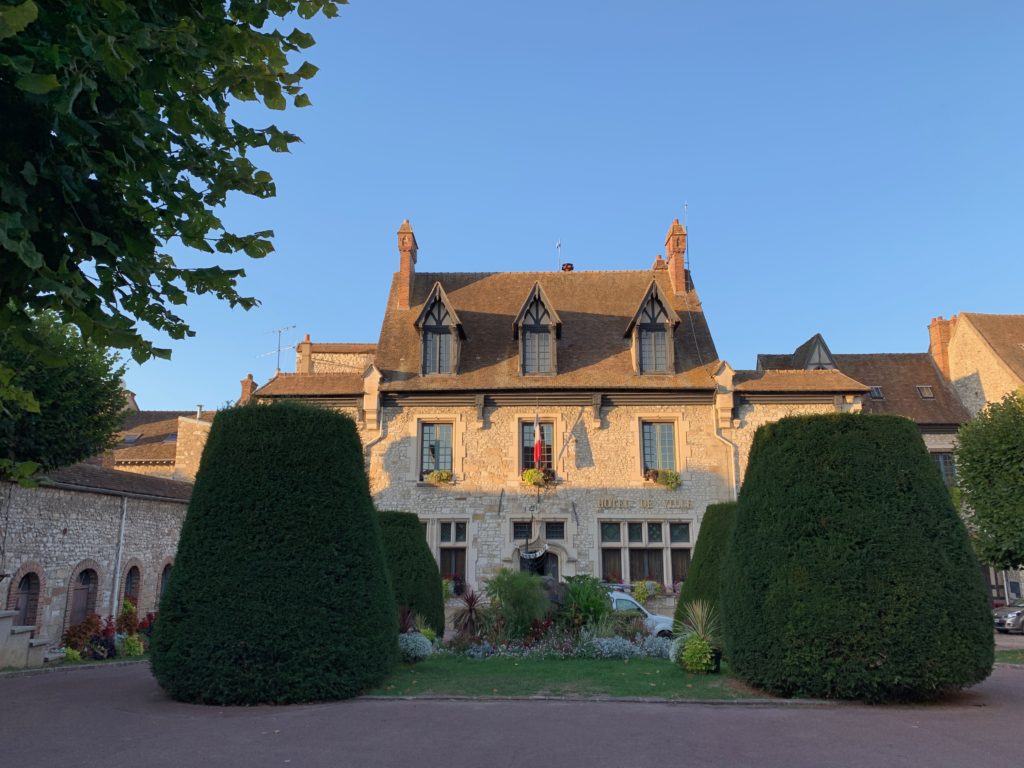
l’Hotel de Ville, Moret-sur-Loing, from Rue Pavé Neuf
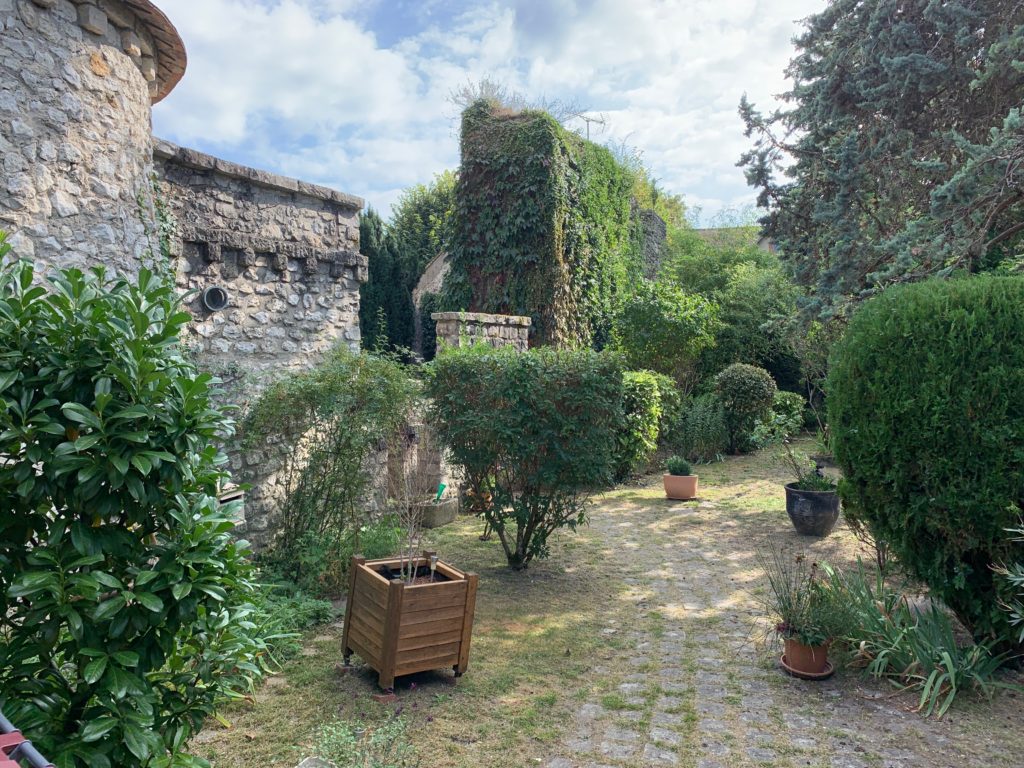
Private garden suspected of once having been the property of the Greatorex women
The city hall’s stately Façade François le 1eme faces the street, which suggests that the present-day Place de l’Hotel de Ville may once have been its backyard. Walking west, the street is lined with small, shuttered stone houses. Perhaps a hundred meters on, the street turns ninety degrees to the right, leading back to Porte de Samois. Passing through, we turned left along the pavement on the western edge of Place Samois. Dead ahead, driveway led to a green wooden gate. Behind it we could see a garden, with yet another fragment of the old city walls. Ivy crept up the side of a round tower. Had we reached our goal? The setting matched the descriptions we had. The published addresses had brought us to this place. Somehow it did not feel like enough. Ramparts were everywhere. A postman would have to be psychic to know to which ramparts he should deliver a letter to the misses Greatorex. We wandered over to Rue des Fosses, the street given as Barnard’s address. Just then a man emerged from the house on the corner. Turning to him I asked if he had heard the name Greatorex, or if he knew anything about American women living here during the last century. He thought for a moment, and said that he did remember hearing something, about a time long ago. There was someone he knew, who perhaps might be able to help.
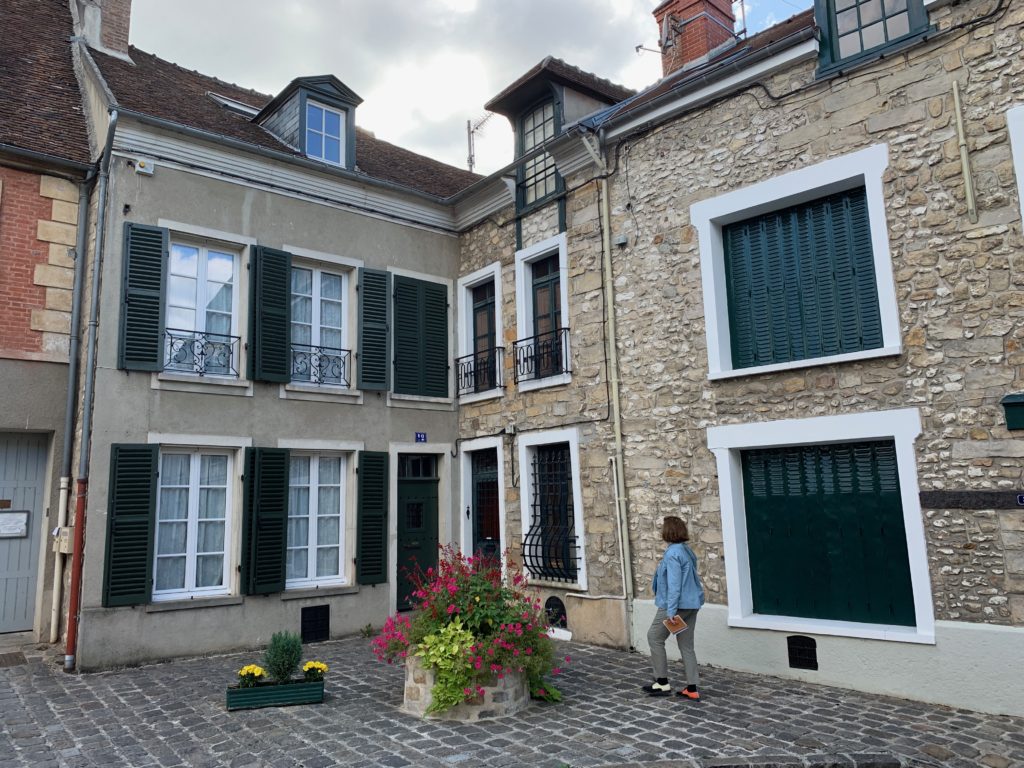
Kathie looking at the houses along Rue Pavé Neuf
He led us back to Rue Pavé Neuf and knocked on the door of one of the stone houses. The top half of the door swung open. He described our mission to the elderly woman, who replied bien sur! Her parents had purchased the house from Harriett Hallowell sometime around the Second World War, and that Hallowell and another old American woman had been living together but that both had died during the war. All the pieces began to fall into place.
Kathleen must have taken possession of the house when Eleonore died in 1909, and then sold it to Sarah Hallowell. Kathleen Greatorex must have broken up the rest of her property over the years, finally entering into a domestic arrangement with Hallowell. Nothing is known about their lives under the Nazi occupation. On her death certificate, the date of Kathleen’s death is given as May 6, 1942, the cause simply as “old age”. Her sole heir was Harriett, who died the following year. We knew we were close. All that remained was to find their home, “the Ramparts”, or whatever remained of it.
(To be continued)