Category Archives: Dispatches
RUCKUS IN PHILADELPHIA: PEOPLE, PLACES AND THINGS. January 29-March 1, 1979
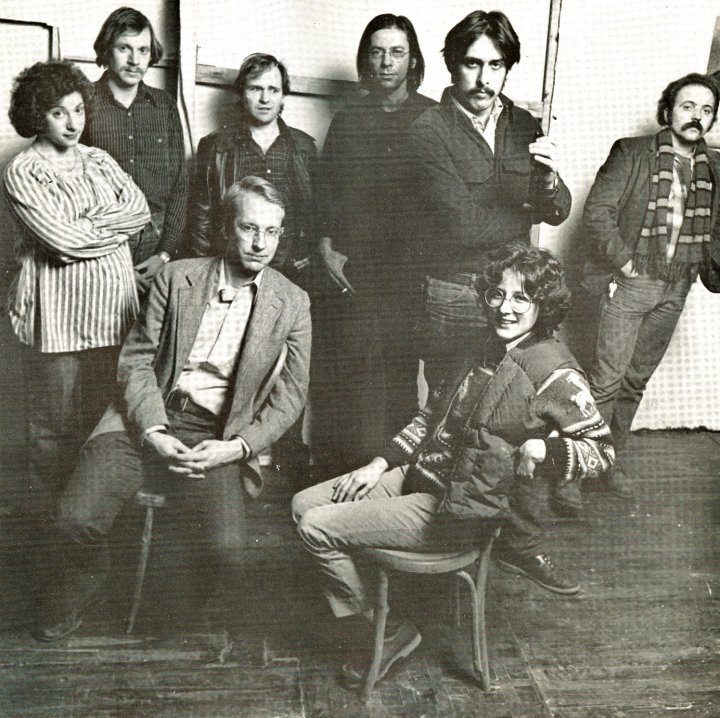
Left to right: Laurie Fabricant, Carter Zervas, Frank Galuszka (rear), Jesse Vandenburgh, Wayne Morris, James Lancel McElhinney, Victoria Davila, Frank Hyder. ” width=”292″ height=”298″ /> Left to right: Laurie Fabricant, Carter Zervas, Frank Galuszka (rear), Jesse Vandenburgh, Wayne Morris, James Lancel McElhinney, Victoria Davila, Frank Hyder. (Photo credit: James E. O’Neal)[/caption]
People Places and Things was a triple-venue exhibition organized by a group of artists composed of Victoria Davila, Frank Hyder, Frank Galusza, Wayne Morris, myself and others, under the auspices of the General Services Administration’s Art-In-Public-Places program. The primary exhibition filled the sprawling lobby and street-level corridors of the William Green Federal Courthouse at 6th and Arch Street. Two simultaneous exhibitions of small works were held at Marian Locks East gallery, on the 200 block of Arch Street, and at Hahn Gallery on Germantown Avenue in Chestnut Hill.
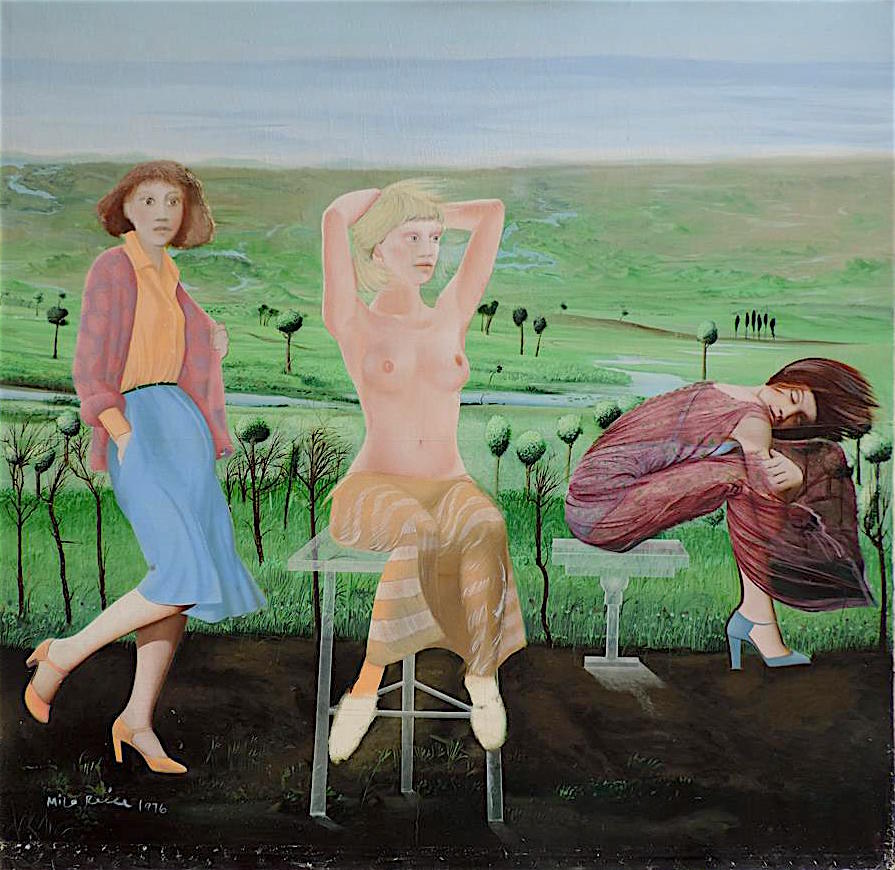
Martha Mayer Erlebacher’s painting Sungazer displayed a wisp of pubic hair, which aroused federal judge Joseph Lord to ban all nudes from the building, claiming that they were offensive to “nuns and children”. We knew people in the press who jumped on the story and milked it for all it was worth. One headline read “No Nudes is Good Nudes, Sayeth Lord”. I protested Lord’s decree by reminding the local head of the GSA that he was part of the executive branch of the government. The judicial arm of government to which Lord belonged was just a tenant. The argument was that Judge Lord had broken protocol and needed to go through channels in order to influence what could (and could not) hang on the walls of a building over which he had no official control. The judge rephrased his remarks. No works were removed. The show was reinstalled. It was the leading story on the evening news and in all the papers for four or five days. It confounds the mind to ponder how the kind of mythological-literary nudity found in Hera Aphrodite Athena. (Milo Reice, 1976) could have raised a blush. One forgets how prudish public taste was during the sexually permissive Disco Seventies.
Absent from the exhibition were Sidney Goodman, John Moore, Arthur da Costa, Ben Kamihira (although his daughter Miya was represented) Walter Erlebacher, Charles Schmidt and Nelson Shanks. Bo Bartlett, Vicent Desiderio, Wade Schuman and Renee Foulks were still in school. As I recall, John Moore had conflicting plans. I don’t think any of us thought to invite Sidney or Ben. It was one of those emerging-artist Andy Hardy “hey kids let’s put on a show” frolics that nobody expected to create any kind of stir.
Despite being less than an all-inclusive overview, People, Places and Things was a defining moment in Figurative art in Philadelphia, where representational art that explored the nude had been the bedrock of studio practice for many local artists since Thomas Eakins. Because the undraped human figure is so ubiquitous, festooning the facade of City Hall, the fountain at Logan Circle and in many other works of public art, the uproar created by People Places and Things was a gobsmacking revelation. It demonstrated to the hidebound Philadelphia art scene and its avant-garde counterculture how figurative art could thrive within a tradition without succumbing to conservatism.
DOWNLOAD: A small chapbook/catalogue was produced for the exhibition:
HUDSON RIVER FIELDBOOK: UPDATE
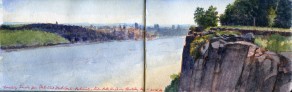
The Hudson Valley has been trekked, navigated, pictured and described more than any other waterway in American art and literature. Mark Twain fashioned his Mississippi as a central character many years after Irving and Cole had celebrated the Hudson. Traveling to sites where other artists and writers had beheld this estuary with many names–San Antonio, Shatemuc, Mahickannituck, Mauritius, and North River, is a form of intervention confirming the physical presence of natural features, but also the human regard, with all its desires and fictions. Landscape is not a fact before us but how we behold it. Mobility plays a major role in my narrative, which is at war with the notion that painting belongs to the wall–a notion I scorn every day by stepping outdoors with a studio in my pocket.
The PDF below represents the contents of a single fieldbook. There are not preparatory works but in its totality, the work itself.
FROM THE ARCHIVES: FALL 2006
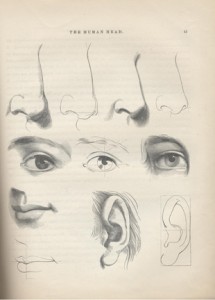
In 2006 the Grolier Club presented an exhibition of 19th -century drawing manuals while a few blocks away the Museum of Modern Art had opened a splashy show about the popular animation house Pixar. The work in the Pixar show consisted of drawings, sculpture and animated films. What tied these two very different shows together was the backbeat of drawing. The following essay is my effort at pairing (and comparing) these two memorable exhibitions.
From Peale to Pixar. American Arts Quarterly. Fall 2006. Volume 23, number 4
http://67.227.253.23/essays/peale-pixar
FIELDWORK: Hudson River Journal
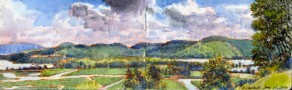
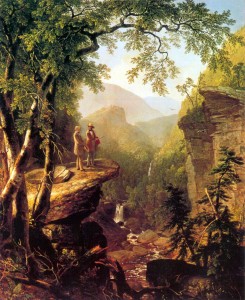
For many years when I was younger, landscape painting was something I would do with other men, like hunting or fishing. Some of my companions on these expeditions were painter Frank Hyder and author James Howard Kunstler, with whom I have been known to reprise these rambles. There was a social dimension to the activity that resonated with Hudson River School artists like Durand, Kensett and Champney painting together in the White Mountains, or Frederic Church and Louis Mignot in the Tropics. Perched on a rock in Durand’s painting Kindred Spirits at Crystal Bridges Museum of American Art, Thomas Cole and William Cullen Bryant embody this kind of camaraderie, a gathering of the arts in wild spaces bursting with inspiration.
When I moved to the south and began to explore Civil War battlefields, my landscape-painting practice became more solitary. The narrative lent itself to individual pilgrimages. Without a thought to the change, the last twenty-five years of forays into the field have seldom been in the company of others. Yesterday painter Eric Holzman–an old friend from our undergraduate days–and I took to the field. Leaving the city via the Henry Hudson Parkway, Eric drove north to the Taconic Parkway, which we followed to route 301 west into Cold Spring, New York. Descending into the village, one is greeted by a wall of rock rising up from the river on the east face of Crow’s Nest Mountain. It’s like Europe, Eric remarked. We parked the car near the landing , where weekend booze cruises from Jersey and Manhattan dock to unload tipsy shoppers. Pointing out West Point, Constitution Island and Storm King to the north, we walked north into a park that had been the historic landing. Couples on blankets lay scattered beneath the shaded grove. Large rocks enlisted into service as benches circled a fire-pit. The jagged contour of Breakneck Mountain caught our eye, beyond the giant belly of Bull Hill.
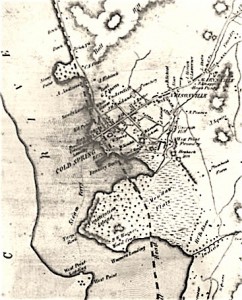
Driving north past Little Stony Point we made a quick reconnaissance and decided to tackle it another day. Driving south on 9G we passed again through the village of Cold Spring and proceeded to Boscobel House and Garden, which is closed on Tuesdays except seasonally, on the second Tuesday of the summer months, when the grounds are open to artists. A few plein-air enthusiasts were toiling away on the margins of a gobsmacking belvedere, looking south past West Point to Bear Mountain and Anthony’s Nose (mountain). Eric found unpacked his kit on the step of the house, a hundred yards behind the bluff. I started working near its edge, constructing a panorama from Crow’s Nest to Land’s end. A corner of my Wood & Faulk leather camp stool tore loose. To my dismay I discovered that the leather had neither been glued, not sewn with the appropriate waxed linen thread. I persevered, sitting on the ground. The groundskeeper came around at five o’clock to clear us out as the Shakespeare on the Hudson audience arrived for pre-performance picnics on the grass. Our return to Manhattan via the Palisades Interstate Parkway took less time than the outbound trip. We noted on how remarkable it is that one can leave the city and return to it along roadways along rivers and through green hills, and how few people know it. Maybe that is not such a bad thing.
From the video production studios at Penguin Random House
HEMINGWAY AT THE MORGAN LIBRARY
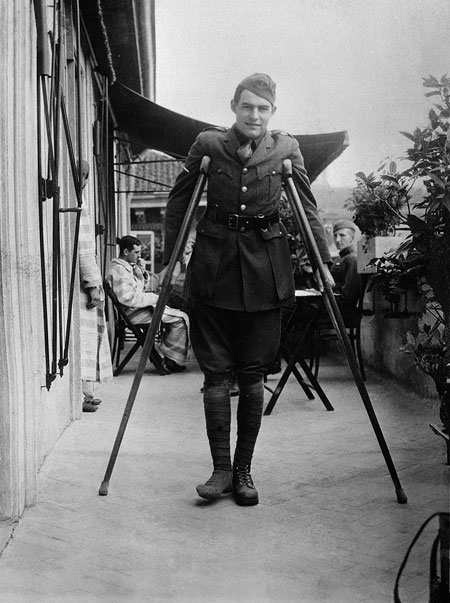
The Morgan’s mission of paying homage to literature and the book arts as it celebrates drawing and the graphic arts is well served by the current exhibition focused on the writings of Ernest Hemingway at the Morgan Library. Among the revelations to be experienced is the character of Hemingway’s writing process. He was known to have written on a typewriter while standing up, which proclaimed his self-image as a man of action, ready at any moment to walk to his next adventure. Lady Frances Trollope and de Tocqueville were struck by how Americans ate and drink on their feet. More than Hemingway’s broad-shouldered midwestern roots, his typed manuscripts marked up in graphite reveal a person showing, not telling, overtaken by a flood of revisions before word one is on the page. During his lifetime these documents would not have been readable in the way they are today. We might have criticized his adolescent penmanship, or how in haste he seldom wrote in horizontals. His sentences curve downward to the right, his mind fighting his body to put words on the page. Sloping scrawl speaks to his faith in savage intuition, and how haste is part of his method as much as the endless changes that follow. A few generations ago before the rise of keyboarding and the decline of penmanship these manuscripts would not have been seen as drawings. But now they can, as clear as Kid Balzac’s prose.
http://www.themorgan.org/exhibitions/ernest-hemingway
Advance copies of the new painting book are now in hand and available for pre-order
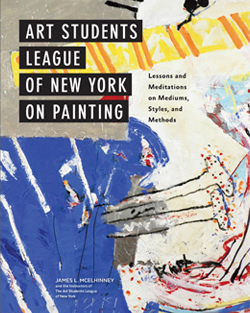
This modern painting guide is a sourcebook for study, teaching, professional practice, and personal enrichment written and edited by league instructor and artist James L. McElhinney in cooperation with the Art Students League of New York, America’s signature art school, run by artists for artists. Founded in 1875, the Art Students League of New York has nurtured students like Jackson Pollack and Georgia O’Keefe. Today, more than 2,500 students of all ages, backgrounds, and skill levels study at the League each month. This book invites the reader into the studio classrooms of some the League’s most acclaimed and beloved instructors–including Sharon Sprung, Mary Beth McKenzie, and Henry Finkelstein–for lessons on a variety of fundamental topics and approaches in painting. Richly illustrated with artwork from the League’s considerable archives, its instructors, and its students, the book will be a source of inspiration and enrichment for painters of all levels.





Journal Painting video featured in exhibition at Wailoa Center in Hilo, and at the Donkey Mill Art Center in Holualoa, will be displayed at the Art Students League of New York Instructors’ 2015 Annual Exhibition. Animation designed by Graham White:http: //gwhite.us
Hawaii Day Four Part Three: Back to Hilo.
Hawai’i Day Four part three: Back to Hilo
href=”https://www.mcelhinneyart.com/jlmcelhinney/wp-content/uploads/2015/07/P1010791-e1438184534201.jpg”>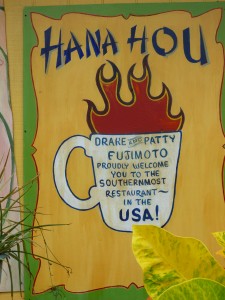
Facing a choice of routes, we decided to not retrace our steps but instead return to Hilo via the Saddle Road crossing the northern end of the island between the peaks of Mauna Loa and Mauna Kea. Driving up to the ridge above Punalu’u, we turned left onto Route 19 and proceeded to Na’ālehu, population 866. The name of the settlement in Hawaiian means “volcano ashes”. Trees line the street passing by a cluster of civic buildings and shops on the left side of which we found a brightly painted single-story building advertising itself as the southernmost restaurant in the United States. The Samoans might have something to say about that if they were inclined to split hairs. The open plan of Hana Hou restaurant was similar to many local eateries on the Big Island; lunch counter and table seating, no air conditioning, fans whirring overhead.
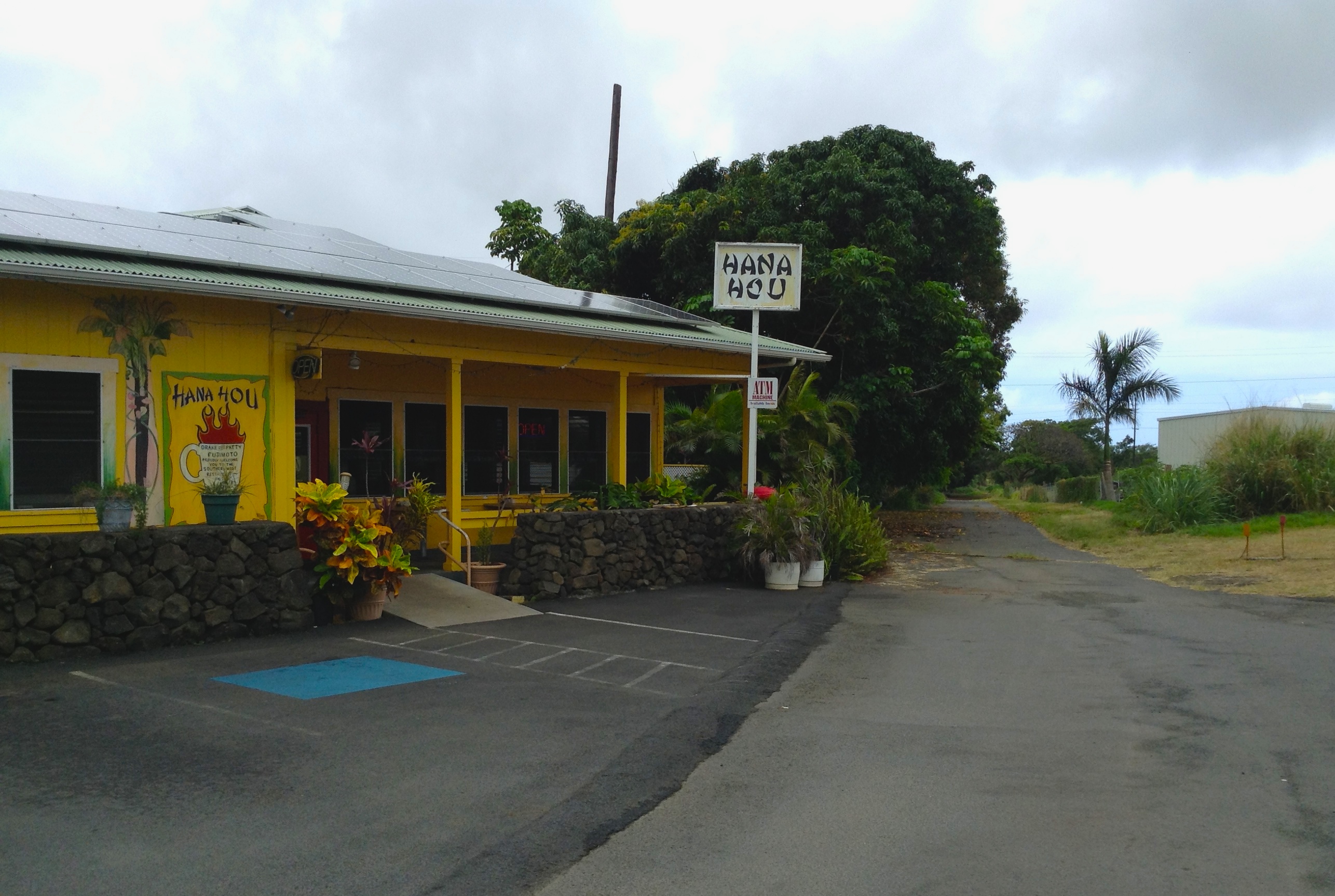
The diner fusion cuisine included fish tacos, pulled pork and salad all served as part of the dish I selected. The management and wait-staff were predominantly native. Sensitive to the resentment that can sometimes be expressed by people of color towards European-Americans, based on the many abuses suffered by their ancestors at the hands of whites, I found indigenous Hawaiians to be outwardly friendly and meticulously polite. An older generation might have remembered, or heard from their elders the story of how mainlanders arrived first to spread Christianity and were followed by sugar planters who at a time when White Supremacy was at its peak overthrew the Kingdom of Hawai’i. The Hawaiian term Ha’ole literally means “without breath” and is said to be derived from the first contact with mariners sailing with Captain Cook, who were ignorant of the practice of exhaling while pressing the nose and brow against that of another as the common form of greeting. Bows and handshakes delivered by Brits were interpreted by the locals as mistrust or hauteur. The last day of school leading into summer vacation is known in some places as “Kill Haole Day”, some native kids allegedly heckle and assault their light-skinned classmates. The majority population on the Big Island is Hawaiian, and my sense is that the majority of those harboring hostility toward whites regard them as inconvenient outsiders or necessary evils. Continuing our journey the road led west, across the landward end of South Point. We were disappointed to no have visited the green sand beach at Papakolea but our vehicle would not have stood up to the rough condition of the road leading to the water’s edge. The slope of Mauna Loa climbed into the clouds on our right. Black lava flows punctuated sunburnt grasslands while out to our left spread the wide blue Pacific.
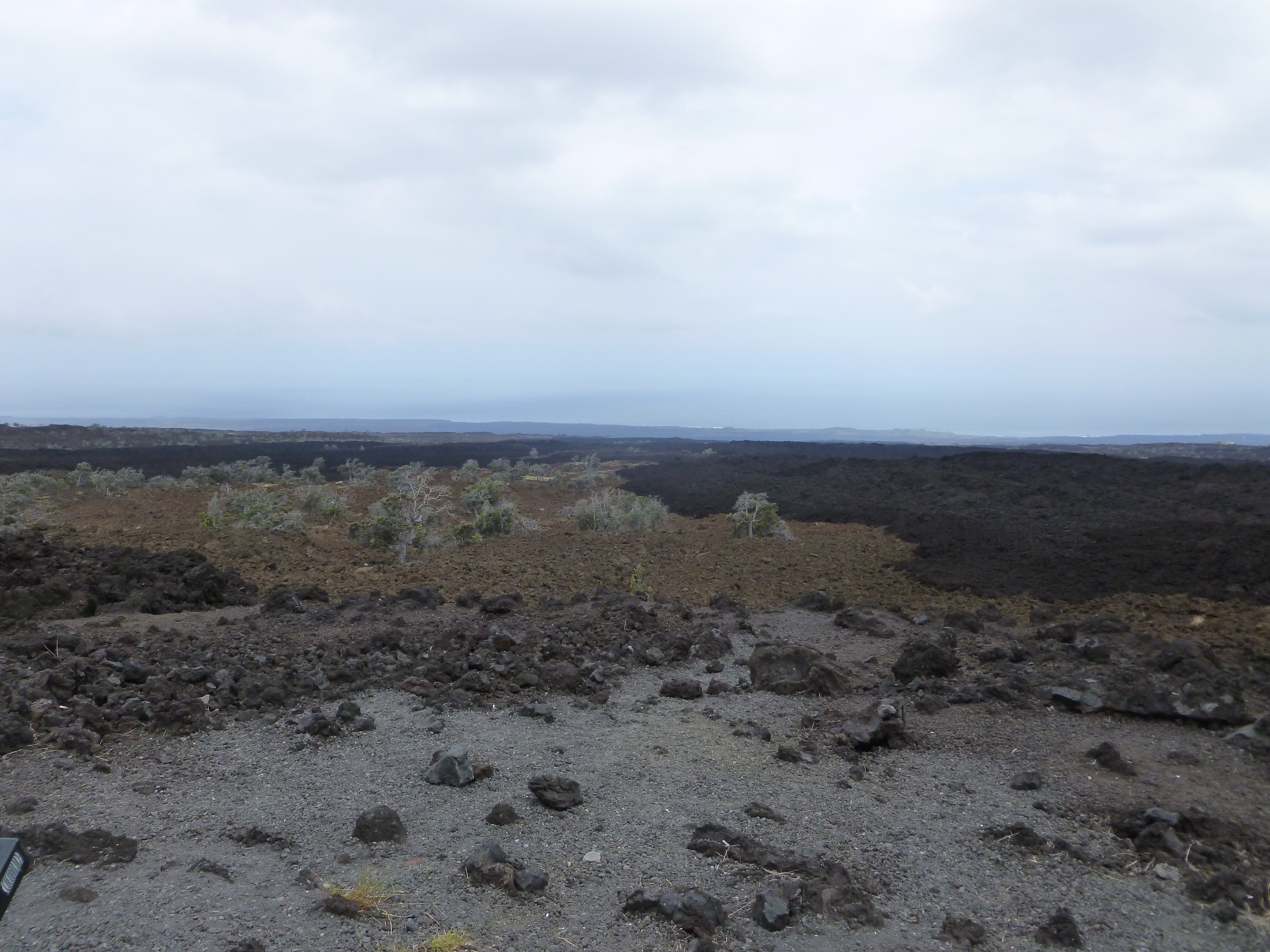
Moving northward toward Kona, the vegetation quickly changed from mountainous savannah to forests and fields as we entered coffee country. Kona coffee is highly renowned and the prices reflect it. A pound of roasted ground or whole beans can set you back sixty dollars. The highway climbed to a thousand feet above the ocean as we moved from the slopes of Mauna Loa onto those of a smaller active volcano named Hualālai. By all reports this is the most worrisome of the five major Big Island volcanoes, and the one most likely to erupt one day. Of course it looms above an enclave of pricey resorts while million-dollar homes pepper its flanks.
A precipitous drop from the shelf of land traversed by the road descended to a shoreline of white breakers crashing against the black rim of a green coastal plain a mile or two in width. We stopped for coffee at a roadside café a few miles below the town of Captain Cook that overlooked the site where the explorer had been killed in a needless dust-up with irate locals. Kathie is maniacal about her coffee and was enchanted beyond words by the heady brew she was served alfresco. The establishment appeared to have once been a service station. The white block building backed up onto a modest lanai with a concrete floor and corrugated steel roof. We debated making a detour down to the coastline where the Kailua-Kona resorts are located, but ditched the plan when we encountered the same bumper-to-bumper beach traffic one finds everywhere else. Instead we veered off the main road on to Route 180 and headed for Holualoa village, where I was to deliver a talk one week hence. The winding two-lane road followed torturous curves bereft of guard-rails. Driveways seemed to plunge and soar up from the roadway’s negligible wooded shoulders at impossible grades, possible only in such a climate but undoubtedly vexing for any car with a standard transmission. The village was a concatenation of shops and galleries, a B&B and an inn priced at opposite ends of the market. Unsure of our ETA in Hilo, we elected to carry on. 180 ended at a t-intersection where we turned right (north) onto 190—the main road between Kailua-Kona and Waimea in the heart of Hawaii’s cattle country. Within a few miles forest and vegetation gave was to arid conditions. We passed to the left almost two thousand feel below the Kona airport and then Kekaha Kai Beach, the coastline stretching off toward North Point and the green Kohala Highlands. Rolling grassy hills punctuated by dark lava flows and extinct spatter cones flanked the highway as off to the right a gathering of clouds shrouded the peak of Mauna Kea. The exit for Hilo arrived suddenly. A right turn from the road to Waimea put us on Highway 200, locally known as Saddle Road. The right of way varied from road cuts through deep lava beds to crossing grassy hilltops. Passing a cluster of tan Quonset huts to our right we approached the massive form of Mauna Kea, coming to the entrance of an eponymous state park located at its southern base.
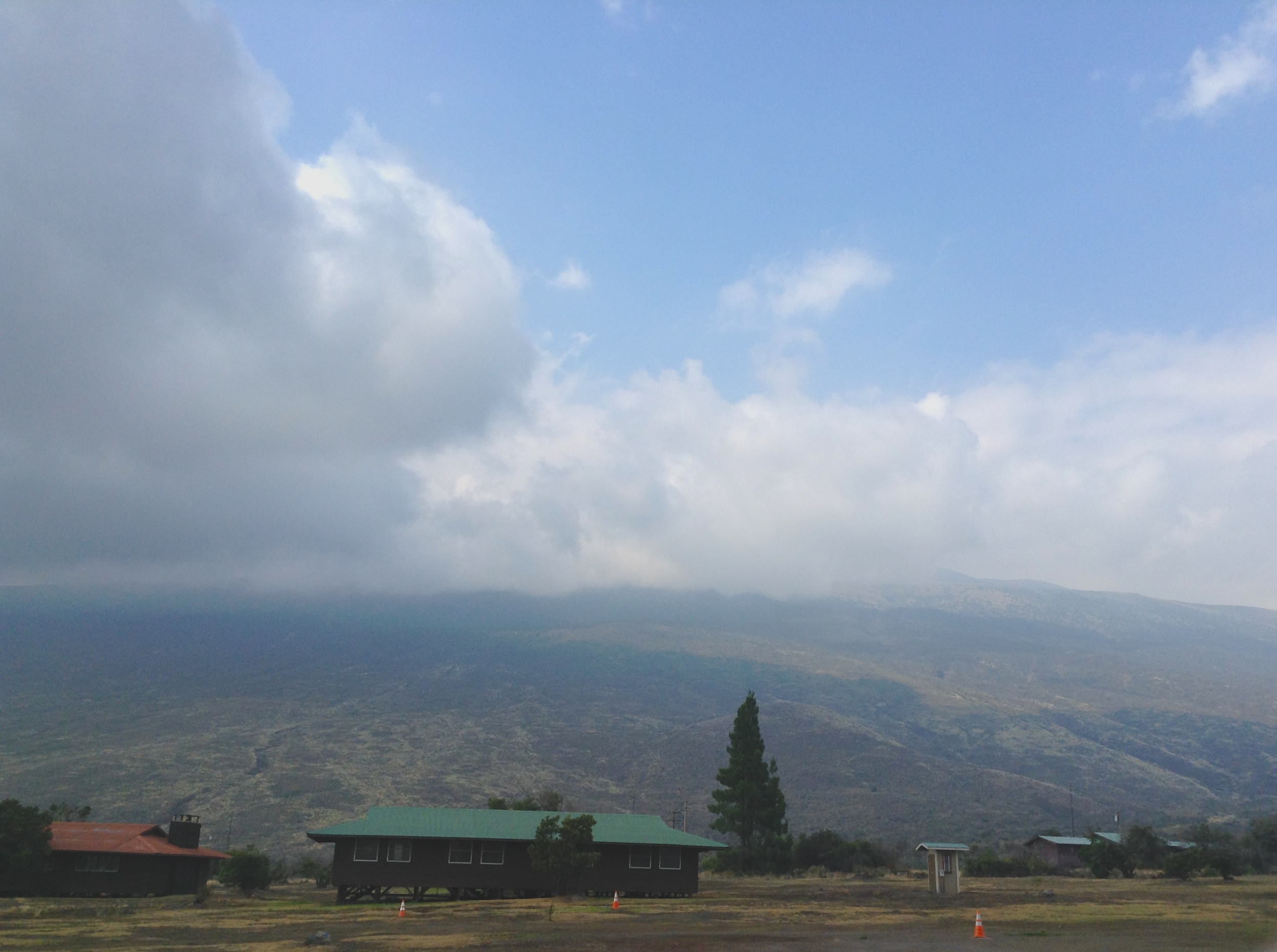
Gullied slopes soared into the clouds. The buildings resembled a KMC type configuration—a quasi-military facility. New parking lots and recreational facilities were under construction, or at least construction had begun. No one was at work on them. The park headquarters were closed, but we made us of the restrooms that were located in a separate building.
A couple of Hawaiian men took a coffee break in a cable company van. A family of mainland tourists relaxed at a picnic table.
As we proceeded east we passed a monument erected next to an extinct spatter-cone; a stone altar festooned with ceremonial offerings, leaves and bundles, and presumed it to have been erected by native activists objecting to the construction of a massive new telescope on the summit of Mauna Kea. Crossing through more lava fields we skirted the northwestern margins of Mauna Loa and were suddenly met with a tangle of vegetation, then forest, then rain. The joke is that on the Big Island one can pass from one climate zone to another simply by crossing the road. Returning to Hilo Route 200 descends dramatically to become Wainuenue Avenue, along which are located many of the K12 public schools and the athletic fields. We returned to the Pakalana, unpacked the car and went to Pineapples for dinner.
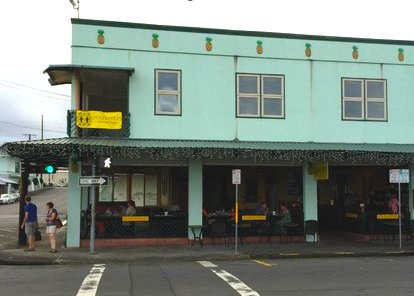
The open-air bistro on the first floor of a low-rise flatiron building on the corner of Mamo, Keawe and Kilauea serves a young, lively crowd. I suspect few tourists were among them, the cruise ship having left port the day before. Our waiter was a friendly twenty-something effeminite man who vaguely resembled The Artist Formerly Known as Prince.
So are we having a drink, yaah? He asked in a creaky voice.
We ordered a couple of cocktails
Ditcha look at the specials, yaah?
They were on a blackboard. We hadn’t. So he told us what they were. We ordered.
Menu and service were above par. It was nice to find a place with an urban vibe.
We paid our check and walked around downtown Hilo before heading back to our quarters. Bums were asleep in the doorway of nearly every shop. Like so many homeless people we had seen in Berlin, many of them possessed a musical instrument and a dog. Two shirtless men had staked out opposite sides of the step of the Tsunami Museum. One of them had a backpack. The other one had a blanket.
At nine o’clock Cronie’s sports bar was getting ready to shut down for the night. Some New Yorkers might have bristled at the midwestern timetable followed by Hilo restaurateurs, or by the strong undercurrent of churchgoing culture. In a stroke of genius our landlord had decided that the best place for the television was on top of the microwave oven. We never turned on it, or the microwave.
In the course of one day we had stood at the smoldering rim of an active volcano, completed a circuit of an island slightly larger than the state of Connecticut, passed through three or four climate zones and had been served dinner by an AFKAP lookalike. Nothing on television could top that.