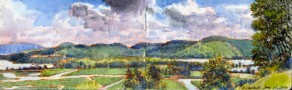
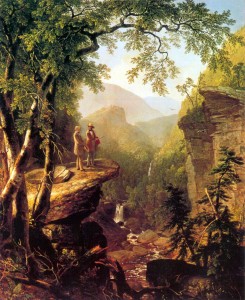
For many years when I was younger, landscape painting was something I would do with other men, like hunting or fishing. Some of my companions on these expeditions were painter Frank Hyder and author James Howard Kunstler, with whom I have been known to reprise these rambles. There was a social dimension to the activity that resonated with Hudson River School artists like Durand, Kensett and Champney painting together in the White Mountains, or Frederic Church and Louis Mignot in the Tropics. Perched on a rock in Durand’s painting Kindred Spirits at Crystal Bridges Museum of American Art, Thomas Cole and William Cullen Bryant embody this kind of camaraderie, a gathering of the arts in wild spaces bursting with inspiration.
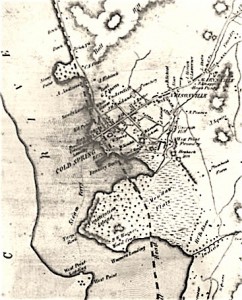
When I moved to the south and began to explore Civil War battlefields, my landscape-painting practice became more solitary. The narrative lent itself to individual pilgrimages. Without a thought to the change, the last twenty-five years of forays into the field have seldom been in the company of others. Yesterday painter Eric Holzman–an old friend from our undergraduate days–and I took to the field. Leaving the city via the Henry Hudson Parkway, Eric drove north to the Taconic Parkway, which we followed to route 301 west into Cold Spring, New York. Descending into the village, one is greeted by a wall of rock rising up from the river on the east face of Crow’s Nest Mountain. It’s like Europe, Eric remarked. We parked the car near the landing , where weekend booze cruises from Jersey and Manhattan dock to unload tipsy shoppers. Pointing out West Point, Constitution Island and Storm King to the north, we walked north into a park that had been the historic landing. Couples on blankets lay scattered beneath the shaded grove. Large rocks enlisted into service as benches circled a fire-pit. The jagged contour of Breakneck Mountain caught our eye, beyond the giant belly of Bull Hill.
Driving north past Little Stony Point we made a quick reconnaissance and decided to tackle it another day. Driving south on 9G we passed again through the village of Cold Spring and proceeded to Boscobel House and Garden, which is closed on Tuesdays except seasonally, on the second Tuesday of the summer months, when the grounds are open to artists. A few plein-air enthusiasts were toiling away on the margins of a gobsmacking belvedere, looking south past West Point to Bear Mountain and Anthony’s Nose (mountain). Eric found unpacked his kit on the step of the house, a hundred yards behind the bluff. I started working near its edge, constructing a panorama from Crow’s Nest to Land’s end. A corner of my Wood & Faulk leather camp stool tore loose. To my dismay I discovered that the leather had neither been glued, not sewn with the appropriate waxed linen thread. I persevered, sitting on the ground. The groundskeeper came around at five o’clock to clear us out as the Shakespeare on the Hudson audience arrived for pre-performance picnics on the grass. Our return to Manhattan via the Palisades Interstate Parkway took less time than the outbound trip. We noted on how remarkable it is that one can leave the city and return to it along roadways along rivers and through green hills, and how few people know it. Maybe that is not such a bad thing.