Thatcher’s Island from Long Beach. Cape Ann. Thursday April 12, 2012
Cape Ann is a headland on the Massachusetts coast located forty miles northeast of Boston. The name has come to designate the island from which it projects into the Atlantic, separated from the mainland by a marshy channel known as the Annisquam River. The island has been a magnet for artists since the nineteenth century.
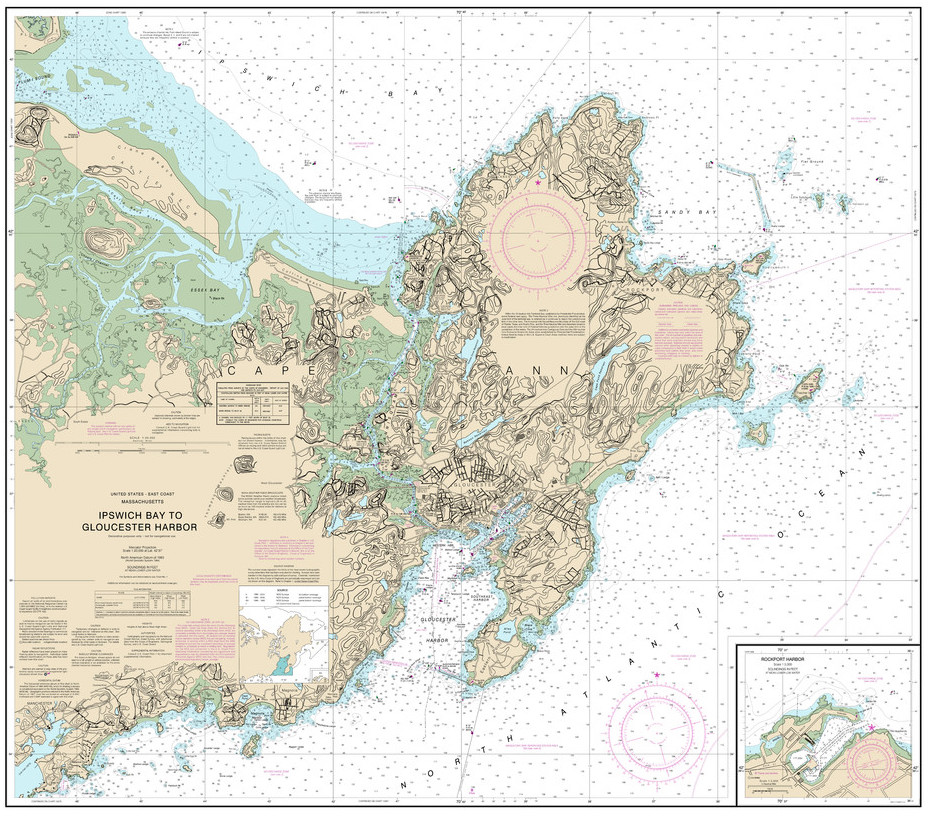
Nautical map of Cape Ann.
Nathaniel Rogers Lane, better-known as Fitz Henry Lane (1804-1865) became a celebrated painter of maritime subjects characterized by a refinement and use of light later dubbed Luminism. Winslow Homer spent the summer of 1880 living on Tenpound Island, in the middle of Gloucester harbor. Other seasonal residents of Cape Ann include Anna Hyatt Huntington, Walter Hancock, Paul Manship, Edward Hopper and Jo Nivison; Marsden Hartley, John Marin. Like Provincetown, Gloucester became an art colony, and summer resort. Unlike P-town, Cape Ann’s quarries and blue-collar maritime industries continue to contribute to the local economy year round.
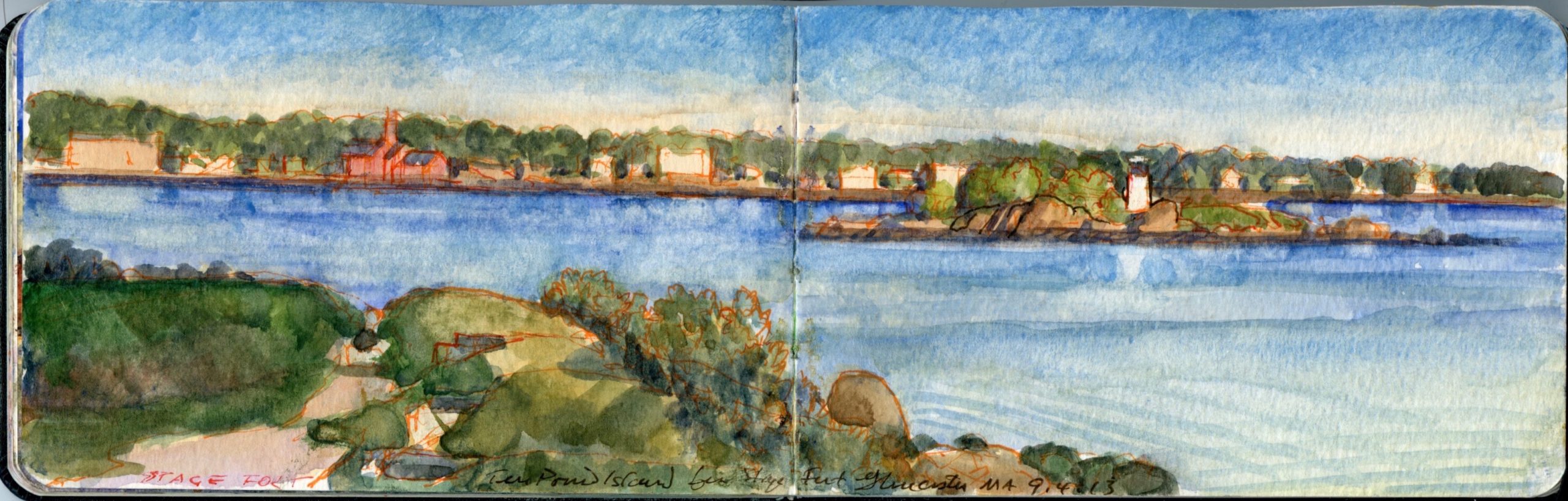
Gloucester Harbor: Tenpound Island from Stage Fort. Wednesday September 4, 2013.

Cloudburst over the Atlantic, from Rockport Massachusetts. Monday April 1, 2013.
I first visited Cape Ann en route to a family vacation on Mount Desert Island. After lunch in Rockport we visited the tourist shops along Bear Skin Neck. Hand-whittled Old Salts, wooden Sperm Whale welcome-plaques, along with views of Motif Number One tempted shoppers with a dizzying array of decorative souvenirs. Even in my teens I knew about Homer. Lane (then “Fitz Hugh”) was a revelation. Sunday painters had set up along the landside bulkhead, focused on the red fishing-shack famed as prime among all dockside motifs. Bernard Chaet (1924-2012) and his family kept a summer cottage a mile north in the village of Pigeon Cove. Driving by Motif Number One he would shout advice at its worshippers.
“More blue!”
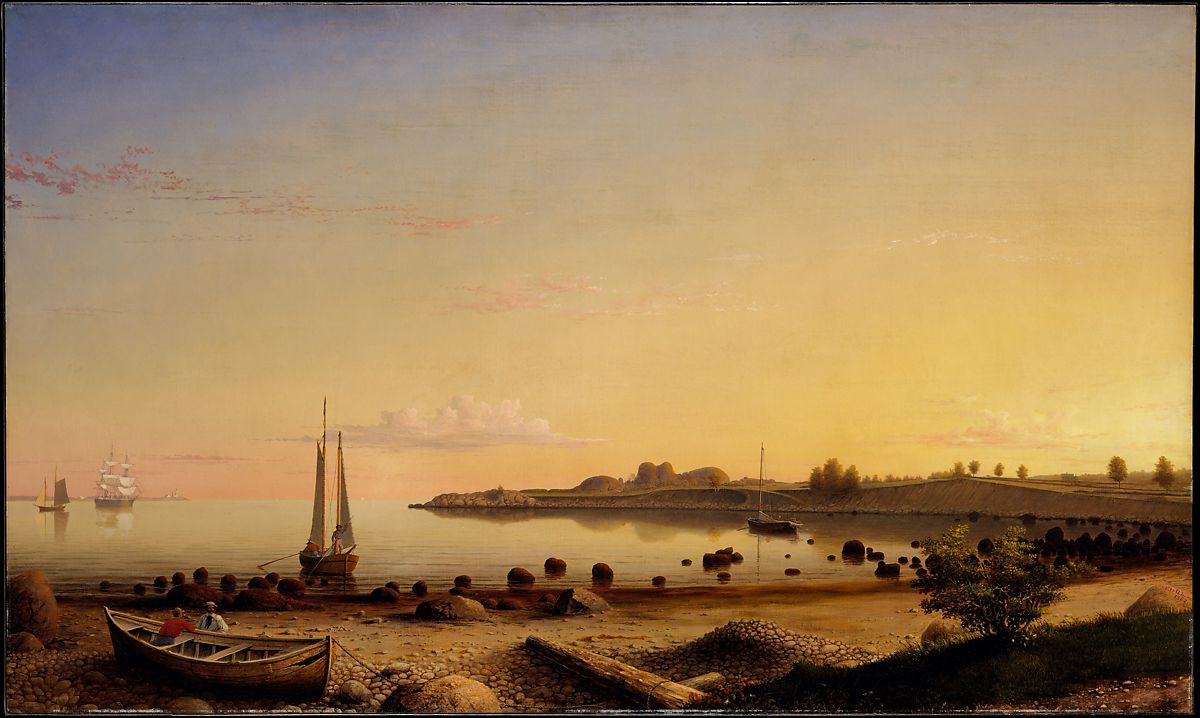
Fitz Henry Lane. (1806-1865) Stage Fort Across Gloucester Harbor. 1862. Courtesy Metropolitan Museum of Art, New York
My first visit to Bernie on Cape Ann was during the summer of 1976, shortly after my graduation from Yale. Serving as his teaching assistant during my final year in the MFA program, we had developed a friendly rapport. My companion at the time was Randi Danforth, whose family lived in Groton. As she visited friends on the North Shore, I drove up to Cape Ann to call on the Chaets. Bernie had grown up in Boston. He and his friend Alan Fink, the founder of Alpha Gallery purchased seasonal homes near an old quarry in the hamlet of Pigeon Cove. At some point, Bernie had taken to rising in the morning to paint the sunrise from Cathedral Rocks, and other points along the rocky shoreline. It became his motif number one for as long as he was physically capable of negotiating the broken ground along the rocky shore. This discipline, his practice yielded some marvelous improvisations that resonated with his lifelong love of Jazz.
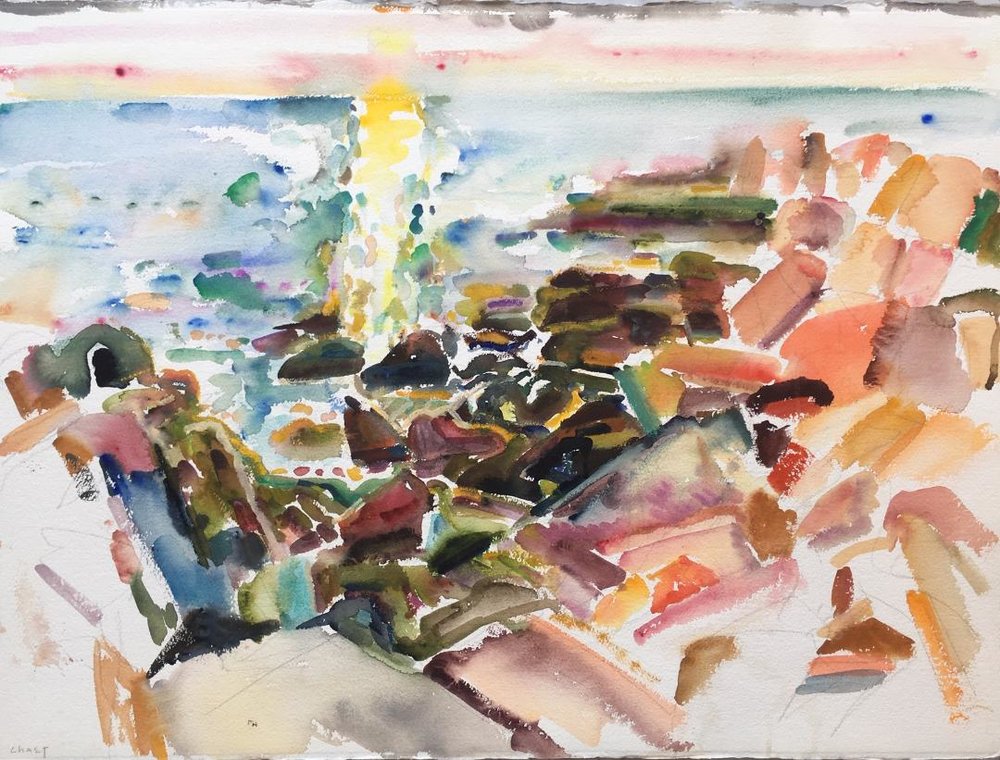
Bernard Chaet. Warm & Yellow. 1990. Watercolor. Courtesy Alpha Gallery, Boston, MA
The painter Dan Gustin graduated from Yale two years before me. He remained in New Haen for several years until he landed a teaching-job in Chicago. I sometimes lent him my student ID so that he and Bernie could play tennis on campus. One day Dan arrived at Chaet’s house on Cold Spring Avenue, ready to hit the court. He rang the doorbell. Nothing.
He rang it again several times. No response. Coming from inside the house Dan heard music. Stepping off the porch he looked through the living-room window. Spinning in the stereo was a jazz album. Not Chet Baker, something wild. Bernie danced around the room in a bacchanalian frenzy. I witnessed something similar one evening when Bernie and I went to listen to his old friend, jazz trumpeter Ruby Braff (1927-2003) at Jimmy Ryan’s on 54th Street in Manhattan. Bernie paid the cover. I bought the first round of drinks. Scotch on the rocks. The venue was intimate. That night is was packed. Looking around the room through a haze of cigarette smoke, there was no sign of Bernie. Seated at a small table was a man possessed. Arms flailing, fingers snapping, both knees bounced up and down. His head shook from side-to-side like a retriever shedding water. I put a drink in front of him. He paused and looked up. It was Bernie.
“This is a real treat” he said. “This guy is GREAT!”
Arriving in Pigeon Cove one Sunday for brunch and a visit, I found Bernie putting the stereo speakers onto the window-sills, facing outward. He switched on the radio and cranked up the volume, so we could sit in the yard while listening to his Sunday morning radio show. Ninon stepped out of the house.
“Bernard. Don’t you think the music is bit loud? We don’t want to disturb the neighbors.”
“Screw ‘em,” he replied with a wicked grin. We had to listen to their Rock & Roll all hours of the night. They can listen to some REAL music!”

Cathedral Rocks from the Emerson Inn, Rockport Massachusetts. Monday September 3, 2012
Over the years I returned to Gloucester. Kathie’s parents lived in Andover. Visiting them we would often make excursions to Essex and Cape Ann. Attending a conference at the Cape Ann Historical Museum, we stayed at the Emerson Inn near Cathedral Rocks. The years had finally caught up with Bernie, who had lost the nimbleness that once allowed him to scramble over the rocks to the sea at dawn. I visited a few of his motifs, but never saw them in the same way. For Bernie, the scattered boulders, jumbled clouds, rhythmic waves, and dancing light were like players in a jazz-ensemble; their music translated into marks and colors.
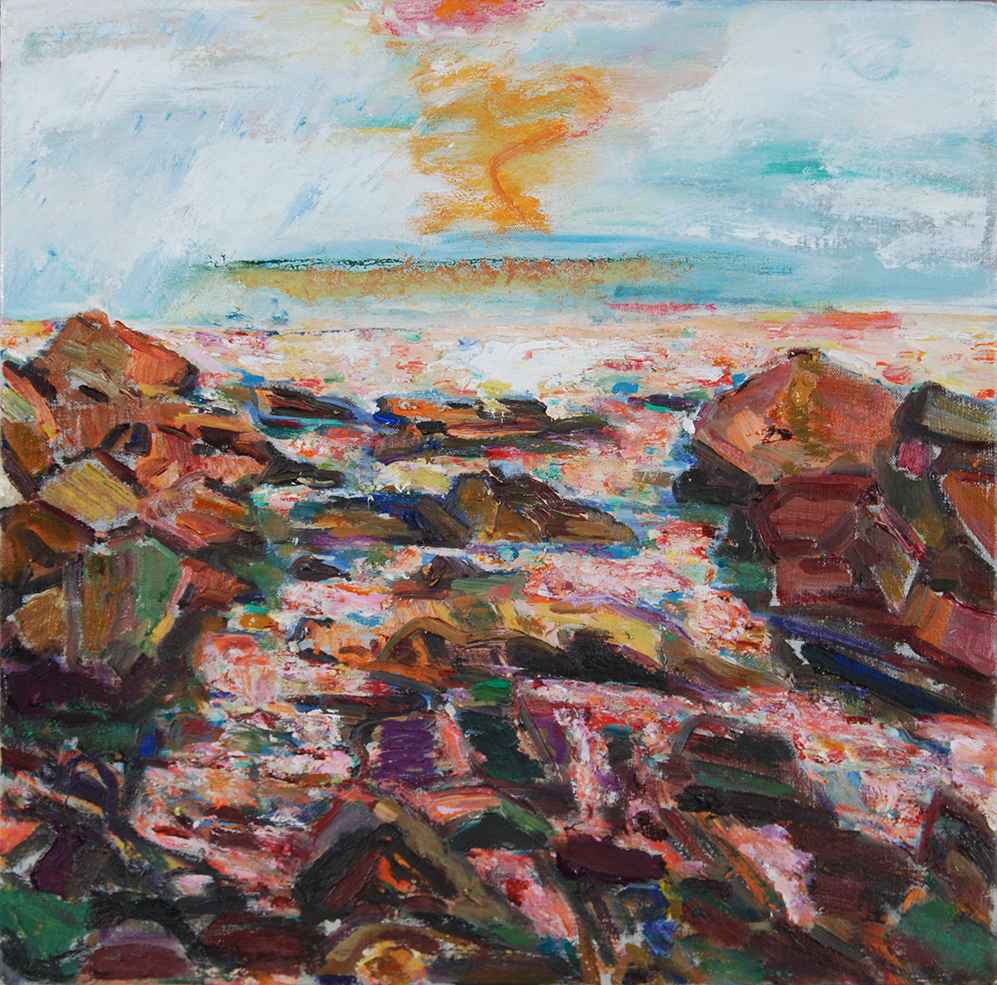
Bernard Chaet. Bass Rocks. 2001-2002. Oil on canvas. 18 x 18 inches.Courtesy Lewallen Gallery, Santa Fe, New Mexico
Bernard Chaet’s estate in represented by Alpha Gallery in Boston and by Lewallen Gallery in Santa Fe
James McElhinney is represented by Gerald Peters Gallery in Santa Fe
Read prior dispatches from The Sketchbook Traveler by James Lancel McElhinney (c) 2020
Coming Soon: Hardcover. $24.95. From Schiffer Publishing. Release date: September 2020.