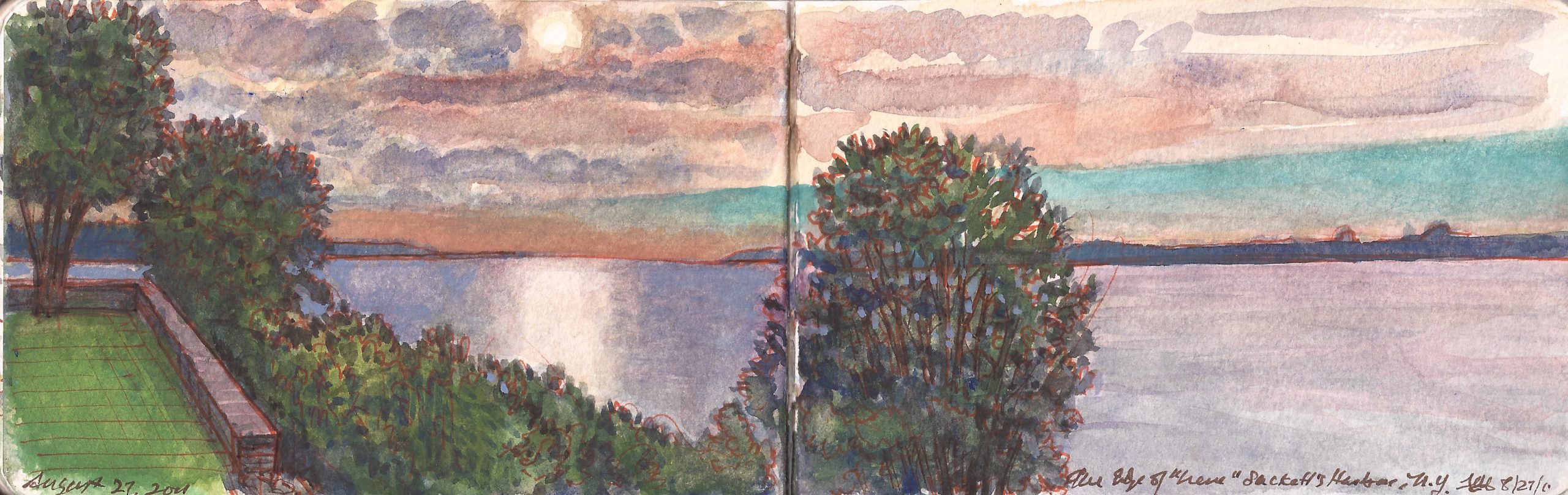
Late Light, Sackett’s Harbor. August 27, 2011
Looking at this morning’s reports of Hurricane Hannah battering the Houston area, I am reminded of the devastating effects of Hurricane Sandy on New York City in October 2012.
In August of the previous year Hurricane Irene slammed into Puerto Rico and tore up the Outer Banks before reaching the mouth of the Hudson River. Kathie and I decided to get out of town. Impending natural disaster gave use an excuse to take a short vacation prior to the start of the academic year. Deciding where to go was easy; north, away from the storm. The question remained where to go. Maine, Niagara Falls, Lake Champlain and the Saint Lawrence Valley were considered. We finally settled on a destination at the eastern end of Lake Ontario.
Driving north through Binghamton to Oswego, where we visited Fort Ontario. From there we proceeded east and north, following the shoreline until we came to Sackett’s Harbor. The village is focused on its sheltered anchorage and waterfront, which is lined with an assortment of dining establishments and a brewpub. Dividing the Harbor from Black River Bay is a crooked finger of land known as Navy Point. During the war of 1812, Britain and the United States were locked in an arms race. Britain commenced building a powerful fleet in the shipyards at Kingston in Upper Canada. The Americans did the same, forty miles away at Sackett’s Harbor, which twice the British tried to capture without success.
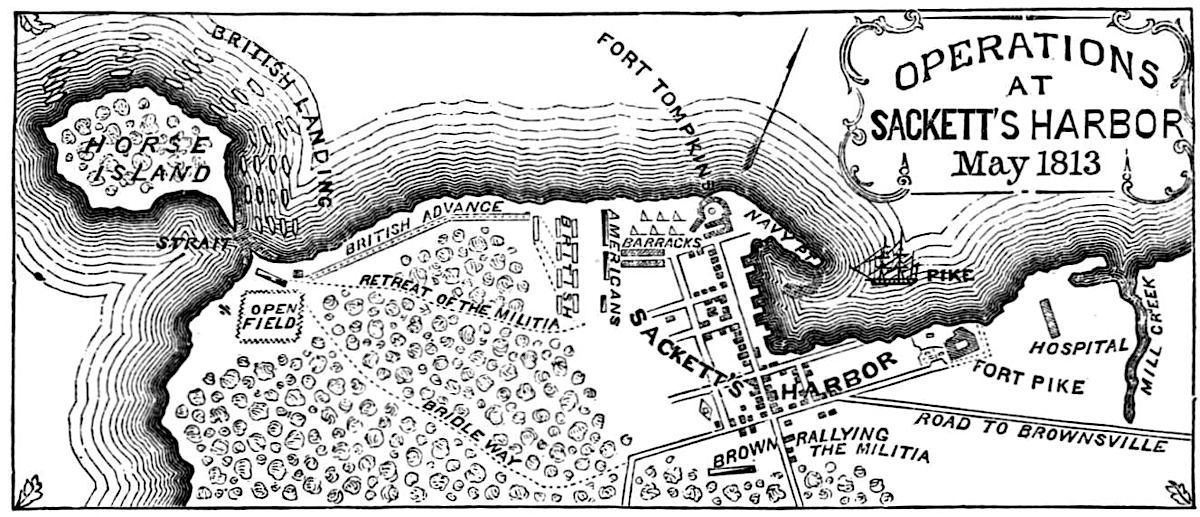
The Battle of Sackett’s Harbor. May 29, 1813. Benson J. Lossing. Pictorial Field Book of the War of 1812.
In late May of 1813, seven hundred regulars landed at Horse Island, a mile south of the village. After scattering a force of New york militia the Brits marched northeast along the shoreline to be faced with a solid line of defense, which repeated attempts could not penetrate. Owning to poor coordination, British gunboats failed to support the attack. Had they not withdrawn just before the arrival of a full regiment of U.S. regulars, the attacking force would have been destroyed or captured.
To behold the wooded grove and manicured fields south of the on August 27, 2012, it was difficult to imagine the momentous events of May 29, 1813. News reports were coming in of storm damage along the Jersey Shore, Long Island and the New York metro-area. After barreling over the city, the storm uprooted trees in the Catskills before pressing north to Lake Ontario. We awoke the following morning to a howling gale. Sheets of rain lashed the windows of our hotel-room for most of the day. By evening skies were clearing. Dark clouds raced across the harbor in the failing light.
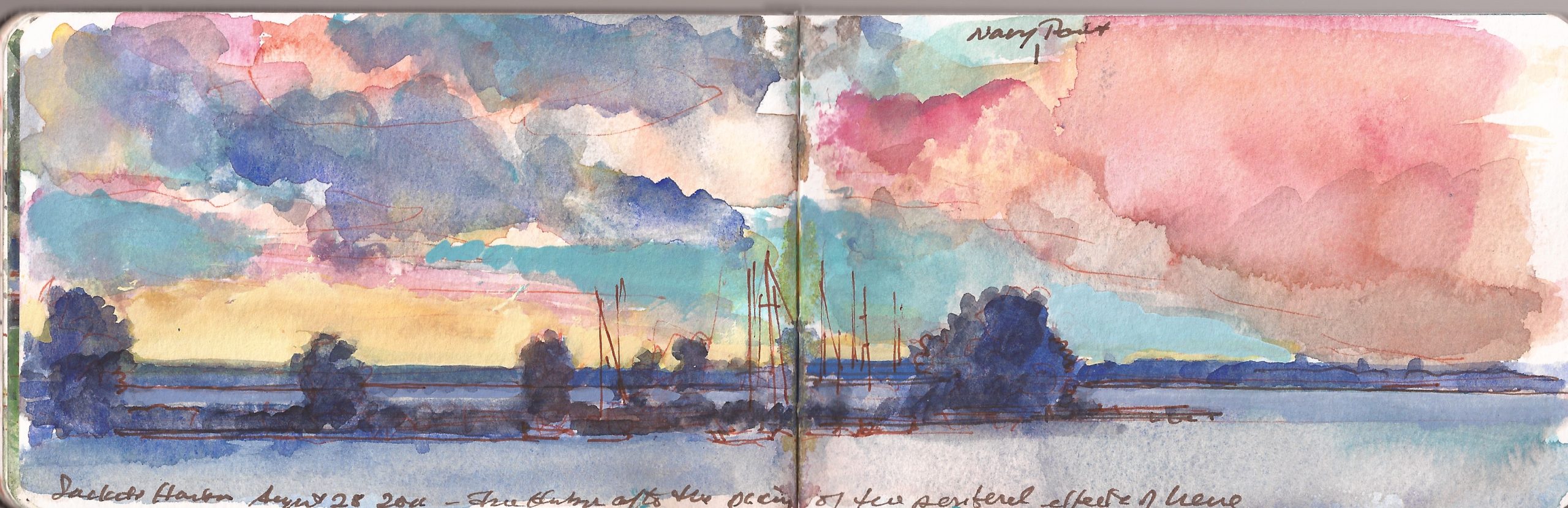
Looking across Navy Point, Sackett’s Harbor. After the Storm. August 28, 2011.
In the morning we checked the news, only to discover that stretches of the New York State Thruway, I-81, Route 17 and numeorus back roads were impassible at many locations. Exploring the north end of town after breakfast, we found a former army base had been developed into a marina and hotels. Former officers’ quarters seemed to have become private dwellings. In the small national cemetery associated with Madison Barracks we found the grave of explorer Zebulon Pike (1779-1813) whose 1806 expedition to locate the source of the Arkansas River was a thinly veiled attempt to gather intelligence about the disposition of Spanish military deployments in what is now Colorado and New Mexico.
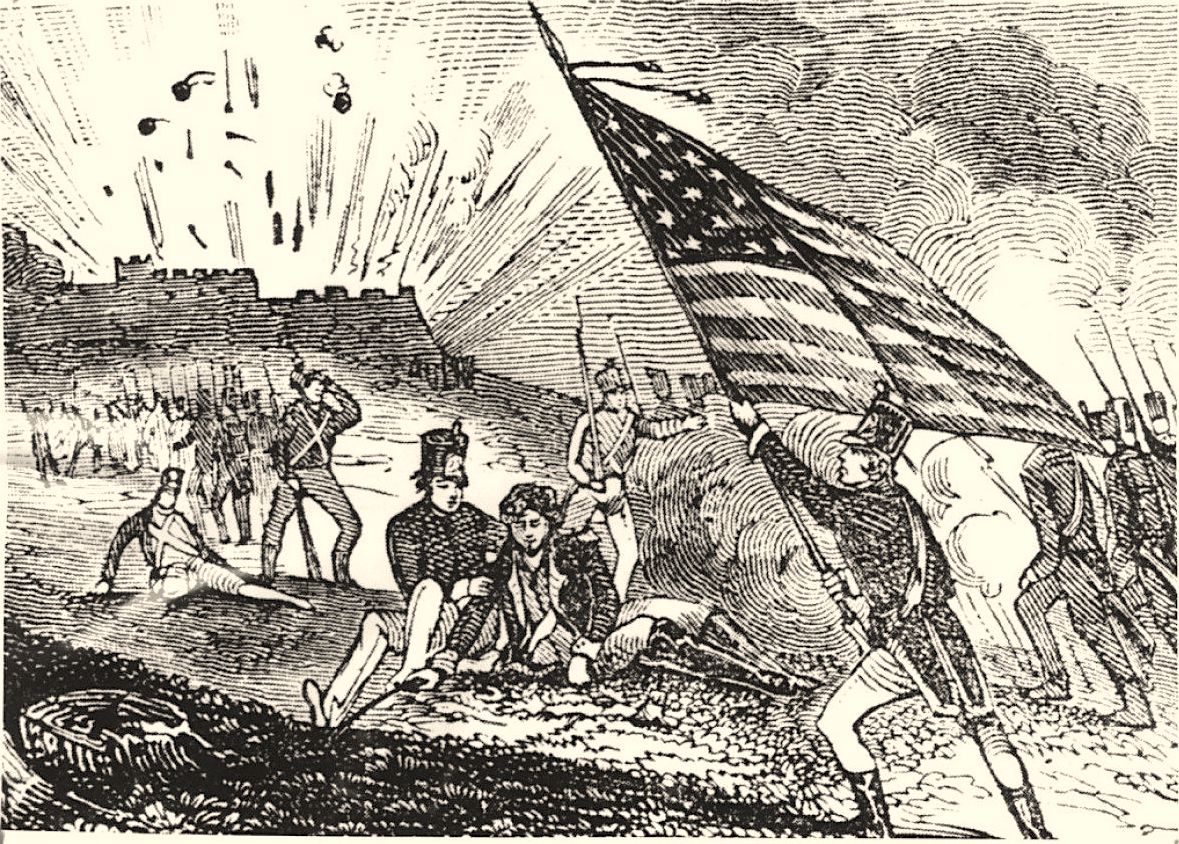
Imaginative depiction of the death of Zebulon Pike.
Following his capture of Fort York (Toronto) on April 27, 1813 Pike was standing on the parade-ground of Fort York (Toronto), interrogating a British sergeant. Unbeknownst to Pike, is men and most of their captives, a slow fuse had been lit inside the fort’s powder-magazine. The explosion launched tons of debris into the heavens, including a large stone block which crushed Pike. What was left of the newly minted general was returned to Sackett’s Harbor for burial. In retaliation for the death of their commander, and for what many on the ground regarded as a cowardly act, the village of York was put to the torch. Sixteen months later the British replied by burning the U.S. Capitol, The White House, and other government buildings in Washington D.C.
Extending our stay another night, we planned to return to the city on the following day. August 30 arrived with many road-closures still in effect. Instead of fighting our way back, we decided to head west to Seneca Falls, drop down along the shores of Lake Cayuga to Ithaca, hoping by then that the highways leading back to New York City would have been cleared. But that is another story.
James McElhinney is represented by Gerald Peters Gallery in Santa Fe
Read prior dispatches from The Sketchbook Traveler by James Lancel McElhinney (c) 2020
Coming Soon: Hardcover. $24.95. From Schiffer Publishing. Release date: September 2020.