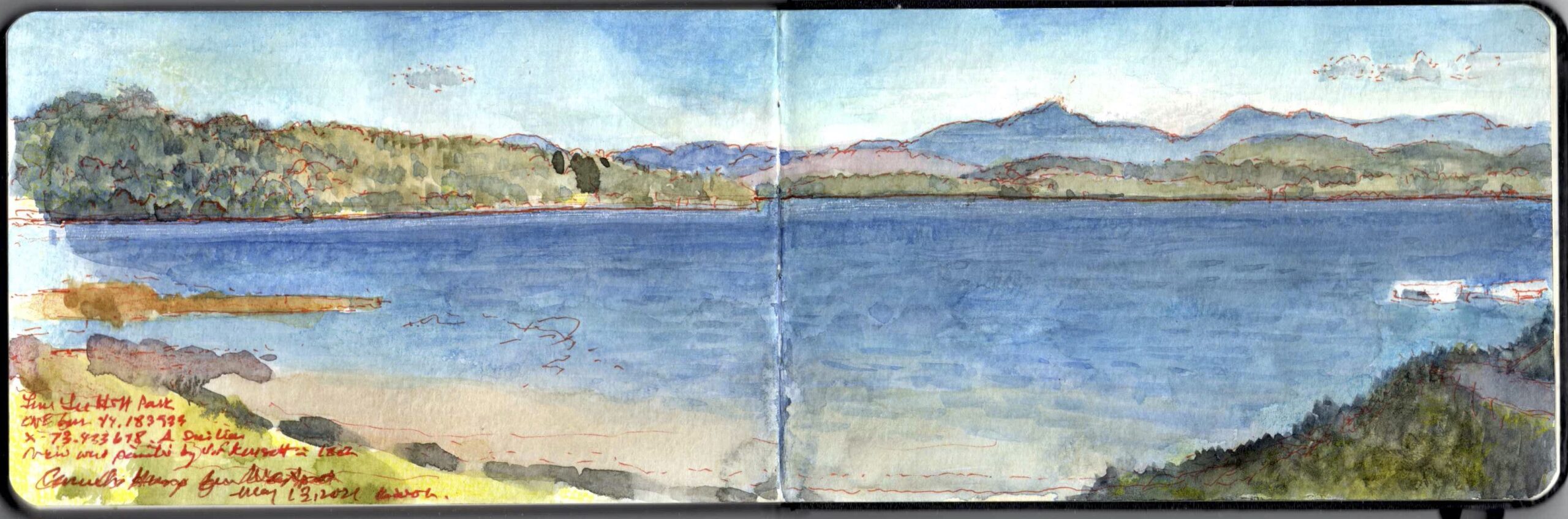
Camel’s Hump Mountain, Vermont, from Lee Park Hill. Westport, NY. May 12, 2021
Traveling south with an Abenaki war-party, Samuel de Champlain’s canoe traversed a large body of water known to his bellicose companions as Pitawbagok, or “the water between the lands.” Their Mohawk enemies to the south called it Kaniatarakwà: ronte, or “the bulging lake.” Noting a peak rising to the east, the explorer named it Leon Couchant, or “resting lion.” The Abenaki called it Moziozagan, or “moose shoulder,” which in English morphed into “Camel’s Hump,” in honor of a beast whose natural habitat was thousands of miles away. Disparity in elevation between its summit and the land from which it rises allows the peak to be recognizable at a great distance; a landmark for travelers since a time immemorial. The geological term for its unusual shape is roche moutonée, an allusion to mutton-fat as an adhesive used by wearers of powdered wigs. During the last Ice Age, ten thousand feet of ice passed over the massive rock. Immense pressure smoothed its upstream face, carving away the downstream side to leave a steeper slope in its wake. All of New England’s mountain-ranges were subjected to this process, including those of coastal Maine. Mapping the orientation of these asymmetrical formations allow us to reconstruct different flow-patterns within the Laurentide ice-sheet. Camel Hump has become an iconic symbol of the Green Mountains. Celebrated by Hudson River School painters, stunning vistas reward a relatively easy three-hour hike to the summit.
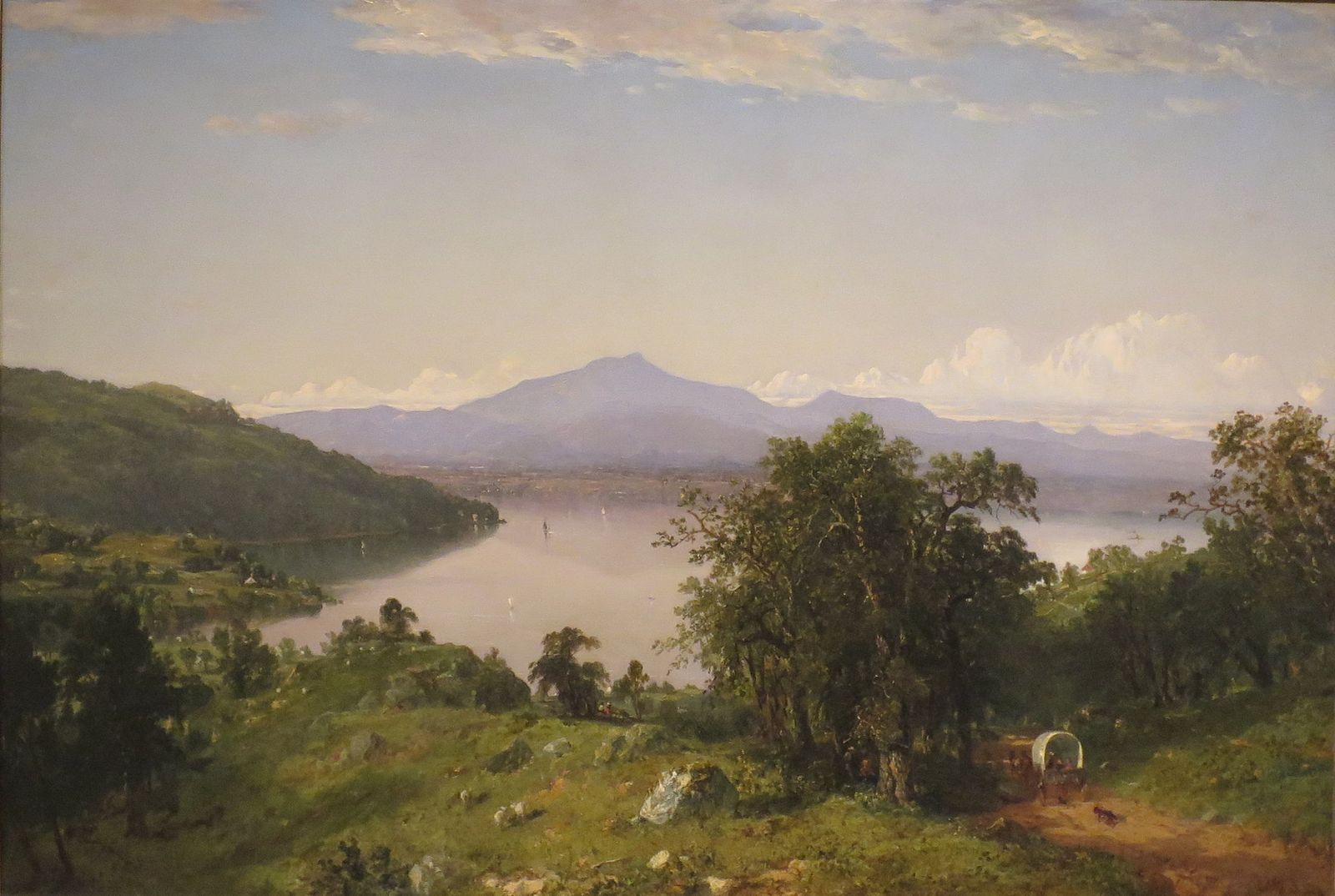
John Frederick Kensett. Camel’s Hump from the Western Shor of Lake Champlain. 1852. High Museum of Art, Atlanta. GA (reproduced under Fair Use, etc.)
My view of the mountain was taken from a hilly corner of Lee Park in Westport, New York. A similar prospect was adopted by John Frederick Kensett in 1852. One can see that he took tremendous liberties in portraying the vista in scale, greatly exaggerating the size of the distant peak. Cherishing verisimilitude, contemporary realists frequently embrace a benighted understanding of historical artworks as reporting visual data with accuracy. In fact the opposite is true. The job of art was to improve on nature. Failing to do so was dismissed as mere imitation. Kensett’s point of view would have been within a few hundred yards of my position.
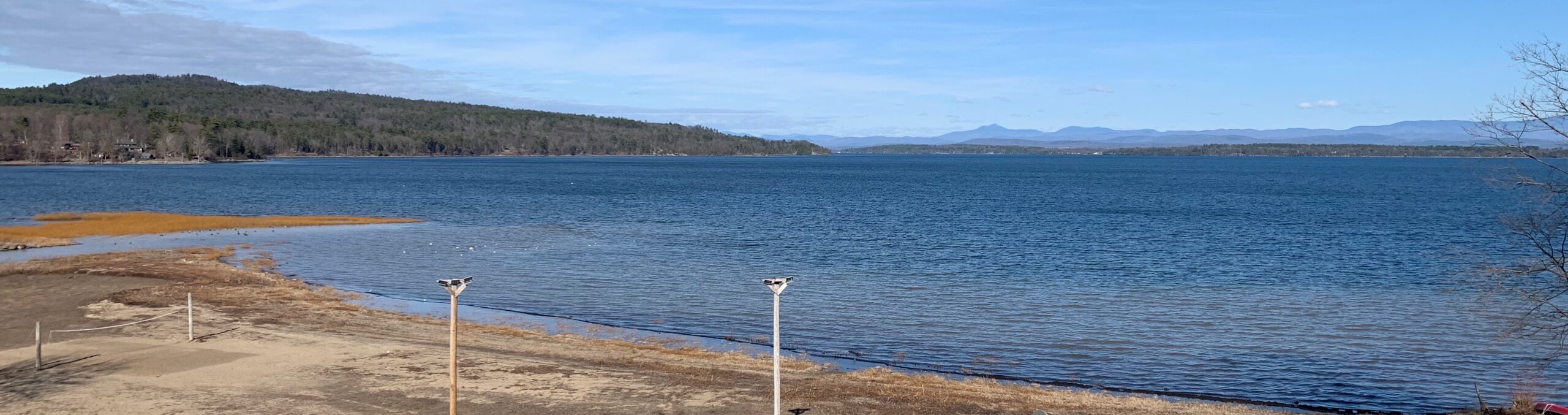
View of Camel’s Hump and Lake Champlain. NW from Lee Park Hill (44.1839 x -73.3447). March 27, 2021. 4:31 PM,
The panoramic photograph above hardly resembles my memory of the scene. Nor would it have given much satisfaction to Kensett. Equipped with a better camera and more judicious lens options, a far more satisfactory result might have been achieved. Regardless of technology, still photography faces an uphill struggle to attain the complexity of human experience. Cinema stands a better chance. Here’s why.
Looking at individual features of terrain, we adjust our vision, zooming in and out, scanning the vista to collect bits of information to be filed away on the hard-drive. Drawing on these memories to reconstruct the scene, the relative size of one thing or another becomes less important than experiential conditions such as space, light, distance and proximity. Thus Kensett’s painting is a faithful reprise of the experience of looking at Camel’s Hump from Westport, unfettered by facts and data. One of the key differences between painting and photography is how either process is shaped by memory. The camera does not see things as we see them. It may take dozens of exposures to capture something that resonates with the photographer’s experience. In drawing and painting, even if we think that we are working from observation, in fact we are always working from memory. One looks at the subject, then turns to the page to make a mark. One looks at the mark, and then studies the subject. Casting our gaze back to the page we remember the subject. Looking back at the subject we remember the page. Because drawing from observation is working from memory, the challenge is not just to report the facts we behold, but to portray our memory of them.
View last week’s Virtual Workshop (May 12, 2021), presented by the HUDSON RIVER MUSEUM. LINK
This week’s workshops:
Hudson River Museum. Wednesday, May 19 @ 1:30 PM, EDT. REGISTER
Greenwich Art Society. Saturday May 22 @ 1PM, EDT. REGISTER
To receive updates and free study guides from the members-only Sketchbook Traveler Resources page, please send us an
wo*******@ne***********.com
“>EMAIL, subject-line “members”
Now available to own: Sketchbook Traveler: Hudson Valley (Photo by the author)
Explore my Quaranteam Dispatches, from April 1-June 8, 2020