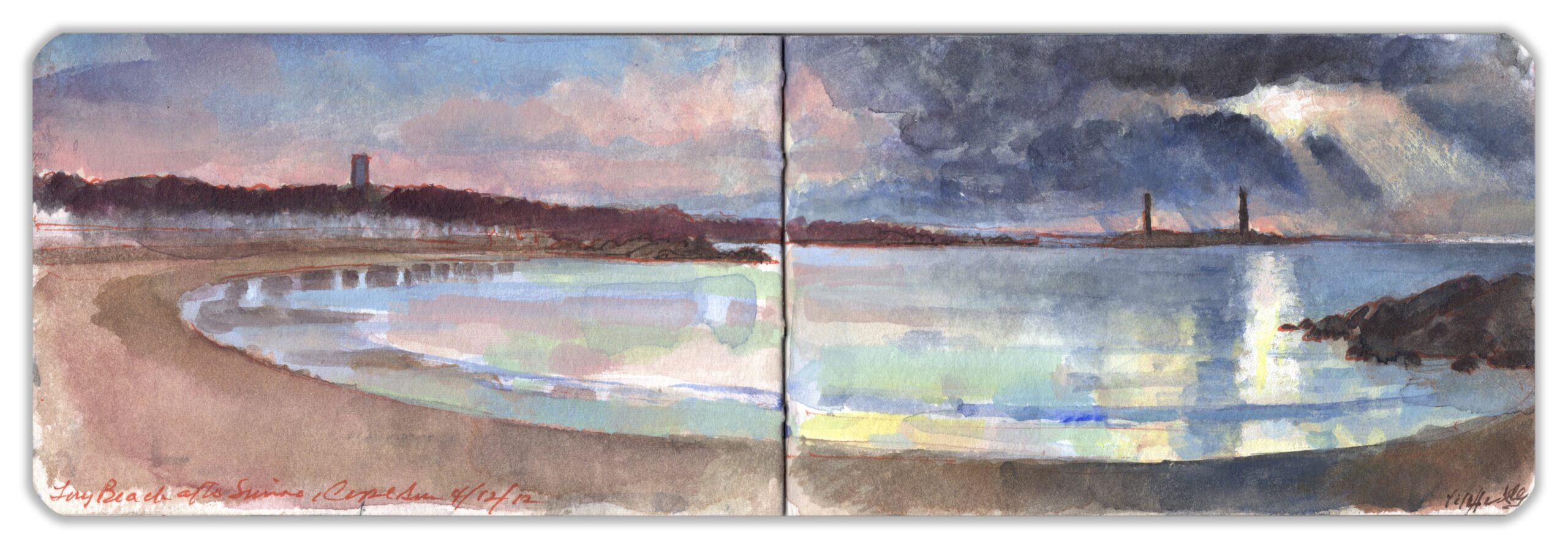
Cape Ann: Thatcher Island Lights from Long Beach. Thursday April 12, 2012
Few subjects invite more derision from self-identified serious painters than lighthouses and fishing-shacks, both of which Cape Ann has in abundance. Great artists like Edward Hopper, Winslow Homer and Fitz Henry Lane were undaunted by these pastiches, perhaps because they found more personal ways to confront them. During a visit to Cape Ann in the spring of 2012, we decided to seek accommodations along its Atlantic coast. Long Beach is a fishhook-shaped strip of sandy shoreline perhaps two miles in length, behind which stands in two ranks a row of seasonal homes. We stayed in the motel tucked in a cover at the southern end of the beach, in a modest room with a kitchen. Starting at the parking-area, a pedestrian walkway stretched northward between the beach and the houses, most of which would be vacant until Memorial Day. At the far end of the strand a stream flowed across the beach, dumping its waters into the ocean. Blowing in from the sea, a cold wind greeted our return to the warm room where we prepared our supper. Daybreak revealed beneath dark clouds the low profile of Thatcher’s Island with its twin lighthouses, silhouetted against a rosy horizon.
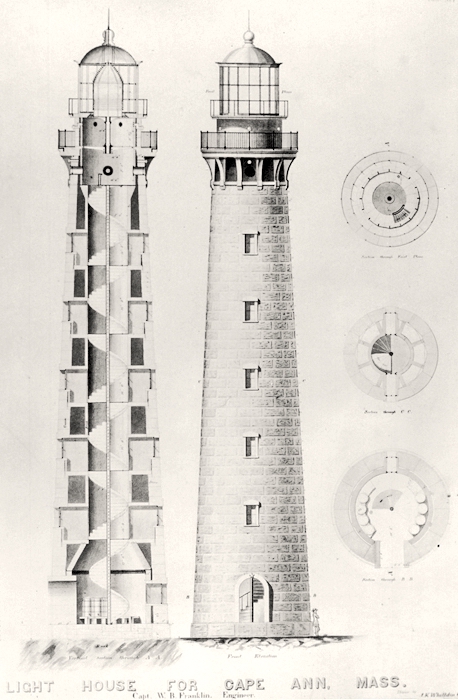
New design for the Thacher Island light-towers. Drawing by Captain William Buel Franklin (1823-1903). A graduate of West Point, Franklin became a member of the elite Corps of Topographical Engineers. He took part in the survey of the Great Lakes and saw action during the Mexican War. In 1857 he was put in charge of lighthouse construction along the New England coast. In 1859 he was made engineer for construction of the U.S. Capitol dome. During the Civil War he achieved the rank of Major General.
Violent storms off the coast of Cape Ann frequently drove ships onto Londoner Ledge, which in 1635 took twenty-one lives aboard the unlucky Watch and Wait. Only two survived. Anthony and Elizabeth Thacher found refuge on a nearby island, which the colonial government awarded them as recompense for their losses. Bequeathed to their descendants, the island was purchased by the colony for the purpose of setting up a pair of lighthouses. As an aid to navigation the towers were built along a north-south axis. The beacons first were lit in 1771. Four years later a detachment of minutemen shut them down. Following the cessation of hostilities the Commonwealth of Massachusetts ceded Thacher’s Island to the federal government. Lighthouse operations resumed in 1793. In 1861, a new pair of towers took their place. As the sun rose behind them one cold April morning, they seemed to signal both hope and danger.
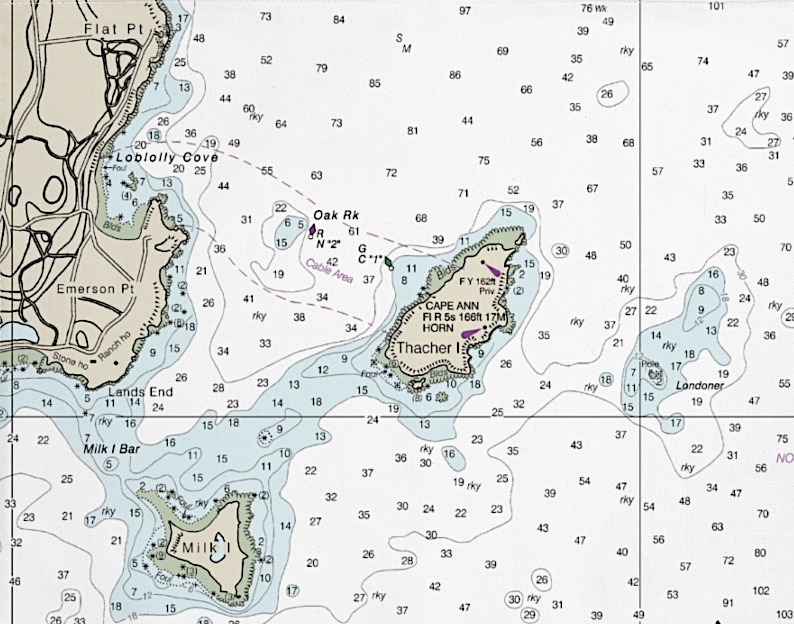
Nautical chart showing Emerson Point, Oak Rock, Thacher’s Island, Londoner Ledge and Milk Island; treacherous waters in fog or bad weather. With tides at time in excess of nine feet, miscalculating the combined effect of currents, winds and tides expose mariners to calamity, in the form of rocky ledges lurking beneath the waves.
Now available to own: Sketchbook Traveler: Hudson Valley

Explore my Quaranteam Dispatches, from April 1-June 8, 2020