Category Archives: Dispatches

April 29, 2020. QT Dispatch #29. Tracking Eliza, an Updated Detective Story

TRACKING ELIZA. A DETECTIVE STORY. James Lancel McElhinney (c) 2020
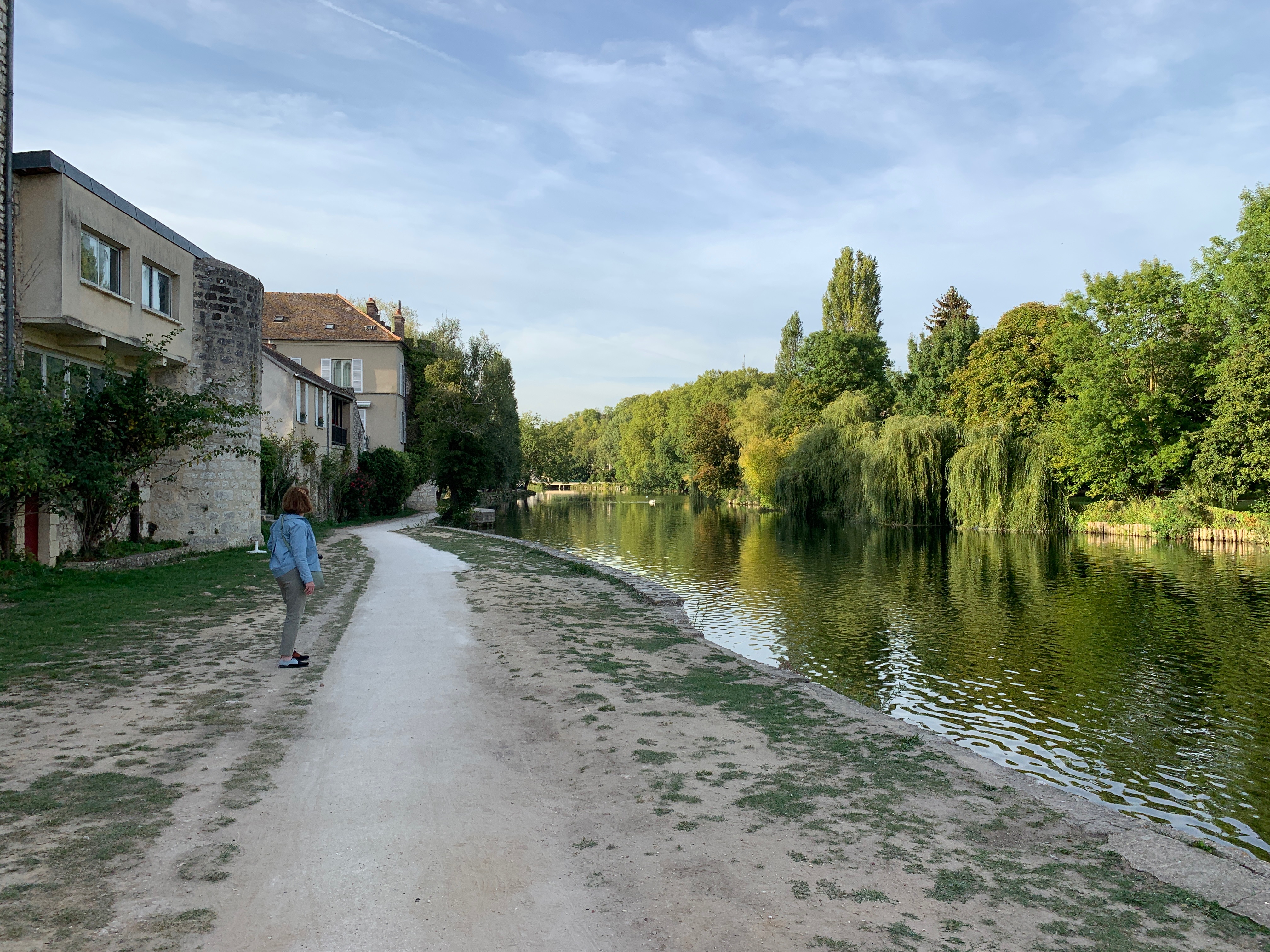

Kathie Manthorne on the esplanade along the left bank of the Loing River, bordered by fragments of medieval defensive fortifications. September 16, 2019.

This story was published several months ago in serial form. Greeting each day now with artworks and travelogue, I share it here again, updated here with new information and images. Enjoy!

Eliza Pratt Greatorex (1819-1897) was a most remarkable individual, celebrated during her lifetime as “the first artist of her sex”. Shortly after her death in Paris, a Midwestern paper in a city where she never lived named her among the greatest women in American history. The story was published in syndication around the country. More than a century after her passing she is all but forgotten. That is about to change.
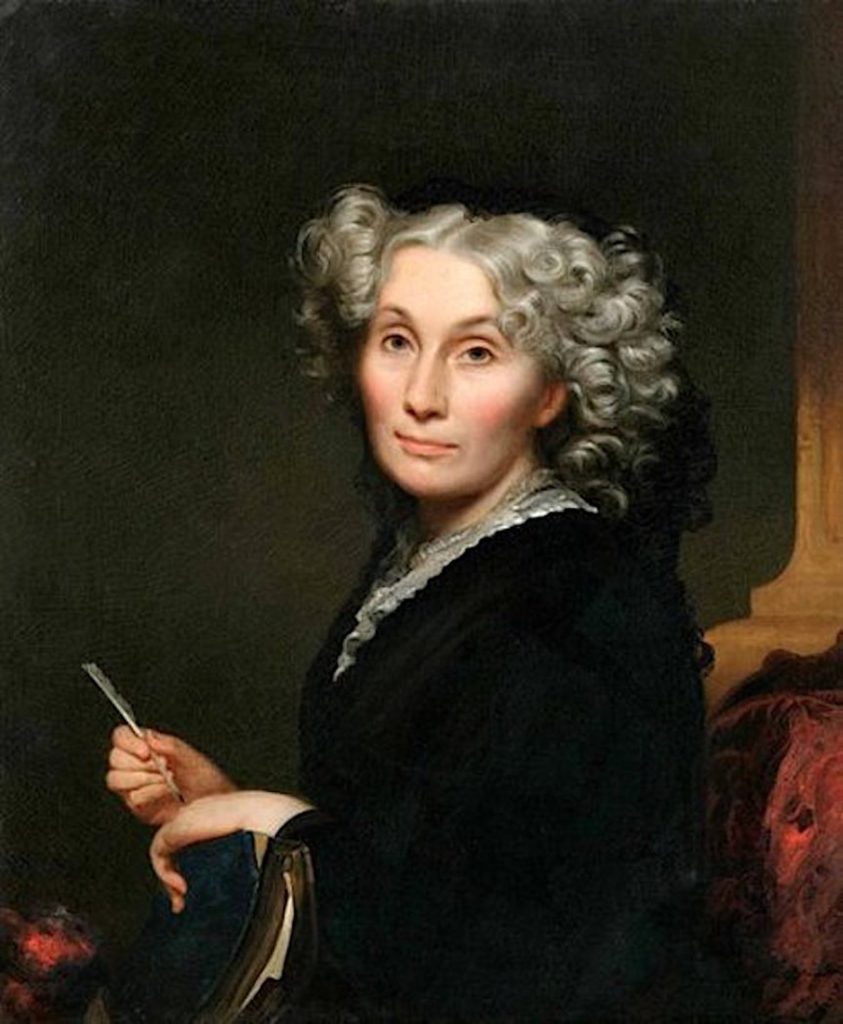

Eliza Pratt Greatorex (1819-1897) by Thomas Boyle. 1869
Collection National Academy of Design, New York.
(Reproduced under fair use, etc.)

Born into a large family, the daughter of a Methodist circuit preacher in Donegal, Eliza Pratt demonstrated a talent for drawing at an early age. During the great famine, her brother Adam emigrated to New York State, opening a dry-goods store in the town of Leroy, known today at the birthplace of Jell-O. Eliza followed, traveling in steerage from Liverpool, arriving in Manhattan, where she was welcomed by the city’s Irish elites. She later met and married a popular composer of church music; Henry Greatorex, son of the organist at Westminster Abbey.
While on tour in Charleston, South Carolina Henry succumbed to Yellow Fever, leaving Eliza with four young children to raise as a single mother. Drawing support from her brother and sister in America, Greatorex traveled to France in pursuit of formal training as an artist. Upon her return, she began exhibiting her work to some acclaim, becoming the second woman inducted into the National Academy of Design. As her children exhibited both musical and artistic talent, when they reached adulthood she brought them into her enterprise, and on travels to Europe and the American West. All the while Eliza developed close relationships with leading feminists. Among her friends were women like Susan B. Anthony, Mary Louise Booth, Grace Greenwood and Helen Hunt Jackson. Later in life, her health began to fail. She and her two daughters left New York, moving to the walled medieval town of Moret-sur-Loing, where all three ended their days. Eliza passed away during a sojourn in Paris in 1897. Records show Eliza’s coffin being collected from an apartment near Luxembourg Garden, then delivered to Gare de Lyon. She was buried in the Cimitiere Municipal de Moret-sur-Loing. Eliza’s sepulchre is inscribed with a verse; 1:John 1:5,

“GOD IS LIGHT AND IN HIM IS NO DARKNESS AT ALL”

Two years later her friend, noted Impressionist painter Alfred Sisley was buried in the plot beside her. Eleanor was interred next to her mother in 1908. Surviving daughter Kathleen Honora marked the graves with two stone slabs, memorializing three generations of her family. Kathleen passed away in 1942 and was buried on the other side of Eliza. Kathleen’s gravestone bears no inscription, but the three modest monuments merge into one. Inseparable in life, the Greatorex women remain united in eternity.
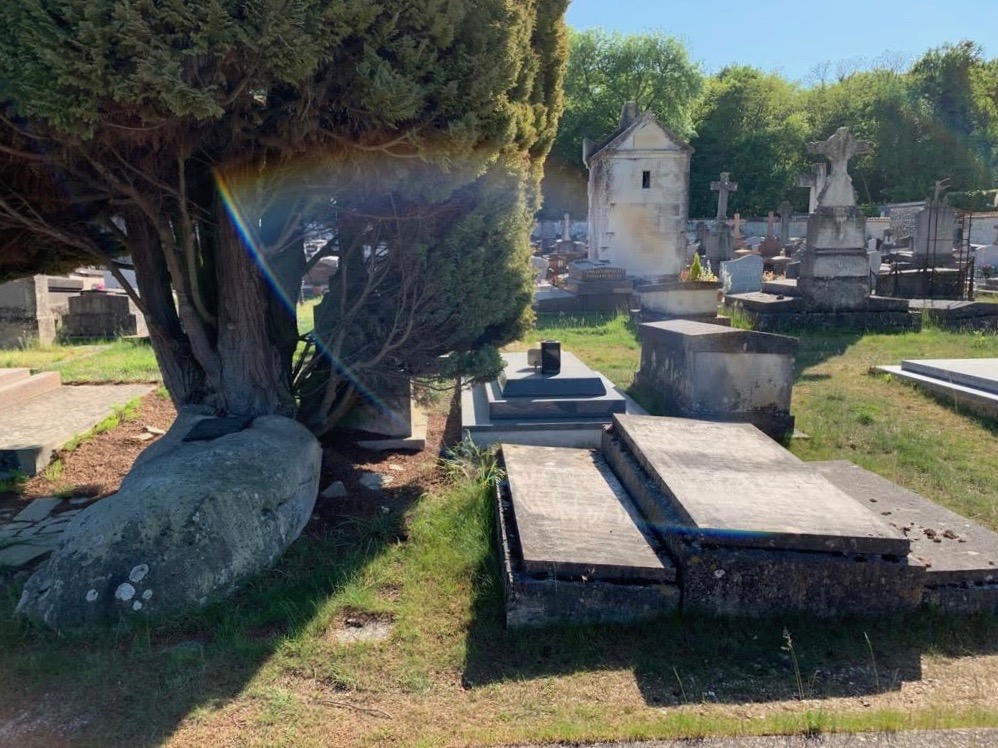

A tree and boulder marking grave of Alfred Sisley, Cimitiere Municipal de Moret-sur-Loing, Ile de France. Just beside it is the grave of Eliza Pratt Greatorex, flanked by those of her daughters Eleanore Elizabeth (left) and Kathleen Honora (right). Pebbles appear to be resting on Kathleen’s grave-stone, the only one of the three. Taking note of this and the year of her death (1942), one wonders if she had been brave as well as talented. (Photograph courtesy of Hans Christian Bohlmann).

Kathie Manthorne began researching Greatorex decades ago, picking up the thread between other books and projects. The process was vexing in part because Eliza left no paper trail in her wake. No collection of papers or letters, fewer documents of other kinds, and a handful of photographs. Her life had to be reconstructed by consulting public records; chiefly newspaper articles reporting on her comings and goings. Kathie and I have retraced Eliza’s peripatetic existence from Manorhamilton, County Leitrim, where she was born—to Pettigoe, County Donegal, where she was raised. We identified her various domiciles in Manhattan, Hoboken, Jersey City, Bay Ridge, Cornwall-on-Hudson, Leroy New York, and Cragsmoor artists’ colony in the Shawangunks of Ulster County. Following her restless path to Milwaukee, Denver, Manitou Springs and Fairplay, Colorado, we found traces of Eliza and her daughters in in Oberammergau and Munich. Apart from Tangier, only one place remained—her final residence at Moret-sur-Loing.
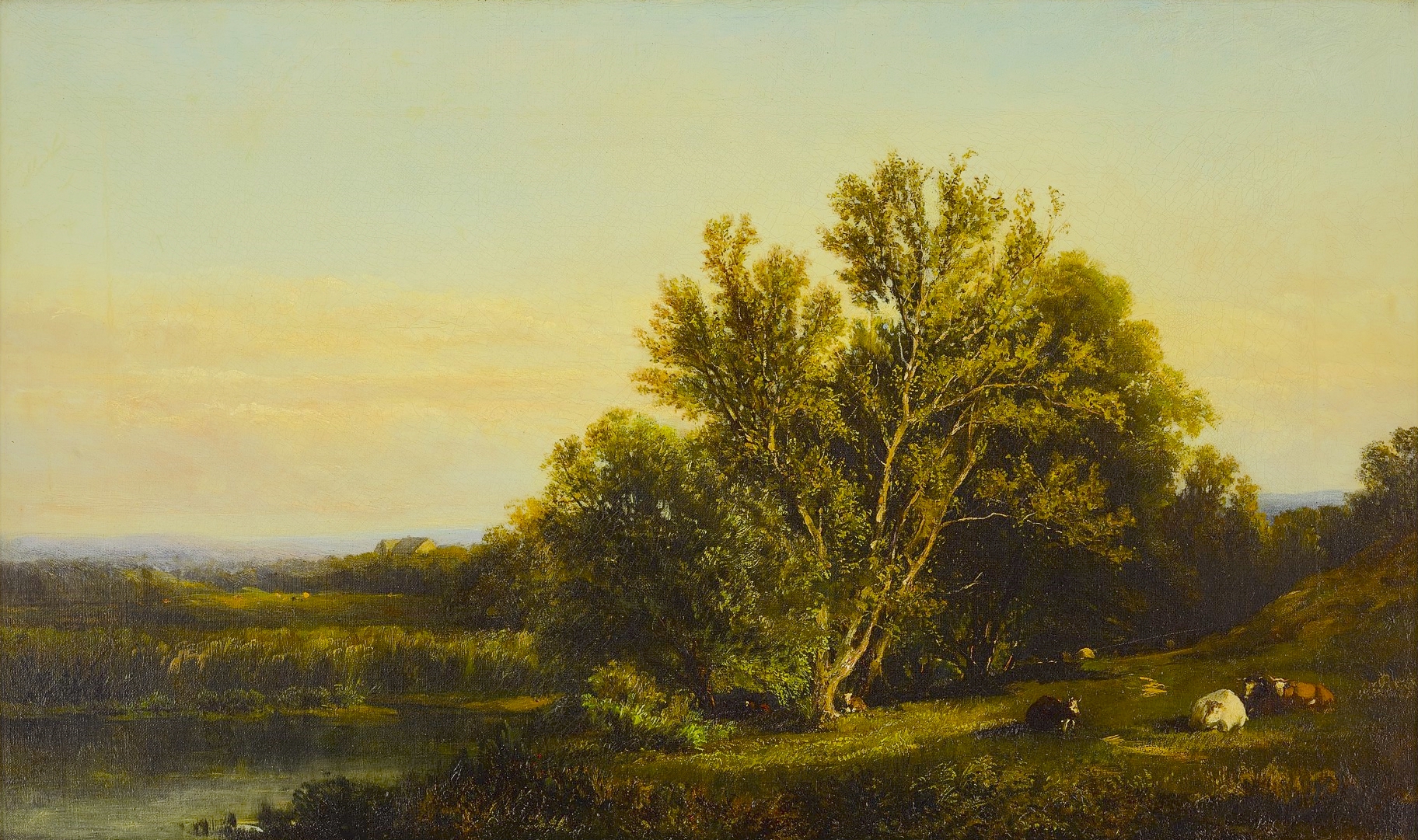

Landscpae Near Cragsmoor. Samuel Dorksy Museum of Art, New York State University at New Paltz. (Reproduced under fair use, etc.)

Last year Kathie completed the first biography of Greatorex, using her life as a kind of prism illuminating a new vision of American art-women in an age of promise. University of California will publish the book later this year. Pompidou Center and the Musee d’Orsay organized Faire/Oeuvre, a conference focused on artistic training for women in nineteenth century Paris. Kathie was invited to deliver a paper on Greatorex and her daughters. It was decided that we would arrive a few days in advance of the symposium. Landing at CDG Roissy, we were met by Michaal, who drove us to Moret. Beyond Melun we entered Fontainebleau Forest—the vast tract preserved today as a national park. I was struck by the condition of the understory—a tangle of brambles and ferns that reminded me in a way of the loving neglect I had observed in German woods, even in official parks like Berlin’s Tiergarten. We passed a plump, forty-something woman in yoga-pants setting up a lawn-chair, parasol and cooler by the side of the road. I asked Michaal if she were a vendor, or just a person who likes to sit on the shoulder of the road. She was a sex worker, he explained. Men pull over, she gets in the car, does her business and her clients drive away. It’s a racket, he said. She’s paying off the cops, who slap her clients with huge fines. I told him the story about going to a pub in Ramelton with my Donegal cousins. Parking a quarter mile away, we walked to the town center. At closing time, we all stumbled out of the pub into a blinding flood of light, provided by the collective headlamps and spotlights of Garda vehicles. I turned to my cousin and said, So that’s why we parked where we did.

Driving past Fontainebleau through another stretch of the forest to Veneux-les-Sablons, after ninety minutes on the road we arrived at Hotel de Cheval-Noir in Moret, a charming nineteenth century auberge on a corner of the Place de Samois, across the street from a monument honoring the town’s most famous resident—impressionist painter Alfred Sisley. The hotel is run by a married couple whom we later discovered are avid aeronauts who met through ballooning. Gilles de Crick was a successful chef who grew weary of the frantic world of culinary arts. Until recently the hotel had operated a restaurant, which now is open for private functions only.
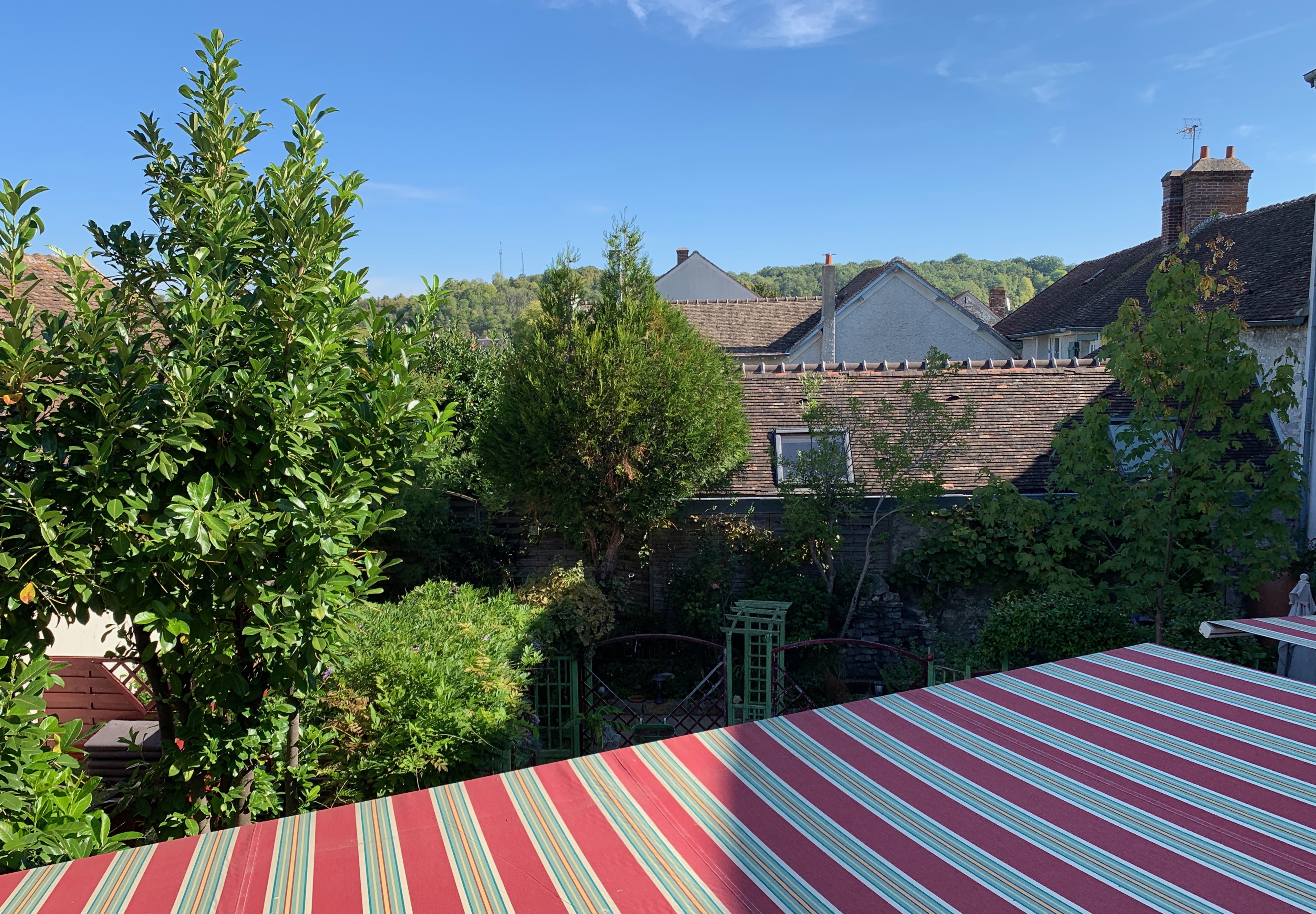

The view from our deck off Chambre Monet, at Hostellerie du Cheval Noir, Moret-sur-Loing

We were greeted by Gilles’s wife Anne Bourdeau, who led us the winding stair to select a room. Kathie had booked the Sisley room, decorated with copies of the master’s work by a local artist. For a few Euros more, we could have the larger Monet room. Both had decks facing north, with en-suite bathrooms. Dragging our bags up the wooden staircase, we collapsed for an hour, pondering our next move.
Stalking Eliza Greatorex, we had come to Moret to locate her final abode. Having only a description by an American woman, in a letter written in 1909 to her sister about calling on Eliza’s daughter Kathleen. The other clue was a short description of the property by Kathleen’s sister Eleanor, who had died in 1908. Surviving letters bear the return address of “Ramparts”. As we soon would discover, most of the town is encompassed by twelfth-century walls, punctuated by cylindrical towers. With less than two days to solve the mystery, we embarked on our adventure by heading to the nearest café.

(to be continued….)
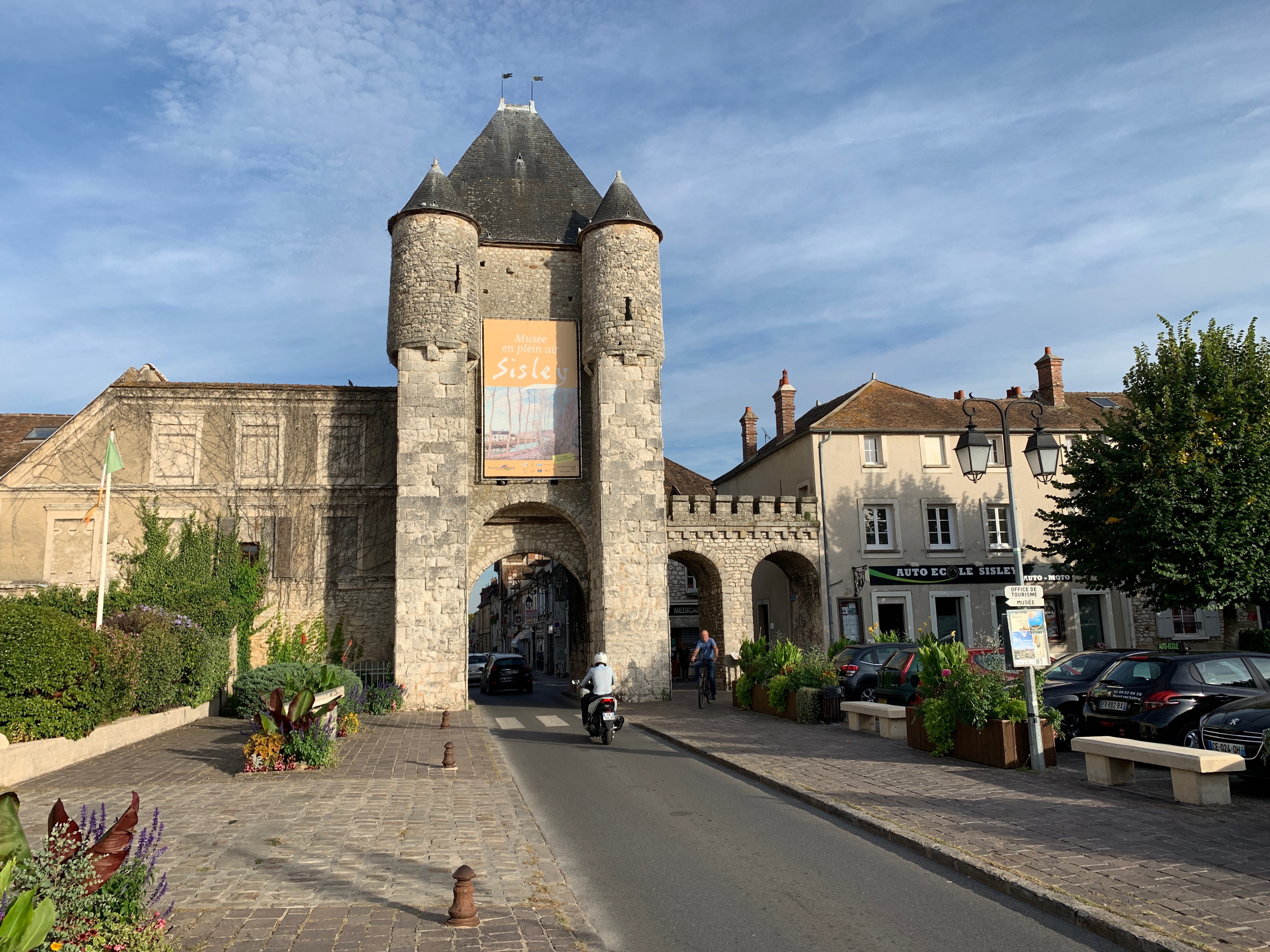

Poret de Samois, Moret-sur-Loing. Ile de France

Opening onto the roof-deck, the French window welcomed a cool breeze into the room. We awoke from our nap just around eleven, on the twenty-four-hour clock. We gathered out wits and debouched from Hostellerie du Cheval Noir into Place de Samois—a small square consisting of small wooded car-park to the south, and a medieval tower to the east, pierced by an arch through which passed Rue Grande—the only straight road in the town.
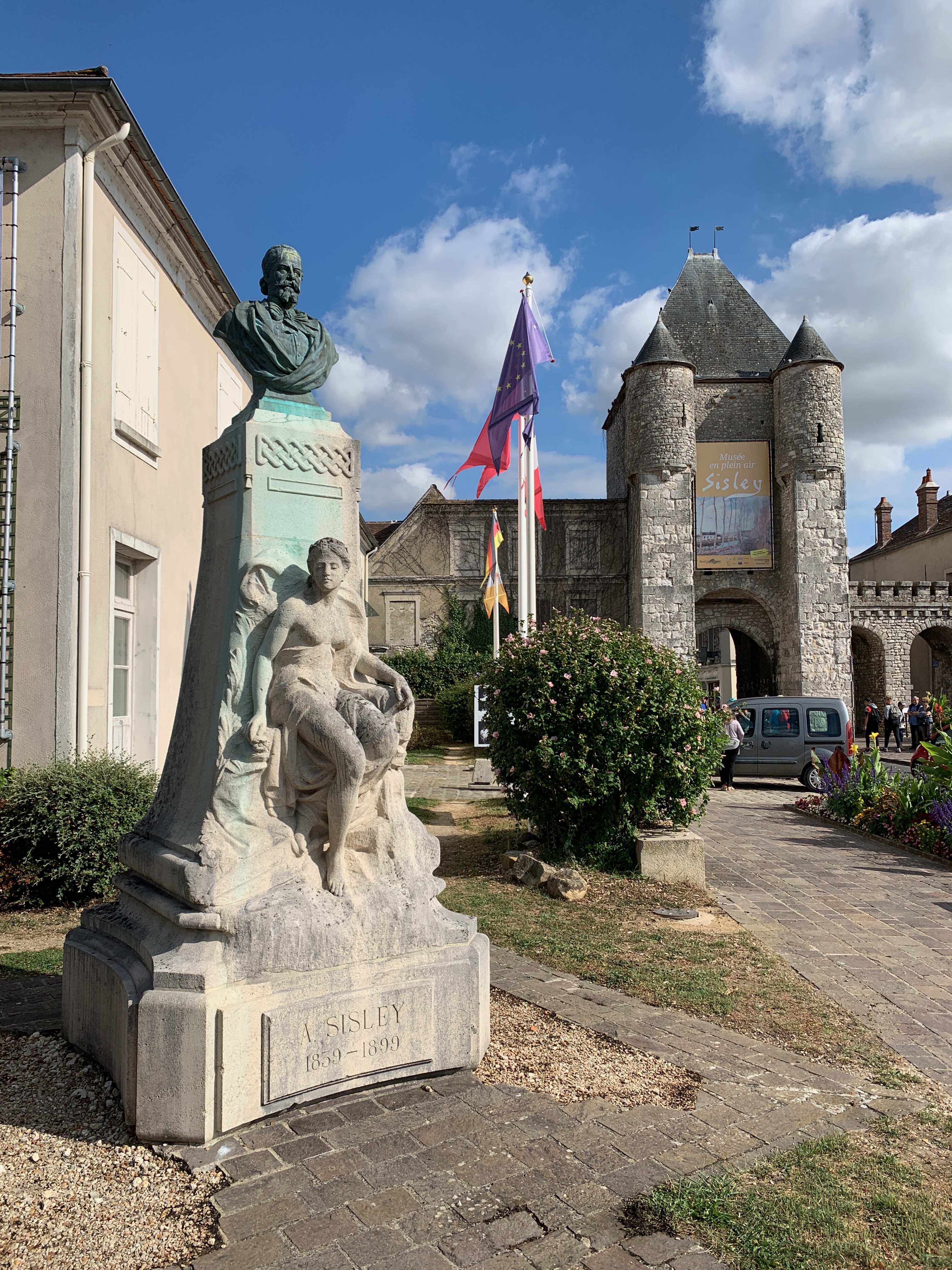

Monument to Alfred Sisley, Place de Samois. Moret sur Loing

It was Monday. At midday, every shop was closed. We stopped at Le P’tit Moret, a creperie on Rue des Granges. The door was open. Music was playing. Chairs were set out on a deck across the narrow street. Calling out to see if the place were open, a young man emerged from the kitchen who told us they would not be serving until noon. Wandering down the street, we emerged onto Place de l’Hotel de Ville—a wide, open square with a gentle incline, paved with flagstones. The city hall resembled a large stone house, next to which stood a timbered building with a glazed storefront, occupied by Les Amis de Sisley, a local society celebrating the legacy of the Impressionist painter who lived and died in Moret. Along Rue Grande, we noticed people sitting at a cluster of umbrella-tables consuming something. Beside them rose a Great War monument—a sandstone private standing at parade rest, honoring the battle-dead of Moret.
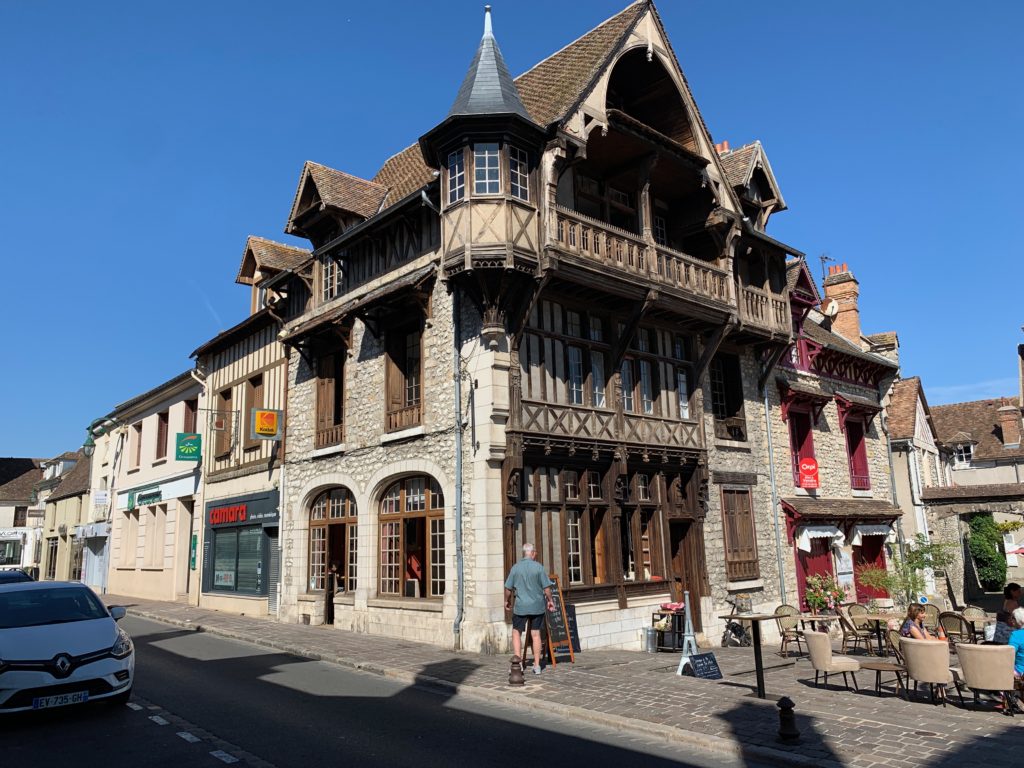

La Maison des Arts, Place de l’Hotel de Ville, Moret sur Loing-et-Orvanne
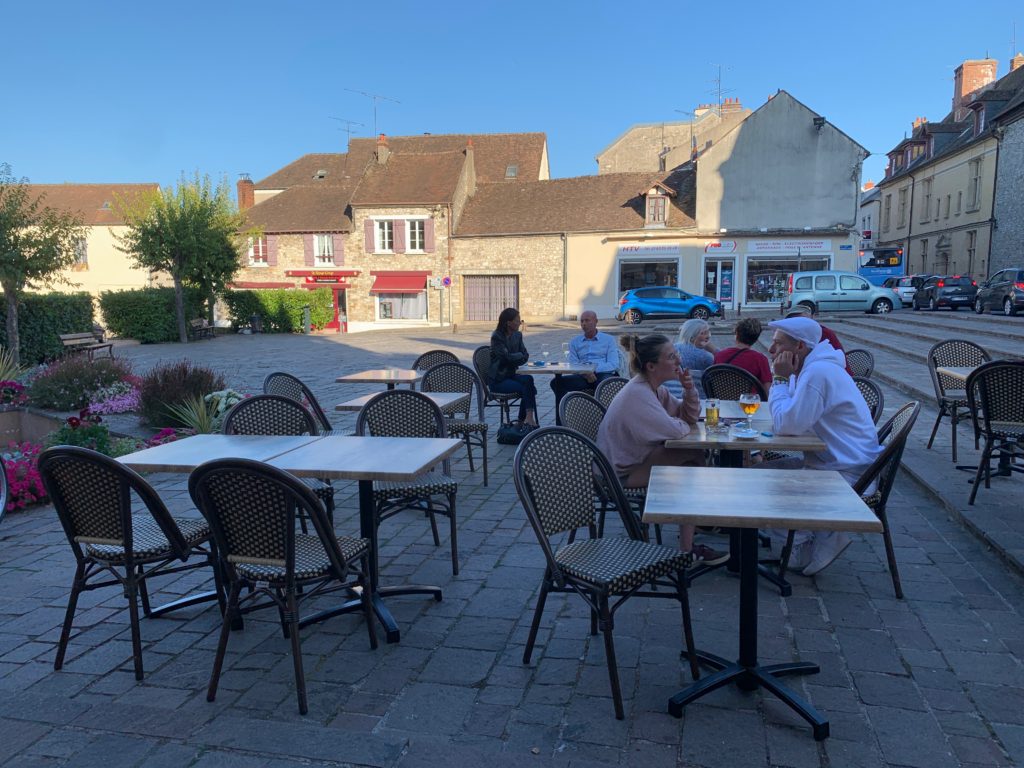

Place de l’Hotel de Ville, Moret. Exterior seating for La Maison des Arts

We took a seat. The young, lanky waiter wore his hair long, with a man-bun. He brought us menus, explaining that while no food is served until noon, the bar was open. At that moment, it would be happy-hour in New York. I ordered a beer for me and a Chardonnay for Kathie. Consuming the beverages with relish, we reveled in pre-prandial decadence. At twelve the waiter reappeared, pencil in hand. We ordered a charcuterie plate and another round of drinks. La Maison des Arts is notable in part for the building—a half-timbered medieval revival, built at the turn of the penultimate century. The woodwork, inside and out, had been done by a master carver and cabinetmaker named Racollet. His personal logo was a rat dipping its tail in a glue-pot, a jeu-des-mots on his name. In French, rat is pronounced with a silent “t”. Combined with coller, “to paste”, a homonym of collet, we have Racoller, or Racollet. The artist carved a humorous self-portrait onto one of the wooden pilasters on the façade of La Maison des Arts.
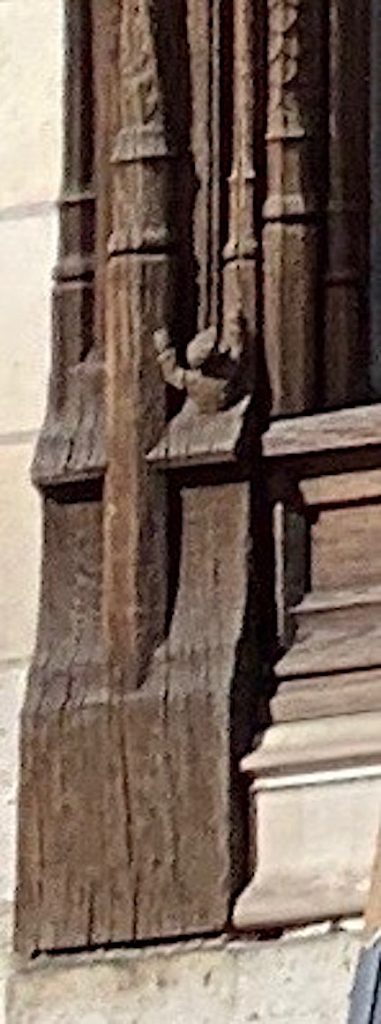
We later were to learn that Racollet had been responsible for a marvelous staircase in the city hall. Lingering over lunch, we reviewed our notes and ordered another round. Like many towns in France, shops in Moret close between noon and 15:00. Here on Mondays they seem never open at all. Strolling back to the hotel, I ducked into the tourism office to obtain a map. The young woman behind the counter knew a little about Sisley but had never heard of Greatorex. She pointed me toward the Sisley monument, a bronze portrait-bust atop a tapering stone pedestal, from which emerged a comely female nude, presumably his muse. Back at the hotel, Anne the proprietress expressed concern about us finding someplace to dine, it being Monday. Her offer to make a reservation for us we graciously accepted. After a catnap, we resumed our reconnaissance by returning to the Place de l’Hotel de Ville along Rue des Granges. Next to the post office we passed through the northern gate, which was crowned with a pitched roof and ornamental cupola.
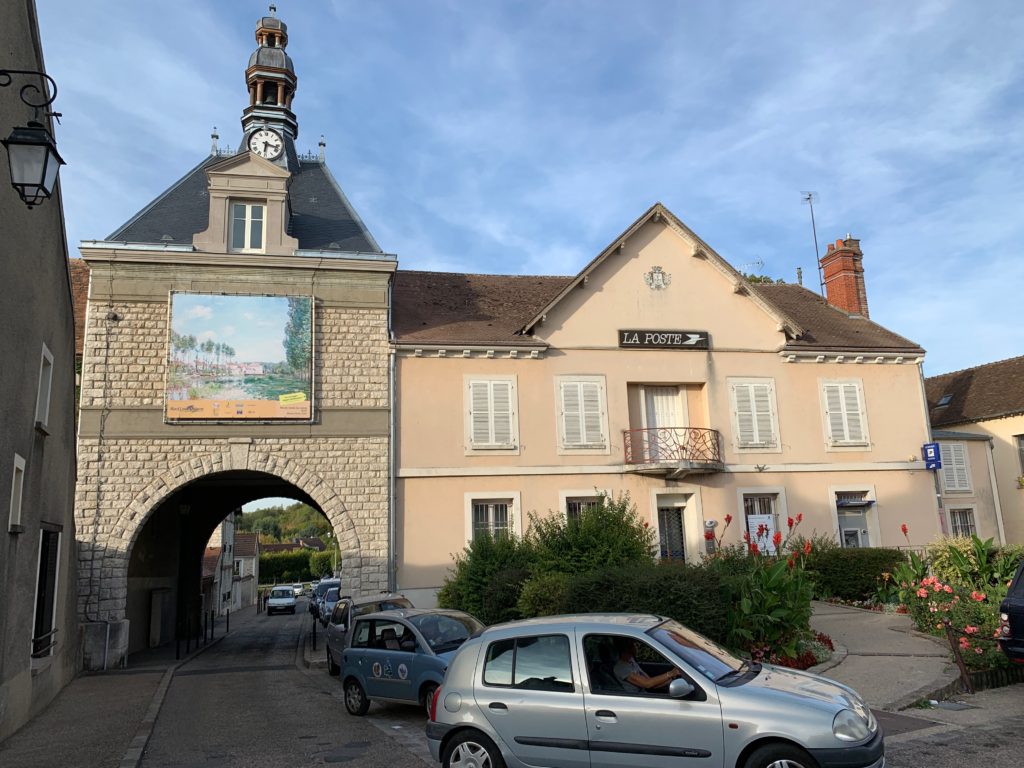

The North Gate, Moret sur Loing
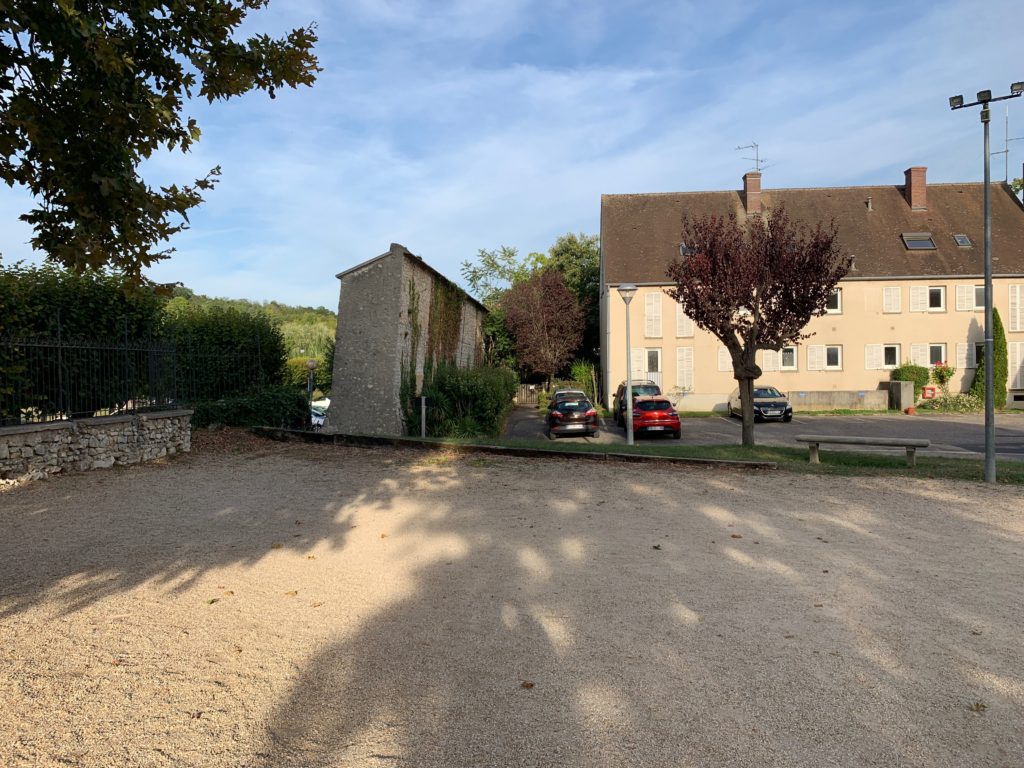

Sandy lot behind the post-office, with a fragment of the ancient wall.
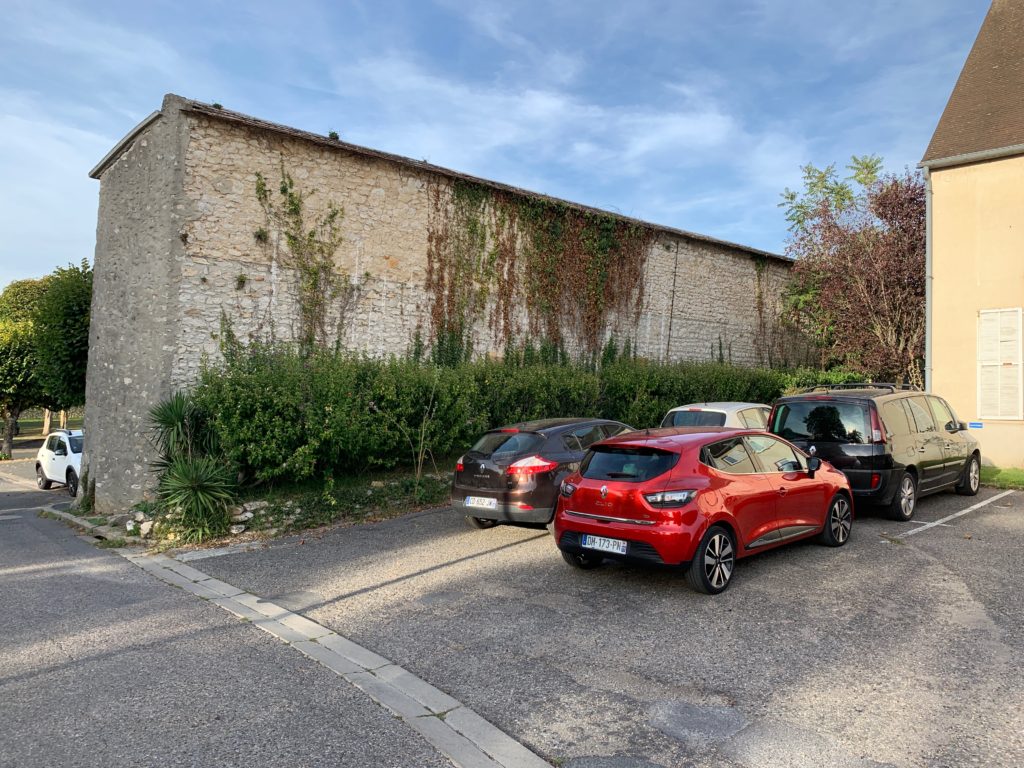

12th-c. perimeter wall, Moret sur Loing

The street—Cour de Couvent, led us to Rue du Peintre Zanaroff, with a car-park across the street, with a park off to the right. Running parallel to Rue Zanaroff on the near side of the street stood a section of the twelfth-century wall, dressed at one end like it had been sliced clean through with a knife. We had found the ramparts. Examining the medieval wall, we were stunned not to find them more stoutly built. Shortly after their construction, the structure would have had a timber walkway near the top, for defenders to occupy in repelling attacks. Below that perhaps one might find modest shops, ateliers and dwellings. Nothing remains today except for the wall, covered with ivy.
At its interior base, a driveway led back to a residential garden where a woman stood talking on her mobile. As the Greatorex women had lived near the ramparts, I saw no harm in asking a local if they had any knowledge or oral tradition remembering three American women living nearby. As I walked up the driveway, a man on a motorbike came up behind me. I explained the nature of my quest, but neither had ever heard tell of American artists living in town. Only Sisley. We continued to follow the wall, peering into gardens, comparing what we beheld with the handful of lines describing the Greatorex property as being by the ramparts, with a small tower nearby, a large studio building which they once tried to rent to Rodin. We walked toward the Loing, around yet another round tower, into a riverside park known as Le Pre Magaron.
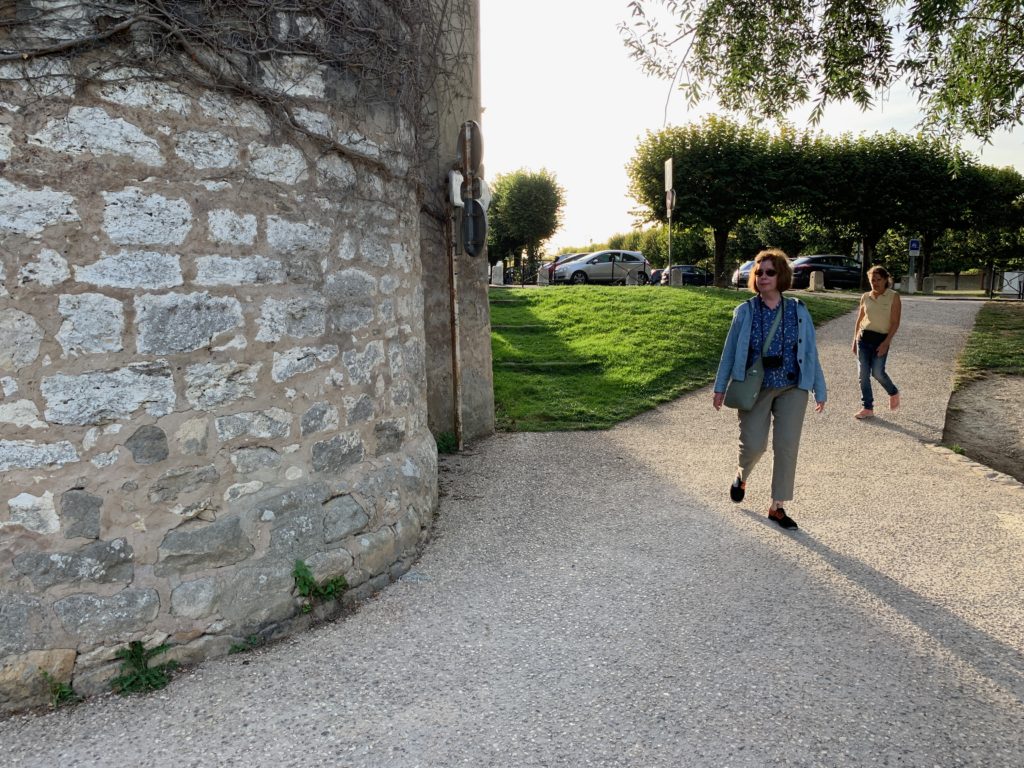

Kathie entering Le Pre Magaron
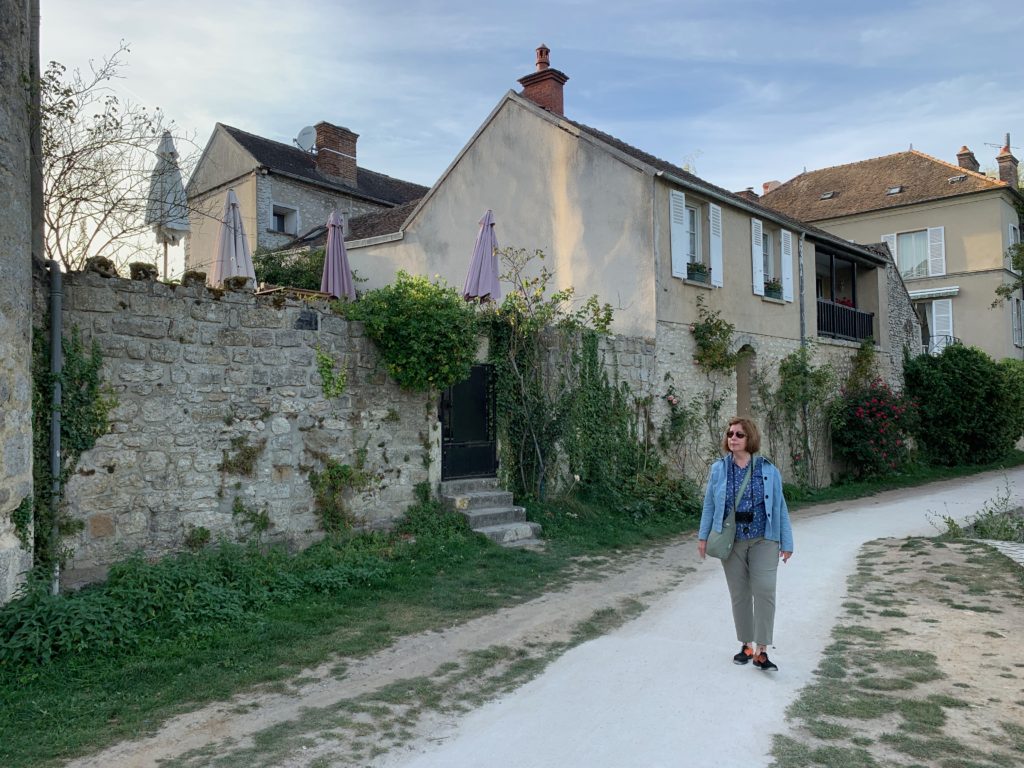

Houses built into the perimeter wall along Le Pre Magaron
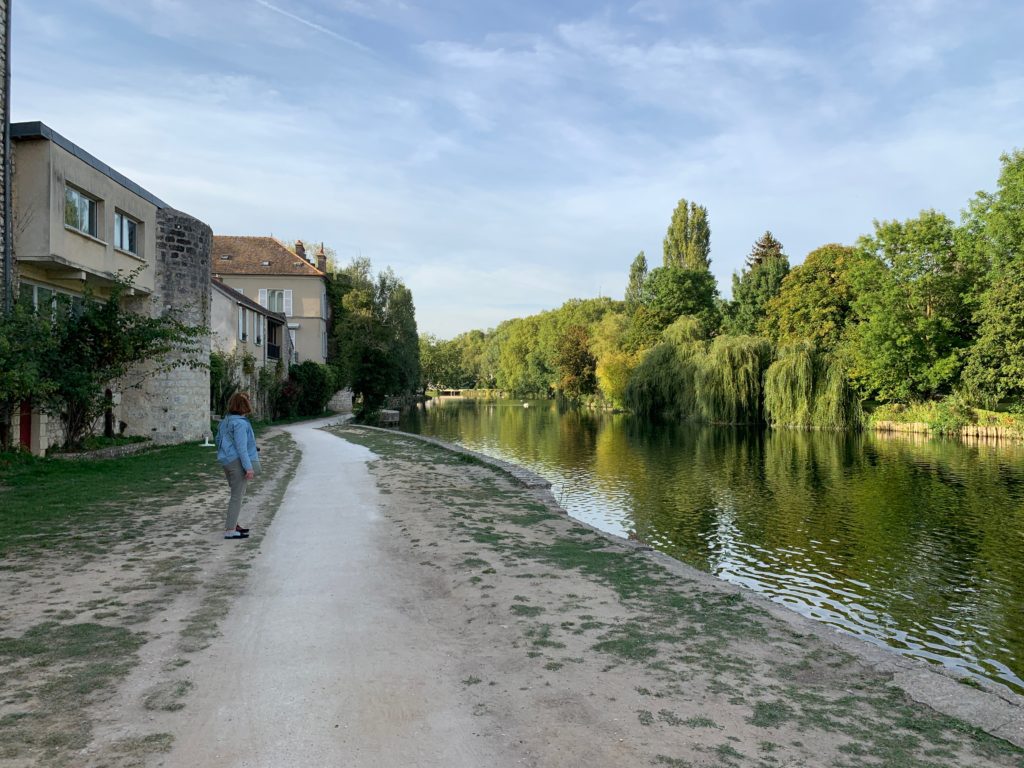

The scholar pauses to reflect

Here the enclosing wall stretched southward, toward the bridge and the Porte de Bourgogne. A number of properties could have fit the bill. Many were built into the remnants of the old city wall. East across the river stood the reconstructed mill. The river Loing empties into the Seine about a kilometer to the north. In the middle of the span is an island, upon which stands a reconstructed mill. The original Moulin Graciot, which had stood for hundreds of years was blown up, along with several arches of the ancient masonry bridge, when German troops withdrew from the town in August of 1944. Another mill along the south side of the bridge—Moulin a Tan has been refurbished to serve as an art gallery, while yet another mill now houses the Musee du Sucre d’Orge des Religieuses de Moret (Moret Museum of Barley-Sugar of the Religious). The shop selling the candies stands opposite the Church of Our Lady of the Nativity (l’Eglise du Notre Dane de la Nativite), on Rue du Puits du Four.
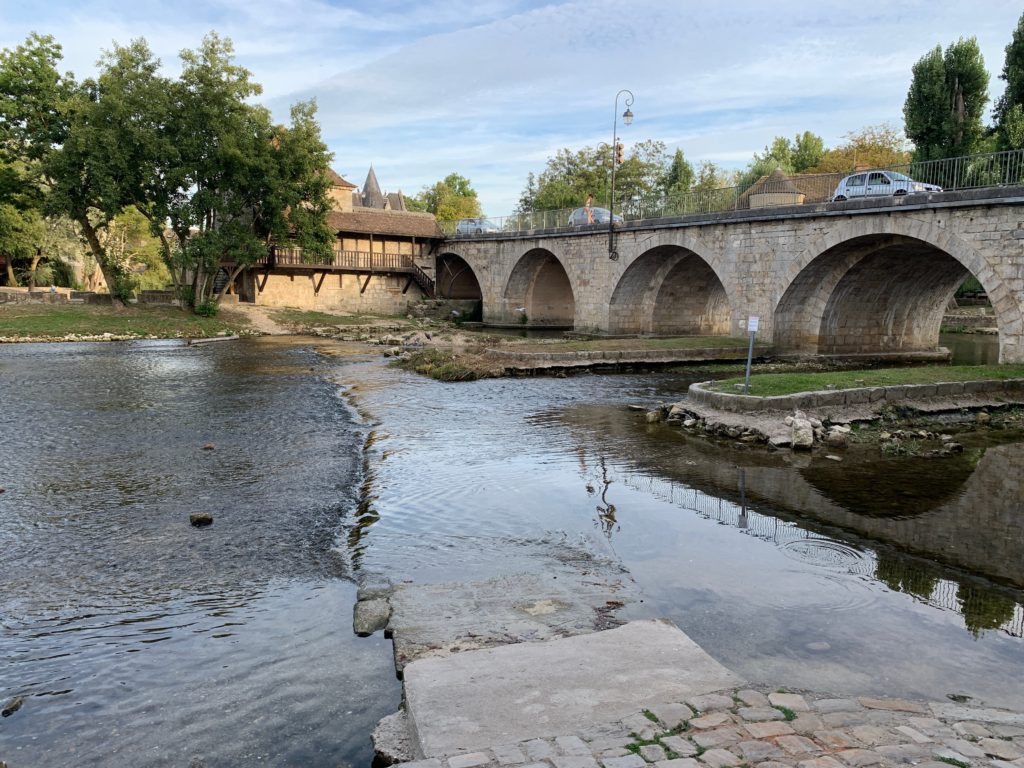

Moulin Gratiot and Pont de Moret
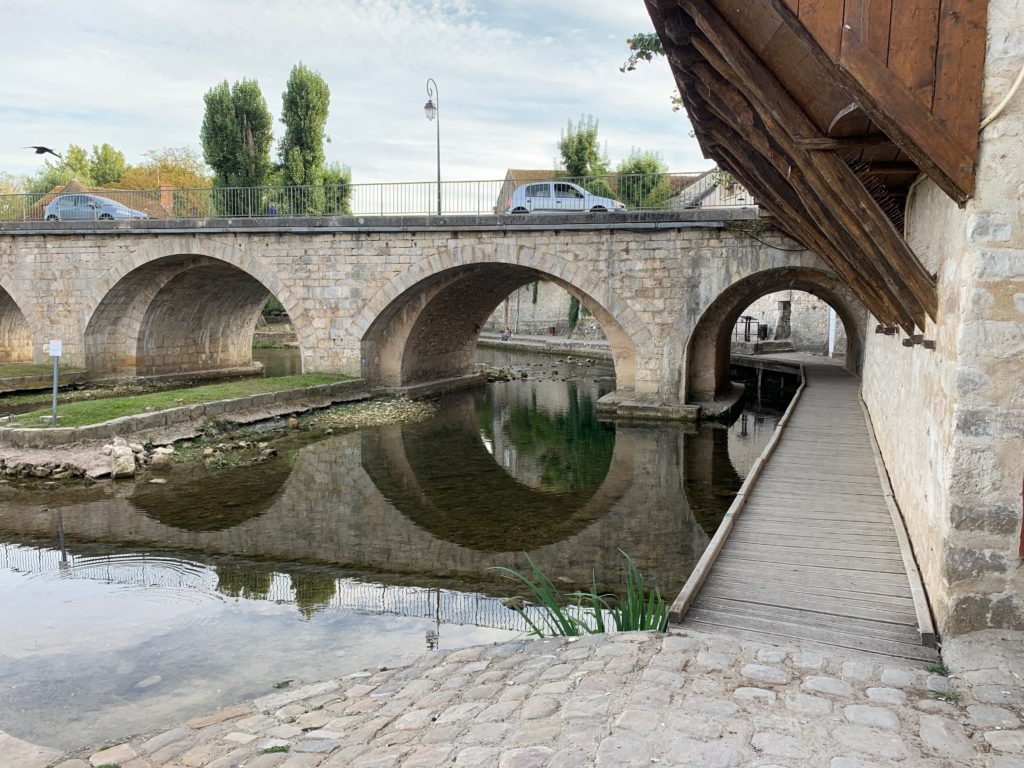

Looking west beneath the bridge to the Quai des laveuses, the low doorway to the staircase beyond
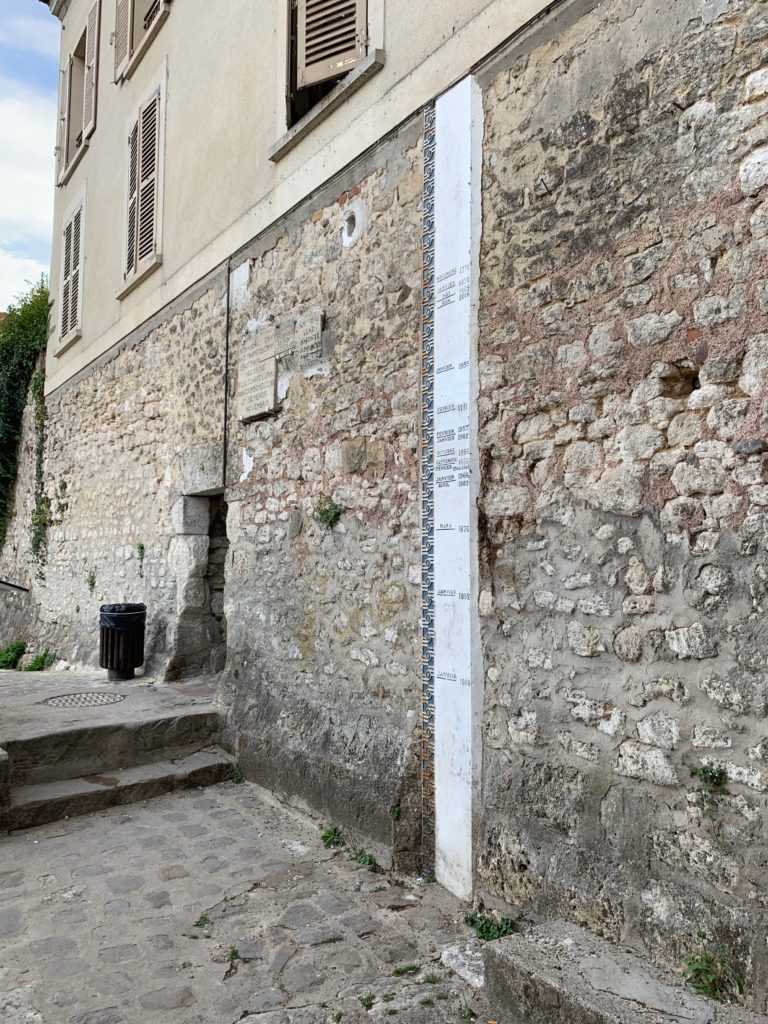

High-water marks recording various flood levels over the century, Quai des Laveuses

Passing below the bridge we came to a series of small waterpower dams, beneath a canopy of trees. The city wall soared overhead. A couple of young women sat huddled at the water’s edge. The paved esplanade known as Quai des Laveuses narrowed to its terminus, where an elderly lady was seated, lost in thought. Backtracking, we came to a low opening in the base of the wall behind a large stone. The doorway gave access to a covered way in which a stairway inclined steeply upwards. A gap between two buildings covering the stairs admitted some light. Aerosol paint tags on the passageway’s dingy yellow stucco walls may be graffiti, but calling it art would be a stretch.
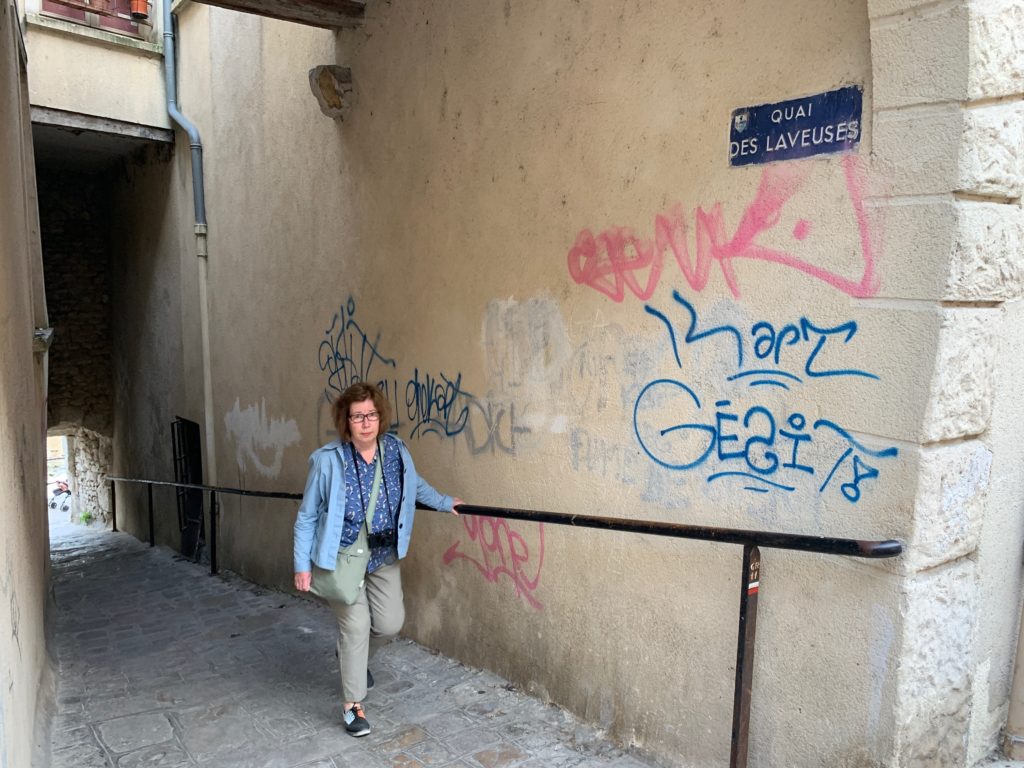

Kathie on the stairs at Quai des Laveuses
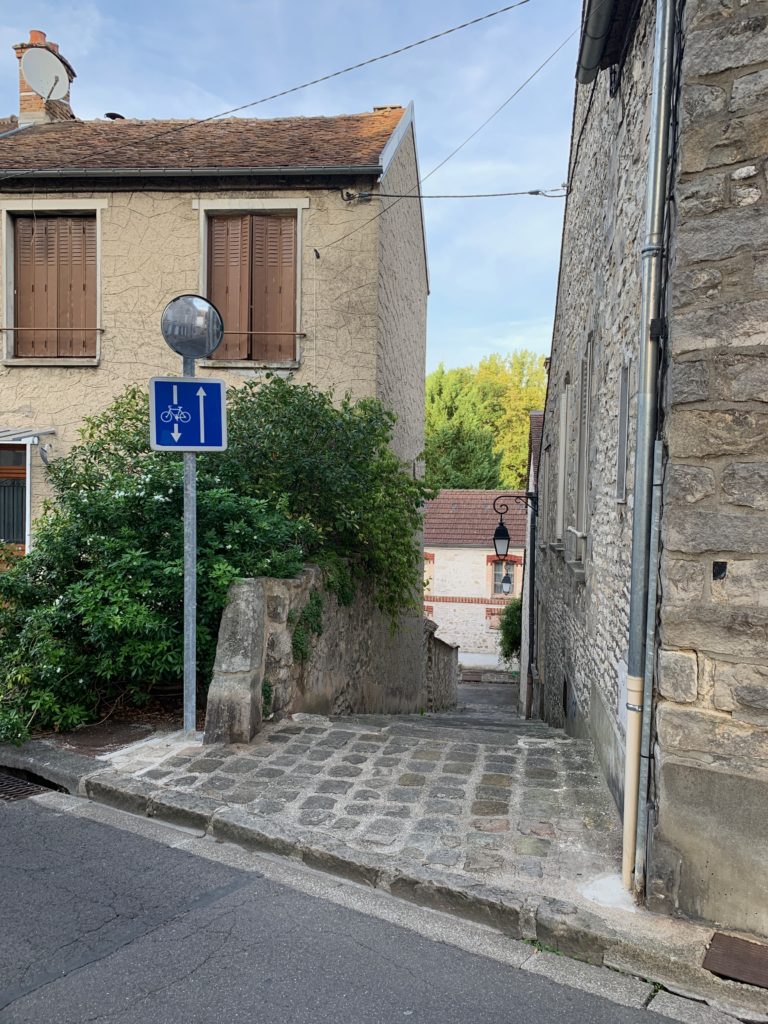

Escalier Royal, between Rue de Tannerie and Rue du Donjon, Moret sur Loing.

We debouched from the tunnel onto Rue da la Tannerie. Walking south we considered the likelihood that any of these properties was the one described by Eleonore Greatorex, or her friend Miss H. Coming to a dead end, we undertook another narrow ascent. In contrast to Quai des Laveuses, Escalier Royal was open to the heavens. Climbing the steps to Rue du Donjon, we turned south to approach the castle-keep. Satellite views show formal gardens and other structures behind the walls. The whole town had been built to function as a fortress, and this massive tower was once its beating heart, a final refuge in the event of a siege. Built between 1128 and 1154 in the Roman style, it resembles some Norman keeps found in the British Isles.
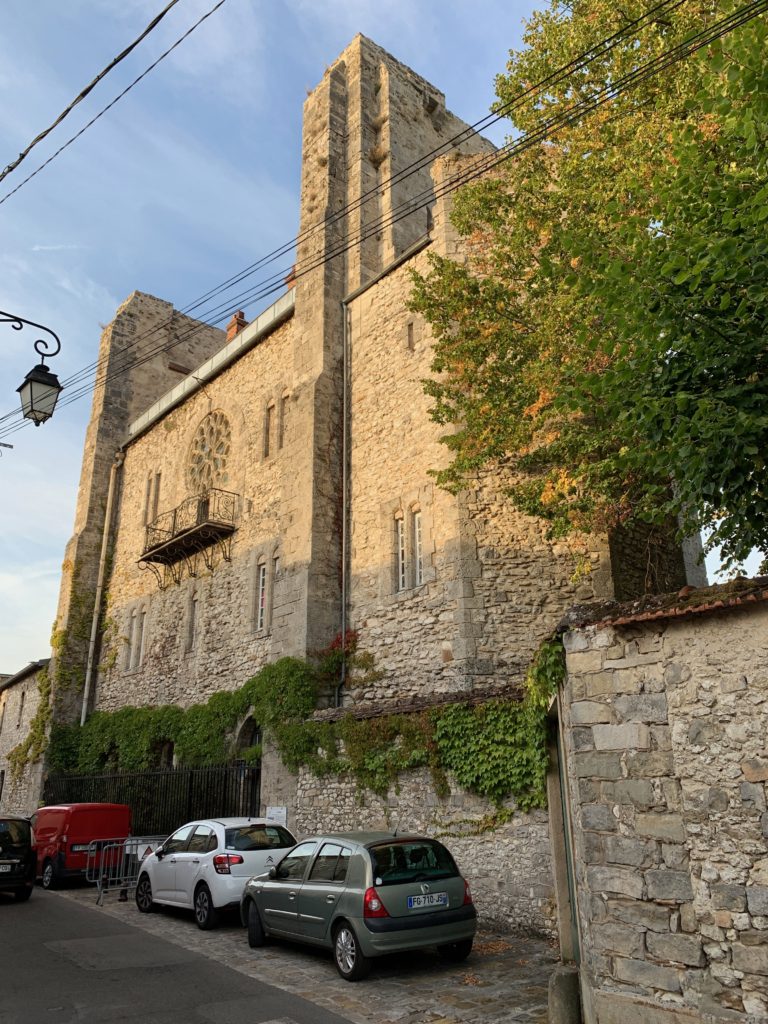

The western facade of the Donjon de Moret
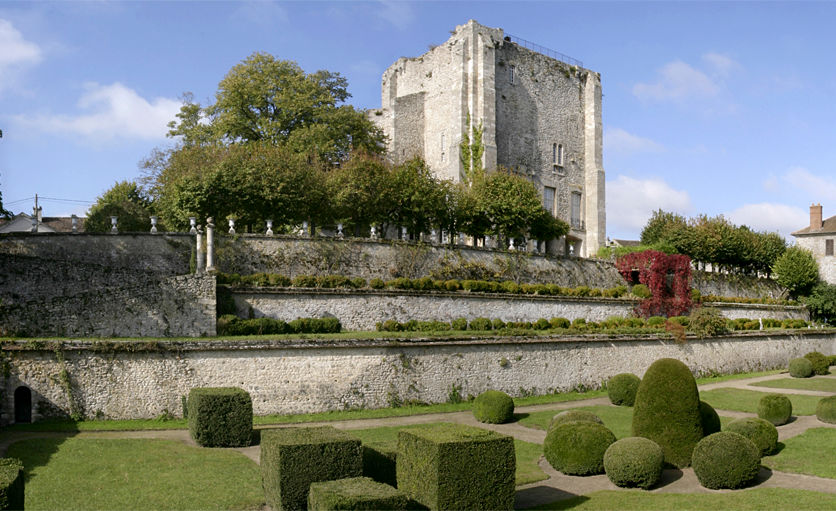

Eastern facade of the Donjon de Moret, from the garden

During the 17th century, it served as a prison. Having been arrested by d’Artagnan, Louis XIV’s disgraced finance minister Nicholas Fouquet was incarcerated here at Moret. Beyond the donjon, the street descended precipitously to another cul-de sac. Reversing direction, we came to Rue Monmartre, finding to our left a tall house set back behind a ten-foot wall upon which hung a plaque, identifying it as the residence of the painter Alfred Sisley. Descending Rue du Donjon toward the church, we drifted into a maze of alleyways—some of them no wider than a domestic hallway.
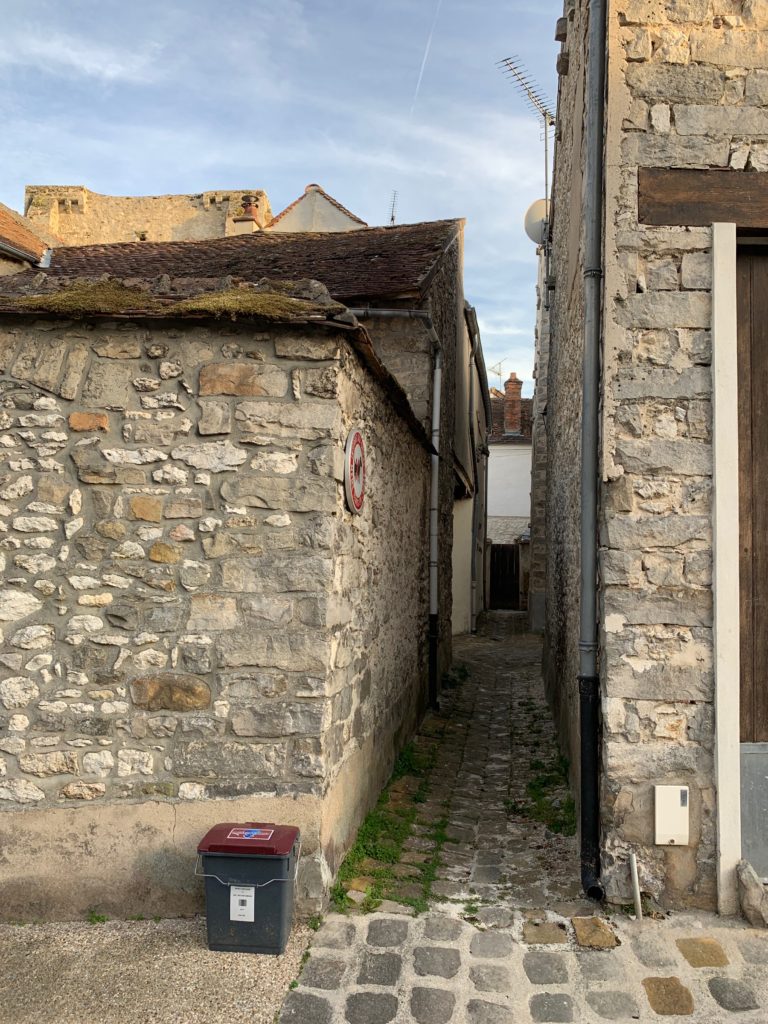

Alleyways, Moret sur Loing
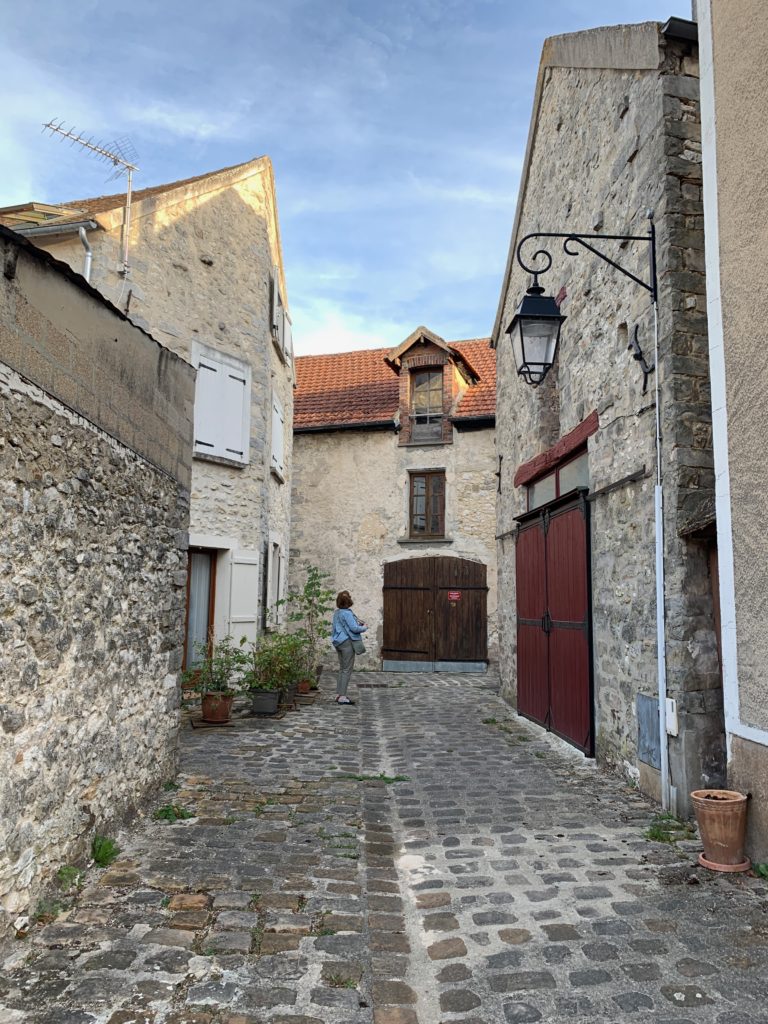

Alleyways, Moret sur Loing
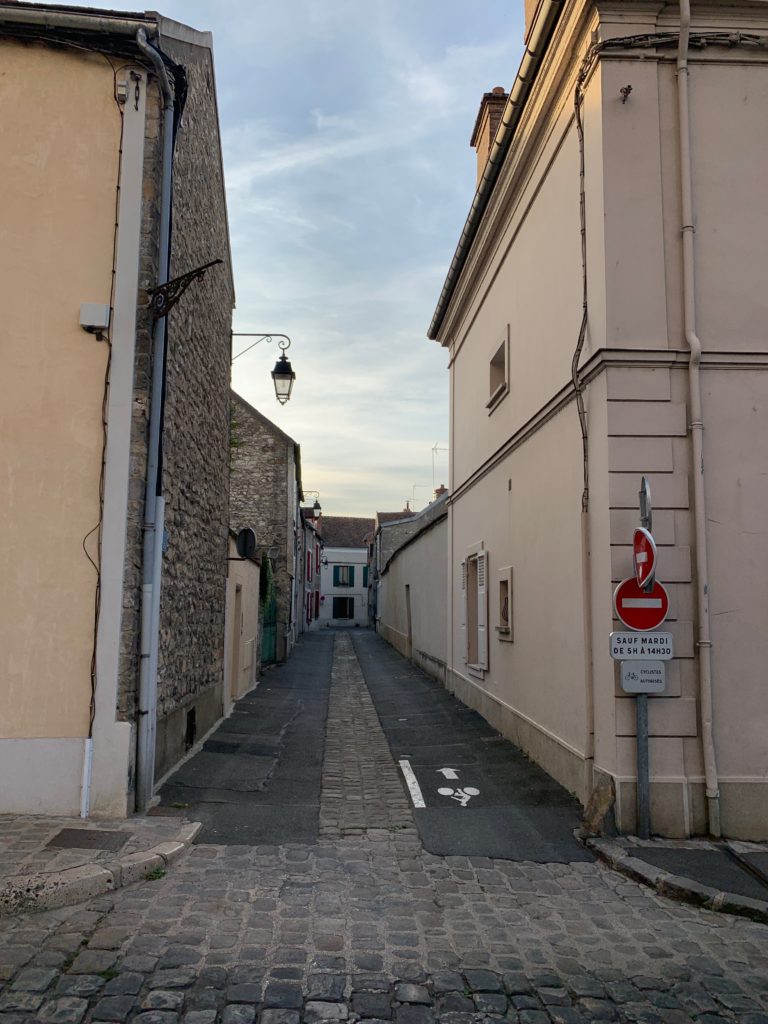

Alleyways, Moret sur Loing

Low stone houses flanking stone stood shuttered and quiet. Returning to Rue de l’Eglise, with an hour to kill before dinner Kathie decided it was time for a snack. She entered l’Echoppe aux Douceurs, a patisserie, while I peered into the window of an art-gallery across the street. At the corner of Rue Grande, we found a bench, where we sat and devoured several rolls. Looking back toward Porte de Samois I saw a woman set out a sandwich-board on the sidewalk. As the sky darkened we made our way back down Rue Grande to L’Entre 2 Ports, a small restaurant specializing in Luso-French cuisine. Kathie and I took our seats on a small deck, perched along the side of the road.
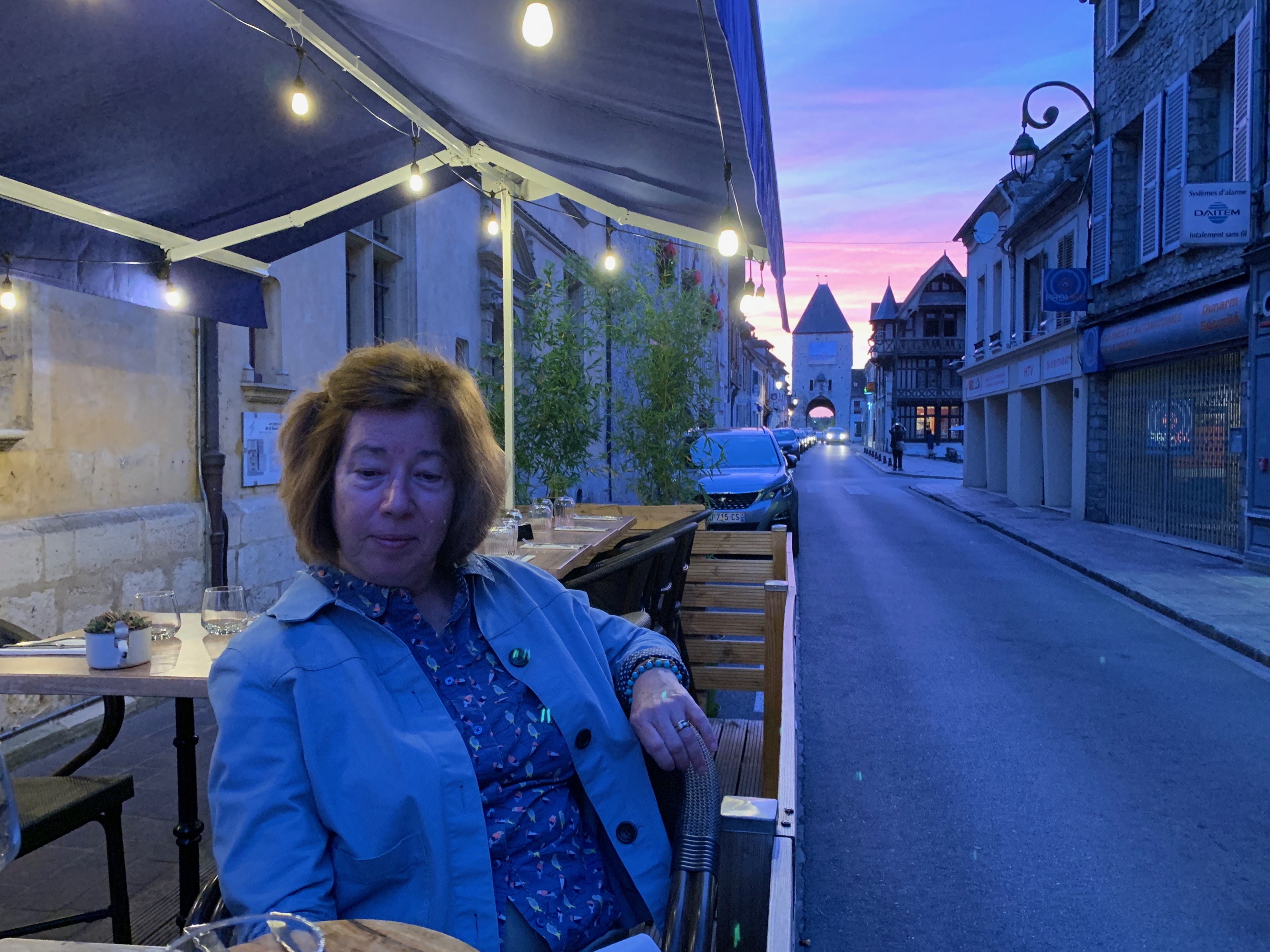

Sitting down to supper at Entre 2 Ports, at the close of a very long day in Moret-sur-Loing

Beneath a blue canvas canopy, plump white lights dangled from electrical cords overhead. Half an hour before, the streets had been deserted. At seven o’clock, small groups of people were seen making their away to one destination or another. Within fifteen minutes the deck that once was ours alone was full of lively conversation. To take our orders, the woman serving us had to stand in the road as cars crawled past behind her. As the sky deepened to an azzurro giottesco our meals arrived. The whole experience conveyed some sense of time-travel. Not because we were dining in a medieval town, or inches away from voitures en passant, but because nearly everyone was smoking, and doing it constantly. Sharing a bottle of light Portuguese wine, Kathie had fish, while I dined on salade de poulpe and maigret de canard. Behind the Porte de Samois the sky assumed first a rosy hue, before blue shifted to a deep purple, above a glorious horizon, glowing red-violet. Walking back through the Place de l’Hotel de Ville we pondered the task ahead, imagining Sisley, Eliza and her daughters treading these very stones, all that remained was to find the place where the peripatetic Greatorex women had finally come to stay, and where the last of them—the beautiful Kathleen Honora–would breathe her last in 1942 at the age of ninety-one.
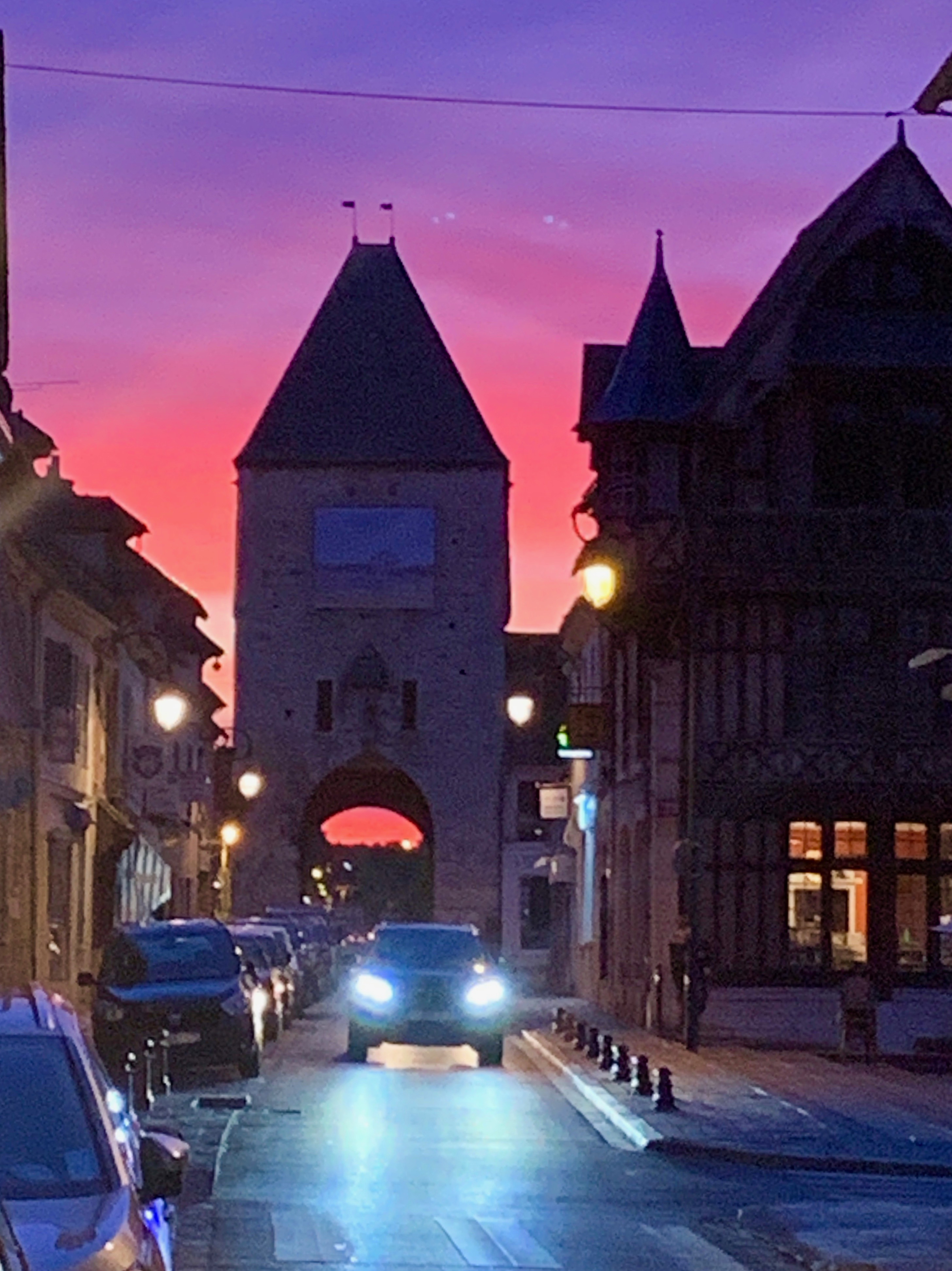

Porte de Samois at Sunset
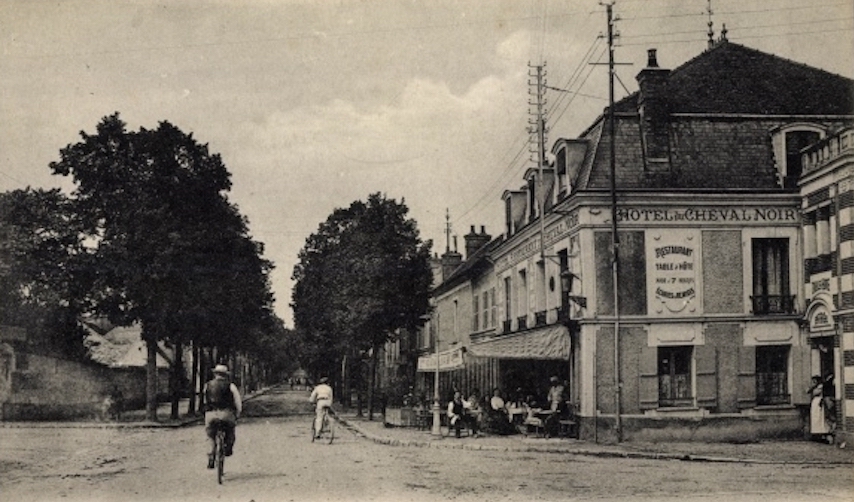

Early postcard of Le Hostellerie du Cheval Noir, Moret. ca 1910

Light crept through the gap in the heavy drapes, announcing the new day. Glowing numbers on a digital clock confirmed that we had slept like the dead, well beyond a polite hour for breakfast. As we entered the small dining-room we were greeted by Père de Crick, Gilles’s father. We never caught his given name. Laid out in lavish quantities, our petit-dejeuner was comprised of croissants, sans et avec chocolat, fresh baguettes, butter, crêpes, fresh fruit, yogurt, fromages et charcuterie and strong coffee, all composed in anticipation of perhaps a dozen people or more, yet we seemed to be the only guests in the hotel. Anne arrived as we finished our meal, to inform us that she had left a message of one of the officers of Les Amis de Moret and Les Amis de Sisley, hoping to arrange an appointment for us on the following day. Thanking her we returned to the room, to see to our ablutions and get organized for the day. We left the hotel by the side door on Rue du Peintre Zanaroff, the only door granting twenty-four access to guests of the hotel. If the building was historic, our keys were retro—white plastic perforated punch-cards from the Disco era. The eponymous painter Zanaroff was a late Impressionist named Prudent Pohl (1885-1966), who took the Russian-sounding moniker for reasons as yet unknown to us, and is remembered by the town of Moret by a street bearing his name. Beyond the crosswalk stand the monument to Sisley. Following the painter’s death from throat cancer in 1899, friends of the artist decided to raise a monument in his honor. Sisley’s daughter contacted Auguste Rodin, who agreed to undertake the task, but the committee disliked Rodin’s proposal and instead hired the lesser-known Simeon-Eugene Thivier (1845-1920).
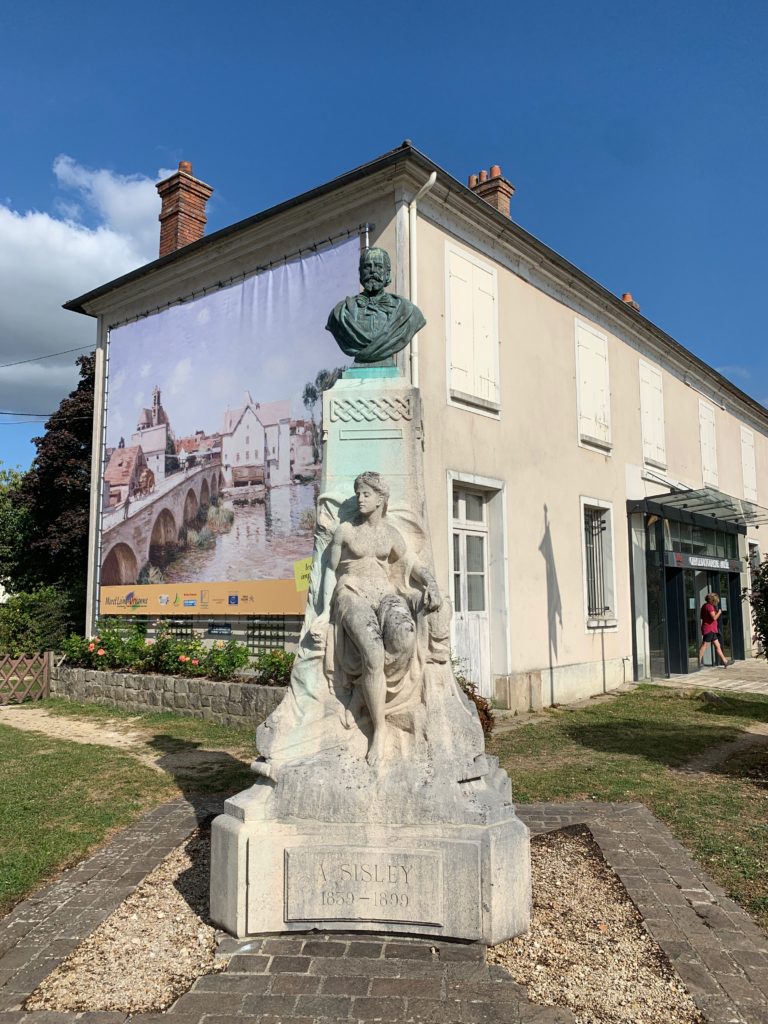
A bronze portrait-bust of the painter crowns a tapering stone pedestal, out of which is seen to emerge a comely semi-nude young woman representing Sisley’s muse. By the time we had revisited the tourism office, acquired a few more maps and brochures, it was approaching midday. Passing through Porte Samois, we proceeded to the Hotel de Ville (city hall) to inquire about how we might research property records. Kathie had determined that both Eleonore and Kathleen Greatorex had lived at a place known only as “Ramparts”, which seems to have been acquired prior to their mother’s death in 1897. After her passing they had tried to entice Rodin into renting a studio on the property, but he ultimately declined. The studio ultimately was leased to the American sculptor George Grey Barnard, who today is famous for the collection of medieval art now housed at The Cloisters in northern Manhattan. Art dealer Sarah Hallowell purchased a property from the Greatorex sisters, where she lived with her mother and niece Harriett. Armed with these tidbits of information, and a few written descriptions of the property by Eleonore and visitors, the trail of breadcrumbs had led us to Moret, but no further.
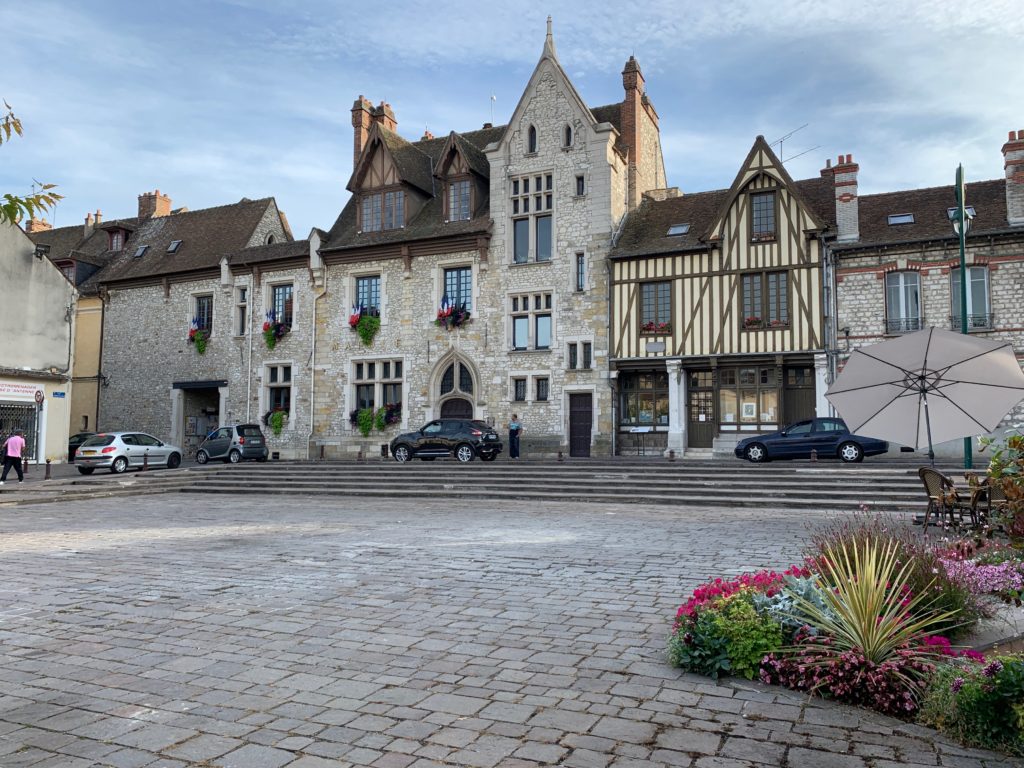

l’Hotel de Ville from Place de l’Hotel de Ville, Moret-sur-Loing. The half-timbered building to the right houses the Sisley Museum, run by Les Amis de Sisley.

The city hall was abuzz with activity as the town made ready for a European Heritage festival to be held over the weekend. Our landlords Anne and Gilles were distracted by preparations for anchoring a hot-air balloon in a soccer-pitch across the river. A young man took interest in our plight, explaining to the receptionist what we were hoping to accomplish. With a wave of her hand she directed him to a pile of books under the window. One of them was a history of Moret. At the top of one page was the headline Quelques Moretains eminents parmi beaucoup d’autres (Some eminent residents of Moret, among many others). Three names leapt off the page:

Eleonore Greatorex (1854-1909) Rue du Pave Neuf. Peintre
Georges (sic) Grey Barnard (1863-1938) Rue des Fosses. Sculpteur
Harriett Hallowell (1820-1913) Place de Samois. Peintre

Kathie noticed immediately that some of the dates were wrong, and that neither Eliza nor Kathleen Greatorex received a mention. Harriett Hallowell was the niece of the prominent American curator Sarah Tyson Hallowell (1846-1924), who had curated the French art exhibited at the Columbian Exposition in Chicago. A new biography of Hallowell by Carolyn Kinder Carr has just been published (July, 2019) by The Smithsonian Scholarly Press. In a letter to a friend dated 1909, Hallowell describes a property she is buying from Kathleen Greatorex as a “…quaint old house, built within the historic walls of beautiful Moret”, mentioning that “Miss Greatorex has her home on the extremity of her property…”
The Hallowell dates published on the Moret notables-list agrees with those of Sarah’s mother, Mary Morris Tyson Hallowell (1820-1913). Despite these errors, we had fresh clues to follow. Writing down the addresses, Kathie and I said our thanks and crossed Rue Grande, taking a table at the now familiar La Maison des Arts. I spread out a map. Kathie took out her notebook. Locating the Greatorex-Barnard-Hallowell addresses on the map, we quickly realized that all were adjacent to one another, or more likely within the same compound. The narrative about a single Greatorex property that had been broken up between 1890 and 1942 suddenly made geographic sense. We were stunned to learn that what we sought had been at our doorstep all along, across Place de Samois from our hotel. Finishing our lunch, we paid the check and walked back to the Hotel de Ville. To the left, a passageway led to a parking-lot beyond which to the south is Rue Pave Neuf (Newly-paved street), presumably the first street in the town to be covered with flags or cobbles.
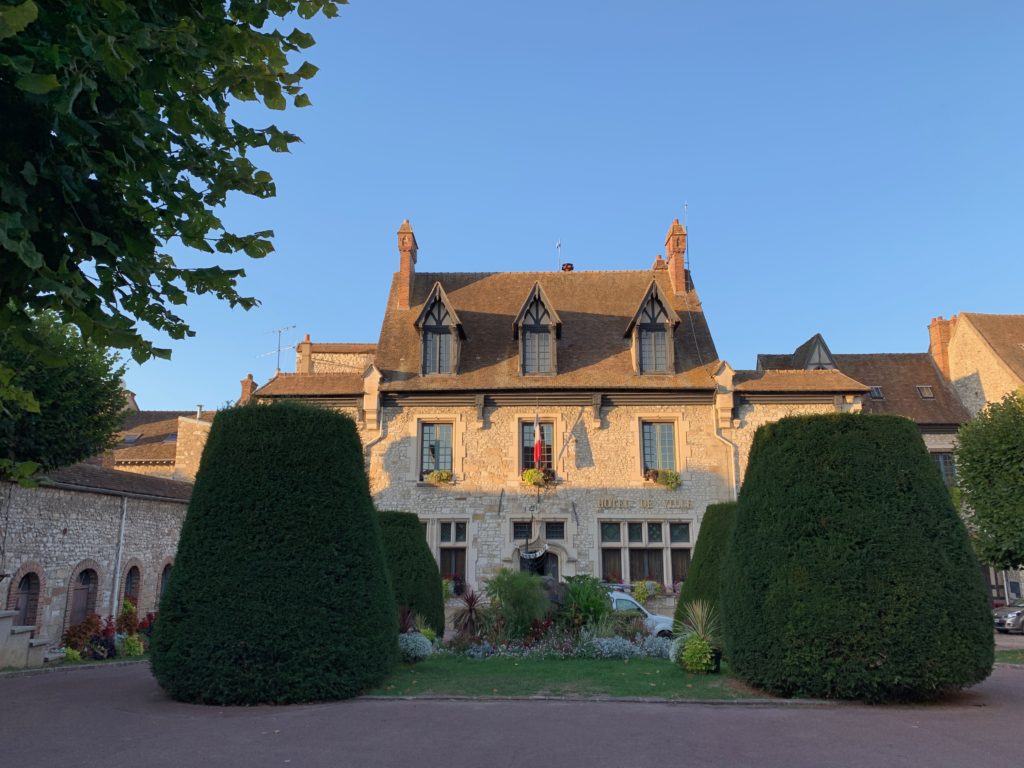

l’Hotel de Ville, Moret-sur-Loing, from Rue Pavé Neuf
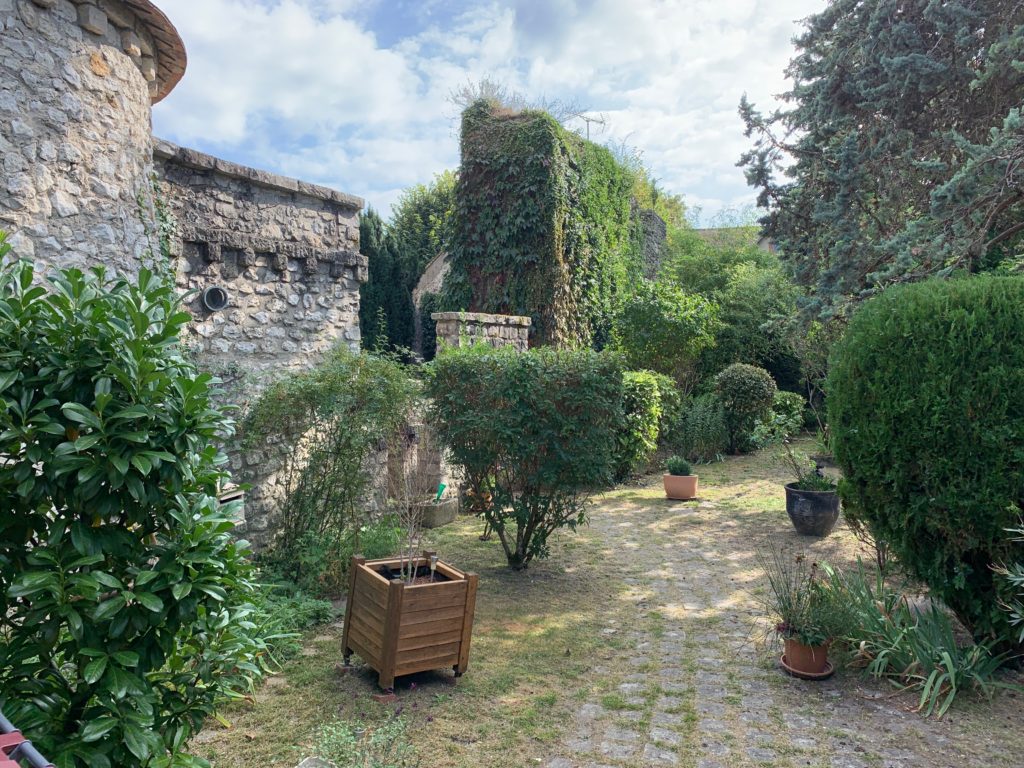

Private garden suspected of once having been the property of the Greatorex women

The city hall’s stately Façade François le 1eme faces the street, which suggests that the present-day Place de l’Hotel de Ville may once have been its backyard. Walking west, the street is lined with small, shuttered stone houses. Perhaps a hundred meters on, the street turns ninety degrees to the right, leading back to Porte de Samois. Passing through, we turned left along the pavement on the western edge of Place Samois. Dead ahead, driveway led to a green wooden gate. Behind it we could see a garden, with yet another fragment of the old city walls. Ivy crept up the side of a round tower. Had we reached our goal? The setting matched the descriptions we had. The published addresses had brought us to this place. Somehow it did not feel like enough. Ramparts were everywhere. A postman would have to be psychic to know to which ramparts he should deliver a letter to the misses Greatorex. We wandered over to Rue des Fosses, the street given as Barnard’s address. Just then a man emerged from the house on the corner. Turning to him I asked if he had heard the name Greatorex, or if he knew anything about American women living here during the last century. He thought for a moment, and said that he did remember hearing something, about a time long ago. There was someone he knew, who perhaps might be able to help.
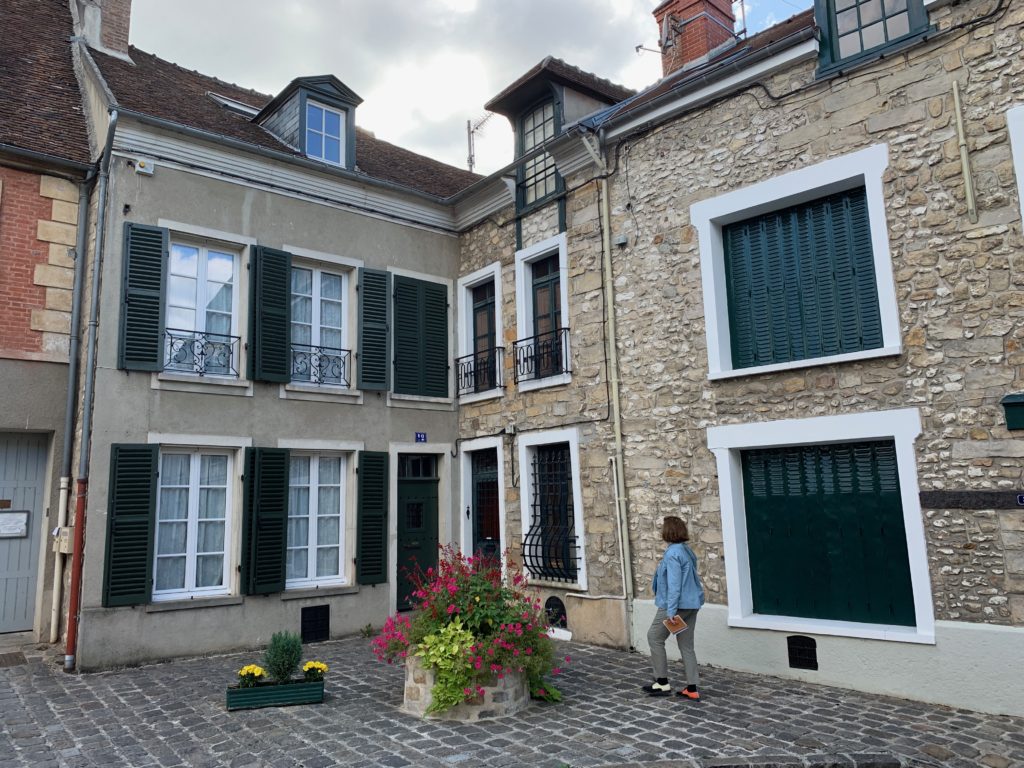

Kathie looking at the houses along Rue Pavé Neuf

He led us back to Rue Pavé Neuf and knocked on the door of one of the stone houses. The top half of the door swung open. He described our mission to the elderly woman, who replied bien sur! Her parents had purchased the house from Harriett Hallowell sometime around the Second World War, and that Hallowell and another old American woman had been living together but that both had died during the war. All the pieces began to fall into place.
Kathleen must have taken possession of the house when Eleonore died in 1908, and then sold it to Sarah Hallowell. Kathleen Greatorex must have broken up the rest of her property over the years, finally entering into a domestic arrangement with Hallowell. Nothing is known about their lives under the Nazi occupation. On her death certificate, the date of Kathleen’s death is given as May 6, 1942, the cause simply as “old age”. Her sole heir was Harriett, who died the following year. We knew we were close. All that remained was to find their home, “the Ramparts”, or whatever remained of it.
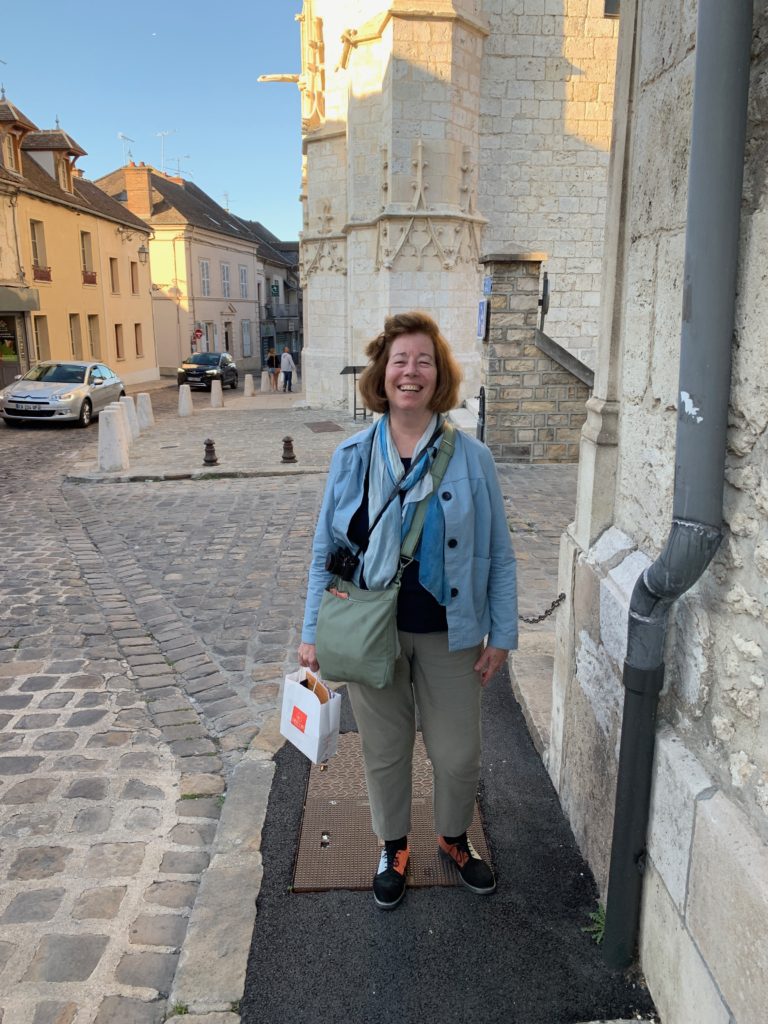

Kathie Manthorne. Boots-on-the-Ground art historian, with a bag full of barley candies. Since people will ask, the polychrome Oxfords are by Camper, acquired in June at On Your Feet in Santa Fe, New Mexico

Backtracking past the city hall, we walked along Rue Pave Neuf until we came to Rue de l’Eglise. Kathie had decided that we urgently needed to acquire a quantity of the famous local barley-candy for future use as gifts. Previous attempts to visit the shop had found the place closed. Turning right onto Rue de l’Eglise, we walked uphill a few blocks to the church. Beyond it on Place Royal we espied our objective, lo and behold–open for business. A painted stone cameo framed in carved heraldic scrollwork, announced that Sucre d’Orge Religieuses de Moret had been in business since 1638. These sweets were first produced in Moret by Benedictine nuns, although their origins surely date to a much earlier time. De Lis Chocolat has preserved its historic appearance, behind a half-timbered shop-front. Wooden shelves and countertops were piled high with sucker-candies, packaged in everything from small sacks to colorful painted tins. An attractive matron stood at the ready, to assist shoppers and take their payments.
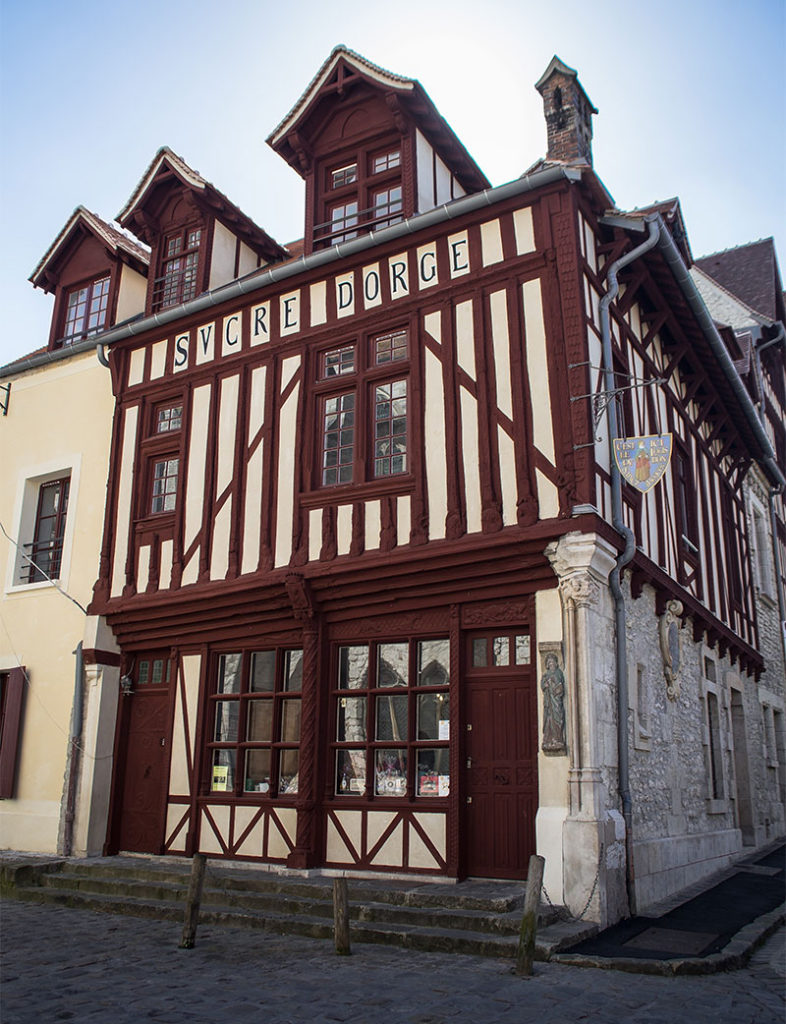

Des Lis Chocolat.Boutique Sucre d’Orge des Religieuses de Moret. Rue de l’Eglise and Place Royale, More sur Loing, Ile de France.
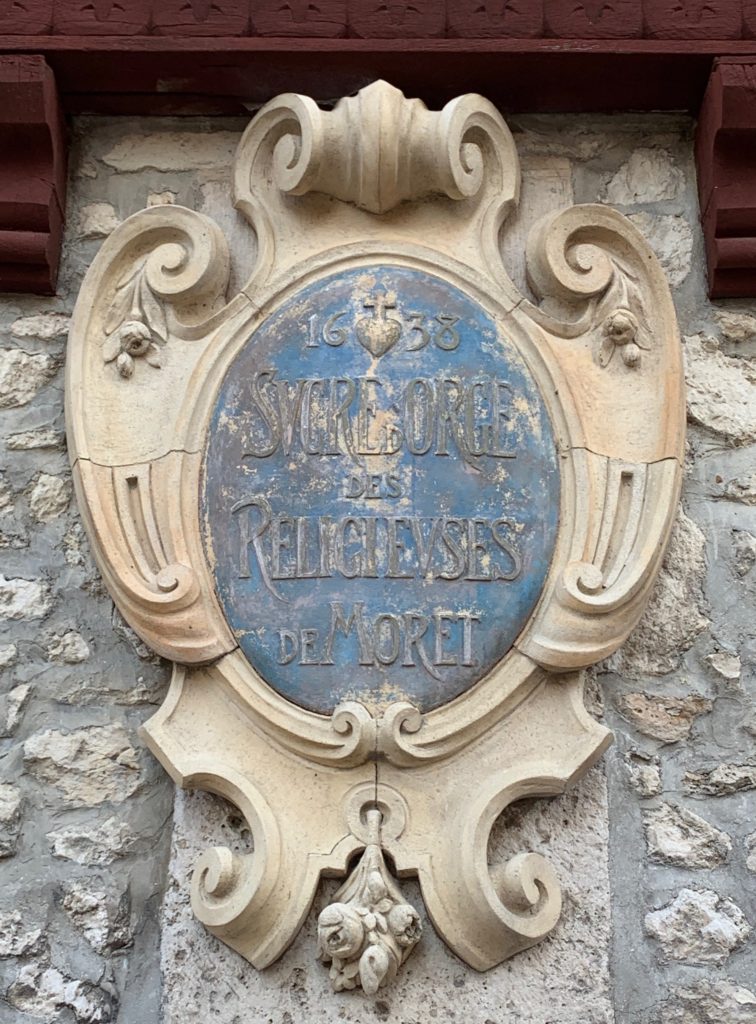
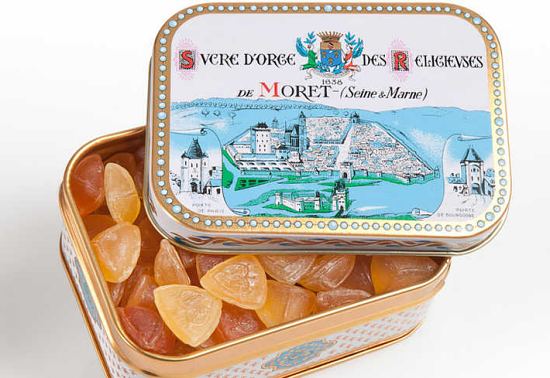
Our first mission accomplished, we seized the opportunity to visit the church. Finding it open, we entered and lit candles in memory of the recently departed. Notable for its historic pipe-organ, l’Eglise de Notre Dame de la Nativite is a cathedral in miniature, with soaring vaults above light-flooded spaces. Construction began in the 12th century, around the same time as the Donjon and city walls. Suffering physical damage during the revolution of 1789 and employed for a variety of secular functions for the duration. It served as a subject for a number of paintings, including one by J.B.C. Corot, and later by Alfred Sisley, whose house stands around the corner and up the hill. Today the church serves an active congregation as a place of worship, and the general community as a concert venue.
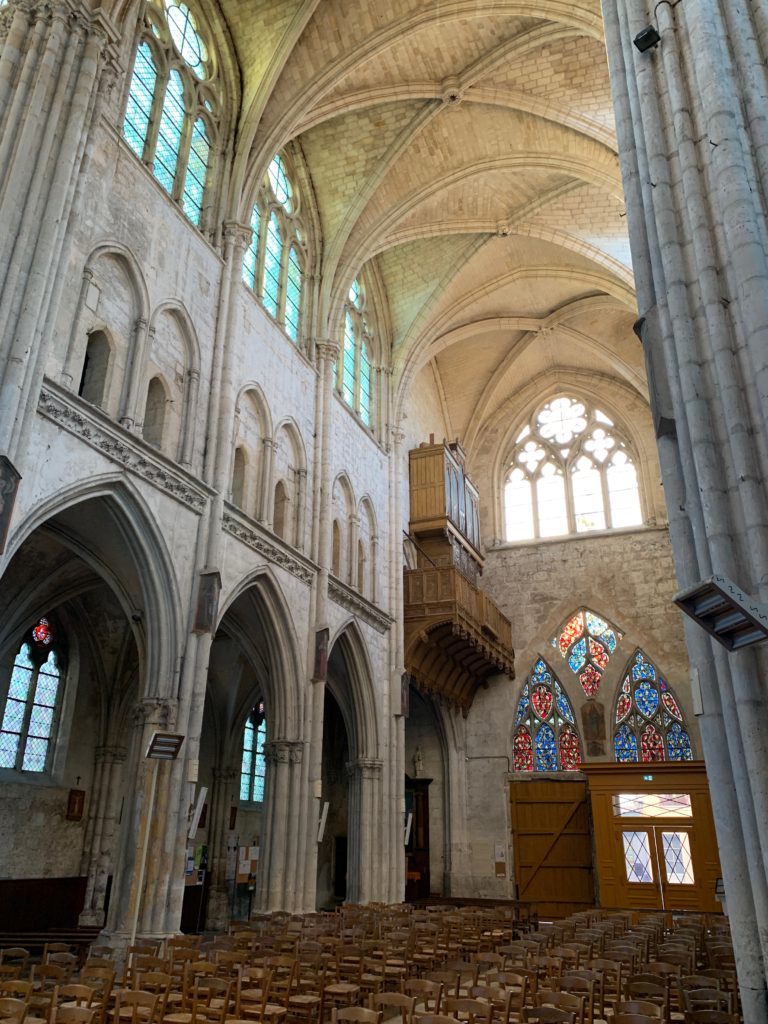
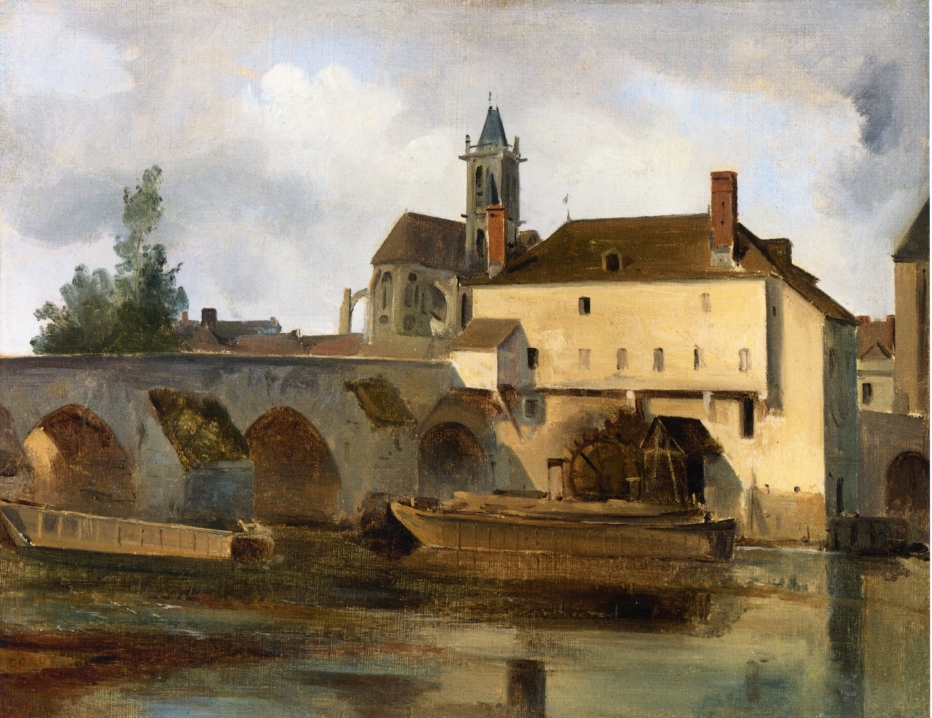
View of Moret by J.B.C. Corot. 1822
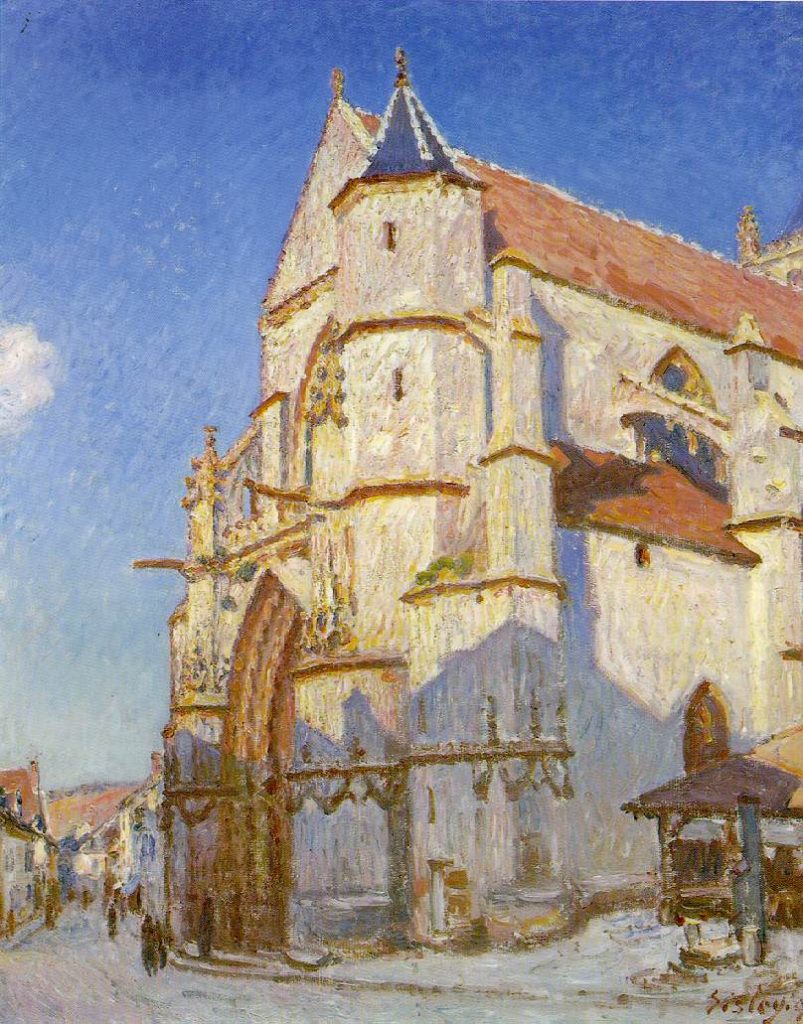

The Church at Moret by Alfred Sisley. 1894. The view is from the corner of Place Royale looking north along Rue de l’Eglise, next to Boutique Sucre d’Orge
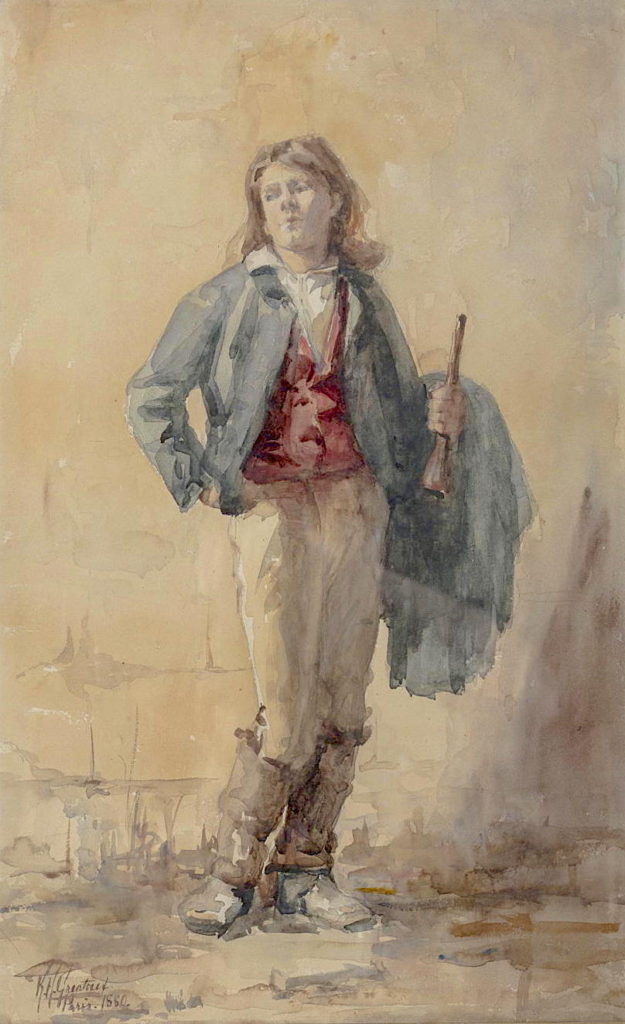

Jeune Chasseur 1880. Watercolor on paper-board. Kathleen Honora Greatorex (1851-1942) The hunter is dressed for the field, wearing a short roundabout jacket and stout knee-gaiters. Holding a hunting-horn, a cloak is thrown over his left arm. Long flowing hair adds to an effeminate romantic appearance, completely unlike Courbet’s rustic killers. One wonders if the sitter is male.

According to Kathie’s research, Kathleen Greatorex had a close and possibly intimate friendship with Sisley near the end of his life, buying his paintings to provide some financial support. Her grandfather had been a Methodist circuit-preacher. In spite of that, and her own Anglican upbringing, Kathleen Greatorex must have shared her mother’s ambivalence about sectarianism. Eliza Greatorex once had an audience with Blessed Pope Pius IX, and had become a close friend of the parish priest during her sojourn in Oberammergau. Contemporary accounts characterized her beliefs as more spiritual than religious. We had come to Moret to find a piece of real estate. We also found ourselves walking in the footsteps of three remarkable expatriate women, whom we had come to know over the years. We stood in the nave. Light streamed through the windows. A chill ran up my back. For a moment, I had the feeling that were I to turn around, they would be there behind me. Having accompanied Kathie on many research trips in search of Eliza Greatorex and her daughters; to Cragsmoor, Ireland, Bavaria, Manitou Springs and now Moret-sur-Loing, nowhere else had I felt their presence so palpably. Throughout the process of reassembling their lives into a coherent narrative, Kathie had been challenged at every turn. Eliza Greatorex once said, “I hate to write letters”. What personal correspondence she left behind is scattered through a variety of private and public collections. Much of the factual details of her biography is drawn from newspaper articles and accounts left by others. Like many Irish parents, she kept her children close. Supporting Eliza’s enterprise in many ways, the daughters never married perhaps because they were always doing her bidding. By the time they had reached Moret, Eliza was slowing down and both of her girls would have been considered old maids. Having come this far, we decided to take a final pass at reconfirming the location of their residence, on our way back to the hotel.
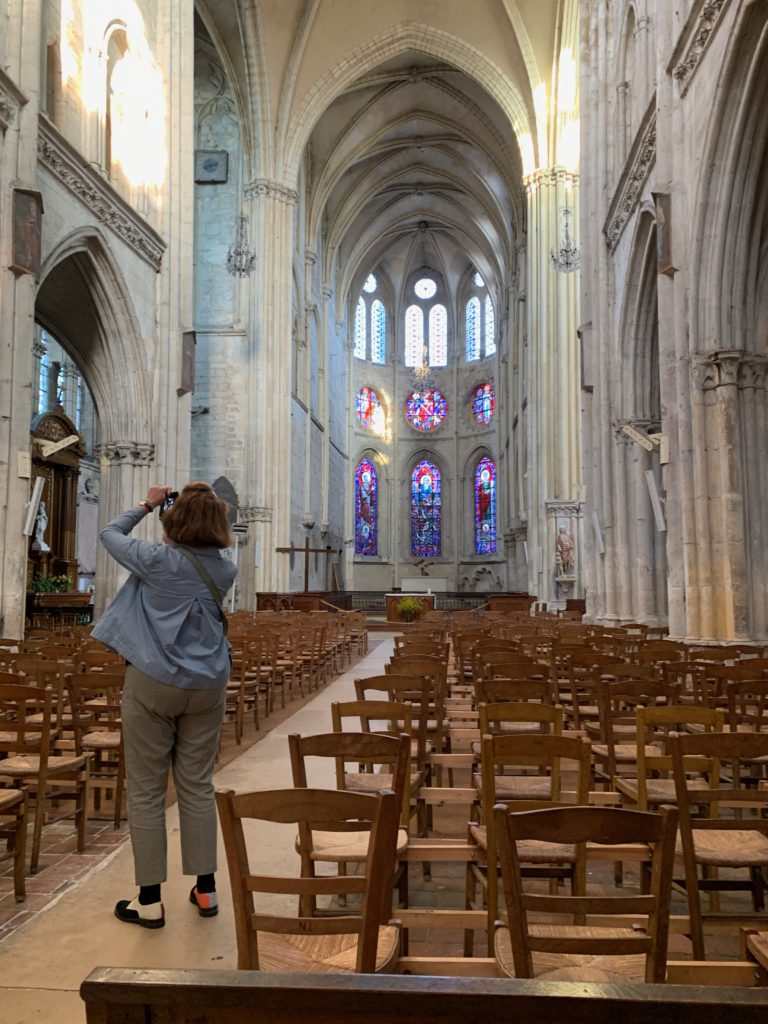
Upon leaving the church we turned left, walked south up Rue de l’Eglise, to its intersection with Rue des Fosses at the top of the hill. Here we turned right, heading back toward Place de Samois. I had the idea that perhaps we might get a glimpse behind the walls, in order to get a better sense of the scope of what we now believed to have been the Greatorex establishment. The only confirmation we had received so far concerned the modest house on Rue Pave Neuf. Questions remained. Where was George Barnard’s studio, that almost was rented by Rodin? Where was the garden described in letters written by Eleonore Greatorex and Sarah Hallowell? Where were the boundaries? What was the extent and configuration of the property? We passed Rue du Clos Blanchet, which led back to the labyrinth of alleyways we had explored on Monday. Rue des Fosses then veered to the right. At the foot of the hill I recognized the now familiar Place de Samois, our final destination. Rooftops were awash in golden light, like the church in a painting by Sisley. Across the street a woman collected her mail. We asked if she knew anything about a group of American women artists living nearby, long ago. She shook her head. When I mentioned the word “ramparts” she replied “la”, pointing to a rough stone wall with a garage-door, painted green. Next to it was a shuttered building with pitched roof and brick chimney that a real-estate agent might call a cottage. In a letter to a friend in 1909, Sarah Hallowell mentioned that “…Miss (Kathleen) Greatorex has her home on the extremity of her property”. If she had sold the house on Rue Pave Neuf to the Hallowells, and was renting buildings to the likes of George Barnard, where had her residence been located? At the far end of the facade was small arched doorway. Just beyond that, set back atop the wall that runs along the sidewalk, was a small stone plaque into which was set a mail-slot. On its metal flap was inscribed “STOP PUB MERCI” (No junk-mail please). Onto the stone surface above the mail-slot was carved: LES REMPARTS. (The Ramparts). Could it be?
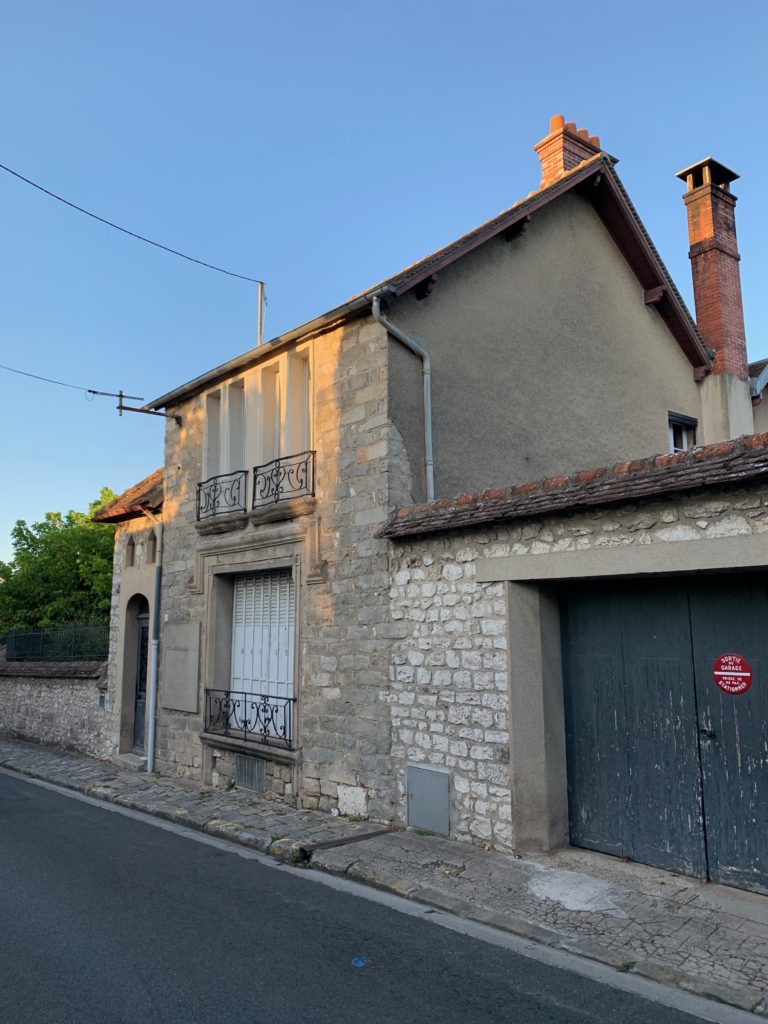
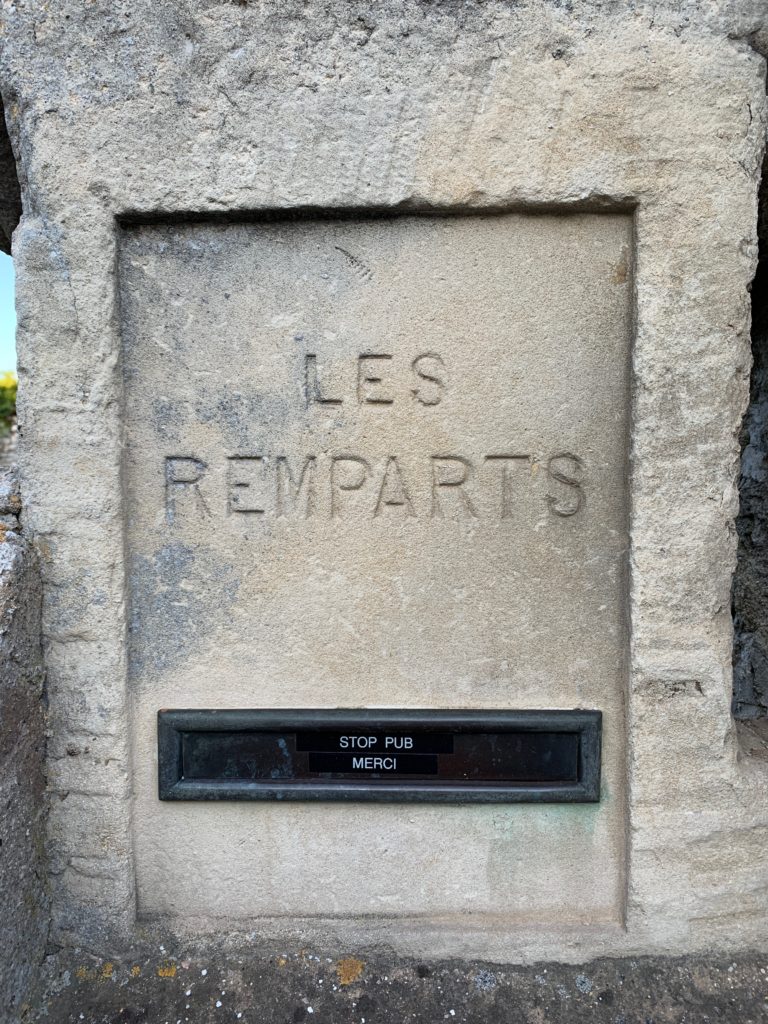
Craning my neck, standing on my toes, I peered over the wall to behold a beautiful sunken garden, enclosed by stretch of the old city walls. It was just as Eleonore had described it, like an amphitheater. At its southern end stood an elegant home, tucked up behind the smaller building that faced Rue des Fosses. The street was on the same level with the second floor of the main house, or the premier-etage if one starts counting above the ground floor. Making note of the name on the doorbell we made some inquiries and discovered that the current residents treasured their privacy, which we were eager to respect. In just two days, our goal of discovering the final residence of the Greatorex women had been achieved. Astonished by our luck, we marched down to the Cheval Noir, where Anne informed us that a meeting had been arranged for us the following morning with Les Amis de Moret and Les Amis de Sisley. Anne then made a dinner reservation for us as the creperie next door. With a couple of hours to kill we returned to our room, opened a bottle of wine we had been saving, settled ourselves on the deck, and took stock of the day.
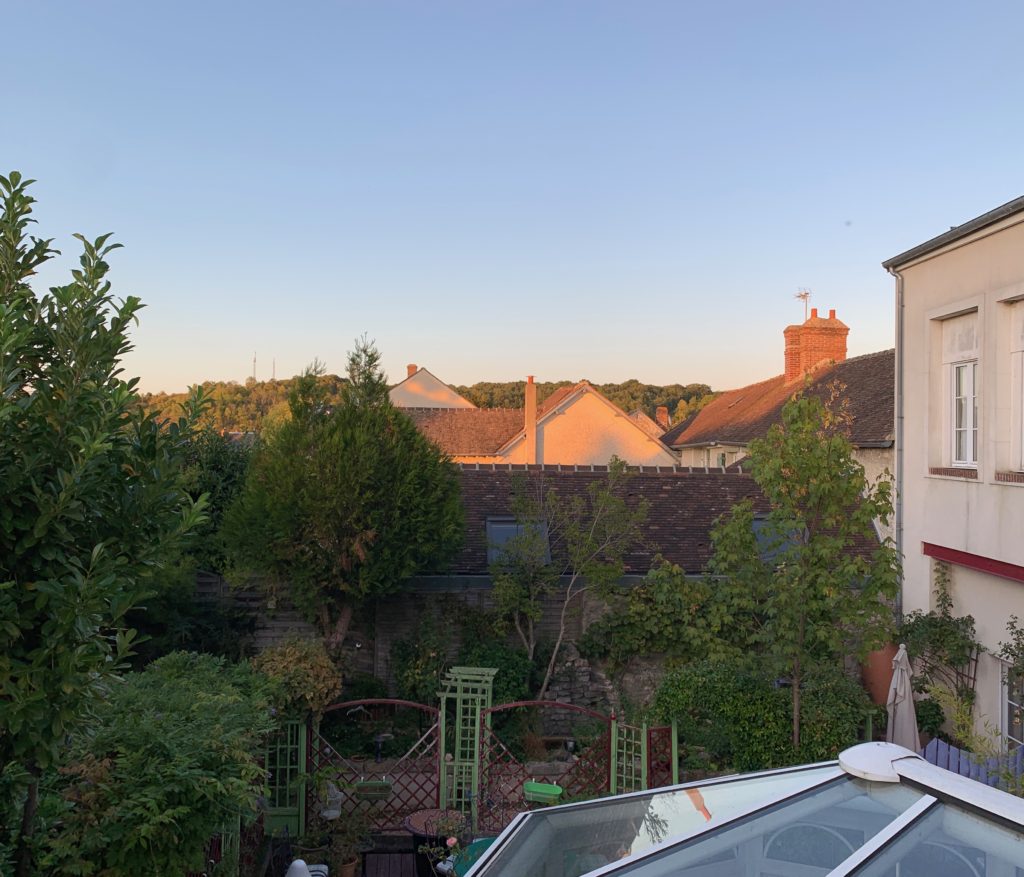

Rooftops of Moret at Sunset, from the deck behind the Chambre Monet above Courtyard of Hostellerie du Cheval Noir

Our final day in Moret began with another fabulous breakfast at Hostellerie du Cheval Noir. Our host Anne had arranged for uys to meet with three gentlemen who represented the organizations Les Amis de Moret and Les Amis de Sisley. None had ever heard of Eliza Greatorex or her daughters. We shared our research with them, and were informed that according to local lore, a number of medieval statues, and a capital from a column in one of the nearby churches had been purchased by an American artist for a museum in New York. Kathie explained that the artist in question was George Grey Barnard, (1863-1938) whose collection now forms the core of the Met Cloisters. We unpacked the tale of finding Les Remparts, diplomatically inquiring if the present owners of the property might welcome a call. We were discouraged from pursuing the idea, as the owners put great stock in their privacy. It was enough to know that we had indeed located the former Greatorex abode. Kathie had discovered that Auguste Rodin nearly rented a large studio on the property that later was rented by Barnard.
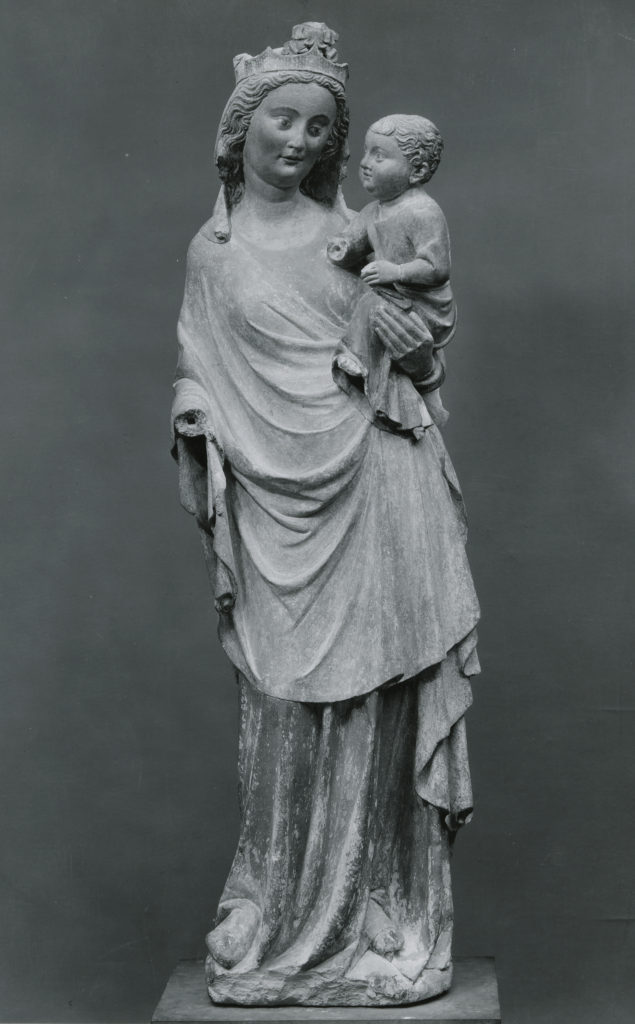

Standing Virgn and Child. France (Moret sur Loing). ca 1300-1350. Met Cloisters, New York.
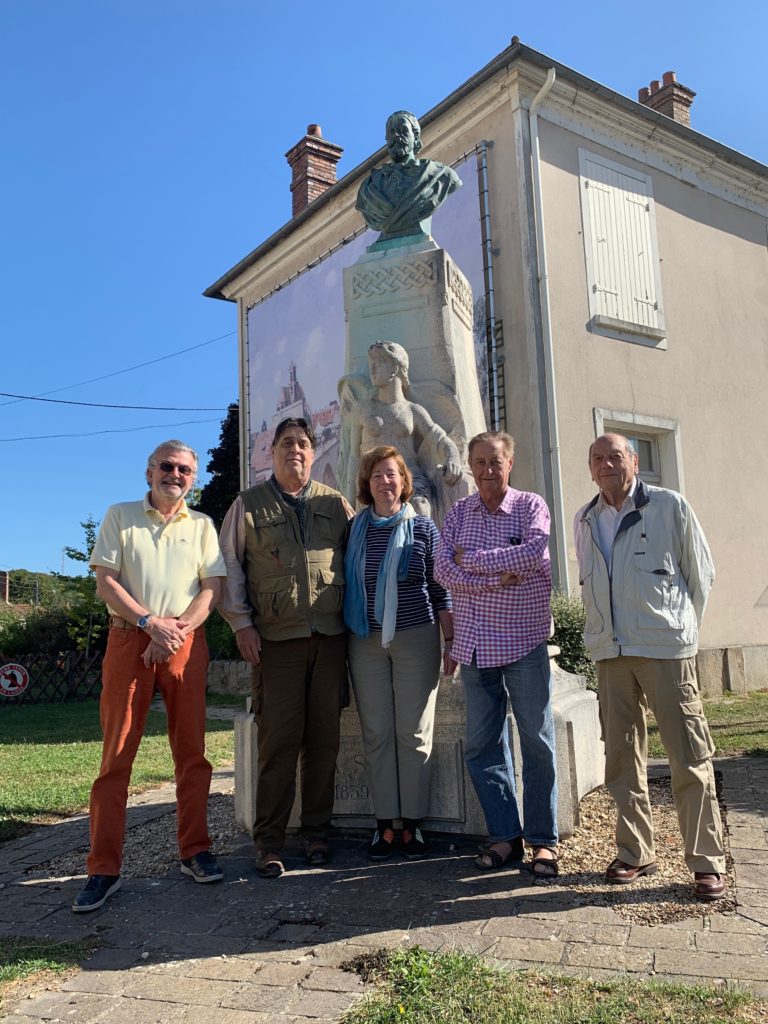

With the officers of Les Amis de Moret and Les Amis de Sisley, in Moret sur Loing. Ile de France. Left to right: Christian Lecoing, James McElhinney, Kathie Manthorne, Luc Paylot, René Roesch.

Christian Lecoing, who spoke very good English, expressed interest in learning more about Greatorex, not only because of her daighter Kathleen’s friendship with Alfred Sisley. but because of her activites as part of the plein-air etching movement. Kathie shared that Eliza not only kept a place in Paris, near the Jardins de Luxembourg, but that she had also embarked on sketching excursions to Cernay-la-Ville, and Chevreuse, today a ninety-minute drive from Moret. It seemed that the town of Sisley might have yet another artist to feature along the Routes des Peintres, a project celebrating the travels of Impressionist painters. We learned hat apart from establishing partnerships with towns along the Impressionsims Routes, Moret operated an artist residency progam through a cultural exchange with Sichuan, China. The story goes that one day a Chinese painter set up an easel on the banks of the Loing and one thing led to another. Everyone was under time constraints as the whole town was busy getting ready for the annual European Heritage festival on the weekend, and we had a train to catch. Following an exchange of contact information, we crossed the street for a photo opportunity at the foot of the Sisley monument. While we had hoped to locate the graves of Eliza and her daughters, we had no time to spare. Luc drove us to the station. We all promised to keep in touch. Arriving in Paris, we discovered our hotel reservation (and those of others scheduled to speak at the symposium) had, through some administrative mishap, been cancelled by Centre Pomidou. How Musee d’Orsay came to our rescue is a tale for another day.
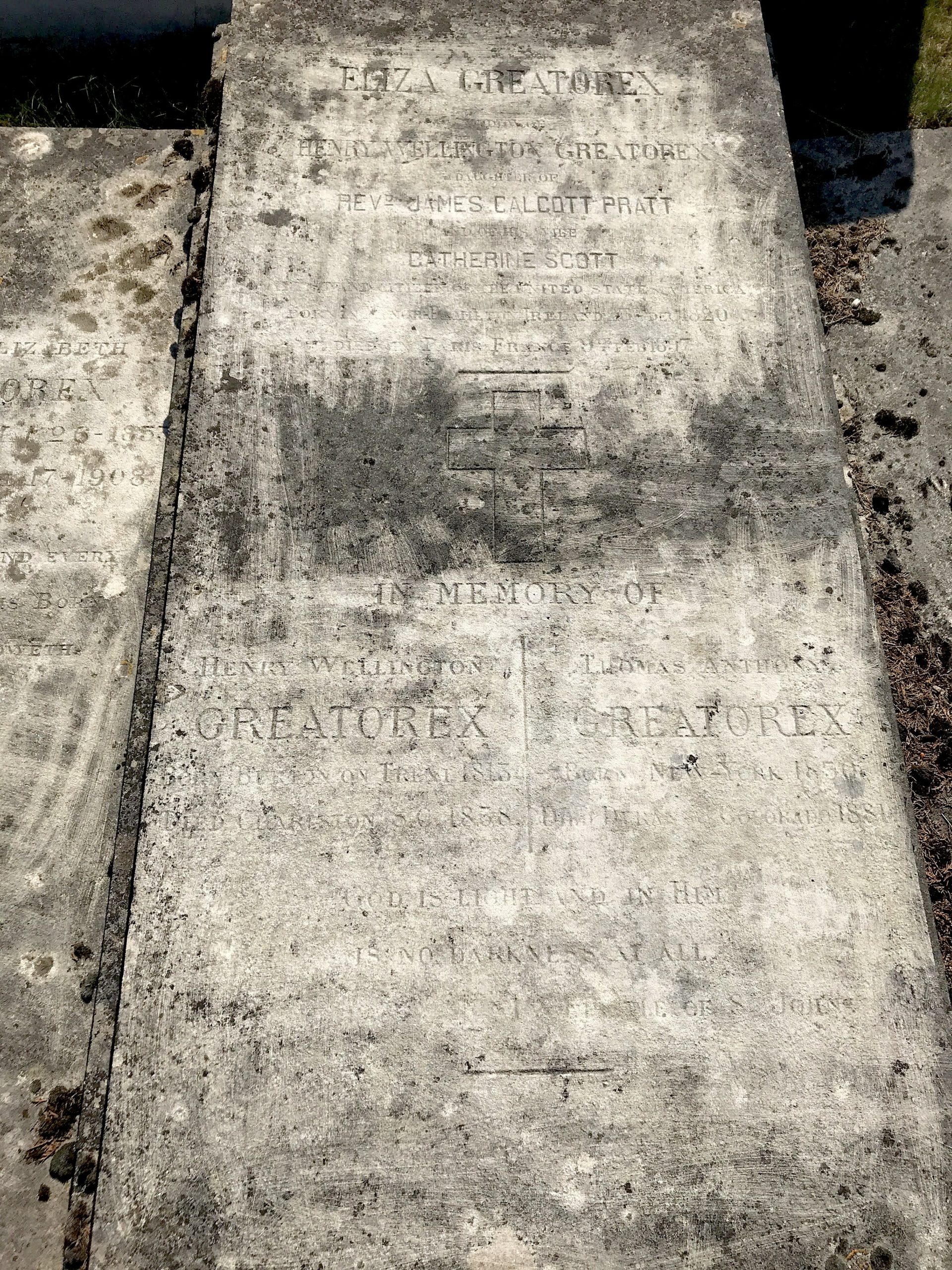

The grave of Eliza Pratt Greatorex (1819-1897) Cimitiere Municipal de Moret-sur-Loing, Moret-sur-Loing et Orvanne, Ile de France.

Photograph courtesy of Hans-Christian Bohlmann, who upon reading my account of our visit to Moret kindly wrote to us, attaching photographs of the graves of Eliza, Eleanor and Kathleen. Had we visited the cemetery we would have found them next to the town’s most famous resident Alfred Sisley. Given the closeness of his relationship with Kathleen during his final years, and her generosity toward him in life, it is possible that she continued to be his benefactor in death. The proximity of their graves is unlikely to be a coincidence. We wish to extend our heartfelt thanks to Monsieur Bohlmann, and other kindlyMoretains who assisted our quest including Anne Boudreau, Gilles de Crick, Christian Lecoing, Luc Paylot, René Roesch, the wonderful staff at the Hôtel de Ville and others…many thanks!

NEW BIOGRAPHY OF ELIZA PRATT GREATOREX by KATHERINE MANTHORNE
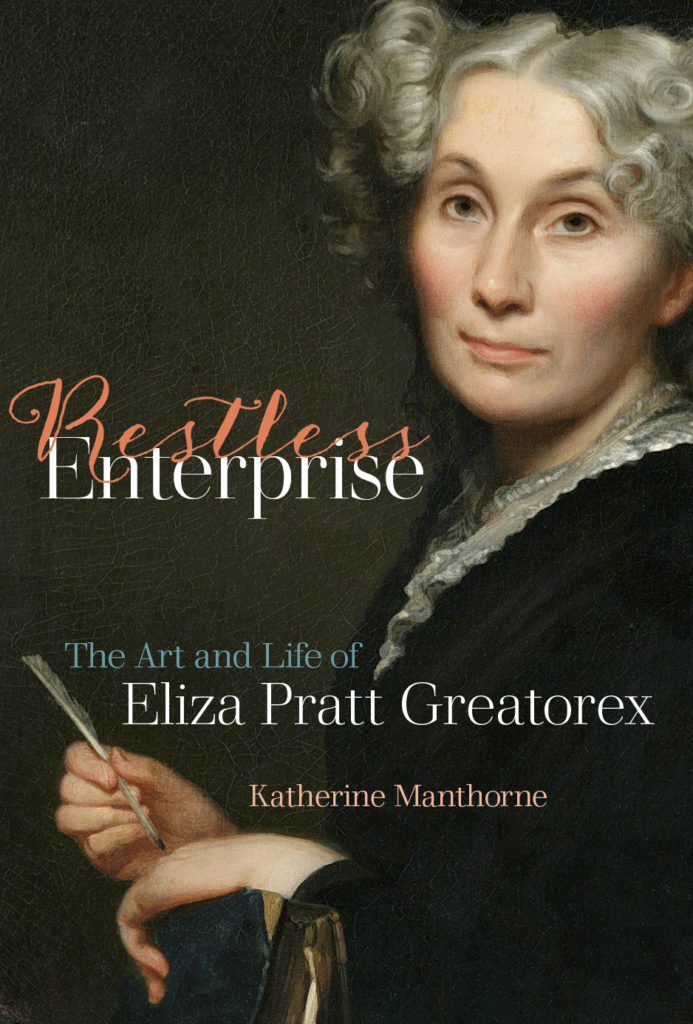
This inspiring book rewrites the history we thought we knew about women artists in 19th-century New York. Rediscovering a life once described in the national press as among the most important women in American history, the author also brings other lesser-known women into the canon. Unlike privileged woman like Mary Cassatt, Greatorex was born in Ireland, the daughter of a Methodist circuit-preacher, who through personal industry and restless entrepreneurship managed as a widow to raise four children, while building a stellar career as the foremost American woman-artist of her age. In researching this book, Kathie retraced Eliza’s journey from Ireland to New York, to Munich, Oberammergau, Colorado and Paris.
Having been on a number of these expeditions, and having read every page more than once, I can say that many surprises await the reader. This is not just an academic biography. It’s a page-turner. I know these are cliches, but Eliza’s story will have you cheering. You will laugh. You will cry. You will be inspired.

Pre-order a copy online now, and receive a 30% discount.
April 28, 2020. QT Dispatch #28. Revolutionary War Battery, Fort Lee, New Jersey

The world we have known never be the same. We can beguile ourselves with the vain hope that things will return to normal, forgetting that the world has always been in flux. Human evolution has been driven by geological upheaval, climate change and plagues. Calamities like COVID-19 remind us of the fragility of life, the durability of the human spirit. For the first time in the history of the planet, a unique intelligent life-form has been focused on a single natural disaster, in real time, at the same moment in time.

Making lemonade out of bitter fruit, these quotidian posts are offered as messages of hope, not just for our own survival, but as motivation to turn our attention to the world around us, to treasure what we had previously taken for granted, to draw strength, wisdom and compassion from deeper engagements with nature.


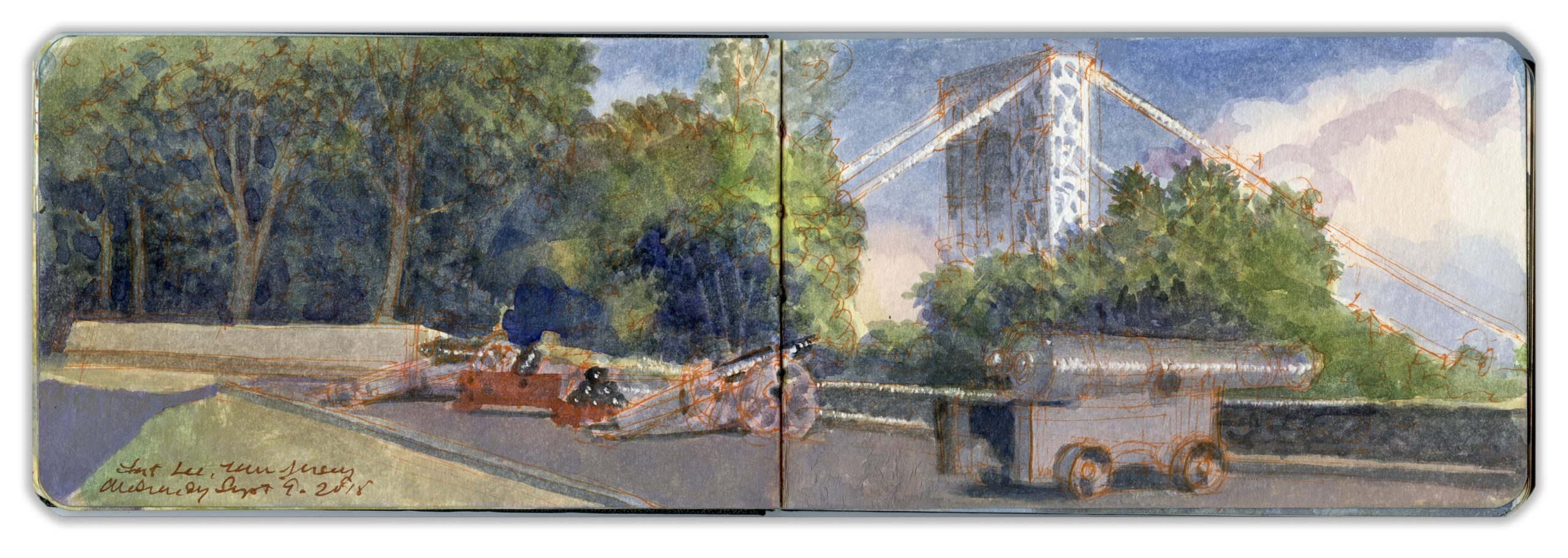
Reconstructed Revolutionary War Battery, Fort Lee.

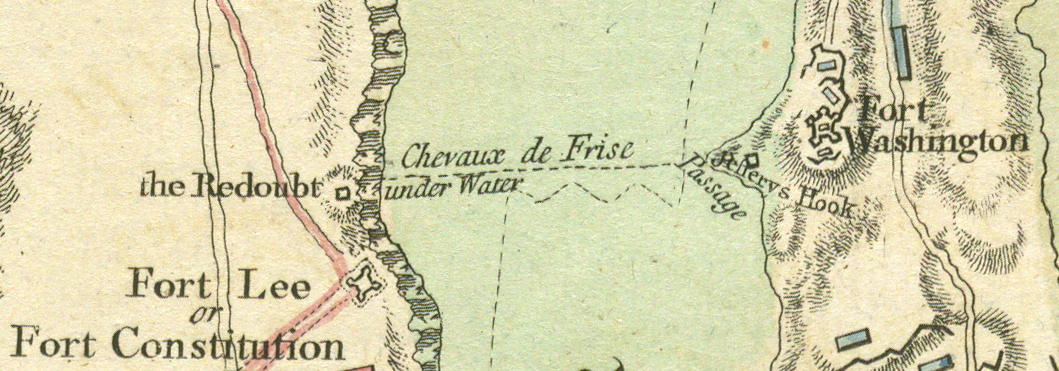
The southern end of a basalt diabase sill known as The Palisades had been fortified in the summer of 1776, in anticipation of an invasion by British Forces. Armed with several batteries of cannon, the earthen fort projected fields of fire across the Hudson to the east, while Fort Washington stood on the highest point on the island of Manhattan, its guns facing westward. A chevaux-de frise of sunken ships had been placed in a row across the river, from Jeffrey’s Hook to the foot of the cliffs below Fort Lee.


Disposition of Forts Lee and Washington (Knyphausen), 1777. The roadway leading north from Fort Lee exists today as The Long Path.

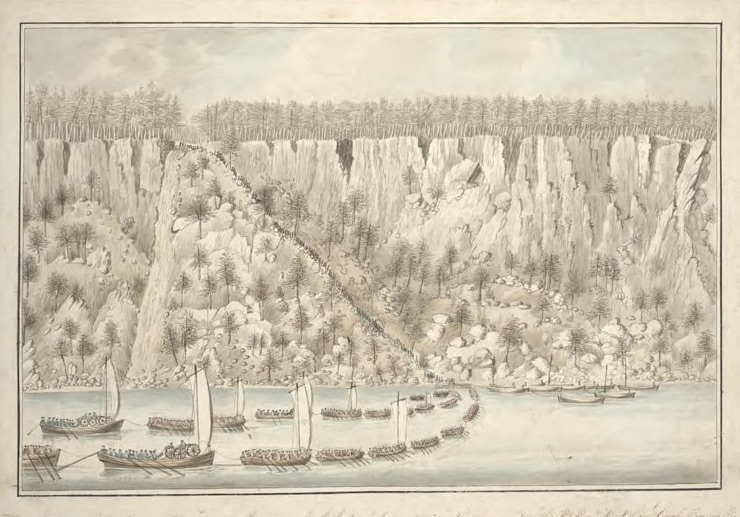
Today’s George Washington Bridge stands directly above the remains of this obstacle. On November 16, 1776, helpless and frustrated, George Washington looked across the river, as British and Hessian troops overran the fortification that bore his name. Four days later, Charles Lord Cornwallis led British regulars up a cleft in the escarpment at to cut off Washington’s line of retreat. The maneuver failed. Five weeks later Washington and the remainder of his army captured the Hessian garrison at Trenton, New Jersey, striking a blow for independence.


British troops under Charles Lord Cornwallis scaling the Palisades in pursuit of Washington. November 20, 1776. Watercolor by Captain Thomas Davies, Royal Artillery. Collection New York Public Library map division. (Reproduced under fair use)

The George Washington Bridge opened in 1932. During its construction, a ditch was carved through the basaltic diabase cliffs to accommodate the roadway. In 1937 the states of New York and New Jersey created the Palisades Interstate Park Commission, with Monument Park (Fort Lee) as its southernmost terminus. For the bicentennial of the American Revolution in 1976, the access-road was improved. An interpretive center was built, with adjoining parking-lots. Earthworks were restored to recreate the feeling of an eighteenth-century fort.

I first visited the site on January 2, 1991. The entry-gate had a woebegone appearance. The park drive snaked its way up a short rise, leading to parking-area and visitor center. There was no sign of life. A long trail led to the southernmost overlook, from which one scans Manhattan’s western shore down to the harbor. Views of the western banks of the Hudson reach down to Weehawken, site of the infamous Burr-Hamilton duel. Rebuilt for the Bicentennial with lawn-timbers and earthen fill, mock artillery positions ran from north to south through wooded heights just behind the precipice. Fiberglass panels simulating fascine revetments were cracked and disintegrating. The fort once again was falling to ruin. The effect was doleful and desolate. Litter, soda-cans and cigarette butts lay scattered about among the dead leaves.
Preceding Hollywood as the center of film production during the early years of silent cinema, Fort Lee had been the headquarters of Fox Film Corporation. Ashcan School artist Everett Shinn worked in the movie business. Young Thomas Hart Benton found odd jobs appearing as an extra, or working as a grip in silent films. By the twenties, film studios relocated to Southern California. Shooting in open lots, sunshine and warmer climate increased their productivity.
Monument Park was deserted as I returned to my vehicle. With the onset of twilight, it seemed best to avoid nefarious company.
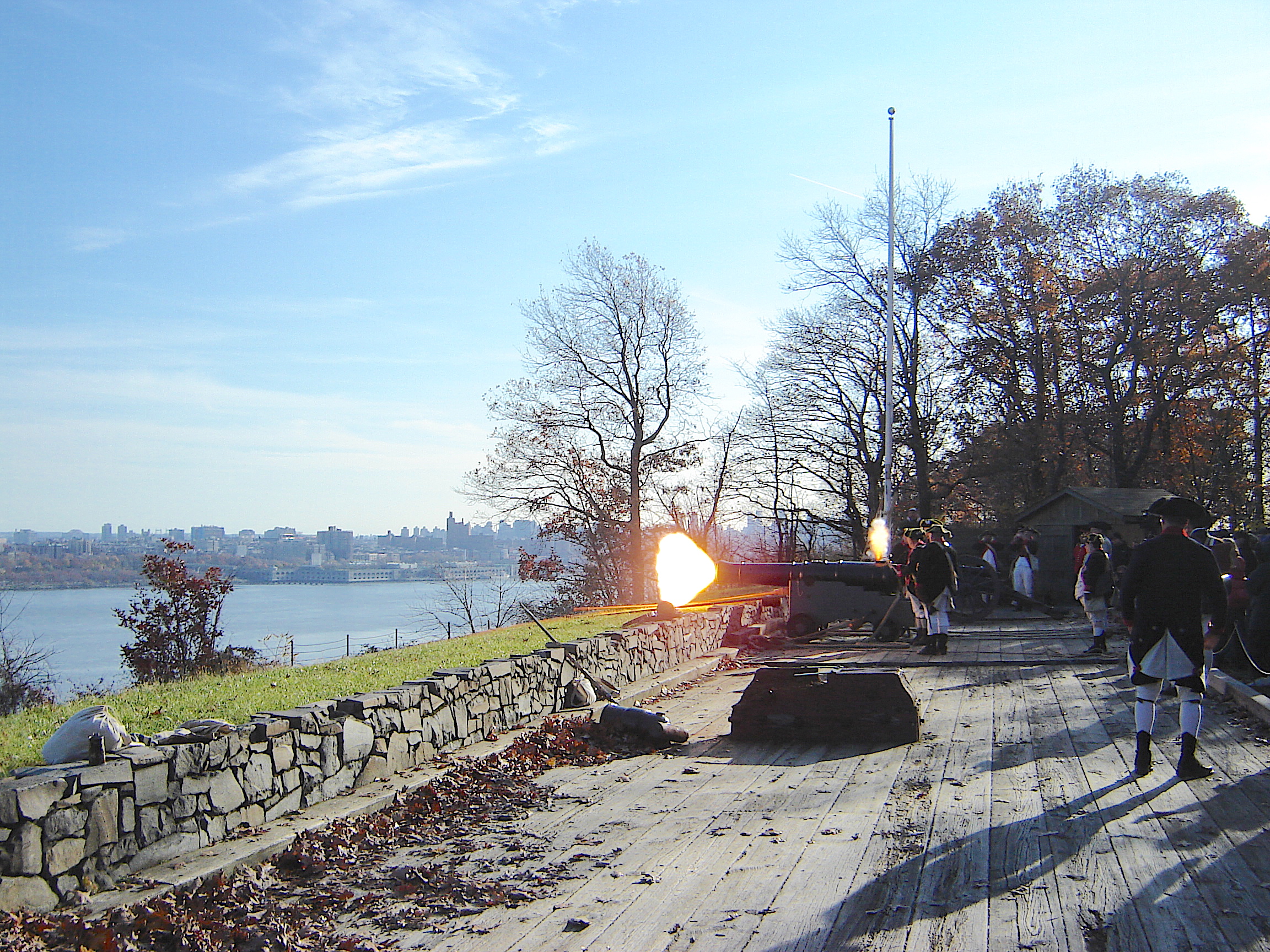
Thirty years later, the park has been reborn, with many improvements and increased visitation. Observing the anniversary of the Battle of Fort Washington, living historians gather each year to interpret the Revolutionary-War period with demonstrations of drill, cooking, musket and cannon-firing. Discharging the thirty-two-pounder rattles windows and sets off car-alarms in Manhattan.
Painting at Fort Lee a few years ago I noticed two Korean women speed-walking. Spotting me, they slowed to a halt then wandered up, peering over my shoulder. I looked up and smiled.
They smiled back.
“Any questions?” I asked.
“Yes” said the older one. “Are you married?”


Firing the 32-pounder at Fort Lee. November 21, 2010.

(Image and text were featured in the exhibition James McElhinney. Discover the Hudson Anew, curated by Laura Vookles. Hudson River Museum. Yonkers, New York. September 13, 2019 to February 16, 2020. Published also as a limited-edition in Hudson Highlands. North River Suite Volume One. Needlewatcher Editions. New York. 2018)

(A preview of SKETCHBOOK TRAVELER by James L. McElhinney (c) 2020. Schiffer Publishing).

Copyright James Lancel McElhinney (c) 2020 Texts and images may be reproduced (with proper citation) by permission of the author. To enquire, send a request to

ed******@ne***********.com


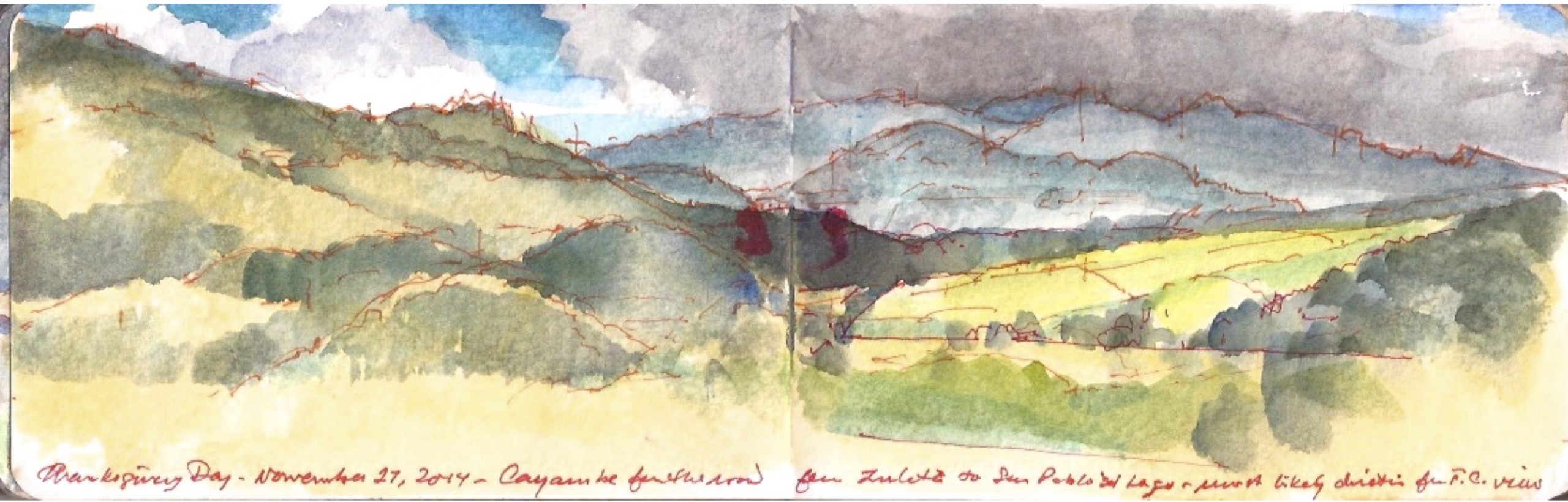
APRIL 27, 2020. QT Dispatch # 27. Fort Tryon Park. New York, New York

The world we have known never be the same. We can beguile ourselves with the vain hope that things will return to normal, forgetting that the world has always been in flux. Human evolution has been driven by geological upheaval, climate change and plagues. Calamities like COVID-19 remind us of the fragility of life, the durability of the human spirit. For the first time in the history of the planet, a unique intelligent life-form has been focused on a single natural disaster, in real time, at the same moment in time.

Making lemonade out of bitter fruit, these quotidian posts are offered as messages of hope, not just for our own survival, but as motivation to turn our attention to the world around us, to treasure what we had previously taken for granted, to draw strength, wisdom and compassion from deeper engagements with nature.


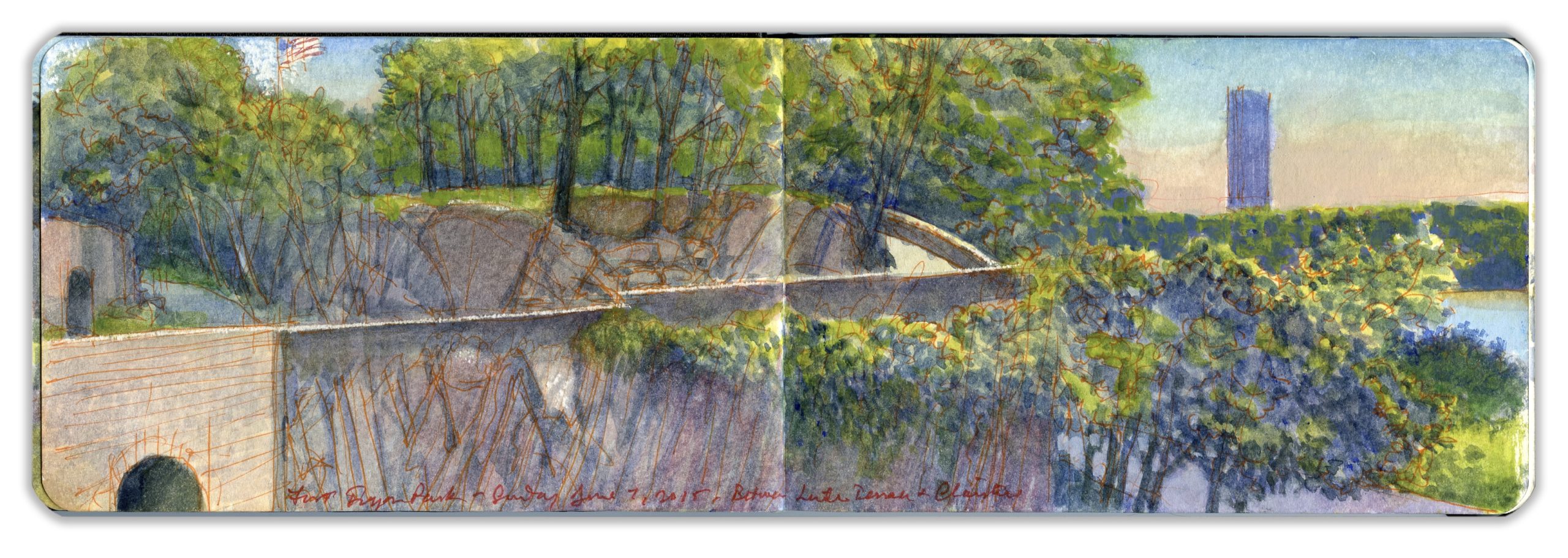
Fort Tryon Park. Journal painting. June 7, 2015. 3.5 x 10.5 inches

George Washington was one of the luckiest men alive. At the tender age of twenty-one his actions lit a spark that would engulf European powers in global conflict for seven years. Two years later he would survive unscathed one the most crushing defeats of regular troops in British colonial history. In 1759 he married the wealthiest and most eligible widow in Virginia. Not yet thirty, Washington had come to see himself as a man of destiny.
Given command of Patriot forces in 1775, he oversaw the siege of Boston, compelling Crown forces to evacuate the city. Their response was to send an armada with twenty thousand troops to capture New York City. Losing one-fifth of his men in the Battle of Brooklyn, Washington led what remained of his army to Manhattan. Their escape was concealed by heavy fog. Pursued for the next two months, clashing with Crown forces at Harlem Heights and White Plains, Washington shifted his base across the Hudson, leaving Nathaniel Greene in command of three thousand men to fortify the rocky northern tip of Manhattan.
On November 16, 1776, eight thousand British and Hessian troops disembarked along what today is Harlem River Drive, just north of the present-day site of Peter Jay Sharp Boathouse. Wiping out a small force posted on Fort George Hill, Crown forces marched west across Kingsbridge Road, now Broadway. Scaling the vertiginous rocky heights, General Wilhelm von Knyphausen’s Hessian brigade attacked an artillery position guarding the northern perimeter of Fort Washington. When one of the gunners fell, his twenty-five-year-old wife took his place in the cannon-crew. Margaret Corbin fought on until she was disabled by a Hessian bayonet. Watching in horror, Washington must have felt that his luck had run out. Having lost half of his army in two months, he led the rest across New Jersey. One step ahead of their pursuers, the Continentals slipped into Pennsylvania to lick their wounds. Defeat would teach Washington how to make his own luck. Five weeks later what was left Washington’s army crossed the Delaware again, to deliver a bloody nose to British prestige by capturing nine hundred Hessians at Trenton.


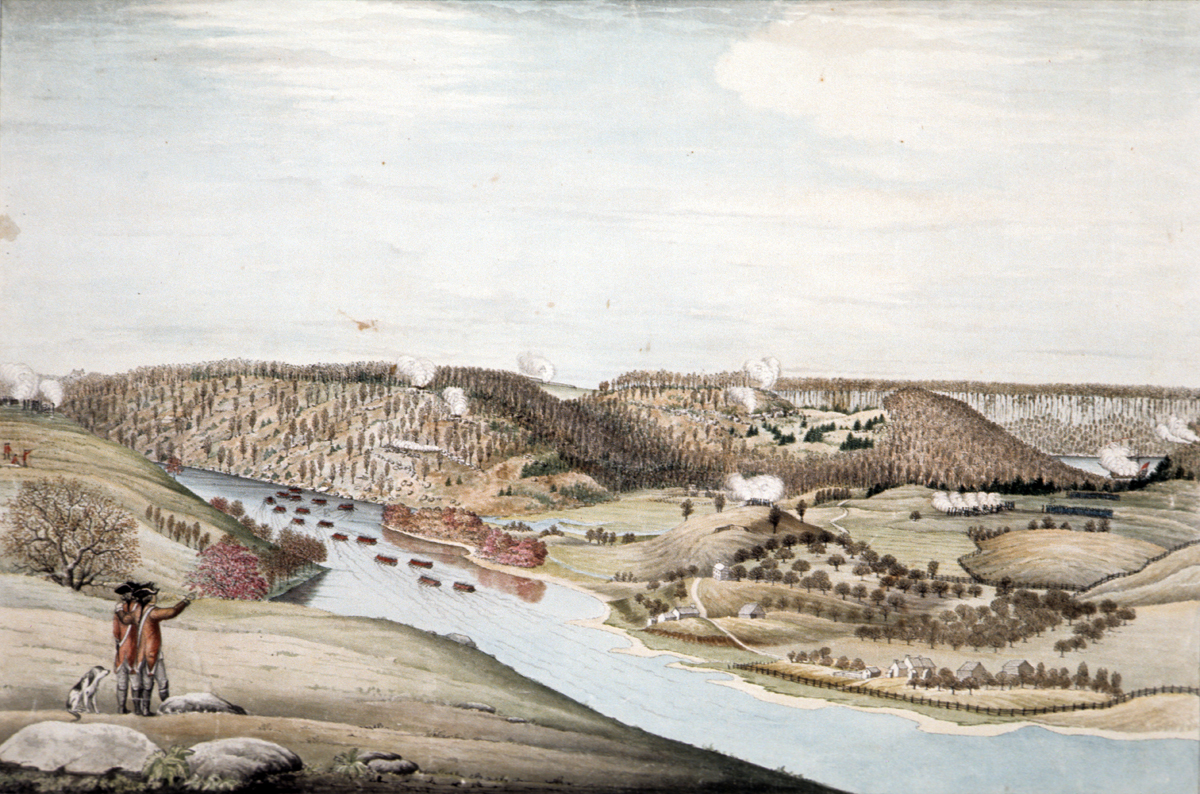
View of the Battle of Fort Washington. November 16, 1776. Thomas Davies, Royal Artillery. New York Public Library.
Among skills British officers were expected to possess was topographical drawing, a compulsory subject at the Royal Military Academy at Woolwich. Noted as a gifted artist-naturalist, Thomas Davies (1737-1812) was employed by General Howe to record the British campaign in New York. In 1777 Davies was put in command of Fort von Knyphausen, fomerly Fort Washington. Kathie Manthorne and I live on the battlefield, just downhill from Fort Washington. The site today is preserved as Bennett Park, located at 183rd Street and Fort Washington Avenue. Davie’s prospect today is located near the intersection of Fordham Road and Sedgwick Avenue in the Bronx.

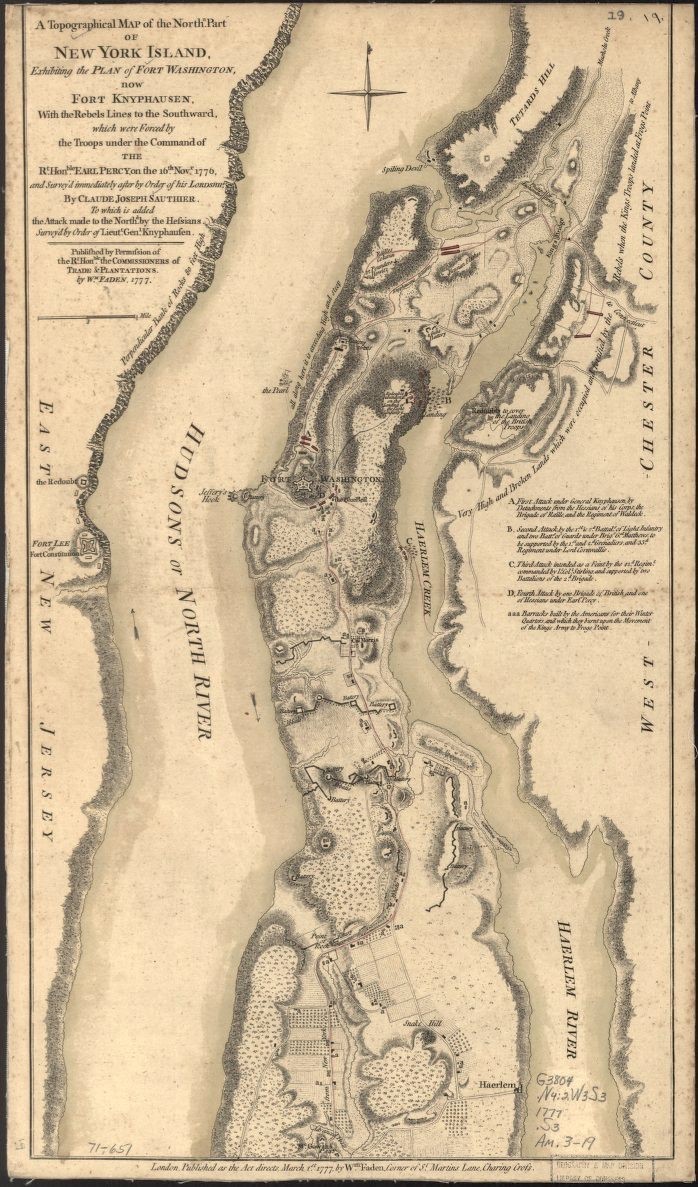
Below: Map of New York (Manhattan) Island. 1777, showing the disposition of opposing forces during the battle of November 16, 1776.

During the nineteen-thirties, newly constructed gardens, paths, stairways transformed the former battlefield into a park. Marked by a flagpole, Corbin’s fateful stand lies buried under masonry terraces, evoking an historic fortification. Day and night, the national colors fly at its summit. In the mid-nineties, celebrities like Bette Midler and Washington Heights resident Dr. Ruth Westheimer helped transform the park into one of the most beautiful in the city, and one of the least crowded. At the northern end of the park stands a cluster of reconstructed European chapels and gardens. The Cloisters was created through a unique collaboration between philanthropist John D. Rockefeller, Jr. and then curator James Rorimer, one of the famed Second World War Monuments Men. Resting my sketchbook atop a stone wall, people drifted by me as I painted. No one paused to look over my shoulder. This is New York. When film stars, world leaders or raving lunatics stroll down the avenue, nobody gives them a second look.
.

(Image and text were featured in the exhibition James McElhinney. Discover the Hudson Anew, curated by Laura Vookles. Hudson River Museum. Yonkers, New York. September 13, 2019 to February 16, 2020. Published also as a limited-edition in Hudson Highlands. North River Suite Volume One. Needlewatcher Editions. New York. 2018)

(A preview of SKETCHBOOK TRAVELER by James L. McElhinney (c) 2020. Schiffer Publishing).

Copyright James Lancel McElhinney (c) 2020 Texts and images may be reproduced (with proper citation) by permission of the author. To enquire, send a request to

ed******@ne***********.com


APRIL 26. QT Dispatch #26. Outriggers on the Schuylkill

Waiting for the crisis to pass, our thoughts go out to friends and loved-ones, who also shelter in place. News arrives of old friends passing away, people we knew and admired. Immobilized as we are, we can all relive our travels. I invite you to join me in celebrating the joys of Quaranteam travel. These are also messages of hope, not just for our own survival, but that we might begin to treasure what we had been taking for granted, to draw strength, wisdom and compassion from deeper engagements with nature.
.


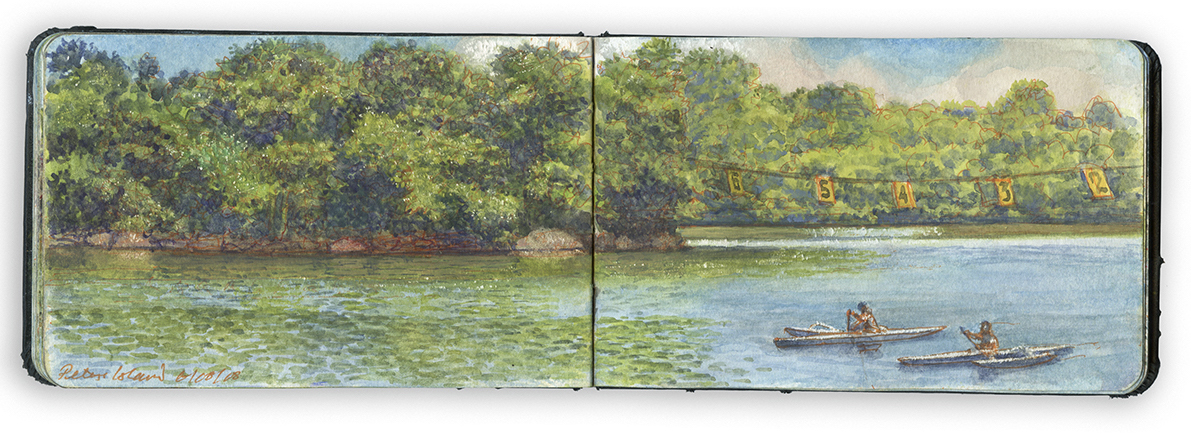
Outrigger Canoes Passing Peters Island. Sunday, June 10, 2018. Schuylkill River Sketchbook.

Famed as an international center of amateur competitive rowing, the Schuylkill River passing through Fairmount Park is also a magnet for paddling clubs. The oldest of these is the Philadelphia Canoe Club founded in 1905. Since the 1980s Philadelphia Dragon Boat Association has competed with distinction around the world. With roots in Hawaiian culture, Philadelphia Outrigger Canoe Club was founded in the 1990s. Competing with other outrigger clubs in the annual Hoe Wa’a Challenge ocean-race off Brigantine, New Jersey the Schuylkill River provides a waterway for training and practice.
On June 10, 2018, I set up along Kelly Drive, making quick sketches of rowers when a pair of outriggers paddle by, A braided steel cable stretched across the channel marks lanes used by crews in rowing competitions. The paddlers were middle-aged women enjoying a pleasant turn on the river, displaying for the moment none of the fierce competitiveness exuded by determined oarsmen and women rowing in sculls.
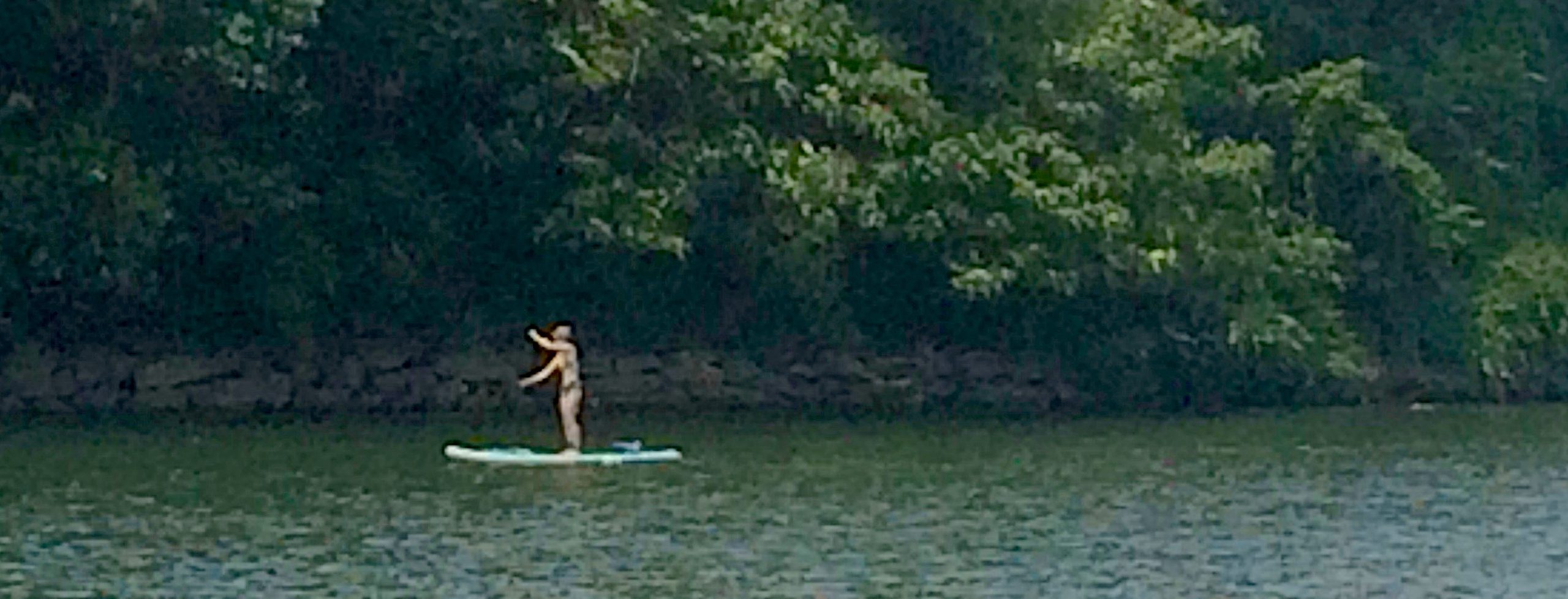
Later in the day I noticed another paddling-sport in action, as a woman completed several circuits around Peters Island on a paddleboard. Looking for information on what clubs may exist, I found a webpage for Stand Up Paddleboard Philly with a contact portal but no physical address. Its promotional language promised ways to “…stay fit and learn about Philadelphia’s unique urban geography and ecological systems. Based on the Professional Stand Up Paddleboard Association, the sport seems to be geared more toward personal enrichment than organized competition.


Stand Up paddleboard off Peters Island. Schuylkill River, Philadelphia PA USA. Sunday, June 10, 2018. Photograph by the author.

Remembering Philadelphia fifty years earlier, I am heartened to find such a diversity of people making use of the riverbanks. I fall into conversation with an African-American woman who shared that her military daughter was deployed in the Middle East. She comes down to the river at least once a week, she tells me, to soothe her mind. She waves at a fellow walking by, carrying a fishing-rod and white join-compound bucket. I ask if she knows him. No, she says, but he’s always here, hoping to catch a big one. I tell her about the fifty-pound catfish somebody pulled out of the river at East Falls. A hundred yards to the north along the sunny esplanade, a couple spreads a blanket on the grass. Hearing behind us a loud crash, glass breaking, people screaming. I jump up. Darting out of the parking-area, a hatchback was broadsided by another vehicle on Kelly Drive. Fortunately the only damage was to the machinery.

(A preview of SKETCHBOOK TRAVELER by James L. McElhinney (c) 2020. Schiffer Publishing).

Copyright James Lancel McElhinney (c) 2020 Texts and images may be reproduced (with proper citation) by permission of the author. To enquire, send a request to

ed******@ne***********.com


April 25, 2020. Q.T. Dispatch # 25. The View from Olana

Waiting for the crisis to pass, our thoughts go out to friends and loved-ones who also shelter in place. Old friends pass away, people we loved and admired. Immobilized for the time being, we can revisit destinations, near and far. join me in celebrating the joys of Quaranteam travel, the hope that these diversions might inspire us to value things we had taken for granted, to draw strength, wisdom and compassion from deeper engagements with nature.


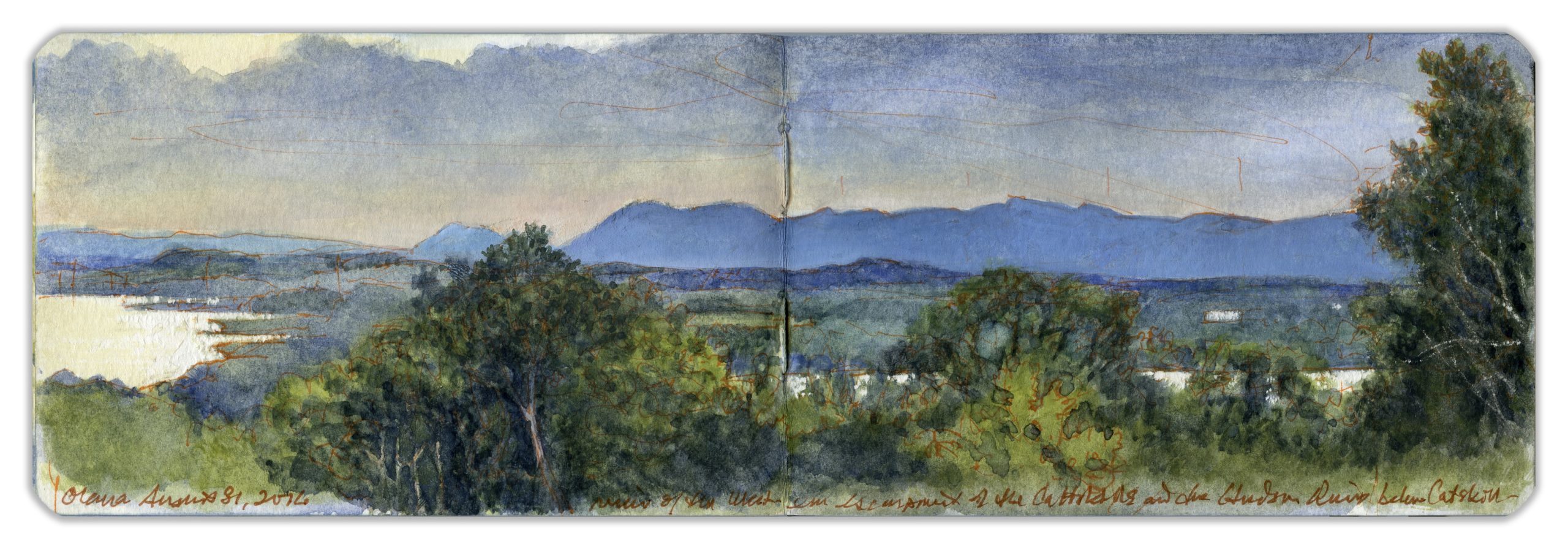
CATSKILL ESCARPMENT FROM OLANA.August 31, 2016. Watercolor and pen on Moleskine watercolor sketchbook. 3.5 x 10 inches. 2016

“Nature has been very lavish here in the gift of her beauty- I am sure you would enjoy the noble scenes which our windows command”
Frederic Edwin Church to Henry Wadsworth Longfellow, 1880

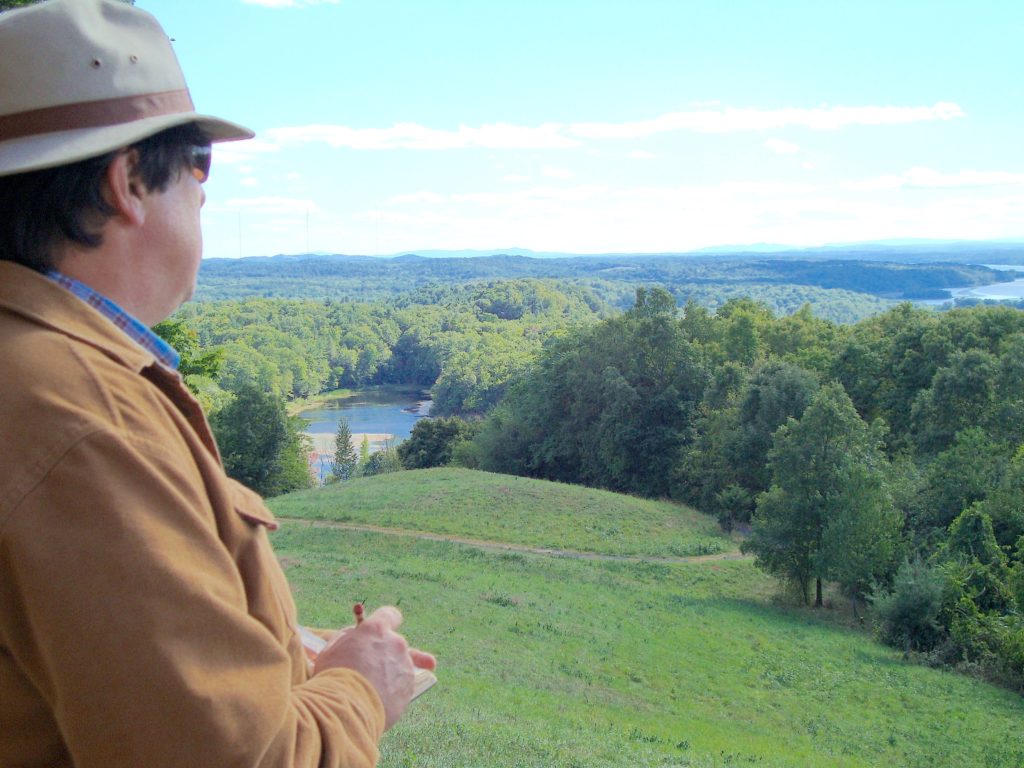
Sitting on the edge of the south porch at Olana—the home of Frederic Edwin Church. The day is warm, threatening rain. Wednesday. We had just driven up from the city to deliver Kathie to a meeting. The previous week we had been in London, Kew and Greenwich. Like the Royal Observatory, Olana crowns a hill that spills steeply down a wide, grassy slope.
The difference here is that I am not looking across the Thames at the Isle of Dogs, with the new Docklands rising up behind it to the north. Dark clouds to the west seem to promise approaching thunder and rain. Visitors on a guided tour of the house peer over my shoulder. No one pauses to give me advice, or ask me what I’m doing. I am just part of the scenery. A young couple walks to the edge of the hilltop. They take a selfie. A drop of rain lands on the back of my hand.

(A preview of SKETCHBOOK TRAVELER by James L. McElhinney (c) 2020. Schiffer Publishing).

Copyright James Lancel McElhinney (c) 2020 Texts and images may be reproduced (with proper citation) by permission of the author. To enquire, send a request to

ed******@ne***********.com


April 24, 2020. Q.T. Dispatch # 24. Under the Volcano

Waiting for the crisis to pass, our thoughts go out to friends and loved-ones who also shelter in place. Old friends pass away, people we loved and admired. Immobilized for the time being, we can revisit destinations, near and far. join me in celebrating the joys of Quaranteam travel, the hope that these diversions might inspire us to value things we had taken for granted, to draw strength, wisdom and compassion from deeper engagements with nature.


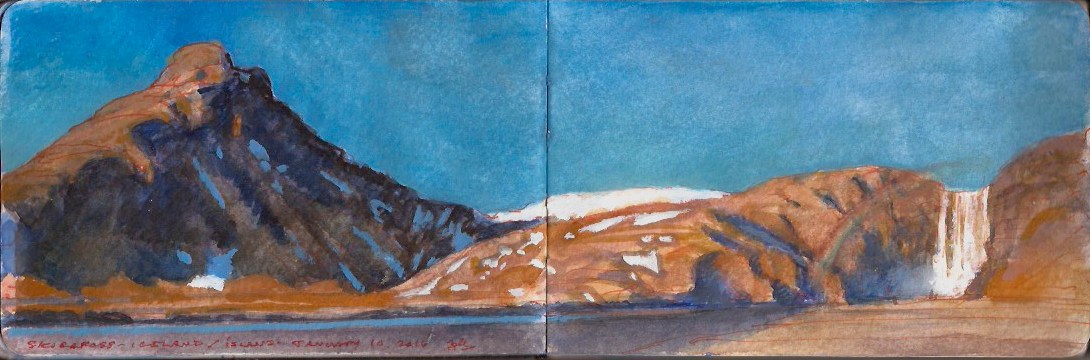
Skogafoss. Iceland. January 10, 2016. Journal painting. 3.5 x 10. 5 inches. (8.89 x 26.67 cm)

January 10, 2016. Iceland. Turning left onto Highway 1, we proceed east. Set back to our left is a long escarpment. Above it, the slope climbs toward the snowy mass of Eyjafjallajoküll.
To our right the coastal plain stretches south toward nearby beaches. We pass a large tidal lagoon with black sand beaches to our right. Holtsós Arne tells us was a harbor in Viking times, but now is divided from the Atlantic by a narrow sand-bar. Hovering over the horizon, the sun casts a ruddy hue on a large mesa to landward. Looking like a slice of pie on the map, from our earthbound perspective we behold a sheer upheaval of basalt. Through a gap between this formation and the escarpment we had been following we behold the volcano summit, where a short time ago we had stood. Arne changes the subject.
“You know,” he asks me, “in Reykjavik there is a kissing cousins app.”
I asked if it was some kind of naught dating site, for people looking to hook up.
“Oh no,” he replies. “We Icelanders are very friendly. The problem is there are so few of us that you can’t be sure if someone is not a relative. If an Icelander talks to another one long enough, they’ll probably figure out that they have a common ancestor. Most of us are distant cousins.”
I asked him how the app works.
“Let’s say you just meet this really nice girl at a bar. At last call, maybe she wants to come home with you. You can take precautions and all that, but you know, drinking an all…anything can happen. If you have the app on your phone, you can just bump your phone against hers and it will tell you if she’s a first cousin or anything like that. Don’t want a baby with six fingers.”
“Reykjavik sounds like a wild town.” I say
“Not so much, but you know we’re all human.” Arne adds. “The app is more for young people going to clubs and bars. Cheaters used to hike into this ravine above Selfoss, where there are many hot springs. Some writer put it in a guidebook to sexy destinations, so now everybody goes there. It’s no secret anymore.” I ask him where cheaters go now. Hotels, he replies.
I ask is there is a hookup app for the Hidden People. Probably so he replies.
On paper the population of Iceland is a little over three hundred thousand individuals, which does not include giants, trolls, and an invisible race—like the Irish Tuatha de Danann. Living in natural features like rocks and hillocks the Huldufolk, or Hidden People are very real to Icelanders. Woe to him who builds a road or house, or disturbs in any way the natural arrangement of terrain, without some negotiation with this intangible population. This is accomplished through licensed intermediaries—ordinary human beings who represent their interests.


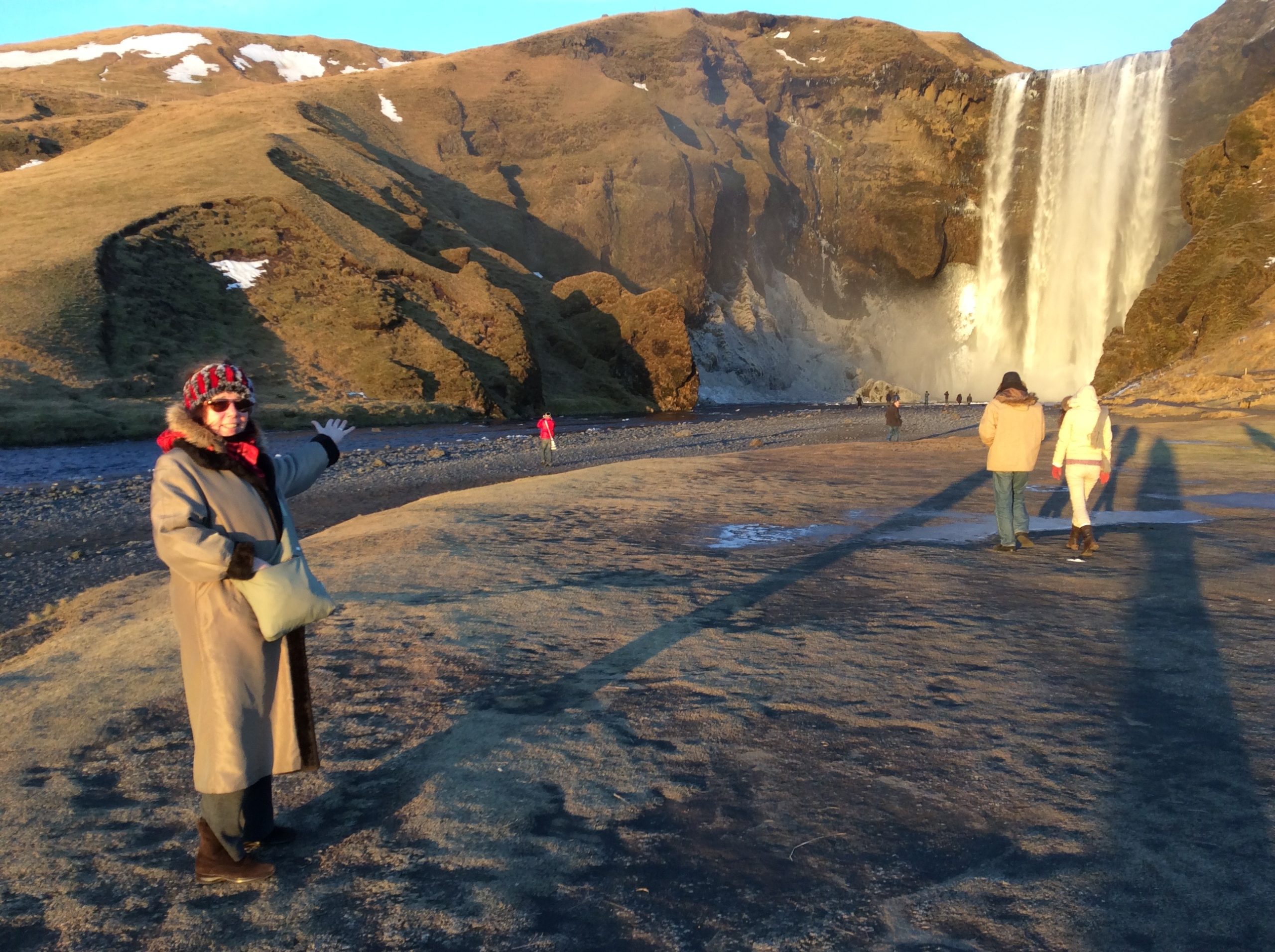
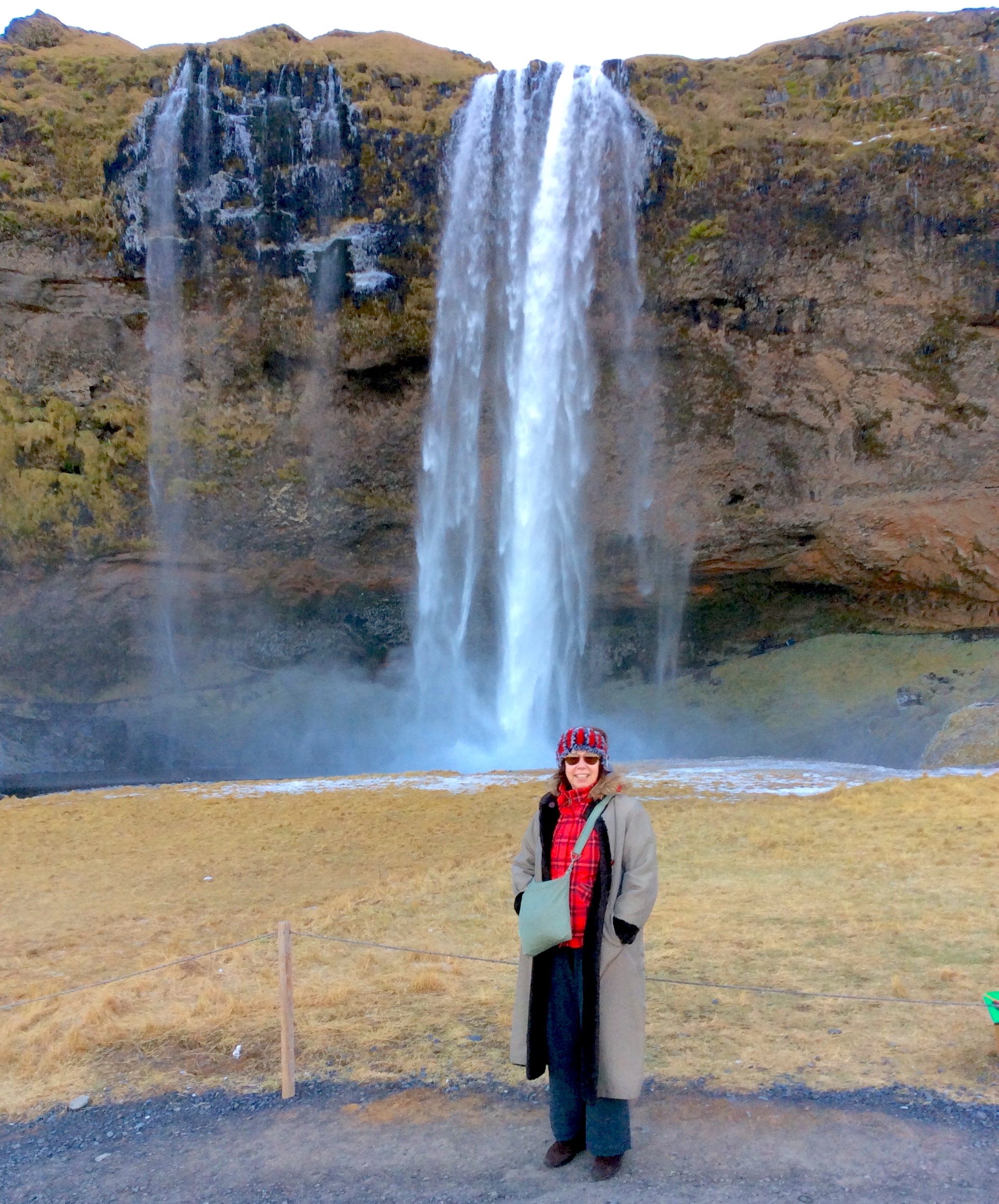
Skogafoss. January 10, 2016. The waterfall is caused by runoff from a glacier on the southeastern slopes of Eyjafjallajokull. Kathie Manthorne as cicerona.

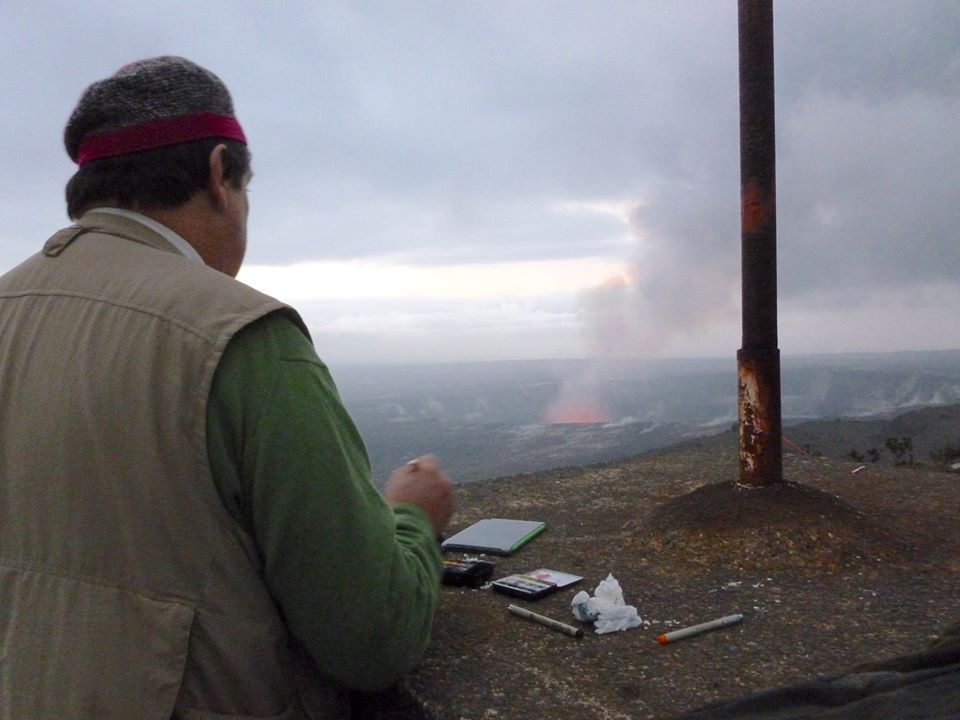
Unlike Seljalandfoss, which has minimal amenities by comparison, Skogafoss has a proper restaurant, from which a trail leads to the base of the falls. The approach required walking across ice and snow with some care. My camera was tucked in the pocket of my Barbour oilcloth Anorak. As Kathie walks to the base of the falls, I choose a prospect and lay out a composition, across a page-spread in orange ink, making notes in watercolor. My field-box is a black-enameled steel box carrying a dozen half-pans aquarelles. The integral water-flask is closed with a threaded knurled brass cap. A rectangular enamel cup fits over the device, holding closed the lid, which serves as a palette. A high-sign from Arne beckons us back to his SuperJeep.


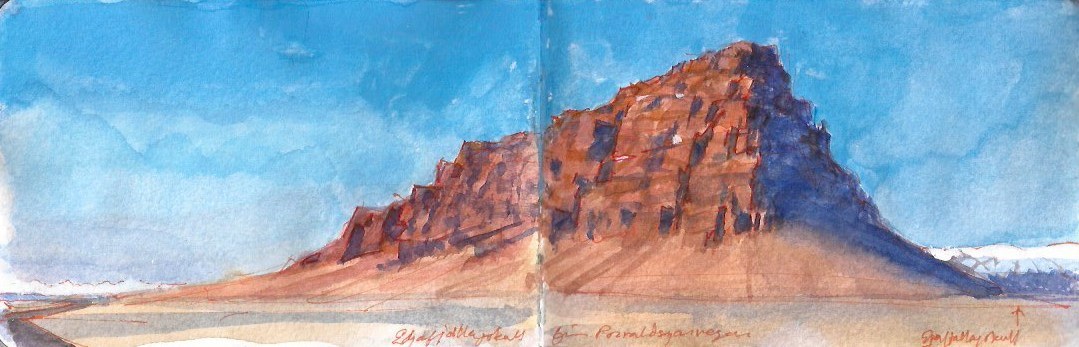
Basaltic outcropping next to Thorvaldseyri. January 10, 2016. Journal painting. 3.5 x 10. 5 inches. (8.89 x 26.67 cm)

We make one final stop at Thorvaldseyri, an historic farmstead that runs a museum dedicated to Eyjafjallajokull. It being Sunday, the gate was closed. Despite Arne’s insistence that some Icelanders have gone back to the old Norse gods, others still observe the Christian Sabbath. Parking on the shoulder, I am impressed by an almost complete absence of litter by the roadside.
I make start another painting, of an impressive vertiginous tabletop hill, just west of the farm. Driving back to Reykjavik in the dark, we are silent. Arne puts on some music.
Of Monsters and Men had burst on the scene in 2010. Icelandic pop star Bjork was already a household brand. Arne tells us that Icelanders are very proud of their literary heritage, going back to the Elder Edda, Snorri Sturlurson, and the late Halldór Laxness, winner of the Nobel Prize for Literature. Medieval Iceland had the highest literacy rate in all of Western Europe. People would read to one another by the sputtering light of whale-oil lamps.
Passing Hvaergirði, Thousand Eyes is playing. Ahead the glow of Reykjavik lightens the dark western sky.
Kathie had booked us rooms at Hotel Natura, which though pleasant was nothing like its name.
The midcentury Bauhaus-style building stood beside what had been an Allied airfield during the Second World War. As we all tumbled out of the Jeep, I reached for my wallet to give Arne a tip. It was nowhere to be found.
Searching all my pockets and shoulder-bag, we looked on the floor-boards and under the seats.
Fortunately, I had scanned both sides of my credit cards and uploaded the PDF to my online Dropbox. Retrieving the document from a computer the hotel provided to guests, I went to our room and cancelled them all.
Three months later a person unknown to me sends me a query on Facebook messenger.
“Did you visit Iceland recently?”
Replying that I had, they responded by asking if I had lost a wallet. I replied that I had. The Good Samaritan informed me that she and her husband volunteer for periodic roadside cleanup details. Picking up litter along Highway 1, they found my wallet near Thorvaldsyeri. Addresses were exchanged. The wallet arrived a week or so later, containing all the credit cards and cash. Nothing had been taken.

James Lancel McElhinney © 2020
Queries:

ja***@mc***********.com


© James Lancel McElhinney. 2016
Enquiries:

ja***@mc***********.com


Disclaimer: The above is a work of fiction based on real events. Any resemblance to fact is coincidental. “Print the Legend”

(A preview of SKETCHBOOK TRAVELER by James L. McElhinney (c) 2020. Schiffer Publishing).

Copyright James Lancel McElhinney (c) 2020 Texts and images may be reproduced (with proper citation) by permission of the author. To enquire, send a request to

ed******@ne***********.com


April 23, 2020. QT Dispatch # 23. The Summit of Eyjafjallajokull Volcano, Iceland

Waiting for the crisis to pass, our thoughts go out to friends and loved-ones who also shelter in place. Old friends pass away, people we loved and admired. Immobilized for the time being, we can revisit destinations, near and far. join me in celebrating the joys of Quaranteam travel, the hope that these diversions might inspire us to value things we had taken for granted, to draw strength, wisdom and compassion from deeper engagements with nature.


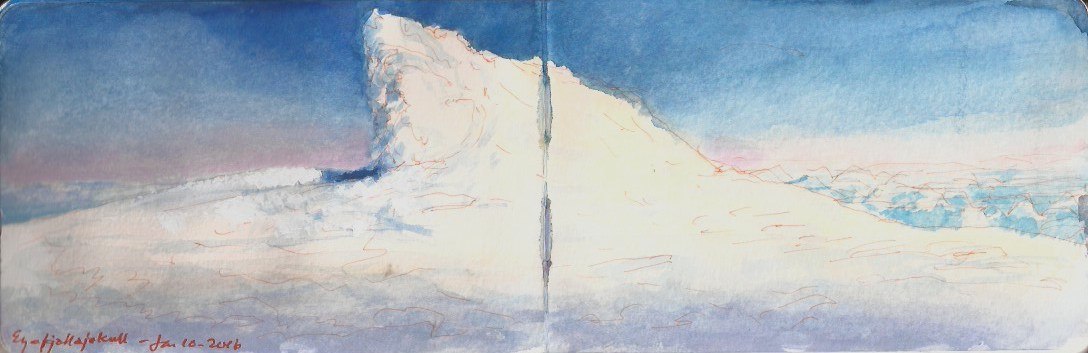
Atop Eyjafjallajokull. January 10, 2016. Watercolor on paper. 3.5 x 10.5 inches.

January 10, 2016. Sunday. Hotel Natura, Reykjavik. Kathie had booked a waterfall tour. Things did not go as planned. Instead they went far better than expected. Read the journal-extract below discover what happened.

Three Super Jeeps make up our caravan. Leaving Reykjavik, we head east on Highway 1, the southern coast road. Passing route 38 on our right, the land drops away. A broad inlet off to our right is fed by an estuary that snakes across the plain below. Passing the foot of table-lands rising steeply to our left, we drive past the town of Selfoss. Our driver Arne informs us that Chess-champion Bobby Fischer is buried at a Church not far from here.
“I thought Fischer was Jewish,” I reply. “How is it that he is buried in a churchyard?”
Arne can’t say for sure, but explains that most Icelanders are Lutheran, and not by choice. When the island was under Danish rule Lutheranism was compulsory, the official denomination for all Baptisms.
“The story we were told in school,” I tell Arne, “was that Leif Ericsson had converted to Christianity a thousand years ago.”
“That may be true,” Arne replies, “but many continued to worship the old gods. Some still do.”
I tell him how indigenous Pueblo communities in the American Southwest celebrate both Catholicism and traditional Kiva mysteries, not in defiance of Christianity, but in a blending of spiritual practices. Early Christian Europe I remind him, converted pagan gods into Christian saints. Medieval cathedrals were often built on the site of Roman temples that had replaced indigenous places of worship.
“That’s interesting,” Arne replies, “but I don’ think the Lutheran church would go for it.”
One of his favorite sagas is about Odin visiting Iceland, walking from one farmstead to another, to see who still worships him.
In outlying areas along the eastern and northern coast, there was some resistance to Christianity.
“What got them to go along with it?” I ask.
“We finally agreed to accept Christianity, but only if the church let us keep our slaves and eat our horses.”

Beyond Selfoss we cross a coastal plain covered by small farms. The road traverses a broad arroyo of black volcanic gravel through which dozens of frozen streams thread pathways to the sea. At Hvolvöllur we stop for fuel, use the restroom and buy sandwiches. The drivers gather for a powwow around the gas-pumps. The lead driver is the owner of the tour company Superjeep Island (pronounced Ice-land).
Arne informs us that his boss just had a call from base. Radar is showing no inclement weather as far west as Davis Strait, on the other side of Greenland. The other drivers are talking about driving to the summit of Eyjafjallajokülll–the unpronounceable volcano that brought air-travel to a halt in 2010 when it dumped thousands of tons of ash on Europe. Like Gaelic, Icelandic orthography to non-speakers is non-phonetic. Eyjafjallayoküll sounds like Aee-yah-fee-yacht-la-yo-cook to an Angophone.

All being game, we proceeded east on highway 1 to route 249. Turning left (north) we pass Seljalandfoss waterfall, turning right onto another road that bends back to the southeast, crossing the stream that feeds the falls. The unpaved road rises, reaching at last a desolate area that seems to have been mined for gravel.
The road-surface ahead almost resembles a stream-bed. Reaching a level area after half a kilometer, the Jeeps halt. Arne gets out. He and the other drivers deflate their tires to improve traction. A short distance ahead we drive onto the snow-pack.
Arne guides the Jeep around unseen pitfalls and obstacles, at times yawing twenty degrees to one side or the other, we crawl upward.
Carefully Arne crawls along a huge snow embankment, piled up against a rocky outcropping curving upward like an amphitheater. The flat, open space below is more likely to conceal dangerous fissures and crevasses.

The third Jeep in our caravan speeds past us.“He’s young,” Arne explains. “His dad owns the company.”

Reaching a broad shelf, we stop at the edge of the glacier. Arne gets out and deflates the tires to further enhance traction. He explains that a tank of compressed air in the rear of the vehicle will be used to re-inflate them when we return to a hard surface. Jumping back into in the car, he takes off his sunglasses, replacing them with a more expensive pair hidden in the side-pocket of his door.
I asked him why change eye-wear.
“Crossing this glacier (pronounced gloss-ear). It’s full of crevasses. The snow-pack should be deep enough to keep us from falling through, but you never know. This is the first clear day we’ve had like this for nine months. It’s up to you. Shall we go for it?”
“You know,” I said. “If we do get killed, I’ll be sure to tell Saint Peter that in spite of everything, you were an excellent driver.”
Looking sharply me, he furrows his brow. Pointing upward, he asks, “What makes you think I want to go THERE?”


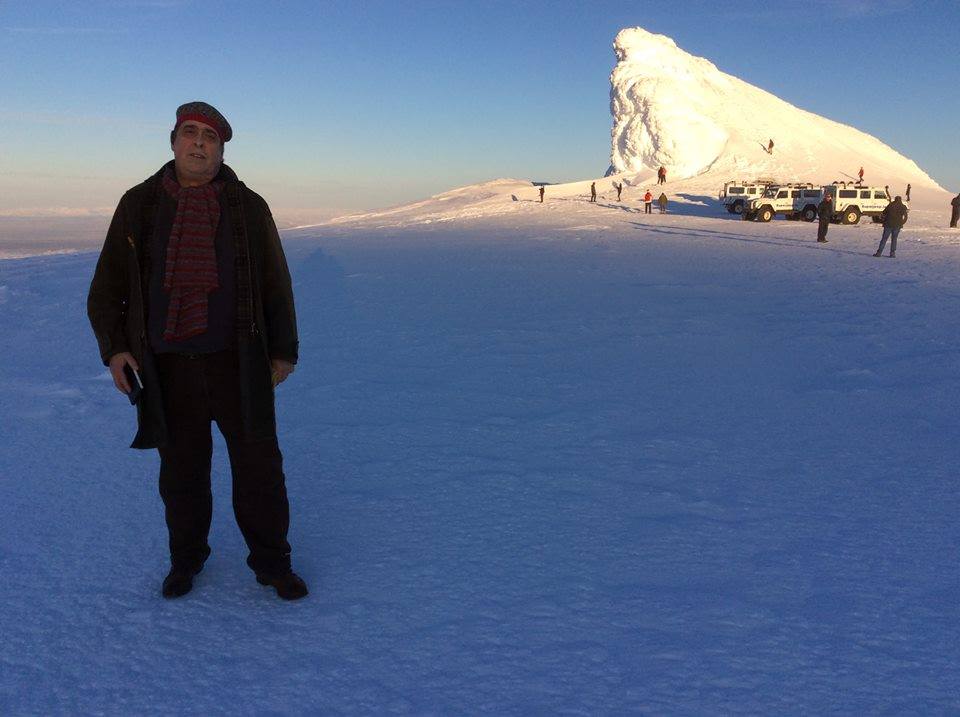
Atop Eyjafjallajoküll volcano, Iceland. January 10, 2016. Sunday. Note the sketchbook in hand.

Proceeding slowly at a steady pace Arne drives us up onto a snowy plateau at the crater’s edge. Another Jeep-tour caravan was already on site. On the northern edge of the shelf is a lopsided pyramid of snow, leaning away from the crater’s edge. I suppose this was created by a combination of the winds, and perhaps heat rising from the crater. People climb the giant snow-pile. I see a red parka at its summit, a child in spirit of Edward Whymper or Edmund Hillary.
Kathie and I walk south, a hundred meters from the tailgater now underway. I make two sketches with color accents, to be elaborated back at Hotel Natura, over a glass of Brennevin, Icelandic schnapps known locally as Black Death.
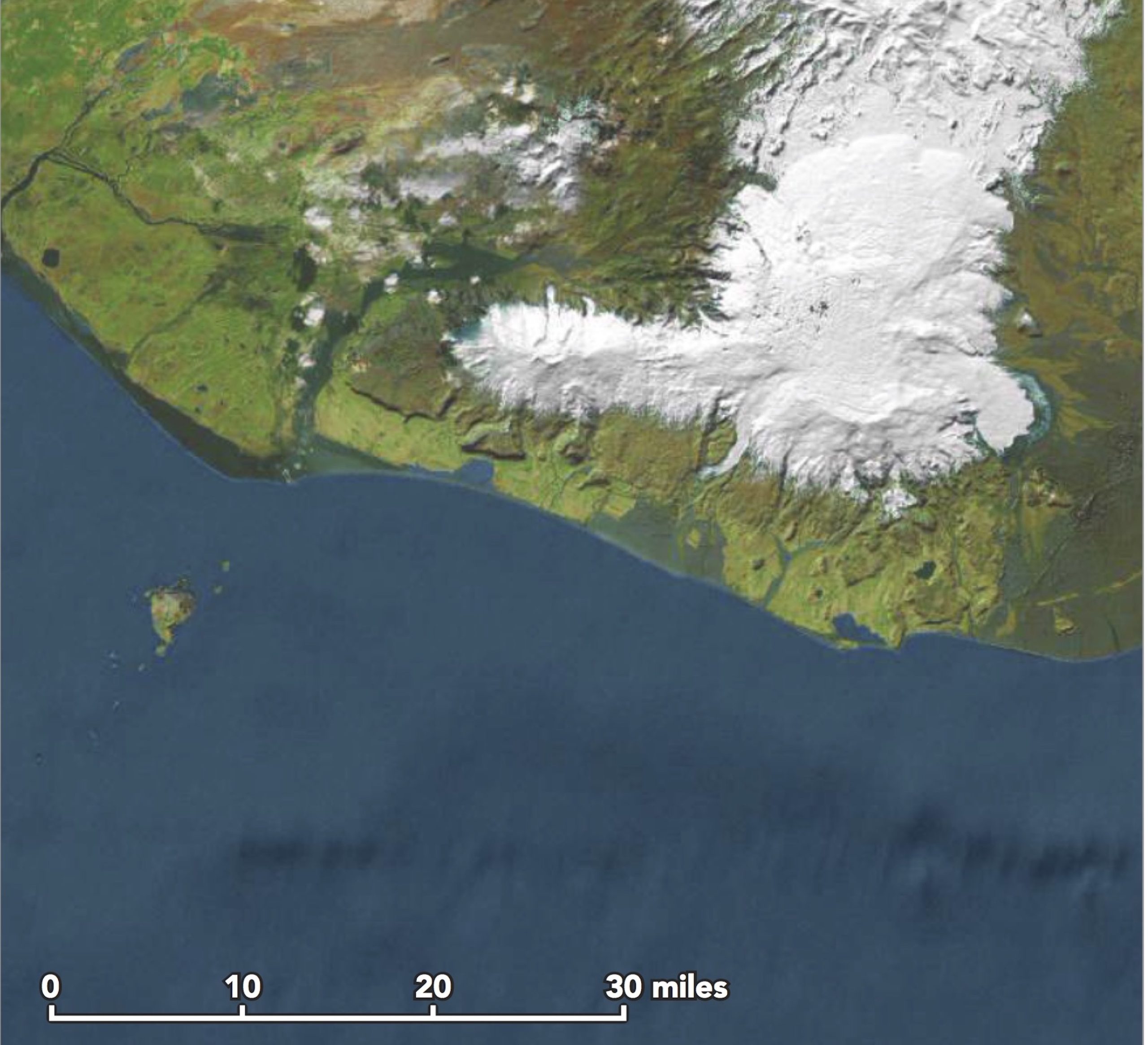
Silence envelopes us. Looking out toward the south we see the Vestmannaeyjar Islands, lying just offshore. The islands are named for a group of Irish slaves massacred by friends of their captor, whom they had murdered during a mutiny.
Reveling in the snowy hush of our wild isolation. Just as we feel the mountain about to whisper deep truths, a roaring blizzard almost knocks us over. Rising up from the crater is a sleek, black helicopter. Landing, the downwash of its rotors blows powdery snow is every direction. Suddenly we are in a James Bond moment. A tall thin woman in a long fur coat and thousand-dollar sunglasses steps out of the chopper, followed by an older, well-groomed man in a knee-length parka. Another man climbs down beside them, perhaps a handler, or their cicerone. Kathie and I walk back to the Superjeep cluster. A woman at the pinnacle of the tipsy pyramid calls down to friends, her words inaudible to us.


Boots-on-the-ground art-historian Kathie Manthorne at Seljalandfoss. June 10, 2016.

Down the mountain and back on blacktop, we stop at Seljalandfoss for photo ops. Again, I make a sketch, adding some color notes for later reference when I unzip the file. Skogafoss, a spectacular waterfall created by runoff from another glacier, on the southeastern slope of Eyafjallajoküll. Located next to the village of Skogár thirty kilometers further east. Today’s excursion will go no farther before returning to the city. (to be continued)

Below: Satellite view of the souther coast showing Eyjafjallaokull and Vestmannaeyjar Islands

© James Lancel McElhinney. 2016
Enquiries:

ja***@mc***********.com


Disclaimer: The above is a work of fiction based on real events. Any resemblance to fact is coincidental. “Print the Legend”

(A preview of SKETCHBOOK TRAVELER by James L. McElhinney (c) 2020. Schiffer Publishing).

Copyright James Lancel McElhinney (c) 2020 Texts and images may be reproduced (with proper citation) by permission of the author. To enquire, send a request to

ed******@ne***********.com


April 22, 2020. Earth Day x Fifty. Quaranteam Traveler Dispatch # 22

Three weeks ago, I published the first in a series of daily website blog-posts, of writings and artworks that celebrate personal mobility, in pursuit of mindful engagements with history, nature and the environment.
In relation to a finished painting, or essay, this process is no less a work of art than is the tree to the fruit it bears.
Shared as messages of hope and solidarity, these posts will appear every day, until these dark days are behind us.

Exploring the banks of the Schuylkill River in 2018, between the mouth of Wissahickon Creek and Fairmount Water-Works I filled a sketchbook with paintings.
Later that year, a limited-edition suite of prints drawn from this journal would become the centerpiece of an installation at Independence Seaport Museum in Philadelphia.


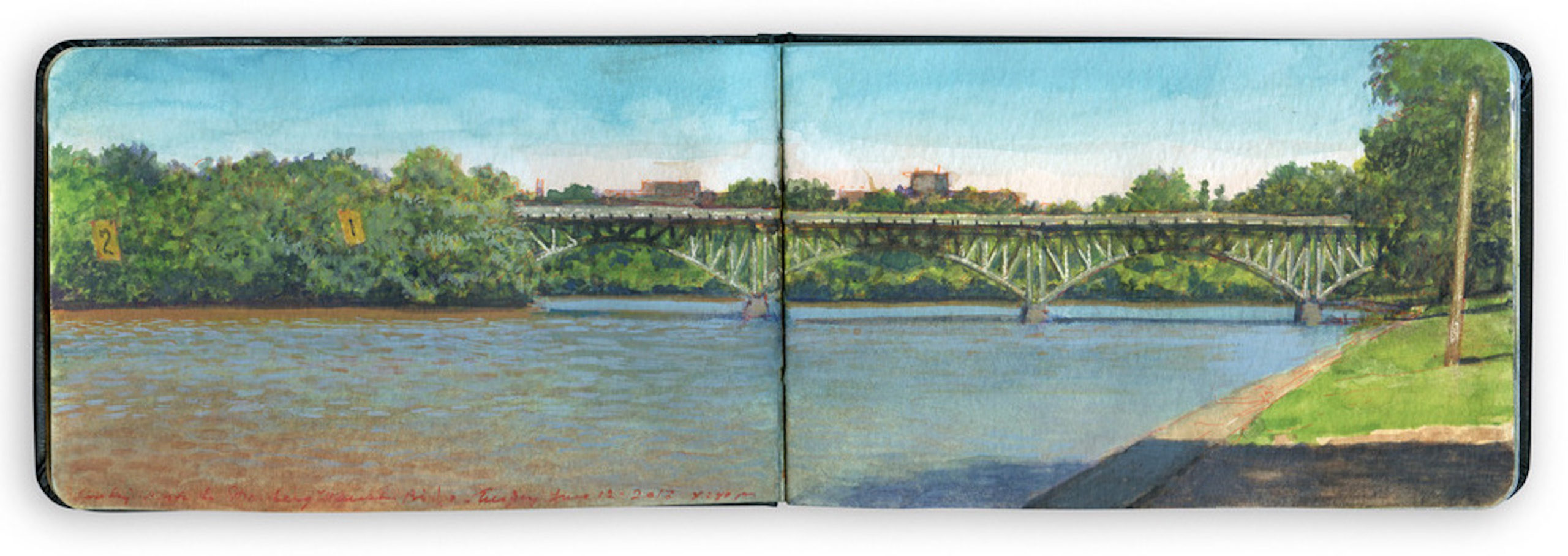
Looking North toward Strawberry Mansion Bridge. June 12, 2018. O.T.W. (On the Water) Schuylkill River Sketchbook

Stretching southward along the west bank of the Schuylkill, between Saint Joseph’s University Gillin Boathouse and the grandstand beside Columbia Railroad Bridge is a broad, grassy embankment sloping gently down from Kelly Drive to a stone bulkhead on the riverbank. Traversed by pedestrian and bike trails, the strand is sheltered beneath a canopy of trees. At its northern extremity is Strawberry Mansion Bridge. Taking its name from an eighteenth-century estate originally known as Summerville, the span was hailed as a marvel of modern engineering. Privately funded, the entire structure was prefabricated twenty-five miles upstream by Phoenix Iron Company and assembled at its present location in 1897. Its filigree steel arches soared above the river, conveying trolley-cars, pedestrians, and vehicular traffic between the eastern and western sections of Fairmount Park. Trolleys stopped running in 1946. After decades of hard use and disrepair, the bridge underwent a major restoration. Work began in 1991 and was completed four years later, just two years shy of the bridge’s centennial.
Just behind my point of view is a parking-lot. Beyond that is the grandstand used for viewing rowing competitions organized by the Schuylkill Navy. Fishermen cast their lines in the river. Sunbathers and picnickers pick their spots along the esplanade. To the left, across the channel is Peters Island. By mid-twentieth century, the wooded sandbar had been married to the right bank of the river by silt, mixed with crushed coal. Before the right-bank channel was reopened in the nineteen-fifties, Peters Island was notorious for clandestine trysts. Stretched between the eastern shore of the island and the left bank of the river is a steel cable, from which are suspended numbered lane-markers to help rowing-crews maintain their positions.
Southeastern Pennsylvania had been deluged overnight by a series of massive thunderstorms. Whenever this happens, effluvia from sewage-treatment facilities upstream sometimes enters the river, tinting it a muddy orange. Under a clear blue sky, the effect has a certain visual appeal. For fishermen, it’s definitely a catch-and-release kind of day.

(A preview of SKETCHBOOK TRAVELER by James L. McElhinney (c) 2020. Schiffer Publishing).

Copyright James Lancel McElhinney (c) 2020 Texts and images may be reproduced (with proper citation) by permission of the author. To enquire, send a request to

ed******@ne***********.com


A Modest Proposal for Getting Past Doomsday

A sage once said that anyone can see the future, provided they don’t care how it will affect them. Most people are terrified by the prospect of death, but there are things far worse—most of them cruel and unnatural. Sensible people are doing what they can to dodge the reaper, but none have a playbook for managing what awaits them in the aftermath. Consider this:

Imagine one morning you wake up, make coffee, switch on your computer and look at the news. In one of the side-banners is an obituary. Oddly the deceased has the same name as you, the same birthday, same date, same year. They have the same address as you, same partner, same everything. Rest in Peace.

A week later, you learn that your late lamented doppelganger has in their will left you all their assets, goods, chattels, and property, real and personal. What do you do?

Answer that question and there is your game-plan. Good luck!

April 21, 2020. Quaranteam Traveler. Bonus Dispatch

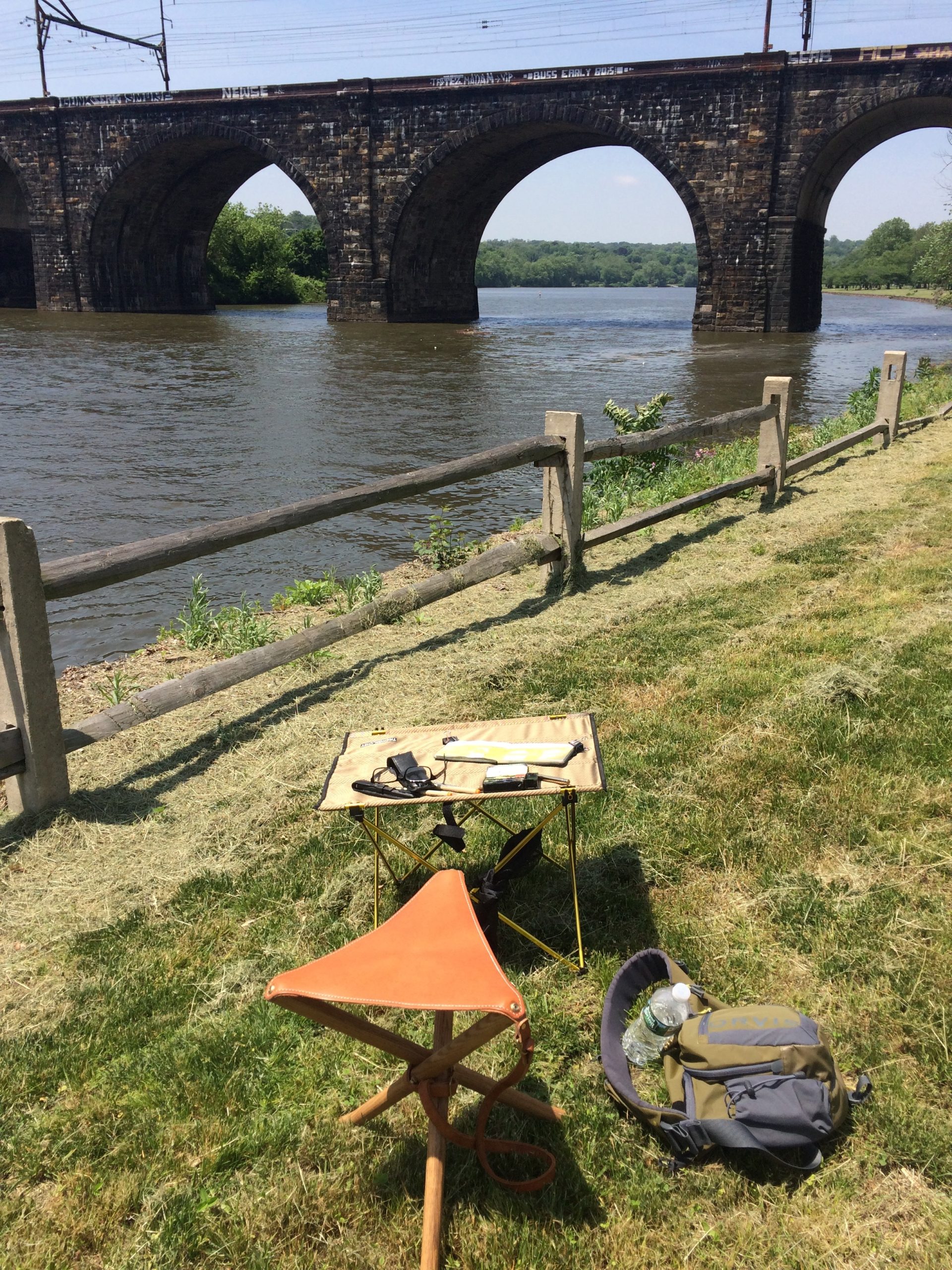
Having received request for information about my field practice, today let’s take a break from looking at art, to look at what you bring to the field, should you wish to pursue mindful travel through drawing and writing


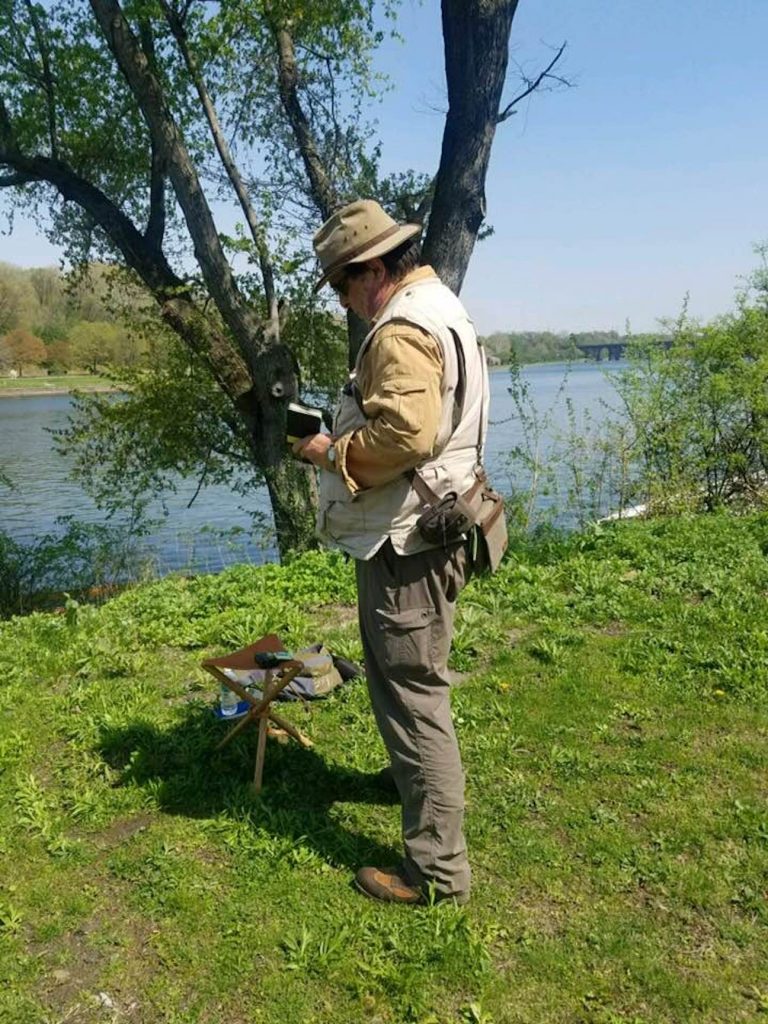
Field setup along the Schuylkill River in Philadelphia. 2018

Note to self. Field kit for day-trips to wild places.Orvis bush shirt, Outback Trading Co. or Filson crushable waxed cotton wide-brimmed round-hat. Drake’s (London) neck-scarf/cravat. Duluth Trading company travel-vest. Season-appropriate cargo pants. Filson belt. Woolen socks (all seasons). All-season yellow deerskin gloves, Danner hiking boots, Wolverine oiled leather 1000-Mile boots, or knee-length Chippewa snake-boots (for protection against briars and venomous reptiles). Orvis snake-proof knee-gaiters are an option. Handmade belt-knife. Compass. Brass-tipped Yew walking-stick with wrought-iron rams-head Branscombe Forge, Devon, England. Telescoping REI walking-stick is also recommended. Wood & Faulk folding tripod stool with leather seat & carry-strap. Filson field-bag, or Frost River field-satchel, or Orvis Safe Passage fishermen’s bag. Kaweco (Austrian) brass pencil (port-crayon) and fountain pen. Sakura Sakura Micron colored pens (orange and brown) Watercolor travel-kit (Golden Paints QoR watercolors; Schmincke, Kremer, Maimeri, Sennelier-brand enameled steel travel-sets, with integral water-flask. Escoda or DaVinci travel-brushes, Paper towels, folded, carried in a reusable zip-lock bag. Safety razor. Moleskine watercolor journal. Pocket notebook. Maps. Mobile phone. Backup charger with cord. A quart-canteen of drinking water. Food: sandwiches, bag of almonds. Sunglasses. Sunscreen. Insect repellent. Travel protocols. When venturing out alone, know where you are heading. Let someone else know your travel/hiking plans. Stick to your schedule. Keep a log. Note date, time, location (map coordinates) with line-of-sight vectors (compass headings), temperature, weather conditions; nature of terrain, flora and fauna. Pay attention. The greatest show on earth is the earth itself.


Leaving no Trace at Mount Greylock, Williamstown, Massachusetts


Atop Eyjafjallajokull, Iceland. Note the sketchbook in hand. Crossing the glacier in out ascent, Arne stopped his SuperJeep, got out and deflated the tires 20% to increase traction. He had a tank of compressed air in the rear of the vehicle to reinflate them when we returned to a hard surface. He jumps in the car, takes off his sunglasses and puts on a more expensive pair that was in the side-pocket of his door. I asked him what he needed to change eye-wear.
“We’re crossing this glacier (pronounced gloss-ear). It’s full of crevasses. I think the snow-pack is deep enough that we can’t fall through, but you never know. This is the first clear day we’ve had like this for nine months. It’s up to you. Shall we go for it?”
As he guided the Jeep around unseen pitfalls and obstacles, at times yawing twenty degrees to one side or the other, we crawled upward.
“You know,” I said. “If we do die, I’ll be sure to tell Saint Peter that in spite of everything, you were an excellent driver.”
Looking sharply me, he furrows his brow. Pointing upward, he asks, “What makes you think I want to go THERE?”

Below: Making a sketch of Cayambe, on the high road between Zuleta and San Pablo, Pichincha Province Ecuador. November 27, 2014.

Cayambe. November 27, 2104

BELOW: Painting at the summit of Kilauea, Hawai’i. Dawn. July 1, 2015

Dawn at Kilauea. July 1, 2015

OUTDOOR JOURNAL-PAINTING GEAR AND SUPPLIES
The mission of expeditionary journaling is to devote as much time to engaging with your surroundings, carrying no more gear than a small messenger bag, or multi-pocket travel vest. Here are the essentials: (Scroll down to the link)

Download (PDF, 600KB)

(A preview of SKETCHBOOK TRAVELER by James L. McElhinney (c) 2020. Schiffer Publishing).

Copyright James Lancel McElhinney (c) 2020 Texts and images may be reproduced (with proper citation) by permission of the author. To enquire, send a request to

ed******@ne***********.com